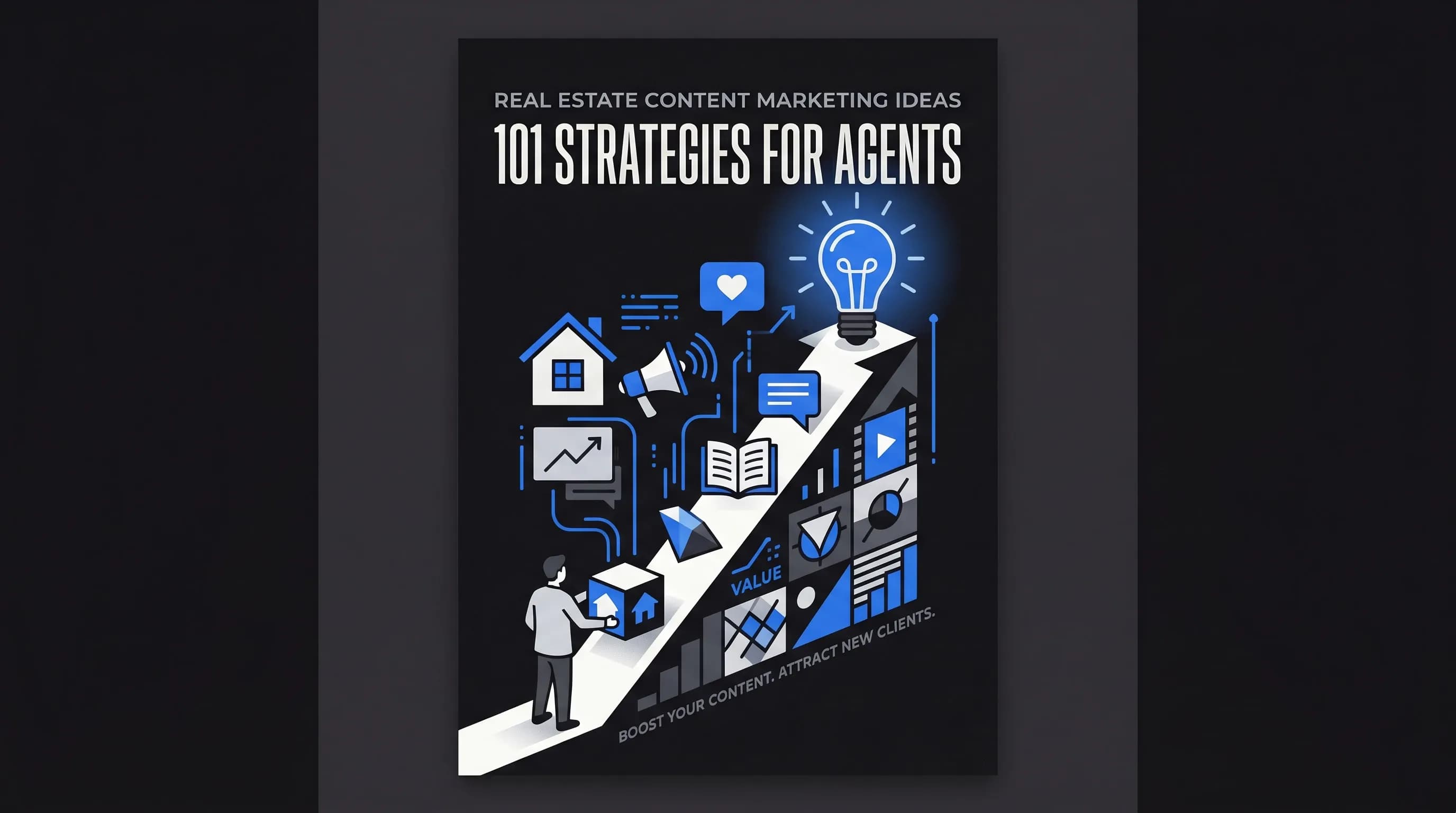
If we have ever stared at our phone wondering what on earth to post today, we are in very good company. Most real estate agents do not struggle because they lack Instagram, Facebook, YouTube, TikTok, LinkedIn, or email. They struggle because they do not have a repeatable content marketing system. They post a few listings, a quote graphic, maybe a market update, and then wonder why real estate social media marketing feels like a second job with no payoff.
That is exactly why this guide exists. We are not here to give fluffy advice about “just be consistent.” We are here to build a practical, beginner-friendly, high-authority guide to real estate content marketing with 101 real estate content marketing ideas we can actually use across social media, blog content, email newsletters, video content, neighborhood pages, and lead generation funnels.
At its core, content marketing for real estate agents means creating useful, relevant, trust-building content and distributing it where prospective clients already spend time. That includes social media platforms, our website, YouTube, email, community partnerships, open house follow-up, and even the way we answer questions in comments and DMs. Social media is often just the starting point, not the destination. The goal is not only likes. The goal is conversation, then relationship, then CRM entry, then client acquisition.
When we do this well, our content helps buyers and sellers feel less confused, more informed, and more confident. It strengthens our real estate brand, reinforces our personal branding, supports local SEO, builds authority in our market, and drives real estate lead generation without sounding pushy or overly salesy.
Real estate content marketing is the practice of publishing helpful content that attracts, educates, engages, and converts an audience of buyers, sellers, homeowners, and local prospects. It is a form of inbound marketing and organic marketing that builds trust before someone ever fills out a form or books a call.
The best real estate marketing content usually does at least one of these things:
And yes, engagement counts as content too. A poll, a question box, a DM conversation, a comment thread, or a quick story sticker is not an extra task. It is part of our content strategy because it builds relationships and gives us market feedback in real time.
People rarely choose an agent because of a slogan. They choose an agent because that person seems knowledgeable, calm, local, responsive, strategic, and trustworthy. Good content marketing for Realtors helps us demonstrate all of that before we ever meet the prospect.
Done right, content marketing for real estate agents can help us:
The best-performing content is usually not the flashiest. It is clear, local, useful, human, and specific. Precision messaging beats generic posting every time. If our ideal client cannot look at a post and think, “That is exactly me,” then the message is too broad.
Not all attention becomes business. If we want content to support real estate lead generation, it needs more than reach. It needs conversion thinking.
The first line matters. Hooks like these usually work better than generic intros:
We should speak directly to first-time buyers, move-up sellers, downsizers, investors, relocation clients, or homeowners in a specific area, not to “everyone.” Niche marketing often performs better than broad messaging.
Local stats, actual neighborhoods, exact price points, real examples, and clear process steps are what make content feel useful instead of vague.
People do not only buy or sell houses. They are making decisions tied to security, timing, identity, convenience, school transitions, family needs, lifestyle, and financial pressure. Helpful content speaks to both logic and emotion.
Every post does not need a hard sell, but it should make the next move obvious. That might be:
Below are 101 real estate content ideas organized into practical content pillars so we can build a repeatable system instead of posting randomly.
These ideas help people know us, remember us, and trust us. Personal branding for real estate professionals matters because people hire people, not logos.
This category is especially good for brand building, authority building, and community familiarity. It also gives our audience a reason to connect with us beyond listings.
Buyer education content is one of the strongest forms of low-pressure real estate marketing because it solves real problems and reduces fear.
These topics work beautifully as carousels, reels, blog posts, YouTube videos, FAQ posts, and email newsletters. They also support content marketing 101 style search intent because they are educational, actionable, and beginner-friendly.
Seller content is a major trust-builder because homeowners often have high-stakes questions and do not want vague answers. They want strategy.
This is excellent content for positioning ourselves as a thoughtful advisor rather than just someone who posts homes online.
Hyper-local content is one of the biggest competitive advantages in real estate content marketing. National headlines are everywhere. Local interpretation is where we win.
This type of real estate educational content supports local SEO, neighborhood page strategy, relocation leads, and long-form evergreen content.
One of the biggest mistakes in real estate social media marketing is posting only listings. People also want to know the area, the lifestyle, the vibe, and the community. Local lifestyle content often outperforms pure promotion.
These are outstanding for community building, engagement, and attracting future buyers and sellers who are not ready right this second but are paying attention.
Listings still matter. We just do not want them to be our only content. The key is to package listing promotion in a way that is useful, visual, and story-driven.
This is where real estate video marketing, virtual tours, reels, YouTube shorts, and open house marketing can shine. Instead of simply posting specs, we show what life feels like in the home and who it fits.
While the list above gives us the 101, there are several content formats that are too important not to mention because they act like multipliers inside a broader real estate content strategy.
Engagement and responsiveness are part of content marketing, not separate from it. Sometimes a simple story poll creates more real conversations than a polished reel.
A big list helps, but a system is what removes overwhelm. The simplest way to organize our real estate marketing strategy is through content pillars.
If we rotate those consistently, our feed stops feeling random and starts feeling intentional. It also helps us avoid a common real estate marketing mistake: over-posting listings and under-serving the audience.
One of the best ways to reduce decision fatigue is to assign themes to days. A basic real estate content calendar might look like this:
If we want a slightly more advanced cadence, we can aim for:
The point is not to create pressure. The point is to create structure.
Different formats do different jobs in our real estate digital marketing mix.
Ideal for tips, hooks, listings, neighborhood highlights, FAQs, and behind-the-scenes moments. This is one of the best formats for Instagram Reels, TikTok, Facebook Reels, and YouTube Shorts.
Perfect for polls, question boxes, quick updates, reactions, and daily visibility. Stories are often where conversations begin.
Great for checklists, myths, step-by-step posts, seller prep, buyer timelines, and market summaries.
Excellent for evergreen search content such as moving to a city, cost of living, neighborhood comparisons, market updates, buyer guides, and seller explainers.
Still valuable for SEO, neighborhood content, local search, and educational real estate marketing content. Blog posts also give us material to repurpose into social posts and email.
One of the best owned marketing channels. Social media is borrowed land; email is ours. We should use newsletters to distribute our best content, not just announce listings.
Helpful for remote buyers, premium listing promotion, and keeping users engaged with a property for longer.
We do not need to be everywhere. We need to be where our audience is and where we can realistically stay consistent.
| Platform | Best use |
|---|---|
| Local engagement, events, listings, community groups, live video | |
| Visual branding, reels, carousels, stories, property and neighborhood content | |
| Professional branding, relocation leads, thought leadership, networking | |
| YouTube | Evergreen search visibility, neighborhood tours, buyer and seller education |
| TikTok | Discoverability, casual educational clips, quick home tours, personality-driven content |
One strong topic can become many pieces of content. That is not duplication. That is strategy.
For example, “3 mistakes first-time buyers make” can become:
Repurposing helps us stay visible across channels without burning out, and it supports an omnichannel content distribution strategy.
Good content works because it pre-sells trust. Prospects can quietly follow us for weeks or months, consume our educational content, watch our videos, save our neighborhood posts, and feel like they already know us before they ever reach out.
That often leads to:
But content by itself is not enough. Good content without follow-up is entertainment. Good content with follow-up is marketing. If someone engages, we should have a next step ready: a guide, a consult link, a neighborhood resource, a home valuation, an email signup, or a buyer or seller roadmap.
Content is one of the clearest ways to reinforce our real estate brand. Branding is not just logos or colors. It is how people experience us repeatedly.
Our brand includes:
If our website, social profiles, testimonials, bio, email, and content all support the same message, our market positioning becomes much stronger.
A lot of agents worry that content marketing will make them sound pushy. Usually the fix is simple:
When our content helps people feel understood, informed, and less intimidated, our marketing starts to feel like service. That is what trust-building real estate content should do.
Organic content is powerful, but strong posts can often go further with paid amplification. We do not need to boost everything. We should amplify the pieces that already show signs of traction or clear business relevance.
Good candidates for paid promotion include:
Paid social advertising works best when it amplifies genuinely useful content, not when it tries to rescue weak content.
We do not have to create everything alone. Collaboration adds variety, authority, and local credibility.
These partnerships help us build a broader real estate marketing ecosystem around our brand.
Vanity metrics are not enough. In real estate agent marketing, we want content KPIs that connect to actual business growth.
Useful metrics include:
We should also watch for qualitative signals:
We do not need to use all 101 today. If we want momentum fast, we can start here:
That is already enough to build a useful, balanced, trust-building real estate content strategy.
The agents who win with content are not always the most polished or the most charismatic online. They are usually the ones who are clear, strategic, local, useful, consistent, and good at turning attention into conversation.
If we had to sum up real estate content marketing in one sentence, it would be this: create content that makes people feel understood, informed, and confident enough to reach out.
That is what builds trust. That is what strengthens our brand. And that is what helps 101 real estate content marketing ideas become an actual client-generating system instead of just another saved post we never use.

Hey, in Propphy we're determined to make a business grow. My only question is, will it be yours?
It's totally free, with no commitments
Hey, in Propphy we're determined to make a business grow. My only question is, will it be yours?
It's totally free, with no commitments