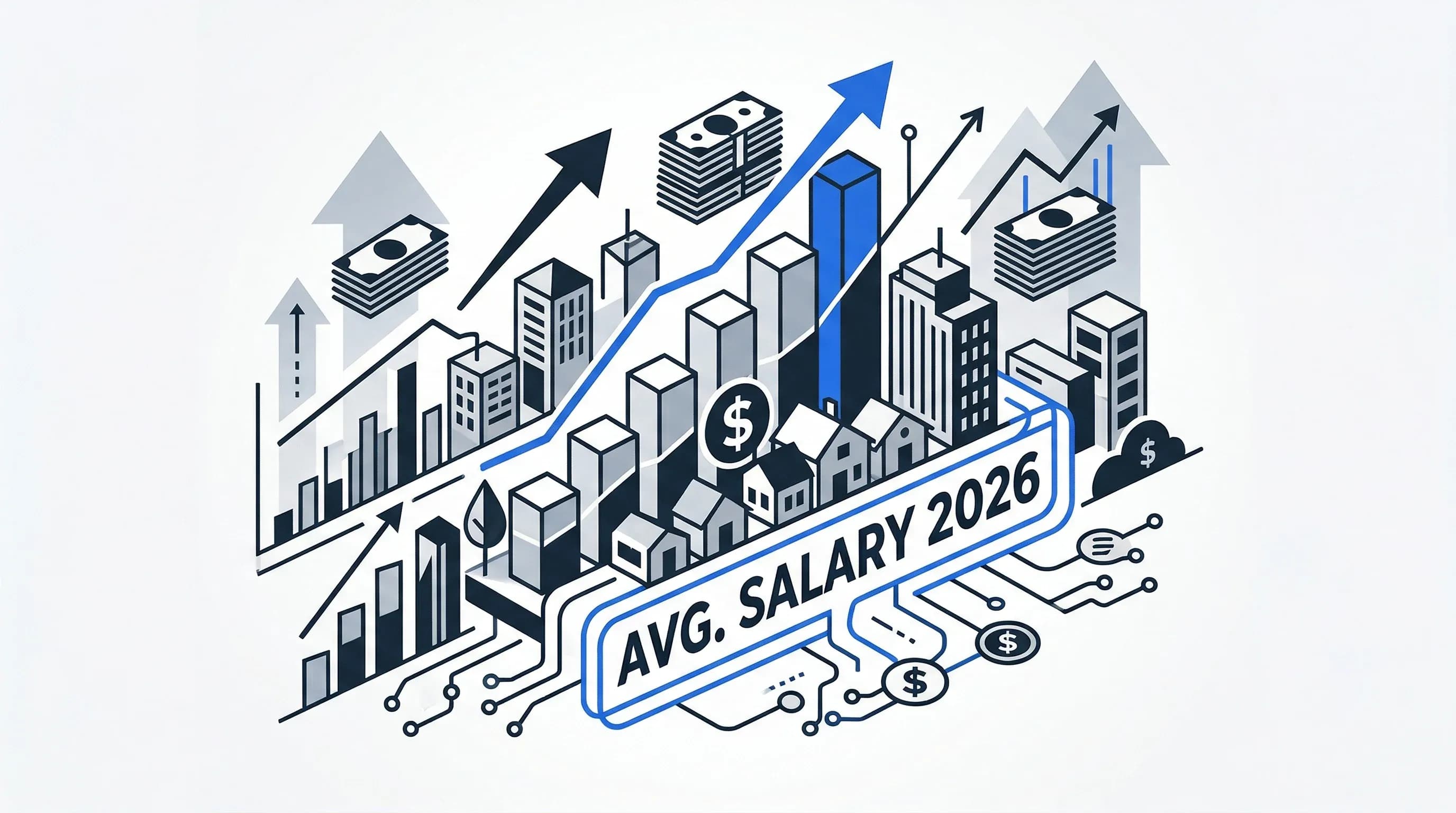
When people ask, “What’s the average real estate broker salary in 2026?” they usually want a clean number they can plug into a spreadsheet. The reality is messier—and a lot more interesting. In this business, how much real estate brokers really make depends far more on how they’re paid, what market they’re in, and how they run their career, than on any published “average salary.”
In this guide, we’ll break down:
- The difference between an “average salary” and what brokers actually earn
- Real‑world income examples in the U.S. and Dubai/UAE
- How commission splits, deal volume, and price point drive your take‑home pay
- What a realistic 2026 income path looks like—from new agent to broker/owner
- What separates brokers stuck at the average from those earning multiple six figures
Agent vs. Broker: Which “Salary” Are We Talking About?
Before we talk numbers, we need to clear up the language. In everyday conversation, people say “realtor,” “real estate agent,” and “real estate broker” like they’re the same thing. They’re not:
- Real estate agent – Has a basic license and must work under a licensed broker.
- Real estate broker – Has additional education, can run their own brokerage, and may have agents working under them.
- Realtor® – Any agent or broker who belongs to the National Association of Realtors (NAR) in the U.S.
Most salary surveys don’t distinguish clearly. When we see “average real estate broker salary,” the data is usually mixing:
- Solo agents working under a brokerage
- Associate brokers who still operate like agents
- Broker‑owners who also get a cut of other agents’ deals
So when we talk about earnings in 2026, we’re really talking about two layers:
- Your own production as a licensee (what most “agent income” stats reflect)
- Override income if you run a team or brokerage and earn a split on other agents’ commissions
Keep that in mind as we compare “average broker salary” to what people actually bank in markets like the U.S. and Dubai.
What Do Real Estate Brokers Earn on Average in 2026?
Let’s start with the headline numbers you’ll see quoted most often, then we’ll explain why they’re so misleading.
U.S. broker & agent income in 2026
Looking at recent NAR data and projecting modestly into 2026, we land roughly here for gross annual income (before taxes and business expenses):
- All Realtors (part‑time + full‑time): around $50,000–$60,000 median gross.
- Realtors with 16+ years’ experience: around $90,000+ median gross.
That lines up well with what we see in real‑life income stories: agents who actually survive and stay full‑time tend to move into the $80,000–$150,000 band after a few years, while the people who never treat it like a business cluster under $50,000—or wash out entirely.
Average real estate broker salary in UAE (2026)
On the UAE side, platforms like PayScale list an average real estate broker salary of about AED 50,050 per year. Converted, that’s only around US $13,500.
That sounds shockingly low—until we remember what’s actually being measured:
- Mainly fixed‑salary roles with modest bonuses
- Very little of the pure commission‑only Dubai agent income that never shows up as “salary” on a payslip
If we look at what full‑commission brokers in Dubai actually earn in 2026, we see a different picture entirely:
- New or struggling agents: under AED 5,000–10,000/month in the first few months
- Reasonably effective sales agents: around AED 20,000–60,000/month
- Top luxury agents: AED 80,000–150,000+ per month, with some months far above that when big villas or penthouses close
The same pattern repeats in North America, Europe, and elsewhere: the “average broker salary” hides a brutally lopsided income curve.
Why the “Average Real Estate Broker Salary” Is So Misleading
If we rely only on that neat “average salary” figure, we completely misunderstand the business. There are three big reasons.
1. Part‑timers drag the numbers down
National figures lump together:
- Full‑time brokers closing 20–40 transactions a year
- Agents who sell one home to their cousin and nothing else all year
- Licensees who are effectively retired but still in the dataset
That’s like averaging NBA players with people who shoot hoops twice a year at a family BBQ, then calling it an “average basketball income.” It technically isn’t wrong—but it’s useless if we’re serious about a real estate career.
2. New and failing agents skew the curve
Every year, a wave of new agents and would‑be brokers get their license, hang it with a brokerage, and then:
- Never learn how to generate leads
- Close zero deals or only 1–2 low‑commission transactions
- Quit within 12–24 months
They all show up in the averages, and they’re a big reason “typical” earnings look low. In parallel industries like life insurance, we’ve seen surveys where 166 agents combined made about $841,000 in net income—an average of just over $60,000/year. But a handful were pulling in $20K–$25K per month while many sat at or near zero. Real estate broker income is almost identical: a skinny tail of very high earners and a fat chunk of underperformers at the bottom.
3. Market, price point, and model matter more than the license
One of the biggest mistakes we see is assuming the license itself sets the income. We’ve watched agents in a high‑price state like California comfortably clear around $100,000/year, while people in lower‑price states with the exact same license and skill set sit closer to $50,000–$60,000—purely because home prices and commission dollars are smaller.
The situation is even more extreme when we compare traditional salaried broker roles to commission‑only markets like Dubai:
- A broker on a nominal AED 50,000/year “salary” in the UAE might actually be earning most of their money via commissions that don’t show in the base figure.
- Meanwhile a Dubai luxury agent who has moved into beachfront villas can pocket more from one AED 30M sale than many fixed‑salary brokers earn in several years.
That’s why when we’re planning income for 2026, we focus less on the license and more on the model: commission structure, transaction count, price point, and overhead.
How Real Estate Brokers Actually Get Paid in 2026
Whether we’re talking about a residential agent in the U.S. or a broker in Dubai, the same basic elements show up in the pay structure.
1. Commission first, “salary” second
In most real estate careers, especially by 2026, the idea of a steady, traditional “broker salary” is the exception, not the rule:
- Typical U.S. setup: you’re paid a percentage of the commission on each transaction (your Gross Commission Income, or GCI), split between you and your brokerage.
- Dubai & UAE: most real estate brokers and agents are on a commission‑only or commission‑heavy model, sometimes with:
- No basic salary at all, or
- A small base (e.g., AED 2,000–10,000/month) plus reduced commissions and strict KPIs
As production grows, almost everyone who’s serious moves toward higher splits and lower base salary. It’s the only way to let earnings scale.
2. Commission math in a typical U.S. market
Let’s anchor this to a simple 2026 example.
- Average home price in your market: $400,000
- Total commission on the deal: say 5%, split between listing and buyer side
- Your side: 2.5% of $400,000 = $10,000 gross commission
If your split with your brokerage is 70/30 in your favor:
- $10,000 × 0.7 = $7,000 to you before taxes and your own expenses
Now watch what happens as we move deal count:
- 10 transactions/year: 10 × $7,000 = $70,000 gross to you
- 20 transactions/year: = $140,000
- 30 transactions/year: = $210,000
There’s no magic in “average broker salary”—it’s just a function of:
- Average commission per deal
- Your share of that commission
- Number of closed deals
3. Commission math in Dubai & UAE (2026)
Dubai is structured a bit differently, but the logic is the same.
Rentals (leasing agents)
- Typical agency commission: 5% of the annual rent, often with a minimum fee.
- Example: a property renting for AED 120,000/year → 5% = AED 6,000 to the agency.
- If you’re on a 50/50 split, your share is AED 3,000 for that deal.
Sales (secondary market)
- Standard agency commission: around 2% of the sale price.
- Example: apartment sells for AED 2,000,000 → 2% = AED 40,000 total commission.
- On a 50/50 split, that’s AED 20,000 to you; on a 70/30 split, it’s AED 28,000.
Because the UAE has no personal income tax, those figures are essentially net from a tax perspective. There are no tax deductions shaving 30–40% off the top the way there are in many Western countries, which is why the Dubai real estate agent earnings story looks so different even though the “average salary” figure on paper seems low.
4. Commission splits & brokerage models
Your actual take‑home pay depends heavily on the split with your brokerage and the model you choose.
- Starter splits: brand new agents, especially those getting training and leads, might start around 50/50 or 60/40.
- Experienced producers: can negotiate 70/30, 80/20, 90/10 or join “100% commission” brokerages where they pay a flat fee per transaction.
- Broker‑owners/team leaders: keep most of their own commission and collect a slice of their agents’ GCI (often 20%–50%), but they also carry the overhead and risk of running a business.
We’ve seen agents jump from just over 50% net of their gross commission at a franchise office to keeping more than 90% by moving to an independent or 100% model—instantly increasing their “salary” without closing a single extra deal.
Real‑World Broker Earnings: From New Agent to Top Producer
To make this concrete, we like to look at actual income paths rather than just theoretical ranges. Below are examples we’ve seen repeated across markets and years, adjusted realistically for 2026.
Year 1: New agent/broker associate (U.S. market)
In the first 12 months, a full‑time but brand‑new agent typically:
- Spends the first month on busywork (logos, business cards, onboarding) instead of income‑generating activities.
- Doesn’t fully commit to a prospecting schedule until 2–3 months in.
- Closes only a handful of deals.
A very typical first‑year outcome we’ve seen looks like:
- 3 sales, around $1.2M in total volume.
- Net to the agent after splits: roughly $25,000 (before taxes).
In income‑band terms, most first‑year full‑timers who actually work land somewhere between $20,000 and $50,000. Many never get off the ground and earn close to zero.
Years 2–3: Developing agent, building momentum
By the second year, if we stick to a daily lead‑generation schedule—calls, open houses, social media content—the picture changes quickly. We’ve watched agents go from:
- Year 1: 3 sales, ~$25K net
- Year 2: 12 sales, ~$4.1M volume, around $88K net
Once we know how many conversations we need to book appointments, and how many appointments lead to listings and closings, our income becomes much more predictable. At that stage, a realistic 2026 band for a serious full‑time agent is around $50,000–$120,000.
Years 4+ : Established solo producer
Past the three‑year mark, agents who treat this like a business usually settle into one of these lanes:
- Moderate producer: 10–15 deals/year in a mid‑priced market → often $80,000–$120,000 gross.
- Strong solo producer: 20–30 deals/year, or fewer deals at higher price points → $120,000–$200,000+ gross.
This is the group that lives comfortably above the “average broker salary,” but doesn’t necessarily show up on stage at events. They just run their pipeline, control expenses, and quietly bring in six figures year after year.
Top producers & small teams
Top solo agents and small team leaders layer leverage on top of skill:
- They work higher‑priced listings.
- They have admin or transaction coordinators.
- They might have buyers’ agents handling overflow.
By 2026, realistic ranges for this tier look like:
- $200,000–$500,000+ annual gross income in many U.S. markets.
In prime coastal or luxury markets, those numbers can be significantly higher—especially when individual sales can generate $30K, $40K, $50K+ commission checks per side.
Dubai career path: rentals → sales → luxury
Dubai’s broker income curve has its own shape, but the progression is very clear.
- 0–6 months (Leasing agent, rentals only)
- Close 3–4 rentals a month with a combined annual rental value around AED 400,000.
- Agency earns 5% = AED 20,000 in commission.
- On a 50/50 split, you earn AED 10,000 → roughly AED 6,000–15,000/month depending on deal flow.
- Purpose of this stage: gain market knowledge, learn paperwork, and build confidence.
- 6–18 months (Sales agent, mid‑market sales)
- Transition from rentals into sales where each deal pays more.
- Close a single AED 2.5M townhouse:
- 2% commission = AED 50,000 to the agency.
- 50/50 split = AED 25,000 to you, tax‑free.
- With 1–2 mid‑market sales per month, a typical income range is AED 20,000–60,000/month.
- 18+ months (Luxury / prime communities)
- Move into premium communities and off‑plan or secondary luxury sales.
- Close a AED 30M villa at 2% = AED 600,000 agency commission.
- On a 70% agent split, your share is AED 420,000 from that single transaction.
- Top luxury agents consistently see AED 80,000–150,000+ per month in a strong year, with occasional months far above when marquee deals close.
This is why Dubai real estate agent earnings look “life‑changing” in the headlines, while the “average salary in UAE” charts still quote figures around AED 50,050/year. They’re measuring completely different populations.
Broker-Owner & Team Leader Income in 2026
When we move from being an agent under a broker to being the broker (or building a team), our income gains a second engine: overrides on other people’s production.
Two income streams: production + override
A broker‑owner or team leader in 2026 typically earns from:
- Personal production – Their own listings and sales, just like any agent.
- Overrides/splits – A percentage of their agents’ GCI in exchange for brand, support, systems, and leadership.
Let’s model a straightforward 2026 scenario.
- Your personal deals
- 20 deals at $400K average price = $8M volume.
- 2.5% side commission = $200,000 GCI to your side of the transactions.
- Your five agents
- Each does 10 deals at $400K = $4M each, or $20M total volume.
- 2.5% side commission = $500,000 GCI per agent → $2.5M total from your agents’ deals.
- Your average “house” split is 30%:
- 0.30 × $2.5M = $750,000 gross override to your brokerage.
So the top‑line numbers are:
- $200,000 from your own production.
- $750,000 from overrides on agents.
- $950,000 total GCI flowing into your brokerage.
That does not mean you personally “make” $950K. You still have:
- Staff and admin salaries
- Office or virtual platform costs
- Lead generation and marketing
- Errors & omissions insurance
- Technology and training expenses
In our experience, many small to mid‑sized brokerages net somewhere around 15%–30% of gross after all operating costs. In the example above, that would be something like $150,000–$300,000 net profit to the broker, plus whatever portion of personal production they keep after covering their own overhead.
That’s solid money—but it’s far from guaranteed, and it’s not as simple as “start a brokerage, become a millionaire.” In 2026, broker‑owner income still tracks tightly with how well we recruit, develop, and retain productive agents, and how disciplined we are about expenses.
What Actually Drives a Real Estate Broker’s Income
If we strip away the hype and focus on what moves the needle for broker salary and agent earnings in 2026, the levers are remarkably consistent across markets.
1. Transaction count & lead generation
Everything flows from how many quality conversations we have. In every real‑world case we’ve studied, the turning point in income came when the broker or agent:
- Stopped obsessing over logos and websites, and
- Started tracking daily lead‑generation activities:
- Calls to past clients, sphere, FSBOs, expireds
- Open houses every week
- Consistent local content on YouTube, Instagram, or Facebook
- Networking with investors, developers, or relocation companies
We’ve watched agents who spent their first few months tinkering with branding and closing nothing transform their income simply by focusing on a basic rule: “conversations first, everything else second.”
2. Your split and cost structure
Two agents can have identical production and radically different “salaries” because of how their businesses are structured.
- High‑support, low‑split model (common in big franchises and teams)
- Offers heavy training, brand recognition, and sometimes leads.
- Takes a larger slice of your GCI (e.g., 50/50 or 60/40).
- Lean, high‑split or 100% model
- Much higher agent split (80/20, 90/10, 100% with transaction fees).
- Less built‑in training and lead gen; you fund more of your own marketing.
We’ve seen agents double their net income simply by moving to a more favorable model once they had their own systems and leads in place, even when their transaction count stayed flat.
3. Market, price point & segment
Where you work—and what you sell—matters enormously:
- Lower‑price markets: may require 25–30 transactions a year just to hit $100K.
- Higher‑price markets: might only require 10–15 deals to reach the same income.
- Dubai leasing vs. sales: most brokers treat rentals as a 6–12 month stepping stone to sales because the per‑deal earnings are so much higher on the sales side.
- Luxury segments: bring enormous upside—but also demand much higher market knowledge, brand positioning, and relationship skills.
The pattern we see again and again is a progression:
- Rentals / entry‑level sales – learn the ropes, build confidence and a base of clients.
- Mid‑market sales – stabilize income in the $80K–$150K range.
- Luxury / investments / commercial – potentially step into the top 1% of earnings over time.
4. Skills, training & operational discipline
Licensing courses teach us how not to break the law. They do not teach us how to build income.
The brokers and agents who reliably beat the “average salary” curve invest in:
- Negotiation and client communication – so they can justify their commission and win listings at full fee.
- Systems and processes – checklists, CRMs, and transaction workflows that free up time to sell instead of firefighting.
- Training beyond the license – from RERA broker courses in Dubai to advanced listing or buyer‑conversion training in the U.S. and Europe.
We’ve watched new Dubai agents who took training seriously start closing rentals and small sales within 2–3 months, while peers who tried to “wing it” struggled far longer despite operating in the same performance‑driven, tax‑free market.
A Realistic Income Path for 2026 (U.S. & Dubai)
Putting everything together, we can sketch out realistic—not fantasy—paths for what a committed broker or agent might earn by 2026 and beyond.
U.S. broker/agent income path
- Year 1 (full‑time, learning phase):
- Most land between $20,000–$50,000.
- A significant number earn less or quit.
- Years 2–3 (developing, consistent effort):
- Typical range for those who stay the course: $50,000–$120,000.
- Years 3–5 (established solo producer):
- Common band: $80,000–$200,000, depending on price point and transaction count.
- Year 5+ (if you build a small team or brokerage):
- Realistic net for many: $150,000–$300,000+, with top operators going higher.
Dubai broker/agent income path
- First 3–6 months:
- Mostly rentals; income roughly AED 6,000–15,000/month, sometimes less early on.
- 6–18 months:
- Transition from rentals into mid‑market sales.
- Reach AED 20,000–60,000/month if deal flow is consistent.
- 18+ months (top performer track):
- 2–3 mid to high‑value sales per month moves you into the AED 80,000–150,000+ per month range in strong years.
- Occasional luxury transactions can add six‑figure months (in dirhams) on their own.
Against that backdrop, the official “average broker salary” of AED 50,050/year tells us almost nothing about what a driven, commission‑based Dubai broker will really make.
Is a Real Estate Broker Career “Worth It” in 2026?
Whether we’re looking at U.S. numbers or Dubai’s tax‑free, commission‑based market, the honest answer is nuanced.
- No, it is not easy money. The first 12–18 months can be financially and emotionally brutal if we’re not prepared.
- Yes, the upside is real. If we stick it out, learn the skills, and structure our business intelligently, this is one of the few careers where moving from “average salary” to top‑1% earnings is genuinely possible over a few years.
The income bands we’ve laid out—$80K–$200K for established solo agents, AED 80K–150K/month for strong Dubai sales brokers, mid‑six‑figures for small broker‑owners—aren’t fantasies. We see them in real production reports and tax returns. But they only belong to a minority who:
- Prospect daily, not occasionally
- Treat their license like a business, not a side hustle
- Make smart choices on splits, expenses, and training
- Give the career 2–3 years to compound instead of quitting at the first dry spell
If we want a predictable, fixed paycheque, a commission‑driven real estate broker career may feel too volatile. But if we’re comfortable trading security for upside—and we’re willing to work like owners rather than employees—the 2026 earning potential is still very much there, in both traditional markets and high‑reward hubs like Dubai.
In other words, the “average real estate broker salary in 2026” might sit around $50K–$60K globally, but the more important question is where we intend to sit on that curve—and what we’re prepared to do, structurally and strategically, to get there.