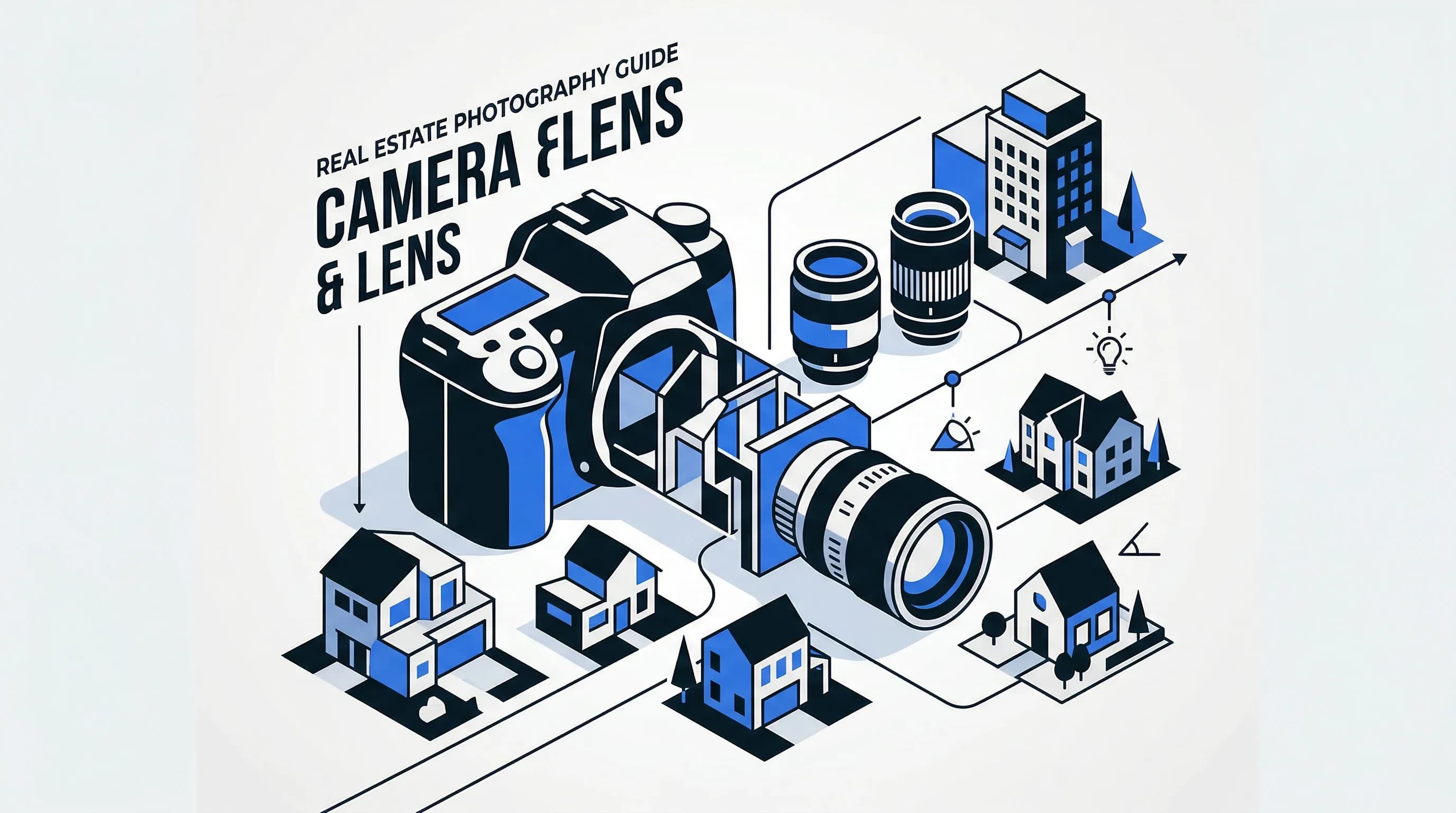
When we choose a camera and lens for real estate photography, we’re not chasing the latest specs — we’re solving a very specific job: show spaces accurately, attractively, and consistently, without making them look like a funhouse. That shifts the whole conversation from “what’s the newest flagship?” to “what gear actually helps us deliver great listings, fast, at a profit.”
In this guide, we’ll walk through how we evaluate cameras, lenses, focal lengths, and angles for property photography, plus how we balance budget, video and virtual tours, and long-term growth of a real estate photography business.
Define Your Real Estate Photography Goals First
Before we even look at camera specs, we clarify the work we’re actually going to do. Real estate is a narrow niche, which is good news because it simplifies gear decisions dramatically.
We usually start with four questions:
- What types of properties are we shooting?
- Small rentals and apartments
- Standard residential homes
- Luxury homes, commercial spaces, or new builds
- How will the images and videos be used?
- MLS listings and portals only
- Print brochures and flyers
- Social media ads and short‑form content
- 3D virtual tours, walkthroughs, and floor plans
- What services are we actually selling?
- Still photos only
- Stills + video walkthroughs
- Stills + 360° / 3D virtual tours and digital twins
- What’s our budget and upgrade path?
- Testing the waters on a tight budget
- Growing business that needs reliable gear and faster workflow
- Established studio serving high‑end builders and designers
Our answers tell us whether we can happily run with an APS‑C body and one wide‑angle zoom, or whether we really do need a full‑frame mirrorless body, multiple lenses, and maybe even a 3D capture system to produce complete virtual tours and floor plans.
Key Camera Features for Real Estate Photography
Interiors are challenging: bright windows, dark corners, mixed lighting, and tight spaces. So when we choose a camera for real estate photography, we care far more about sensor quality, bracketing, and ergonomics than about sports‑style autofocus or 40+ megapixels.
Sensor Size, Resolution, and Dynamic Range
We’ve found that you don’t need a crazy megapixel race winner to create photos that sell homes faster. The sweet spot:
- Resolution:
- 18–24 megapixels is a solid minimum for professional work (MLS + print).
- 30–45 MP can be useful if you do big prints or heavy cropping, but the gains for real estate listings are often marginal.
- Sensor size:
- APS‑C (crop sensors) give excellent results, lower cost, and smaller kits.
- Full‑frame sensors offer better dynamic range and low‑light performance, and they make it easier to get truly wide fields of view with less distortion.
- Dynamic range: This is critical in interior photography. We want to hold detail in bright windows and dark furniture in one HDR blend, so we pay close attention to cameras known for good highlight and shadow recovery.
- Low‑light performance: If the files are clean at ISO 400–1600, we’re happy. Backside‑illuminated (BSI) sensors are a bonus for indoor real estate photos.
In our own work, we’ve settled around 24 MP full‑frame or APS‑C bodies for most jobs because that hits the sweet spot between quality, editing speed, and storage costs.
DSLR vs Mirrorless for Real Estate
We’ve shot jobs on both DSLRs and mirrorless cameras. Both can produce professional real estate images; the differences are about usability and long‑term ecosystem.
- DSLR advantages:
- Excellent battery life for long days of back‑to‑back listings.
- Huge used lens ecosystems, including wide‑angle and tilt‑shift lenses.
- Often great value on the second‑hand market.
- Mirrorless advantages:
- Electronic viewfinder (EVF) – what you see is what you get, including exposure and white balance.
- Generally better video features (4K, log profiles, continuous AF), which matters if we’re shooting walkthrough videos.
- Smaller, lighter bodies for moving around properties all day.
- Modern lens lineups with excellent rectilinear wide‑angle zooms.
Our rule of thumb: if we already own a DSLR, we keep using it and upgrade lenses first. If we’re buying into a system today for the long term, we tend to pick a full‑frame mirrorless body because it supports both stills and video work for years to come.
Ergonomics, Durability, and Power
Real estate photography means walking, climbing stairs, crouching in corners, and working fast. The body needs to be comfortable and practical, not just impressive on paper.
- Grip and weight: A camera that feels good in the hand and balances well with a wide‑angle lens lets us work longer without fatigue.
- Control layout: Dedicated dials for shutter speed, aperture, and ISO speed up on‑site adjustments. Custom buttons for bracketing, self‑timer, and focus modes are a big workflow win.
- Articulating or tilting screen: We use this constantly:
- Low angles in tight bathrooms or hallways.
- Over‑the‑counter shots in kitchens.
- Keeping the camera level while still seeing composition.
- Battery life:
- We always plan for at least two to three batteries for mirrorless bodies per day.
- DSLRs typically last longer on a single charge, which is a real advantage on heavy days.
- Dual card slots: For professional real estate work we like in‑camera backup, especially on high‑end listings. It’s not mandatory to start, but it’s a smart business risk move.
- Weather sealing: We’ve shot exteriors in drizzle and dust; weather‑sealed bodies and lenses reduce stress and downtime.
HDR, Exposure Bracketing, and RAW
HDR for real estate photography isn’t optional for many interiors; it’s the norm. We routinely use exposure bracketing to handle contrast between windows and rooms.
On any camera we choose for real estate, we look for:
- Auto exposure bracketing (AEB):
- At least 3 frames (−2, 0, +2 EV); ideally 5–7 frames for more extreme scenes.
- Adjustable step values (1 EV, 2 EV, etc.).
- RAW capture: Non‑negotiable. We always shoot RAW so we can merge HDR exposures cleanly and fix white balance and color later.
- Manual or Aperture Priority mode: We avoid full Auto. Aperture Priority with bracketing is our default for interiors.
- Tripod‑friendly behavior: Some cameras limit bracketing when using self‑timer or remote; we make sure those features work together smoothly in our chosen system.
Video, 360°, and Virtual Tour Capabilities
More and more, agents expect at least basic video or walkthroughs, and some want full 3D virtual tours.
When we intend to offer video tours, we prioritize:
- 4K video (24/25/30p, ideally 60p) for smooth property tours.
- In‑body image stabilization (IBIS) or stabilized lenses for handheld or gimbal work.
- Microphone input (and if possible headphone output) for clean audio when agents present on camera.
- Reliable continuous autofocus with face/eye tracking to keep presenters sharp.
- Good control of rolling shutter so walls don’t wobble during pans.
For immersive experiences and floor plans, we either pair our still camera kit with a 360° camera (like Insta360/GoPro) or use a dedicated 3D capture system that can generate a complete digital twin, walkthrough, and floor plans from a single scan. We don’t see this as replacing a DSLR or mirrorless; we see it as an extra service line we can bolt on once stills income is steady.
Connectivity and Workflow Integration
Fast delivery sells. Our real estate workflow benefits a lot from camera connectivity features:
- Wi‑Fi / Bluetooth: For quick previews on a tablet with clients wandering behind us, and occasional direct transfers for rush social media posts.
- USB‑C and fast card readers: We import hundreds of RAW files per shoot, so we care about transfer speed as much as shutter speed.
- Tethering support: On high‑end commercial interiors we sometimes tether to a laptop so clients can approve compositions on the spot.
How to Choose the Right Lens for Real Estate Photography
The lens is where the “real estate look” actually comes from. After shooting plenty of properties, we’ve seen that a good rectilinear wide‑angle lens will do more for your photos than upgrading to the latest camera body.
Ideal Focal Lengths and Lens Types
Real estate photography is fundamentally wide‑angle photography. We want to show how rooms connect and feel, not just a single wall.
On a full‑frame camera, the classic ranges for real estate are:
- 14–24mm zoom for interiors and tight exteriors.
- Many pros consider 16–20mm the sweet spot for most interior shots.
- 24–35mm for exteriors and more natural, compressed perspectives.
On an APS‑C body (approx 1.5x crop factor):
- We look for something like 10–18mm or 10–24mm – that gives us roughly 15–27mm full‑frame equivalent.
- For most interiors we shoot around an equivalent of 16–18mm. On APS‑C that’s usually around 10–12mm.
In day‑to‑day jobs, we find we spend most of our time at the wide end for interiors, then zoom in slightly for more natural‑looking exteriors and detail shots.
Rectilinear vs Fisheye for Real Estate Photos
For listing photos, we always choose rectilinear wide‑angle lenses. These are designed to keep straight lines straight, which is exactly what we want in architecture and interior photography.
We avoid fisheye lenses for regular real estate work because they bend lines aggressively and make spaces look distorted or “curved.” Even when software corrects some of that, the perspective often still feels wrong and undermines buyer trust.
Aperture: f/2.8 vs f/4 vs What You Actually Use
For real estate stills, we’re rarely shooting wide open. A typical bracketed interior set might be at f/7.1–f/11 on a tripod to maximize depth of field and sharpness.
- f/4 wide‑angle zooms are usually perfect:
- Lighter and cheaper than f/2.8 versions.
- Sharp by the time we stop down to f/8.
- f/2.8 zooms are more justified if:
- We do a lot of video in dim interiors.
- We shoot handheld ambient‑only stills and want shorter shutter speeds.
In our own setups, we’re comfortable with an f/4 wide‑angle for photo‑only jobs, and we step up to f/2.8 if we know video is going to be a core product.
Image Stabilization: Helpful but Not Critical
Because we shoot most interior real estate photos on a tripod with exposure bracketing, in‑lens or in‑body stabilization is less critical for stills. We do, however, appreciate stabilization when:
- We’re shooting hand‑held detail shots at slower shutter speeds.
- We’re filming walkthrough videos.
We don’t pick a real estate lens based on stabilization alone, but it’s a nice bonus if the other factors (focal length, distortion, sharpness) are right.
Distortion, Perspective, and Optical Quality
Real estate photography is unforgiving when it comes to distortion. Crooked door frames or bowed countertops immediately make images feel cheap or misleading.
When we evaluate lenses for property photography, we look for:
- Low barrel distortion at the wide end, or at least distortion that is easily corrected with lens profiles.
- Good corner sharpness at working apertures (f/7.1–f/11), since buyers look at the edges for important details like cabinetry and trims.
- Moderate vignetting that’s easy to correct in post.
For higher‑end architectural work, we sometimes reach for tilt‑shift lenses (e.g., 24mm TS on full‑frame) to keep verticals perfectly straight in‑camera and control perspective more precisely. For most real estate jobs, though, we shoot a bit wider on a standard rectilinear zoom, keep the camera level, and then use software perspective correction and cropping in post.
Angles and Focal Lengths for Real Estate Photography
Choosing the right camera and lens for real estate photography doesn’t end with buying the gear. How we use focal lengths and angles in each room is what actually makes images look realistic and trustworthy.
Why Angles and Focal Lengths Matter
Buyers spend most of their time on listing photos. Our job is to make rooms feel spacious and inviting without creating an “Alice in Wonderland” effect where everything is stretched beyond reality.
The two levers we control on every shot are:
- Focal length (how wide or tight we shoot).
- Camera position and height (where we stand and how high the camera is).
We use focal length and angle to build buyer trust: if they arrive at a property and it looks roughly the way it felt in the photos, that’s a win.
Practical Focal Length Ranges (Full‑Frame Equivalent)
In practice, we treat focal lengths in a few zones (full‑frame equivalents):
- 14–18mm:
- Very wide, ideal for small rooms and tight interiors.
- Needs careful composition to avoid stretched edges and distorted walls.
- 18–24mm:
- Our main workhorse range for living rooms and bedrooms.
- Gives a natural sense of space for most standard‑sized rooms.
- 24–35mm:
- Great for exteriors, curb appeal shots, and more editorial interior views.
- Far less distortion and a more “cinematic” compression.
On APS‑C, we simply divide those focal lengths by ~1.5 to get our target lens settings.
Best Angles and Focal Lengths by Room Type
Over many listings, we’ve settled into some reliable habits for each room type.
Kitchens and Bathrooms
- Camera height: Roughly countertop height (around 1.1–1.2 m). That keeps counters and cabinets looking natural.
- Position: We usually shoot from one of the corners or just outside the doorway to show as much layout as possible.
- Focal length: Typically 16–18mm on full‑frame (or equivalent), only dropping wider if the room is genuinely tiny.
- Angle: We keep the camera level to preserve straight verticals on cabinets and tiles.
Living Rooms and Bedrooms
- Camera height: Around eye level (~1.4 m), sometimes slightly lower for a more grounded feel.
- Position: Corners or positions where we can show at least two walls plus a window, which creates depth and context.
- Focal length: We like 20–24mm for a natural look. We’ll go wider if the space is small, but we try to avoid living at 14–16mm unless necessary.
- Angle: The camera stays level or nearly level. Any tilt gets corrected in post to keep verticals straight.
Hallways and Transitional Spaces
- We pay extra attention to keeping the camera perfectly level – converging walls are especially obvious here.
- Focal length sits around 18–22mm equivalent; much wider than ~16mm exaggerates the “tunnel” effect.
- Sometimes we step back and shoot through doorways to give context without overemphasizing the narrowness.
Exteriors and Facades
- Focal length: We often shoot between 24–35mm equivalent for front elevations. That keeps the house proportions natural and avoids distorted rooflines.
- Angle: We keep the horizon level and correct any slight tilts in post.
- We prefer to step back physically rather than going ultra‑wide; this helps preserve realistic proportions.
- For twilight photos, we bracket exposures to balance the bright sky, house lights, and garden shadows.
Budget Considerations: Where to Spend and Where Not To
Real estate is one of those niches where good technique, smart angles, and fast delivery usually matter more than the most expensive body. We’ve seen photographers build solid businesses with kit that Internet spec‑wars would call “entry level.”
Understanding Diminishing Returns
From our own upgrades, here’s how returns usually play out:
- Going from a kit lens + basic body to a good wide‑angle zoom + mid‑range body is very noticeable in final images.
- Going from a mid‑range body to a flagship body often yields improvements we appreciate as photographers (AF speed, build, minor dynamic range gains), but clients rarely notice.
- Above ~24MP, most agents and buyers won’t see the extra resolution, but you will feel it in slower imports and heavier storage.
What We Prioritize First
- Lens quality – a rectilinear wide‑angle zoom with low distortion and solid sharpness.
- Tripod and head – stability for HDR bracketing, precise composition, and repeatable framing.
- Camera body – with good dynamic range, reliable bracketing, RAW, and comfortable handling.
- Optional extras as the business grows:
- 360° camera for simple virtual tours.
- Dedicated 3D scanning camera if we want to offer full digital twins and floor plans.
- Off‑camera flash system if we move into flambient or more advanced lighting.
We’ve repeatedly seen better ROI from upgrading lenses and workflow tools than from buying the latest “pro” body just because it’s new.
Practical Camera and Lens Setups for Real Estate
Let’s translate all this into concrete camera and lens combinations that work well for property listing photos, broken down by budget and ambition. The exact brand is less important than the pattern.
Starter: APS‑C Camera + Wide‑Angle Zoom
If we’re entering the market on a tighter budget, we’re looking for:
- Any current APS‑C body (Canon, Nikon, Sony, etc.) that offers:
- Manual mode and Aperture Priority
- RAW capture
- Auto exposure bracketing (AEB)
- A 10–18mm or 10–24mm rectilinear wide‑angle zoom.
This gives us about a 15–27mm full‑frame equivalent, perfect for interiors and exteriors. Paired with a sturdy tripod and basic HDR workflow, this setup is absolutely capable of professional MLS‑ready real estate photography.
Mid‑Range Workhorse: Full‑Frame Mirrorless + 14–35/16–35mm
When we’re ready to commit long‑term and want strong stills and video performance, we gravitate toward:
- A full‑frame mirrorless body around 24 MP with:
- Good dynamic range
- Solid 4K video options
- Good EVF and ergonomics
- Decent battery life or easy external power options
- A wide‑angle zoom like:
- 14–30mm f/4 or 14–35mm f/4
- 16–35mm f/4 or f/2.8 if video is a priority
This combo covers almost everything: 14/16mm for small bathrooms and tight kitchens, 18–24mm for most interiors, and up to ~30–35mm for exterior and detail shots.
Adding a Second Lens: Mid‑Range Zoom or 50mm Prime
Once we’re shooting regularly and want more variety in our galleries, we add:
- 24–70mm or 24–105mm mid‑range zoom:
- Longer focal lengths (35–70mm) give more natural exteriors and tighter detail shots.
- We might keep the wide zoom on one body and the 24–70 on another for speed.
- 50mm f/1.8 (“nifty fifty”) for:
- Detail shots with shallow depth of field (staging accents, fixtures, decor).
- Branding and headshots for agents as an add‑on service.
Even as we add lenses, the core workhorse for interiors remains that rectilinear wide‑angle zoom around 14–24mm (full‑frame) or 10–18mm (APS‑C).
High‑End and Specialty Setups
At the very top end — when we’re servicing luxury builders, designers, or magazines — we might justify:
- Higher‑resolution full‑frame bodies (30–45MP) for large prints and heavy cropping.
- Fast, top‑tier wide zooms (14–24mm f/2.8, 16–35mm f/2.8) paired with:
- 24–70mm f/2.8
- 70–200mm f/2.8 for exteriors, pools, and landscaping.
- Tilt‑shift lenses (e.g., 17mm, 24mm) for precise perspective control in architecture and high‑end interiors.
We only go there when there’s a clear business reason: bigger budgets, demanding clients, and deliverables that justify the investment.
Essential Accessories for Real Estate Photography
Even the best camera and lens for real estate photography need support gear. In our kits, certain accessories are non‑negotiable.
- Tripod with a solid head:
- The backbone of HDR for real estate; we shoot almost all interiors on one.
- We prefer tripods with quick height adjustments, flip locks or twist locks we trust, and a head that makes micro‑adjustments easy.
- Remote shutter release or self‑timer:
- Eliminates camera shake during bracketing sequences.
- Built‑in or accessory level:
- Most modern cameras have an electronic level; we rely on it heavily to keep verticals straight.
- Extra batteries and memory cards:
- We always carry more than we think we’ll need; battery or card failure is not a conversation we ever want to have with a client.
- Lens cleaning kit:
- Smudges on windows or flares from dust can ruin a set. A blower, microfiber cloth, and lens wipes live in our bag at all times.
- Optional flash kit:
- If we use flambient techniques (flash + ambient blends), we add:
- At least one off‑camera flash
- Light stands
- Wireless triggers
Traditional Cameras vs 360° and 3D Systems
We’re often asked whether a 3D camera can replace a DSLR or mirrorless for real estate listings. In our experience, they’re tools for slightly different jobs.
Traditional Still Cameras
Pros:
- Maximum control over composition, lens choice, and lighting.
- Best image quality for hero shots, marketing materials, and editorial work.
- Flexibility to shoot:
- Stills
- Video tours
- Details and lifestyle imagery
- Headshots and branding
Cons:
- Capturing and editing HDR, detail shots, and exteriors takes more time.
- 3D tours and floor plans require separate tools or services.
360° Cameras and 3D Capture Systems
Pros:
- Very fast capture of entire rooms with a single scan per location.
- Ability to create:
- Interactive 3D virtual walkthroughs
- Floor plans
- “Digital twins” of properties
- Attractive for agents who want modern, interactive marketing beyond stills.
Cons:
- Less creative control over individual frame composition.
- Higher upfront costs for pro‑level 3D cameras and subscriptions.
- A different workflow and learning curve.
We don’t see this as an either/or. Many real estate photographers successfully:
- Shoot traditional stills with an interchangeable‑lens camera, and
- Use a 360° or 3D system to add virtual tours and floor plans as a higher‑tier package.
Testing and Renting Before You Commit
Because specs never tell the whole story, we like to test real estate camera and lens combos the way we actually work.
- Rent or borrow gear:
- Shoot a couple of real properties using your normal HDR, composition, and editing workflow.
- Pay attention to how the files grade, how the lens handles distortion, and how the camera feels after a few hours.
- Read real‑world reviews focused on wide‑angle performance:
- Distortion characteristics
- Corner sharpness
- Behavior at 14–16mm vs 20–24mm
- Consider the whole system:
- Availability of third‑party wide‑angle lenses
- Used market for bodies and glass
- Future upgrades (video, 3D tours, tilt‑shift, etc.)
We’ve avoided some expensive mistakes simply by renting a lens that “looked good on paper” and realizing that its distortion pattern or handling didn’t fit our shooting style.
Decision Checklist: How to Choose Your Real Estate Camera and Lens
To wrap everything into a simple process, here’s how we’d walk through choosing a camera and lens for real estate photography today.
Step 1: Choose the Camera Body
- Sensor and resolution:
- APS‑C or full‑frame
- At least 18–24 MP
- Good dynamic range for interior HDR
- Body type:
- DSLR if you already own compatible lenses and value battery life.
- Mirrorless if you want EVF, better video, and a future‑proof system.
- Essential features:
- RAW capture
- Auto exposure bracketing (HDR bracketing)
- Comfortable ergonomics and an articulating screen
- Nice‑to‑have features:
- Dual card slots
- 4K video (if you plan on tours)
- IBIS or stabilized lenses
- Wi‑Fi / Bluetooth connectivity
Step 2: Choose the Lens (Most Important Part)
- Lens type: Rectilinear wide‑angle zoom.
- Focal range (full‑frame equivalent):
- Roughly 14–24mm or 16–35mm for full‑frame.
- Roughly 10–18mm or similar for APS‑C.
- Optical characteristics:
- Low, controllable barrel distortion at the wide end.
- Good corner sharpness at f/7.1–f/11.
- Reasonable vignetting that post‑processing can correct.
- Aperture:
- f/4 is fine for stills on a tripod.
- Consider f/2.8 if video or handheld work in low light is a major priority.
Step 3: Match Focal Lengths and Angles to the Job
- Interiors: Mostly 16–20mm equivalent, wider only when spaces demand it.
- Exteriors: Aim for 24–35mm equivalent for natural proportions.
- Camera height:
- Countertop height for kitchens and bathrooms.
- Eye level or slightly below for living areas and bedrooms.
- Camera angle: Keep it as level as possible and correct remaining perspective in post.
FAQs About Choosing a Real Estate Photography Camera and Lens
What is the best camera for interior real estate photos?
The best camera for interior real estate photography is any APS‑C or full‑frame body that offers RAW capture, good dynamic range, and reliable exposure bracketing. We’ve had excellent results from mid‑range 24MP bodies paired with a quality wide‑angle lens, and those tend to offer the best value for most photographers.
Do I need a full‑frame camera for real estate photography?
No, you don’t need full‑frame. An APS‑C camera with a 10–18mm‑type lens can absolutely deliver professional real estate photos for MLS and print. Full‑frame becomes more compelling if you want better low‑light performance, ultra‑wide fields of view with less distortion, or you’re planning to grow into high‑end commercial interiors and architecture.
What is the best focal length for real estate interiors?
For most interior real estate photography, the sweet spot is around 16–20mm on full‑frame, or the equivalent on APS‑C (about 10–13mm). It’s wide enough to show the space but not so wide that it looks fake. We reserve anything wider than ~14–16mm full‑frame for genuinely tight rooms.
Which lens is best for small rooms in real estate photography?
In very tight spaces (small bathrooms, tiny hallways), we reach for the widest end of a rectilinear zoom — around 14–16mm on full‑frame (or ~10mm on APS‑C). The key is to use that width judiciously, keep the camera level, and correct distortion in post so the room doesn’t look cartoonishly large.
What is the best budget camera for real estate photography?
A great budget option is any recent APS‑C mirrorless or DSLR body that offers manual controls and AEB, combined with an affordable rectilinear wide‑angle zoom in the 10–18mm range and a sturdy tripod. That combination is far more important than brand or having the latest flagship.
What accessories do I really need besides the camera and lens?
We consider a tripod and remote trigger essential. After that, we want extra batteries, memory cards, a lens cleaning kit, and a spirit level or in‑camera level. For more advanced techniques, we add off‑camera flash, light stands, and triggers.
How much should I spend on a real estate photography setup?
As a starting point, you can build a capable real estate kit (APS‑C body + 10–18mm lens + tripod) within a modest budget. If you’re building a long‑term business and want full‑frame plus video capability, plan for a mid‑range full‑frame mirrorless body, a 14–30/35 or 16–35mm lens, and a tripod, then grow into second lenses and 360/3D options as your income allows.
Ultimately, the “best” camera and lens for real estate photography are the ones that let you consistently capture wide, accurate, distortion‑controlled views of properties, integrate smoothly with your HDR and editing workflow, and fit your budget so you can keep investing in the part that matters most: your technique, client experience, and marketing.