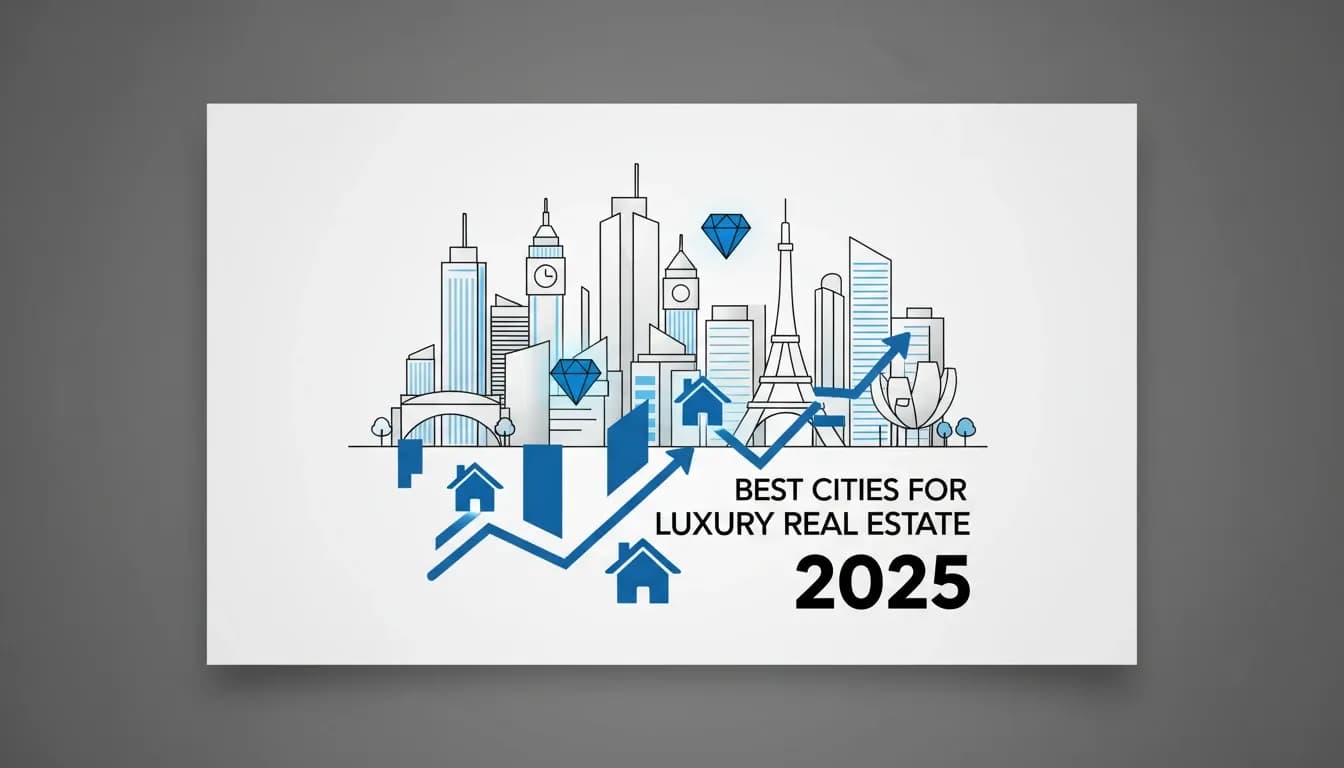
When we talk about the best cities for luxury real estate, most people jump straight to Monaco, London, New York, or Dubai—and they’re not wrong. Those are the global status capitals where prime property acts as a safe‑haven asset and a calling card for the ultra‑wealthy.
But once we spent time digging into both data and real‑world markets, we realized something important: the world’s “luxury map” actually runs on two layers. On one layer, we see ultra‑prime cities where billionaires park capital in ultra‑luxury penthouses and waterfront mansions. On the other, there’s a quieter but equally powerful story: places where $400,000–$1 million buys an estate, a beachfront condo with resort amenities, or a vineyard farmhouse instead of a compact city apartment.
In this guide, we’ll walk through the best cities for luxury real estate across both layers—global ultra‑prime hubs and high‑value lifestyle markets—and explain what type of buyer each one really works for.
Across every serious ranking of global luxury real estate, the same ingredients show up again and again. When we talk to agents in Los Angeles, walk new towers in Panama City, or review second‑home data on Dubai or Monaco, three pillars keep surfacing:
For high‑net‑worth investors, all of this turns luxury real estate into a strategic, generational asset—a mix of wealth preservation, lifestyle base, tax residency play, and global status symbol.
Let’s start with the cities that dominate every global luxury real estate ranking—where the world’s wealthiest families anchor their portfolios and buy second (and third) homes.
Monaco is the undisputed benchmark for ultra‑luxury real estate prices and scarcity‑driven value.
Monaco works because it combines near‑zero land availability with a tax‑friendly regime (no personal income tax), extreme security, and global name recognition. Owners don’t just buy apartments; they acquire social positioning and legal residency benefits in one of the world’s most protected enclaves.
Properties are often held for decades and passed down through families. That multi‑generational hold pattern means liquidity is thin and supply is permanently constrained, which is part of why Monaco sits at the top of almost every list of the best cities for prime luxury homes.
Despite political and economic headwinds, Hong Kong remains one of the most expensive real estate markets globally, particularly in ultra‑prime enclaves.
Ultra‑luxury buyers here prioritize discrete, high‑security homes with sweeping harbor or city views. For many Asian UHNWIs, Hong Kong still acts as a capital hub and safe‑haven asset base, even as they diversify into Singapore, London, or Dubai.
In the span of about two decades, Dubai has gone from desert outpost to one of the top global cities for ultra‑luxury real estate. In some recent periods, it has even outpaced New York in the number of residential transactions over US$10 million.
What really stands out to us when we look at Dubai alongside markets like LA, Orlando, or Panama City’s Costa del Este is how deliberately engineered the luxury ecosystem is. Everything from master‑planned waterfronts to infrastructure and immigration policy is designed to make Dubai a premier luxury destination and global crossroads for wealth.
It now ranks among the world’s top 10 cities where the ultra‑wealthy buy second homes, with more than a thousand UHNW individuals holding secondary residences there. For many families, a villa on Palm Jumeirah or a branded penthouse near Burj Khalifa is as much a global base and tax diversification tool as it is a showpiece home.
London remains one of the most important cities in global luxury real estate—no matter how many times people predict its decline.
The real power of London for high‑net‑worth investors comes from its mix of prestige, rule of law, educational gravity, and deep liquidity. When we talk to buyers comparing LA beachfront with London townhouses, London often wins for those seeking a portfolio anchor rather than just a lifestyle trophy.
It’s also one of the world’s biggest hubs for ultra‑wealthy second homes, with over 9,000 UHNW individuals owning secondary residences there. That kind of entrenched demand is why—even after political shocks and tax changes—Mayfair and Knightsbridge still sit near the top of any ranking of the world’s best places to buy prime property.
New York is the archetype of a global luxury real estate city: deep, liquid, and endlessly re‑inventing itself.
Owning a Manhattan address—especially with Central Park or skyline views—is still one of the clearest signals of global wealth. For UHNW buyers from Europe, Asia, and Latin America, New York functions both as a statement property market and a practical base for business, culture, and education.
It also ranks near the top of global lists for secondary residences, with roughly 12,800 ultra‑wealthy individuals holding second homes in the city. In portfolio terms, New York is a place where luxury real estate behaves more like a blue‑chip equity: cycles happen, but long‑term demand and global relevance consistently reassert themselves.
Singapore is a very different flavor of luxury compared with Monaco or LA. It’s less about overt show and more about precision, governance, and discretion.
Many wealthy families treat Singapore property as a wealth‑preservation and residency strategy, pairing it with holdings in more volatile markets. Ultra‑luxury condos here emphasize security, privacy, and long‑term livability—closer in spirit to Costa del Este’s clean, master‑planned vibe than to, say, a party‑oriented enclave in Ibiza.
Las Vegas is one of the most interesting “new era” luxury cities on the global map. Traditionally, it was seen as an entertainment city rather than a serious address for UHNW primary homes. That’s changing fast.
What we like about Las Vegas, especially when we compare it to LA’s Westside or Southern California coastal markets like La Jolla, is how much space and amenity you get per dollar. Lakefront villas, resort‑style master‑planned communities, and high‑service condos can still be relatively accessible by global luxury standards, while offering a serious upgrade in tax profile.
Looking at secondary residence data is one of the best ways to spot the true best cities for luxury real estate. A second home is rarely an impulse purchase for an ultra‑rich household; it’s a signal that a city checks multiple boxes at once.
Recent analyses show:
Smaller but powerful niche markets include:
We pay attention to these numbers because they reveal where the ultra‑wealthy have decided to anchor their lifestyles and hedge their risk. If thousands of UHNW families own second homes in a city, that city is very likely to remain one of the best places to buy luxury property over a multi‑decade horizon.
Ultra‑prime is only half the story. Once we started comparing Monaco, Dubai, and New York with what $400,000–$1 million buys in lesser‑known cities, a very different—and frankly more accessible—global luxury map emerged.
If we redefine luxury as space, character, and lifestyle per dollar, the best cities for luxury real estate suddenly include West Virginia, Orlando’s golf enclaves, Panama City’s Costa del Este, Caribbean islands with citizenship‑by‑investment, and wine‑region Europe.
In parts of the U.S. Midwest and South, we routinely see 3,000–4,000 sq ft homes—Victorians, brick estates, farmhouses—trading under $150,000. For global buyers used to €50,000 per sq m in Monaco, this is almost surreal.
Who are these “luxury” cities best for?
On the other end of the spectrum, some cities are pure “brand” luxury—and that is exactly what their buyers want.
LA is the textbook case of ultra‑prime lifestyle real estate in the U.S.
What we consistently see in LA is that buyers pay for view, micro‑climate, and neighborhood brand. A hillside mid‑century above the Basin lives very differently from a valley property 20°F hotter, even at a similar price point. For global elites who already own in Monaco or London, LA is often the lifestyle city that delivers Hollywood glamor and year‑round outdoor living.
Orlando is one of the most underestimated luxury cities in America. Once you zoom into its top enclaves, the market looks surprisingly sophisticated.
For many buyers who don’t necessarily need Manhattan or Monaco but still want security, golf, water, and community amenities, Orlando’s best neighborhoods function as “soft ultra‑luxury”: big houses, strong lifestyle, and relatively manageable long‑term ownership costs.
In Latin America, Costa del Este in Panama City is one of the clearest examples of a modern, master‑planned luxury city‑within‑a‑city.
The luxury real estate components range from investor‑oriented micro‑units (like Arcadia, where ~$320K gets you a fully serviced rental unit) to family‑sized apartments with full ocean views (Upper East Tower, around $1.4M+) and gated houses (Antigua, roughly $950K for 4,300 sq ft with community amenities).
We see Costa del Este as a great fit if you want:
The Caribbean adds something special to the list of the best cities and regions for luxury property: sun, sea, and sovereign benefits. Many islands explicitly court foreign buyers and UHNW inflows via low taxes and citizenship‑by‑investment (CBI) programs.
We see Caribbean properties used three ways by global buyers:
When you strip away the brand names (Paris, Geneva, central London), Europe suddenly looks full of cities and regions that deliver genuine luxury real estate under $1M.
These are the cities and regions we recommend when someone says, “I want the European dream—wine, sea, old stone houses—but I don’t want to spend €5 million.” For many buyers, especially those balancing lifestyle with moderate rental yields, they’re among the best value luxury real estate markets in the world.
Whether we’re looking at Monaco penthouses, Dubai waterfront villas, a Beverly Hills hillside home, or a Tuscan farmhouse, the investment logic for wealthy buyers is remarkably consistent:
This is why, for UHNWIs, luxury real estate in the best global cities isn’t just a purchase; it’s a strategic necessity sitting alongside private equity, treasuries, and operating businesses.
The phrase “best cities for luxury real estate” is meaningless unless we anchor it in your reality—your budget, risk profile, lifestyle, and mobility.
Here’s how we map the landscape when we help buyers narrow down options:
If you’re deciding where to buy, we suggest working through five simple questions:
Once you’re clear on those, the best cities for luxury real estate—whether that’s Monaco and Dubai, La Jolla and Beverly Hills, Costa del Este and the Algarve, or West Virginia and Winter Park—start to sort themselves into a short, actionable list.

Hey, in Propphy we're determined to make a business grow. My only question is, will it be yours?
It's totally free, with no commitments
Hey, in Propphy we're determined to make a business grow. My only question is, will it be yours?
It's totally free, with no commitments