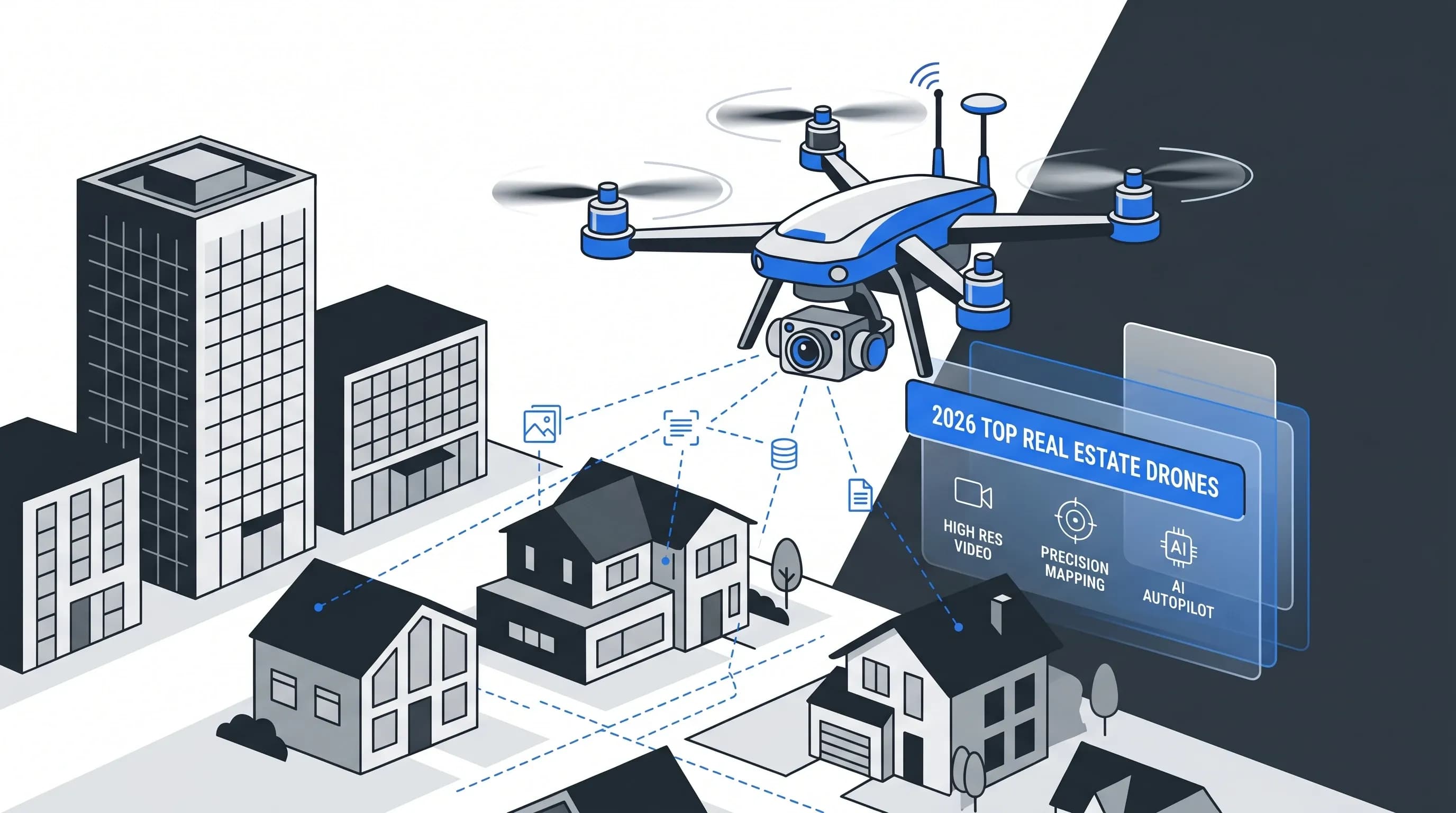
Choosing the best drone for real estate photography in 2026 is not really about chasing the flashiest aircraft or the longest spec sheet. It is about picking the camera drone that helps us shoot properties faster, safer, and with better results for clients. In real estate, that means clean aerial listing photos, smooth drone video, reliable flight time, predictable handling, and image quality that holds up for MLS listings, social media, and premium property marketing.
After comparing the leading options and the patterns across top recommendations, the market is fairly clear. The DJI Air 3S is the best overall drone for most real estate photographers, the DJI Mavic 3 Pro is the premium choice for luxury listings, and the DJI Mini 4 Pro is the smartest portable option for agents, beginners, and quick-turn content. For non-DJI buyers, Autel still offers the most credible alternatives, while specialty FPV tools can add a different layer for interior fly-throughs.
We will break down the top real estate drones, explain which specs actually matter, compare the top models, and help you choose the right drone for your workflow, budget, and market.
Ground-level photography shows the home. Drone photography shows the property.
That difference is huge. Aerial imagery gives buyers instant context that standard exterior photos cannot. It shows how the house sits on the lot, reveals outdoor amenities, highlights landscaping, and places the property within the neighborhood. When we are marketing homes, especially competitive listings, that context can directly affect perceived value.
Drone photos are especially useful for showing:
They also help us present a listing more professionally. In practice, sellers notice when a listing presentation includes polished aerial views, and buyers scrolling online tend to engage faster when the photography answers key questions immediately.
If we are choosing a drone for property photography, we should start with what helps in actual paid work. Not every headline feature matters equally. In real estate, the priorities are more practical than dramatic.
Image quality is still the foundation. For serious real estate photography, larger sensors generally give us better dynamic range, cleaner shadows, better low-light performance, and more flexibility in editing. That matters because property shoots often involve bright skies, dark landscaping, shaded porches, reflective windows, and mixed lighting.
As a rule of thumb:
We do not necessarily need extreme resolution. Most clients will never ask whether we shot 4K, 5.1K, or 6K if the final aerial photos and video look clean, balanced, and professional.
For real estate photography, RAW capture and auto exposure bracketing are close to non-negotiable. AEB helps us recover sky detail, open up shadows, and produce polished HDR images that look far better than a single exposure in difficult exterior light.
If a drone does not fit comfortably into an AEB and RAW workflow, it is much harder to recommend for paid listing work.
A real 3-axis gimbal matters for both stills and video. It helps keep bracketed shots cleaner, improves hover stability in images, and gives us smooth movement for property videos. This is one of those features that stops being optional as soon as we work around rooflines, trees, driveways, and facades regularly.
Flight time is one of the most underappreciated productivity features. A drone with enough endurance to cover multiple angles, a full shot list, and even a second pass saves time and stress. In the field, that matters more than people admit.
For real estate, we generally want:
This is a big one. A drone that feels stressful slows us down. A drone that flies predictably lets us focus on composition. That is why wind handling, stable hovering, and simple operation matter so much for real estate photographers who work on schedules, not perfect weather.
Smaller drones can absolutely do strong work, but when the wind picks up, larger airframes usually feel more confidence-inspiring. That is one of the main reasons many full-time shooters eventually move beyond ultra-light drones if drone work becomes a major revenue stream.
Real estate flights happen around trees, fences, power lines, chimneys, gutters, and backyard structures. Omnidirectional obstacle sensing, good return-to-home behavior, strong transmission, and reliable GPS lock are not luxury extras. They reduce mistakes and help us work faster with less mental load.
Portability matters more when we are covering multiple listings in a day. A compact foldable drone is easier to keep in the car, easier to deploy quickly, and easier to justify carrying all the time. For many agent-photographers, that convenience is exactly why the Mini-class drones remain so popular.
Telephoto capability is especially useful in real estate because very wide lenses can exaggerate distance and distort facades. A tighter lens lets us create more flattering exterior compositions, compress space more naturally, and isolate features like pools, docks, guest houses, and landscaping without flying too close to structures.
If we want the safest recommendation for most working professionals, the DJI Air 3S is the one. It sits right in the sweet spot between portability, image quality, flight time, safety features, and price. For many buyers, it is the smartest all-rounder and the best real estate drone for 2026.
What makes it stand out is not just one spec. It is the overall package:
For real estate photography, that balance matters. We can capture wide establishing shots, tighter exterior angles, backyard features, and cleaner neighborhood context without constantly feeling limited by the aircraft. It is also one of the most compelling choices for photographers who want more capability than a Mini but are not ready to jump to full Mavic pricing.
Best for: most real estate photographers, agent-photographers growing in-house media, suburban and midrange luxury listings, mixed photo and video work.
Main drawback: it still does not quite match the premium rendering of a larger 4/3 sensor drone for top-tier luxury marketing.
The DJI Air 3 is still one of the best drones for property photography if we want a dependable daily driver. It remains a go-to recommendation because it offers dual-camera versatility, long flight times, strong obstacle sensing, and a more approachable price than the Mavic line.
It is especially useful when we want a drone that just gets through listing shoots efficiently. In practical use, that matters as much as pure image quality. Many real estate businesses need a workhorse more than a flagship.
Best for: everyday residential listings, medium-to-large homes, high-volume media businesses, photographers who value efficiency.
Main drawback: newer options may offer a stronger main sensor or slightly better low-light performance.
For premium listings, waterfront homes, estates, and high-end commercial properties, the DJI Mavic 3 Pro remains one of the strongest real-estate-specific recommendations. This is where image quality, dynamic range, and lens flexibility start to justify the higher price.
Its biggest strengths include:
That larger sensor makes a visible difference when skies are bright, shadows are deep, or the client expects polished, magazine-style listing imagery. We also like the extra confidence that comes from a bigger aircraft in more demanding conditions. Some experienced real estate shooters still prefer the Mavic 3 family specifically because the larger sensor and more advanced exposure control make it feel less limiting in real jobs.
Best for: luxury listings, full-time real estate media companies, premium twilight photography, coastal and windy markets, high-fee commercial work.
Main drawback: cost, size, and less grab-and-go convenience than the Air or Mini lines.
The DJI Mavic 4 Pro is the premium choice for buyers who want the newest top-end foldable camera drone. On pure capability, it is arguably the most advanced option in this roundup. It offers flagship-level imaging, strong battery life, telephoto flexibility, advanced gimbal features, and very high-end safety systems.
For real estate, it can absolutely produce stunning work. But we should be honest: this is not the value pick. It is the “money is no object” pick.
Best for: top-end luxury marketers, hybrid photographers who also do high-level commercial and non-real-estate work, buyers who want the latest premium platform.
Main drawback: price. For many listing shooters, the Air 3S or Mavic 3 Pro makes more business sense.
The DJI Mini 4 Pro is one of the most practical camera drones in the real estate space. If we want portability, easy setup, low friction, and a strong balance of quality and affordability, it is still one of the smartest choices on the market.
It makes sense for a lot of users because it is:
It is also one of the best examples of a drone that reduces friction. Quick setup, easy battery swaps, straightforward controls, and smart controller options make it extremely attractive for solo shooters and agents building content in-house.
That said, we should not pretend it is magic. The smaller sensor means less dynamic range and less low-light flexibility than the Mavic 3 class or some 1-inch sensor drones. In strong wind, it is also less confidence-inspiring than larger platforms. If we regularly shoot windy waterfronts, open land, or high-end twilight work, stepping up can make sense.
Best for: real estate agents, beginners, solo creators, travel-heavy shooters, backup drone users, social-first marketing.
Main drawback: not the strongest still-image platform for premium luxury work.
If the DJI Mini 5 Pro is widely available in your market, it deserves attention as a serious lightweight real estate drone. It has been positioned as the next step above the Mini 4 Pro, with improvements in sensor size, low-light performance, wind handling, and safety features like front LiDAR.
For buyers who want a compact, sub-250g drone with fewer compromises, it could be one of the most interesting options in the category.
Best for: buyers who want the lightest serious real estate drone possible with stronger imaging than earlier Mini models.
Main drawback: pricing and availability may determine whether it is truly a better buy than the Mini 4 Pro or Air 3S.
If we want a non-DJI option without dropping into toy-like compromises, the Autel Evo II Pro V3 is still one of the most credible alternatives. Its 1-inch sensor and solid still-image quality make it relevant for real estate photographers who care most about file quality and want a different ecosystem.
Best for: non-DJI buyers, still-photo focused workflows, sunrise and sunset exteriors, users prioritizing image quality over app polish.
Main drawback: DJI still tends to offer a more polished ecosystem, stronger support, and better overall market dominance.
The Autel Evo Lite+ remains a useful option for photographers who want a midrange alternative with a 1-inch sensor and variable aperture. That combination can be attractive for daylight exterior work and balanced still photography.
Best for: non-DJI buyers shopping midrange, users who value image quality and variable aperture.
Main drawback: obstacle avoidance and system maturity generally trail DJI.
The DJI Air 2S is still worth considering in 2026 if we are buying used or discounted gear. A 1-inch sensor, good photo quality, and relatively compact size make it a very capable older-value pick.
Best for: budget-conscious professionals, used-market buyers, photographers who want better sensor quality without paying for the newest generation.
Main drawback: shorter battery life and older avoidance tech than the Air 3 series.
If the budget is tight and we just need a legitimate starting point, the DJI Mini 2 or Mini 2 SE still makes more sense than gambling on random cheap drones. These models remain practical because they are portable, stabilized, and capable enough for basic listing aerials.
The biggest caution is obvious: no obstacle avoidance. For new pilots, that matters. Around trees, poles, rooflines, and backyard structures, that missing safety net can be the difference between a smooth job and a crash.
Best for: brand-new shooters, side hustlers, occasional drone add-on work, backup kits.
Main drawback: fewer safety features and lower ceiling for professional work.
This is a different category, but it deserves a mention because interior FPV tours can be a premium upsell in real estate media. The GepRC DarkStar 22 is not a standard aerial listing drone. It is a cinewhoop-style specialty tool for dramatic interior motion work.
We would not buy this as our only real estate drone. But as a second drone, it can help create a standout service for luxury or creative property marketing.
Best for: interior FPV tours, cinematic add-on services, creative agencies.
Main drawback: short battery life and a steeper learning curve than standard GPS-stabilized drones.
| Drone | Best For | Camera / Sensor Strength | Flight Time | Main Advantage | Main Tradeoff |
|---|---|---|---|---|---|
| DJI Air 3S | Best overall for most pros | Strong main camera + tele lens | ~45+ min | Best balance of quality, safety, and value | Not full Mavic luxury quality |
| DJI Air 3 | Daily workhorse | Dual-camera flexibility | ~42–46 min | Efficient and versatile | Main sensor trails premium picks |
| DJI Mavic 3 Pro | Luxury real estate | 4/3 Hasselblad + telephoto options | ~38–43 min | Premium files and lens range | Cost and size |
| DJI Mavic 4 Pro | Flagship buyers | Top-end triple-camera platform | Up to ~51 min | Maximum capability | Expensive overkill for many |
| DJI Mini 4 Pro | Portable all-rounder | 1/1.3-inch class sensor | ~30–34 min | Easy, compact, social-friendly | Smaller-sensor limitations |
| DJI Mini 5 Pro | Advanced sub-250g option | Improved Mini-class imaging | Varies by configuration | Lightweight with fewer compromises | Depends on pricing and availability |
| Autel Evo II Pro V3 | Best non-DJI stills option | 1-inch sensor | ~40 min | Strong still image quality | Less polished ecosystem |
| Autel Evo Lite+ | Non-DJI midrange | 1-inch sensor + variable aperture | ~40 min | Good value alternative | Weaker safety/ecosystem |
| DJI Air 2S | Used-market value | 1-inch sensor | ~31 min | Strong older-value pick | Older flight tech |
| DJI Mini 2 / 2 SE | Budget starter | Basic but capable stabilized camera | Good for the class | Affordable legitimate entry point | No obstacle avoidance |
The best drone for property photography depends on what kind of shooter we are. That is the real decision.
This is the smartest buy for most professionals. It gives us modern safety features, strong image quality, telephoto flexibility, and long flight time without forcing us into flagship pricing.
If image quality is non-negotiable, if twilight work is common, or if we market estates and high-end homes, the Mavic 3 Pro makes sense. It is the more serious professional photography drone for premium listings.
If we want a grab-and-go real estate drone for MLS photos, reels, quick content, and light commercial work, the Mini 4 Pro is a great fit. It is also one of the easiest drones to actually carry and use consistently.
If the goal is to get in the game without buying junk, this is still one of the smartest budget picks. We just need to be realistic about safety features and limitations.
If budget is not the issue and we want the most advanced foldable photography platform, the Mavic 4 Pro is the premium choice. It just is not the practical recommendation for most buyers.
That is a specialty service, not an all-purpose solution. But for the right business, it can be a meaningful differentiator.
The truth is simple: skill matters more than gear alone. A thoughtful shooter with a Mini 4 Pro can produce deliverables clients love, while an unprepared shooter with a premium flagship can still come back with weak marketing assets.
One of the most common mistakes is flying too high. Often the best aerial real estate photography happens around 20 to 30 feet up, not at extreme altitudes. Lower shots better emphasize facade shape, yard depth, landscaping, and the scale of outdoor features.
Consistency matters in real estate marketing. A strong property shoot often includes:
Golden hour and early morning usually work best. Midday sun often creates harsh contrast, ugly roof shadows, washed-out lawns, and flat exterior walls. Better light improves even average drones.
For MLS listings and premium galleries, AEB/HDR is one of the most important techniques we can use. It helps preserve sky detail, siding texture, landscaping shadows, and architectural highlights.
Drone photos should look like they belong with the interior and ground-level exterior images. Consistent editing, realistic color, and balanced contrast make the whole property marketing package feel more professional.
For real estate video, we usually care more about smooth movement and clear storytelling than extreme frame rates. Clean 4K is enough for most property marketing. What matters is how the footage feels.
The most useful drone movements for listing videos are:
One of the strongest premium techniques is the exterior-to-interior transition, where the drone approaches the front door and the edit continues inside with a stabilized ground camera or FPV setup. That kind of movement can make a listing video feel much more cinematic.
Some low-cost brands look appealing on paper, but paid work is where reliability matters most. A recurring issue with cheaper drones is that the specs can look impressive while the real-world support, software maturity, transmission reliability, and long-term consistency fall short.
That is why we would generally be cautious with models that depend heavily on inflated marketing rather than a proven ecosystem. For professional real estate photography, a cheaper drone that costs us time, confidence, or a missed job is not actually cheaper.
If we use a drone for real estate marketing in the United States, that is commercial use. The practical answer is straightforward.
We need an FAA Part 107 certificate to fly commercially for real estate. If the drone helps market a property, that is business use.
In the U.S., drones 250g and above generally require registration. Sub-250g drones can reduce some burdens in certain recreational contexts, but commercial obligations still apply.
We also need to check:
Drone liability insurance is strongly recommended. It is one of the clearest signs of professionalism, and standard business policies often do not cover aviation-related claims. If we are serious about real estate drone work, insurance should be part of the business model.
For U.S. buyers, DJI availability and regulatory uncertainty remain worth monitoring. That can affect pricing, new-model access, resale value, and long-term ecosystem decisions. It does not erase DJI’s dominance, but it is one reason some buyers are also evaluating Autel and other alternatives more seriously than before.
If we want the short version, here it is:
Our view is simple: the best drone for real estate photography is the one that helps us show homes clearly, fly confidently, and finish jobs fast enough to make the work profitable. For most people, that means avoiding both extremes. We do not need the cheapest drone with inflated claims, and we do not always need the most expensive premium model either.
If we are building carefully, the Mini 4 Pro is incredibly practical. If we want the best overall mix of quality and real-world usefulness, the Air 3S is the standout. If our business depends on premium luxury visuals, the Mavic 3 Pro is still one of the smartest professional choices available.
In the end, great real estate drone photography is not just about the aircraft. It is about light, composition, safety, editing, and a workflow that helps our clients sell homes better.

Hey, in Propphy we're determined to make a business grow. My only question is, will it be yours?
It's totally free, with no commitments
Hey, in Propphy we're determined to make a business grow. My only question is, will it be yours?
It's totally free, with no commitments