If you’re a real estate agent in 2026, “being on social” is no longer optional—but it’s also no longer as simple as posting a few just‑listed graphics and hoping for the best.
Between AI, recommendation algorithms, and changing consumer behavior, a handful of platforms have clearly emerged as the best social media platforms for real estate agents—the ones that actually bring buyers and sellers, not just vanity metrics.
In this guide, we’re going to walk through the 5 best real estate social networks that help you grow in 2026, how each one really works for lead generation, and how to build a realistic strategy you can sustain without burning out.
Nearly every serious buyer or seller now touches social at some point in their journey, and surveys consistently show that 40–50% of real estate businesses say their best leads now start on social media.
The catch: there’s a huge gap between “we have accounts everywhere” and “we have a real pipeline of clients coming from social media.” Trying to be active on every platform usually leads to:
- Inconsistent posting and weak engagement
- Random content that doesn’t build authority
- Lots of impressions, very few conversations
We’ve seen that when agents focus on the right 3–5 real estate social media platforms and build simple systems, social becomes a reliable channel for:
- Consistent real estate lead generation
- Stronger brand visibility and social proof
- Bigger, healthier referral networks
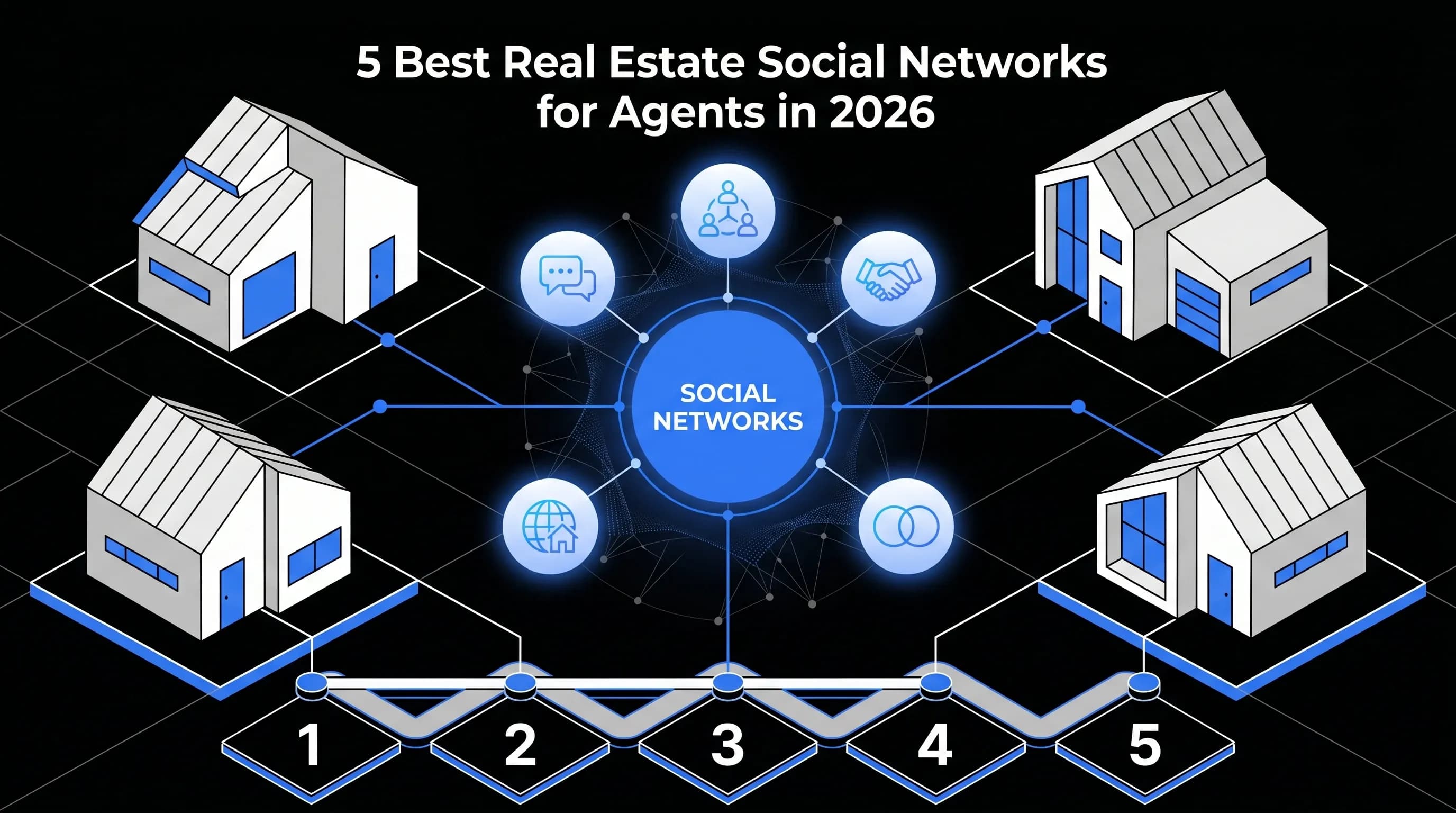
The 5 Best Real Estate Social Networks in 2026 (Quick Overview)
Across what we’re seeing in the field and what current data shows, these are the top real estate social networks you need in 2026 if your goal is actual growth:
- YouTube – Long‑form authority and high‑intent search traffic
- Instagram – Day‑to‑day brand building and conversations
- Facebook – Sphere, referrals, local groups, and ads
- TikTok – Massive organic reach via short‑form video
- LinkedIn – Professional network, referrals, and higher‑value clients
We’ll break down each of these real estate social media platforms with specific tactics and content ideas, then show you how to choose your own “big 3–5” and stitch them together into one coherent social media strategy for your real estate business.
1. YouTube: The King Platform for Real Estate Agents in 2026
If we had to pick just one social media platform for real estate agents in 2026, we’d still pick YouTube
Yes, it’s more “search engine” than social network—but for our purposes, it’s one of the most important real estate social media networks you can invest in.
Why YouTube Is So Powerful for Real Estate Right Now
- Long‑form trust and the “TV show effect” – Buyers and sellers binge 20–30 minute “Living in [Your City]” and “Cost of Living in [Your City]” videos on their TVs, sometimes months before they ever speak to an agent.
- High‑intent search traffic – Viewers are literally typing “best neighborhoods in [city]”, “moving to [city] pros and cons”, and “is it a good time to buy in [city] in 2026?”
- AI is reading your videos – Google’s Gemini and AI Overviews are using your video transcripts as data to decide who is a local expert in specific markets or niches (“best agent for first‑time buyers in [city]”).
- Returning viewers are the new growth signal – In 2026, channels that drive a strong base of returning viewers (30–40% of views from returning viewers) get disproportionate reach.
Best Types of Real Estate Content on YouTube
To rank among the best real estate social media platforms for lead generation, YouTube needs a specific kind of content mix:
- Neighborhood & city guides
- “10 Things You MUST Know Before Moving to [City] in 2026”
- “Living in [Suburb]: Pros, Cons, Schools, Commute”
- Driving or walking tours with commentary
- Cost of living and market breakdowns
- “Cost of Living in [City] (Housing, Utilities, Taxes, Lifestyle)”
- “Is Now a Good Time to Buy in [Area] or Wait Until 2027?”
- In‑depth property tours
- 5–20 minute walk‑throughs with floor plan context, HOA info, and community feel
- Pairs perfectly with shorter vertical versions for Reels/Shorts/TikTok
- Buyer and seller series
- “First‑Time Buyer in [State] 101” playlist
- “Selling Your Home in [City] in 2026 – Step by Step”
How to Structure YouTube Videos for Views, Leads, and AI
To turn YouTube into the best social media for real estate lead generation in your business, we like to use a structure that works for humans, the algorithm, and AI systems:
- Think “TV show,” not random uploads
- Upload on the same days and times every week (e.g., Tuesdays & Thursdays at 10am).
- Viewers and the algorithm should “expect” your next episode.
- Go longer and deeper
- 5–8 minute uploads are rarely enough for real estate now.
- Grow into regular 20–40 minute videos that serious movers will binge.
- Use Q&A style titles and chapters
- “Is [City] a good place to live in 2026?”
- “What are property taxes in [County]?”
We’ve found that detailed chaptering like this works extremely well for both SEO and AI:
00:00 – Is Austin a good place to live in 2026?
03:12 – Cost of living in Austin (housing, utilities, taxes)
09:45 – Best neighborhoods in North Austin for families
16:20 – Renting vs buying in Austin right now
22:05 – Should you wait to buy a home in 2027?
How YouTube Actually Brings Real Estate Clients
YouTube is where we see some of the warmest inbound leads in the entire real estate social media ecosystem:
- Relocation buyers who have watched 5–20+ of your videos before they ever book a call
- Sellers who feel like they already know you and your process
- Repeat/referral clients who stay plugged into your market updates
On many teams, “YouTube lead” is now its own lead source in the CRM because those contacts convert like referral business. That’s why we treat YouTube as the “king” among real estate social networks in 2026.
Instagram remains one of the best social media platforms for real estate agents because real estate is visual and lifestyle‑driven—and that’s exactly what Instagram is built for.
Most of your sphere, past clients, and warm prospects will check you out here before they ever fill out a form or book a call.
Why Instagram Still Dominates Real Estate Social Media
- Visual storytelling – High‑quality photos, carousels, and Reels make listings feel aspirational instead of like MLS screenshots.
- Reels & Stories humanize you – Short, casual video is where people get a feel for your personality, values, and process.
- Interest‑based algorithm – Content is pushed to people interested in real estate, moving, or your city—not just your followers.
- DM‑based lead gen – Many “social media for realtors” success stories trace back to simple DMs that started from a Story, poll, or Reel.
What to Post on Instagram as a Real Estate Agent
We like to organize Instagram into a few high‑impact content pillars so you never run out of ideas:
- Listings & tours
- Carousel posts with 5–8 of the best listing photos
- Reels: 15–60 second walkthroughs (“Here’s what $650K buys in [Neighborhood] in 2026”)
- Local lifestyle
- “Every Wednesday I try a new [City] coffee shop” mini‑series
- Restaurants, parks, gyms, farmer’s markets, local events
- Educational content
- “3 mistakes first‑time buyers in [City] are making in 2026”
- “What higher rates really mean for your monthly payment”
- Buyer/seller tips, financing breakdowns, inspection red flags
- Behind‑the‑scenes & personal
- “Day in the life” Story snippets
- On the way to a listing appointment, showings, or inspections
- Why you do real estate, what matters to you outside work
- Social proof
- Client testimonials and stories
- “Offer accepted” breakdowns and how you won in multiple offers
Simple Weekly Posting Framework (That You’ll Actually Use)
To stay consistent on this real estate social media platform without burning out, a simple weekly schedule works wonders:
- Monday – Market update
- 3 bullets about what’s happening + “what this means for you”
- Tuesday – Personal story
- Your background, your why, family, hobbies
- Wednesday – Community/local feature
- Local business spotlight, neighborhood, event, or park
- Thursday – Educational tip
- Buyer/seller/investor tip in Reel or carousel format
- Friday – Social proof/win
- Client success story or big lesson learned this week
Turn Instagram Engagement into Real Estate Leads
To make Instagram one of the best social media sites for real estate agents in your own business, you need strong calls to action and real conversations:
- Use Hooks–Value–CTA in captions
- Hook: “Thinking about waiting until 2027 to buy? Read this.”
- Value: Explain like you’re texting a friend.
- CTA: “Comment ‘guide’ and we’ll DM you our 2026 Buyer Game Plan.”
- Stories + polls = free warm leads
- Poll: “Considering moving this year? Yes / No”
- Poll: “If you sold, would you stay local or leave the state?”
- DM anyone who taps “Yes” with a personal message and question.
We’ve watched agents with a few thousand followers turn this into hundreds of DM conversations and multiple closed deals—proof that best social media for realtors very rarely means “agents with the biggest follower counts.”
Facebook might not feel shiny anymore, but it still ranks among the best social media platforms for real estate agents in terms of real ROI—especially for sphere, past clients, and local community presence.
Why Facebook Still Belongs in Your Real Estate Social Media Mix
- Your sphere is already there – Friends, family, and past clients are far more active on Facebook than on some trendier platforms.
- Referrals run through relationships – Roughly a third of deals for many agents come from referrals, and Facebook is where those relationships are visible and nurtured.
- Groups are under‑leveraged gold mines – Local buy/sell groups, neighborhood groups, and community pages still have huge organic reach.
- Meta ads are still powerful – Even with Special Ad Category restrictions, Facebook & Instagram ads are among the most cost‑effective ways to generate real estate leads.
Facebook Business Page vs Personal Profile vs Groups
To really understand Facebook as a real estate social network, it helps to think in three layers:
- Business Page
- Functions as your “social storefront” for property listings, videos, success stories, and contact info.
- Essential for running ads and establishing your brand presence.
- Personal Profile
- Typically gets much better organic reach than a business page.
- Best place to blend life, work, and soft real estate content without spamming.
- Groups
- Neighborhood forums, relocation groups, investor communities, and “What’s Happening in [City]” style groups.
- Ideal for providing value, answering questions, and becoming the default local expert.
What to Post on Facebook for Real Estate
To leverage Facebook among your best social media channels for real estate marketing, focus less on viral reach and more on trust, familiarity, and conversation:
- On your personal profile
- Lifestyle posts and personal updates that show you as a real person
- Behind‑the‑scenes glimpses of showings, open houses, inspections
- Light educational posts (“Here’s what I’m telling my sellers about pricing right now”)
- Context‑rich “Just Listed” and “Just Sold” posts that tell the story, not just the result
- In local groups
- Answer housing and neighborhood questions in detail
- Share community resources and events
- Occasionally share standout content like an in‑depth YouTube neighborhood guide
- Avoid spamming listings; aim to be “the helpful one,” not “the ad.”
Using Facebook Ads for Real Estate Lead Generation (Safely)
When we talk about the best social media for real estate marketing in terms of paid campaigns, Facebook/Instagram ads still top the list—if you respect the rules.
- Special Ad Category: Housing
- You must designate your campaigns as “Housing” in Meta Ads Manager.
- No targeting by age, gender, or ZIP; minimum 15‑mile radius around the location.
- Keep creative and copy compliant with Fair Housing guidelines.
- Where ads shine
- Lead magnets: “Download the 2026 [City] Buyer’s Survival Guide.”
- Home value offers: “Find out what your [Neighborhood] home could sell for in 2026.”
- Retargeting: Stay in front of website visitors, video viewers, and email list subscribers.
Used correctly, Facebook remains one of the best platforms for real estate marketing on a cost‑per‑lead basis and a powerful complement to your organic presence.
Among all the real estate social media platforms competing for your time, TikTok stands out for one thing: outsized organic reach.
Short‑form vertical video (TikTok, Instagram Reels, YouTube Shorts, Facebook Reels) is now where huge numbers of buyers and renters spend their downtime—and where they first discover agents they’ve never heard of before.
Why TikTok Is a Top Real Estate Social Network in 2026
- Interest‑based algorithm – Your videos are pushed to people who watch content about real estate, moving, your city, or similar topics, even if you have almost no followers.
- Low production barriers – Simple phone videos with minimal editing often outperform over‑produced content.
- Young and mobile audience – Millennials and Gen Z, who dominate first‑time buyer and move‑up markets, are very active here.
- Viral potential across accounts – We’ve seen small real estate accounts go from a few hundred followers to tens of thousands because one or two videos hit local interest patterns perfectly.
Real Estate Content That Works on TikTok
To make TikTok one of the best social media platforms for realtors to get clients, focus on content that answers questions, shows local realities, and sparks curiosity:
- Simple walkthroughs
- “Here’s what $400K buys you in [Neighborhood] in 2026.”
- “Inside a $1M home in [City] – would you buy this?”
- You don’t always need your own listing; you’re the narrator of what’s available.
- Myth‑busting & quick tips
- “You do NOT need 20% down—here’s what you actually need in 2026.”
- “3 things first‑time buyers forget about closing costs.”
- Local hooks & lifestyle
- “Why everyone is moving to [City] in 2026 (and why some people are leaving).”
- “Top 5 free things to do in [City] this weekend.”
- Process explainers
- “How to buy before you sell in 2026.”
- “Do this before you start house hunting in [City].”
Turning TikTok Views into Real Estate Leads
TikTok is extremely top‑of‑funnel, but it can generate direct deals when you pair views with smart calls to action:
- Comment‑based CTAs
- “Comment ‘guide’ for my 2026 relocation guide to [City].”
- “Comment ‘calc’ and I’ll DM you our free payment calculator.”
- Profile funnel
- Link in bio to a lead magnet, Calendly, or “start your home search” page.
- Clear profile line: “DM us ‘move’ if you’re planning to move to [City] in 2026–2027.”
We see agents whose social media presence for real estate was once focused solely on Facebook and Instagram now getting a meaningful share of new, younger clients from TikTok—without huge follower counts or big ad budgets.
LinkedIn doesn’t get as much buzz as TikTok or Instagram, but it quietly remains one of the best social networks for real estate professionals who want to increase referral volume and attract higher‑value clients.
Why LinkedIn Belongs in Your Real Estate Social Media Strategy
- Professional audience – High‑earning professionals, business owners, executives, and investors are active here.
- Referral ecosystem – Mortgage brokers, attorneys, CPAs, financial advisors, and other vendors all live on LinkedIn and can become consistent referral partners.
- Authority positioning – Data‑driven posts and case studies help you stand out as a serious expert, not just another salesperson.
Optimizing LinkedIn for Real Estate Lead Generation
To turn LinkedIn into one of your best social media platforms for real estate professionals, we like to focus on three things:
- Profile optimization
- A clear, outcome‑oriented headline:
- “Residential Realtor in [City] | Move‑Up & Luxury Specialist”
- About section that speaks to who you help and the problems you solve.
- Professional photo and a banner image that visually anchors you in your market.
- Content mix
- Market updates: “What Q2 2026 data says about prices in [Metro Area].”
- Case studies: “How we sold a stale listing in 9 days with a minor repositioning.”
- Investment‑focused posts: cap rates, regulations, zoning/short‑term rental updates.
- Highlights: closings, certifications, milestones—framed with lessons for your audience.
- Intentional networking
- Connect with every client and professional you work with.
- Engage deeply with posts from local business leaders and partners.
- Join investor and local business groups where serious conversations happen.
How LinkedIn Helps You Grow Your Real Estate Business
LinkedIn is rarely about volume of leads; it’s about quality:
- Referrals from professionals whose clients trust them on big financial decisions
- High‑income, high‑lifetime‑value buyers and sellers
- Better positioned for luxury and commercial transactions
Used this way, LinkedIn earns its place among the best social media platforms for real estate agents in 2026, even if it doesn’t generate as many daily DMs as Instagram or Facebook.
There are more than five platforms agents can use. A few that often come up in conversations about real estate social networks:
- Pinterest
- Great for long‑term traffic on staging, design, renovation, and “dream home” content.
- Acts more like a search engine than a social network; less effective for direct lead gen.
- Worth layering on if you already have strong photo assets and a blog.
- X (Twitter)
- Useful for real‑time market commentary, investor updates, and policy/zoning chatter.
- For most local residential agents, engagement is too low to be a core focus compared to the top 5 platforms above.
We see the best results when agents treat these as “extras” after they’ve built a solid presence on the core real estate social media platforms we’ve covered.
There’s one more “network” we need to talk about, because it increasingly behaves like a hybrid of search and social: AI discovery (ChatGPT, Google’s AI Overviews, Gemini, Perplexity, etc.).
In 2026, buyers and sellers are asking AI systems questions like:
- “Who is the best real estate agent for first‑time buyers in [city]?”
- “What’s the housing market like in [city] right now?”
- “How much house can I afford if I make $X in [city]?”
These systems often respond with a small shortlist of agents, articles, and YouTube channels. And they draw heavily on the same signals you’re building with your social media for real estate:
- Google Business Profile activity and reviews
- YouTube videos and transcripts about your city and niche
- FAQ and local pages on your website
- Educational and authority‑building content on social
How to Position Yourself for AI Recommendations
We find a few practices help your social media efforts “echo” into AI discovery:
- Answer real questions in your content
- Use question‑style titles and headings in YouTube, blogs, and even social captions.
- Example: “Should you sell before you buy in [City] in 2026?”
- Keep your Google Business Profile active
- Post market snippets, new videos, and client stories regularly.
- Collect steady reviews and respond to them.
- Pick a niche and own it
- First‑time buyers, VA buyers, luxury, relocation, downsizing, investors, etc.
- Make that niche obvious across your profiles and content.
AI might not feel like a “social network,” but in practice it behaves like one more place where your real estate social media presence can get you on a short list of recommended agents.
You don’t need to master every real estate social network we’ve mentioned. You need the right stack for your market, your clients, and your schedule.
Step 1: Lock in the Non‑Negotiables
For almost every residential agent in 2026, we recommend:
- Instagram – Your primary visual and brand channel.
- Facebook – For your sphere, local groups, and potential ads.
Step 2: Pick at Least One Authority Platform
Next, choose where you want to build deeper authority:
- YouTube – If you can commit to consistent, longer videos.
- or LinkedIn – If your business leans heavily on referrals, investors, or commercial/luxury clientele.
Step 3: Add TikTok as a Growth Lever (If It Fits You)
Add TikTok (and by extension more Reels/Shorts) if:
- You’re willing to be on camera regularly.
- You want faster follower growth and younger clients.
Practical “Best Mix” Examples
For many solo agents and small teams, a realistic, high‑ROI social stack looks like:
- Core 3: Instagram + Facebook + LinkedIn
- Growth lever: TikTok
- Long‑term authority asset: YouTube as you build capacity
The key is to avoid the trap of “we’re everywhere but not consistent anywhere.” The agents who are winning the most deals from social media for real estate agents are doing a few platforms very well and letting those channels compound over time.
Cross‑Platform Content Strategy: Re‑Use, Don’t Re‑Invent
The only way to sustain a strong presence on multiple real estate social media platforms is to repurpose your content intelligently instead of starting from scratch every time.
Example: Turn One Listing into Multi‑Platform Content
- YouTube – 5–15 minute in‑depth tour with neighborhood and pricing context.
- Instagram Feed – Carousel of 5–8 best photos; caption with story and details.
- Instagram & Facebook Stories – Quick walk‑through, poll (“Which kitchen do you like better?”), countdown to open house.
- TikTok / Reels / Shorts – 15–60 second vertical highlight tour with strong hook.
- Facebook groups – Value‑first post: “New listing that might work if you’re looking for X in [Neighborhood]—here’s what stands out.”
- LinkedIn – Case‑study style post:
- “How we positioned this [Neighborhood] home to sell quickly in a shifting market.”
Core Themes to Rotate Across All Platforms
Regardless of where you’re posting, we see the same content themes performing best for social media marketing for real estate agents:
- Listings & tours – Show people real homes in your market.
- Local life – Restaurants, parks, events, neighborhoods, commutes.
- Education – How‑tos, financing, the process, red flags, strategies.
- Social proof – Testimonials, case studies, client wins.
- Personal brand – Your story, values, routines, behind‑the‑scenes.
One of the biggest pain points we hear about social media for realtors is time. Managing multiple real estate social networks while running a service‑heavy business can feel impossible without systems.
Scheduling & Automation
To keep up with multiple real estate social media platforms without living inside each app:
- Use a social media scheduler for Instagram, Facebook, and LinkedIn.
- Batch create content once or twice a week.
- Reserve “live” time mainly for DMs, comments, Stories, and filming short‑form video.
Speed‑to‑Lead & Follow‑Up
The fastest‑responding agent often wins. Social media leads expect answers quickly, so we like to:
- Use form and DM notifications that actually get your attention.
- Block daily time for:
- Checking and answering DMs.
- Replying to comments thoughtfully.
- Following up with any “hand‑raisers” from polls and CTAs.
Owning Your Audience (Beyond Social)
Every real estate social media strategy is stronger when social feeds your own database:
- Email list – Build it with relocation guides, buyer/seller checklists, and “2026 [City] Market Survival Guides.”
- CRM – Tag leads by source (Instagram, YouTube, TikTok, Facebook) and track who engages with what.
- Retargeting campaigns – Use low‑cost Meta or Google retargeting to stay visible to your warm audience with market updates and client stories.
Think of social as the top of your funnel—and your email list and CRM as the long‑term engine of your real estate business.
To make sure these best social media platforms for realtors actually help you grow, it’s worth avoiding some of the most common pitfalls we see:
- Trying to be everywhere at once – Thin, inconsistent posting on 7 platforms is worse than strong, consistent posting on 2–3.
- Posting only listings – Pure “just listed/just sold” feeds get ignored; people want stories, advice, and local insight.
- Over‑polished, under‑personal content – Perfectly produced videos with no personality often get scrolled past as “ads” or “AI.”
- No clear calls to action – If people have no idea what to do next, they usually do nothing.
- Ignoring DMs and comments – That’s where real relationships and opportunities start.
To wrap this up in a way you can actually implement, here’s a focused 90‑day approach using the best social media platforms for real estate agents in 2026:
- Pick 2 primary platforms for now
- One authority/search platform: YouTube.
- One conversational/social platform: Instagram or Facebook personal.
- Block 4–5 hours per week
- 2–3 hours: planning & filming one YouTube video + 3–5 Shorts/Reels/TikToks.
- 1–2 hours: scheduling posts + DMs + comments.
- Use a simple content plan
- Weekly YouTube video: evergreen, local, Q&A structure.
- 3–5 weekly social posts:
- 1 market update
- 1 personal/lifestyle
- 1 community/local feature
- 1 tip/educational piece
- 1 social proof/win (optional)
- After 60–90 days, review
- Which platform is generating real conversations?
- What content gets saves, shares, replies, and comments with intent?
- Double down there first before adding more platforms.
Final Takeaway: The 5 Best Real Estate Social Networks That Help You Grow
When we strip away the noise and look at where buyers, sellers, and referrals are actually coming from in 2026, these are the 5 best real estate social networks to prioritize:
- YouTube – Long‑form authority, search‑driven leads, and AI visibility.
- Instagram – Visual storytelling, daily brand building, and DM conversations.
- Facebook – Sphere, referrals, local groups, and ad amplification.
- TikTok – Huge organic reach and younger, mobile‑ready clients.
- LinkedIn – Professional credibility, referrals, investors, and high‑value clients.
Start with the 2–3 platforms where your future clients already spend time and where you can commit to showing up consistently. Then layer in the others as your systems mature. Done this way, social media for real estate stops being a chore you “have to do” and becomes one of the most predictable growth engines in your business.