When we talk about building a real estate team, we’re not talking about slapping “The Smith Group” on your yard signs and hoping production magically doubles. We’re talking about building a profitable, high-performing, world‑class real estate team with real systems, clear roles, strong culture, and scalable lead generation.
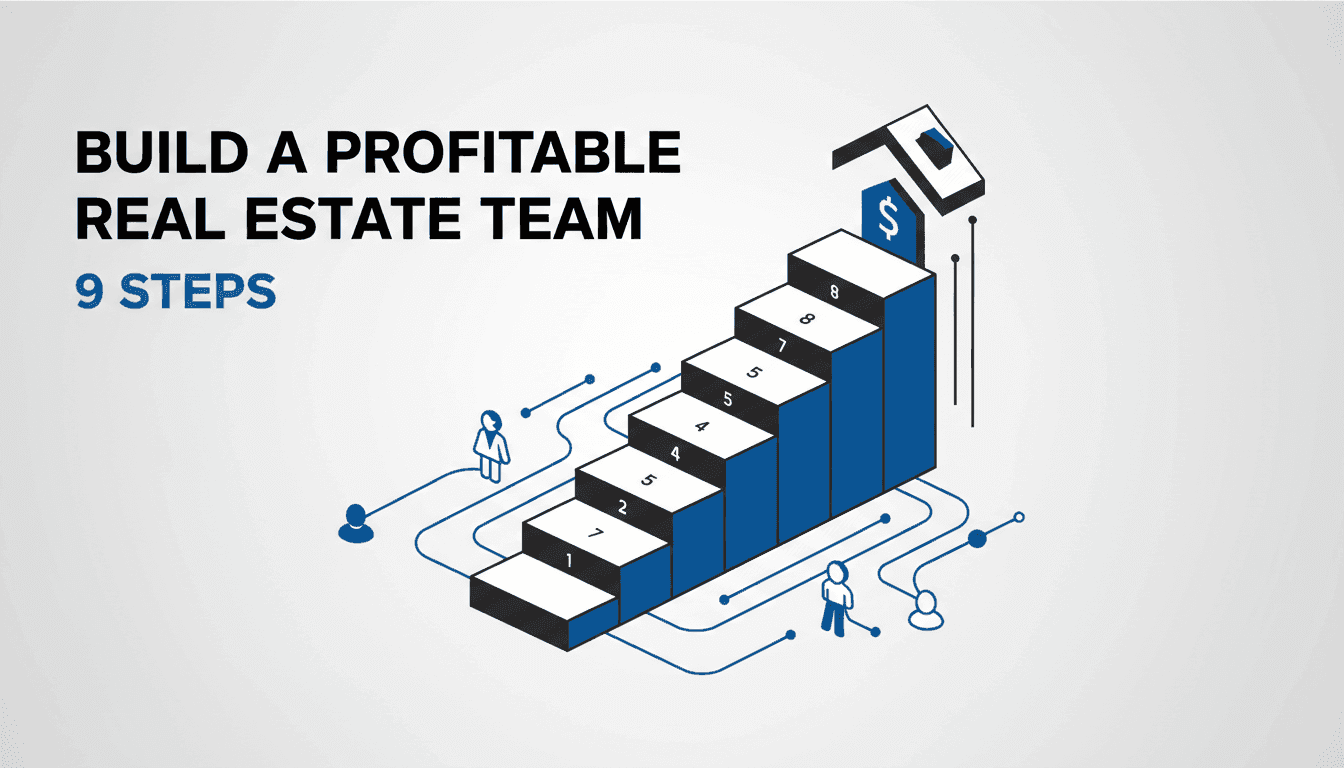
Over and over, we’ve seen that there’s a surprisingly clear, 9‑step path from solo agent to team leader. If you follow it in order—and resist the temptation to skip steps—you can build a rockstar real estate team without burning yourself out or destroying your margins.
In this guide, we’ll walk through exactly how to build a real estate team in 9 steps, covering vision, structure, systems, recruiting, compensation, lead generation, KPIs, and how to design your own exit from day‑to‑day production.
Step 1: Decide If You’re Really Ready to Start a Real Estate Team
Before you Google “how to start a real estate team” and post your first recruiting ad, you need to be brutally honest: are you actually ready for leadership?
The agents who build sustainable, profitable teams almost always share a few things in common:
- They’ve already mastered personal production, especially listings.
- They have a predictable lead‑generation system, not just random referrals.
- They run their business on a real schedule—skills, prospecting, follow‑up, appointments.
- They track their numbers daily and can tell you their contacts, appointments, and conversion rates.
Before building a real estate team, your own business should work without heroics. For many top producers, that looks like:
- Consistently generating 2–3 listing appointments per week.
- Taking around 1 new listing per week when focused.
- Closing in the neighborhood of 40–50 deals per year or more.
If you can’t reliably generate business for yourself, you’re not ready to generate enough for a team. You’ll just end up giving away business you don’t actually have.
Clarify Your “Why” and Long‑Term Vision
Being “busy” is not a good enough reason to start a real estate team. We like to get crystal clear on three questions up front:
- Why do we want a team? Healthy reasons include scaling past personal capacity, creating an asset that outlives our own production, or shifting into leadership. Red flags include “everyone else is doing it” or assuming a team will let us work less without changing anything about how we operate.
- What’s our long‑term vision? Do we want a lean, high‑producing local team that dominates a hyperlocal market? A multi‑market “teamerage” with expansion teams? Or a hybrid where we run a local production team and also build an organization or revenue‑share group beyond it?
- What’s our time and risk tolerance? Are we willing to take on salaries, bigger office space, and heavy lead spend, or do we want a low‑overhead, lean model where we provide training, systems, and some leads but avoid big fixed costs?
Write down your answers in a short vision statement. It doesn’t need to be fancy; a couple of honest paragraphs will become the foundation for your future real estate team structure, commission splits, recruiting strategy, and eventual exit plan.
Step 2: Map Out Your Real Estate Team Vision, Goals & Model
“Team” is one of the vaguest words in the industry. To build a world‑class real estate team, we first define exactly what kind of team we’re building, and where it needs to be in 2–3 years.
Choose Your Real Estate Team Model
There are three broad models we see most often:
- Local Production Team We generate local leads, provide systems and operations, and our agents work those leads in exchange for a split. This is the classic “rainmaker” or team leader model.
- Organization / Revenue‑Share Style Team We attract agents to a brokerage or platform where our income comes from revenue share rather than local commission splits. The focus is on training, masterminds, and recruiting, not on feeding agents daily leads.
- Hybrid Team Model We run a local, top‑producing real estate team and build a broader organization around it. Over time, this gives us both team overrides and leveraged income beyond local transactions.
Each model will change:
- Your real estate team structure.
- Who you recruit and how you position your value proposition.
- How you set up commission splits and compensation.
- What systems and staff you absolutely must have in place.
Set Clear, Measurable Real Estate Team Goals
Once we’ve chosen our basic model, we like to set 12‑ to 36‑month targets that line up with our “why.” For example:
- Production goals: “We want to go from 40 solo transactions to 120 team transactions in 3 years, with at least 60% of volume coming from listings.”
- Profitability goals: “We’ll maintain at least 25–30% net profit at the team level after splits, salaries, and marketing.”
- Team size goals: “Within 24 months, we want 1 full‑time admin, 1 TC, 2 buyer’s agents, 1 listing agent, and 1 ISA.”
When we’re clear on the real estate team goals and model, every later decision—who we hire first, how we pay them, how we structure lead generation—gets a lot simpler.
Step 3: Choose the Right Team Structure and First Hires
Now we start designing the actual real estate team structure. Our mantra here is simple: roles before people. We sketch the team we need on paper first, then plug real humans into that org chart as we grow.
Common Real Estate Team Structures
- Traditional Small Team The team leader (often the rainmaker) focuses on listings and big relationships. They’re supported by an administrative assistant and a transaction coordinator, plus 1–3 buyer’s agents.
- Lead Team Model Heavy focus on online lead generation (PPC, portals, SEO). This model usually includes one or more ISAs, several buyer’s agents, strong admin support, and a very metrics‑driven culture.
- Mentor/Mentee Real Estate Team Experienced agents mentor newer agents under the team’s umbrella. The team’s value is training, scripting, and systems, sometimes with modest lead flow.
- Teamerage / Expanded Team Model The team behaves like a mini‑brokerage: strong brand, operations, systems, often multiple locations or expansion teams. Splits may be lower for agents but value provided is higher and more scalable.
Plan Your First Key Roles and Hiring Order
The temptation is to hire a buyer’s agent before anything else. We’ve found that’s almost always backwards. To build a sustainable real estate team, we typically follow this order:
- Administrative Assistant / Transaction Coordinator This can start as a part‑time TC getting paid per file ($300–$400 per closing in many markets), then grow into a full‑time admin as your production passes ~30–40 deals per year. They handle paperwork, email, MLS input, scheduling, and contract‑to‑close details so you can focus on lead generation and appointments.
- Showing Assistant (Optional but powerful) Before hiring a full buyer’s agent, bringing on a showing assistant gives you leverage without giving up the client relationship. They handle property tours while you control pricing, contracts, and negotiations. Over time, this person can graduate into a full buyer’s agent once they prove they’ll prospect and follow systems.
- Buyer’s Agent Once you’re consistently generating more buyer leads than you can handle—especially those coming off your listings—you bring on a buyer’s agent to handle consults, showings, offers, and negotiations for assigned leads.
- Inside Sales Agent (ISA) As your database and team lead generation grow, an ISA (or two) becomes critical for conversion. They live on the phones, nurture long‑term leads, and set listing and buyer appointments for the sales team.
- Listing Agent Down the line, once your listing volume is high and you’re moving into full‑time leadership, you may bring on dedicated listing agents to handle most seller appointments.
We build a simple org chart that might look like: Team Leader → Admin/TC → Buyer’s Agent → ISA → Listing Agent → Marketing Specialist. That’s our real estate team structure roadmap for the next 3–5 years.
Step 4: Define Real Estate Team Roles, Responsibilities & Commission Splits
Once we know which roles we need, we define them clearly—in writing. Ambiguity is the enemy of a high‑performing real estate team.
Real Estate Team Roles and Responsibilities
For each role on our team, we spell out three things:
- Core responsibilities – What they own day to day.
- Key activities – What they should actually do hourly/daily.
- Success metrics – How we’ll measure if they’re winning.
Examples:
- Buyer’s Agent Responsibilities: Handle buyer consultations, tours, offers, and negotiations; prospect daily; update CRM. Key activities: Contacts per day, appointments set, showings, offers written. KPIs: Conversion rate from appointment to contract, contract to close, and GCI generated.
- Inside Sales Agent (ISA) Responsibilities: Prospecting, lead follow‑up, database nurturing, appointment setting. Key activities: Contacts per day, hours on the dialer, appointments set for agents. KPIs: Contacts‑to‑appointment ratio, appointments‑to‑agreements signed.
- Admin/TC Responsibilities: Listing coordination, contract‑to‑close, document compliance. Key activities: Checklist completion, deadline tracking, client updates. KPIs: Error rate, on‑time closings, client satisfaction, agent satisfaction.
Real Estate Team Commission Splits & Compensation
The real estate team commission split you choose will drive behavior, retention, and profitability. We anchor our compensation models on two questions:
- What value are we actually providing? Leads, systems, admin support, TC, ISA, brand, office space, marketing?
- What behaviors do we want to incentivize? Prospecting, listings, price points, teamwork, referrals?
Common, fair real estate team compensation structures include:
- Different splits for team‑generated vs. self‑generated leads For example, 50/50 or 60/40 on team leads, and 70/30 or 75/25 on SOI/past client business, depending on support provided.
- Tiered commission splits based on production As agents hit higher GCI tiers, they earn slightly stronger splits within agreed ranges. This keeps top producers from feeling capped while protecting team profit.
- Salaries and bonuses for operations roles Admin, TC, ISA often receive a base salary or hourly rate plus production or performance bonuses (e.g., per closing, per appointment set).
Whatever we choose, we keep the real estate team commission split model simple and transparent so agents can easily understand exactly how they get paid—and so we can clearly project profitability.
Step 5: Build the Systems, SOPs & Tech Stack Your Real Estate Team Runs On
This is where many teams either become world‑class or implode. People without systems create chaos; systems without people can always be improved. So we build core real estate team systems and SOPs before we scale headcount.
Real Estate Team SOPs and Processes
We document simple, step‑by‑step standard operating procedures for:
- Lead generation & intake How leads enter the CRM, how quickly we respond, who owns which lead types, and what happens in the first 5 minutes.
- Lead follow‑up & nurturing Clear follow‑up cadences for new, nurture, hot, and past‑client leads; call/text/email templates; and scripts.
- Buyer process From first contact to closing: buyer consultations, showing expectations, offer process, inspection and appraisal management, and communication standards.
- Seller process Pre‑listing prep, pricing strategy, listing presentation, marketing plan, showing feedback, and offer negotiation.
- Transaction management Contract‑to‑close checklists for buyers and sellers: who does what, and by when.
- Marketing & branding Listing marketing checklist, brand guidelines, social and email marketing workflows.
- Recruiting & onboarding How we source, interview, and onboard new agents and staff.
These SOPs don’t need to be perfect or complicated. We’ve started with a single shared Google Doc or Notion “team wiki” and iterated. The key is that everyone can see “this is how we do things here” in writing.
Real Estate Team CRM & Tech Stack
Your CRM is the backbone of your real estate team operating system. At minimum, it should support:
- Lead capture and routing.
- Contact tagging and segmentation.
- Task and follow‑up reminders.
- Pipeline stages for buyers and sellers.
- Team dashboards and real estate team KPIs.
Beyond the CRM, our basic real estate team tech stack usually includes:
- A transaction management platform (for documents and deadlines).
- An email marketing system for newsletters and nurture campaigns.
- A simple project management tool for team projects (training, events, big listings).
- Internal communication tools like Slack or Microsoft Teams.
The goal: when a new agent joins, the systems themselves tell them exactly what to do with every new lead and every deal.
Step 6: Recruit, Interview & Onboard High‑Caliber Real Estate Team Members
Now we’re finally ready to recruit. At this point, our real estate team vision, structure, roles, systems, and compensation are clear. That lets us recruit intentionally, instead of hiring out of desperation.
Real Estate Team Recruitment: Who We Look For
Strong real estate team members typically share a few qualities:
- Cultural fit – They genuinely buy into our core values around client service, ethics, accountability, and teamwork.
- Coachability – They’re willing to practice scripts, follow SOPs, and accept feedback.
- Work ethic – They’ll prospect when they don’t feel like it, show up to roleplay, and track their numbers.
- Complementary strengths – We often use simple personality tests (DISC, etc.) to balance our team (e.g., pairing big‑energy extroverts with organized, analytical types).
For our first producing hire, we almost always prefer someone with at least a bit of a track record (in real estate or another performance‑based field) rather than a brand‑new licensee. Once our team systems and training are dialed, we can successfully bring new agents through a solid mentor/mentee or ISA‑to‑agent path.
A Simple, Smart Hiring Process
We keep our recruitment process structured:
- Initial screening – Quick phone or Zoom interview focused on goals, values, and work history.
- Full interview – Deeper dive into production history, prospecting comfort, problem‑solving scenarios, and expectations about accountability and splits.
- Assessment – Basic personality profile plus, when applicable, a simple skills test (e.g., mock buyer consult or handling a basic objection).
- Team fit conversation – Introductions to key team members to check chemistry and expectations on both sides.
We’re looking for people excited about a real estate team environment—not agents who just want us to hand them warm leads while they wing every script.
Onboarding New Real Estate Team Members
A world‑class real estate team doesn’t throw new hires a login and say “good luck.” We build a structured onboarding and training plan, usually in a 30/60/90‑day format:
- First 30 days: Orientation to systems and SOPs, heavy script practice, CRM training, shadowing on appointments, and clear daily activity targets.
- Day 30–60: Begin taking leads under close supervision, continue roleplay, attend weekly team meetings, hit minimum contacts and appointment‑set goals.
- Day 60–90: Take greater ownership of pipeline, manage deals with oversight, and begin working toward full production standards.
We also assign a mentor or senior agent for each new hire and hold short, regular check‑ins to make sure they’re on track and supported.
Step 7: Train, Mentor & Hold Your Real Estate Team Accountable
Once we have people in place, our role shifts more into leadership: training, coaching, and accountability. Training isn’t a bonus on a real estate team—it’s the product.
Real Estate Team Training Program
We build a predictable training rhythm so skills compound over time:
- Daily: Script and roleplay practice (30–60 minutes). We focus on listing presentations, buyer consults, objections, and price‑reduction conversations.
- Weekly: Team meeting with a training segment, plus a pipeline review where we solve live deal problems together.
- Monthly: 1:1 meetings to review each agent’s real estate team KPIs, upcoming goals, and any roadblocks.
- Quarterly: Business planning and goal‑setting sessions, plus deeper training on topics like negotiations, marketing, or investment property analysis.
We treat training the same way we treat lead generation: it’s a non‑negotiable block on the calendar, not something we squeeze in “if we have time.”
Accountability & Real Estate Team KPIs
To build a high‑performing real estate team, accountability has to be part of the culture. We keep it simple and data‑driven by tracking:
- Leading indicators: contacts, conversations, appointments set, new leads created, database touches.
- Lagging indicators: listings taken, buyers under contract, closings, GCI, average sale price, and conversion rates at each step.
Every agent knows their minimum standards—contacts per day, appointments per week, response times—and we review these consistently, not just when someone is struggling. If someone can’t or won’t meet the basic standards, we address it quickly and directly to protect the rest of the team.
Building a Real Estate Team Culture of Success
Real estate team culture is simply “how we do things around here.” We anchor it with a few non‑negotiable core values, such as:
- Radical honesty with clients about price and strategy.
- Ownership and responsibility—no blaming, no victim thinking.
- Continuous improvement—skills practice, feedback, and growth.
- Collaboration over ego—we win together.
We reinforce these values through who we hire, how we pay, what we celebrate, and what we refuse to tolerate. That’s how we avoid the revolving‑door problem and create a real estate team environment where people stick and grow.
Step 8: Generate, Distribute & Convert Leads as a Real Estate Team
Lead generation is the lifeblood of any real estate team. Once systems, roles, and training are in place, our primary job as a team leader is to keep a steady, predictable flow of leads coming in and being worked properly.
Real Estate Team Lead Generation Strategy
We like to diversify real estate team lead generation across several channels so we’re never dependent on a single source:
- Listings‑based lead gen – Expireds, FSBOs, circle prospecting, past clients and sphere, open houses.
- Online lead sources – Google PPC, Facebook/Instagram ads, portal leads, SEO content (neighborhood guides, market updates, videos).
- Database & referral business – Quarterly client events, email newsletters, birthday and home‑anniversary touches, VIP programs.
- Strategic partnerships – Lenders, attorneys, financial advisors, builders, investors, relocation companies.
We design our real estate team marketing plan so every listing is a mini‑marketing campaign that can generate buyers, more sellers, and reputation in the community.
Lead Distribution and ISA Systems
With more people in the mix, we put clear rules around:
- Who gets which leads – Round‑robin, performance‑based, role‑based, or a mix.
- How quickly leads must be responded to – Measured in minutes, not hours.
- When a lead is considered unworked and goes back into the pond.
Our ISA (inside sales agent) team typically handles new inbound web and PPC leads, long‑term nurture, old database reactivation campaigns, and setting listing and buyer appointments for field agents. This is a major leverage point for conversions on a high‑volume real estate team.
Real Estate Team Branding & Marketing
We also treat the team as a brand, not just a loose group of agents. That includes:
- A consistent brand identity (name, logo, colors, tone).
- A real estate team website built to generate and capture leads, not just look pretty.
- Consistent content—market updates, neighborhood spotlights, social proof—to support hyperlocal domination in our core markets.
Agents benefit from a strong brand that’s bigger than any one person, and the brand benefits from agents who represent it professionally and consistently.
Step 9: Track KPIs, Optimize Performance & Scale Your Real Estate Team Profitably
The final step is ongoing: turning your new real estate team into a consistently profitable, scalable business. That means we’re no longer guessing—we’re managing by numbers and adjusting quickly when reality doesn’t match the plan.
Key Real Estate Team KPIs to Track
At both the team and individual levels, we track:
- Marketing & lead gen metrics: Leads per source, cost per lead, cost per closing, ROI by campaign.
- Sales activity metrics: Contacts per day, appointments set, appointments met.
- Pipeline & conversion metrics: Listings taken, buyers under contract, close rates at each stage.
- Financial metrics: GCI, team profit margin, average sale price, and agent net income ranges.
- Client experience metrics: Online reviews, repeat/referral ratio, NPS (Net Promoter Score).
We use CRM dashboards and simple scorecards to keep these KPIs visible to everyone. This makes coaching much simpler: instead of “you’re not doing well,” we can say “your contacts are good, but your appointment‑set rate from those contacts is low—let’s work your script.”
Optimize, Pivot, and Design Your Exit
With data in hand, we review regularly:
- Monthly: Lead sources: which to scale, which to pause. Agent performance: who needs support, who’s ready for more responsibility.
- Quarterly: Real estate team commission splits and comp models: are they still fair and profitable? Team structure: do we need another admin before another agent? Any role confusion that needs to be cleaned up?
- Annually: Big‑picture strategy: Are we on track with the 2–3‑year vision we set? Do we want to push for more markets, more agents, a leaner but higher‑producing team, or start transitioning more into investments and organization growth?
Ultimately, the goal of a real estate team is to buy back your time and build wealth, not to create a bigger, more stressful job. As your leaders and top agents step up, you can gradually step out of buyers, then most listings, and eventually run your team as a true business—supported by systems, world‑class people, and a clear, data‑driven operating system.
From Solo Agent to Real Estate Team Leader: Your 9‑Step Blueprint
When we lay it out, building a profitable real estate team in 9 steps looks like this:
- Decide if you’re ready to start a real estate team – Master your own production, schedule, and numbers first.
- Map out your vision, goals & model – Choose between local production team, organization, or hybrid, and set your “money rules.”
- Choose the right team structure & first hires – Start with admin/TC and showing assistant before piling on agents.
- Define roles, responsibilities & commission splits – Get clear on who does what, how success is measured, and how everyone gets paid.
- Build systems, SOPs & tech – Document lead gen, follow‑up, listing, buyer, and transaction processes in a real estate team playbook.
- Recruit, interview & onboard high‑caliber people – Hire for culture and coachability, then give them a real 30/60/90‑day plan.
- Train, mentor & hold the team accountable – Make scripts, skills, and KPIs part of the daily and weekly rhythm.
- Generate, distribute & convert leads as a team – Build diversified lead sources, clear lead routing, and strong ISA support.
- Track KPIs, optimize, and scale profitably – Use numbers to make decisions, protect margins, and design your long‑term exit.
If you want to turn this into a concrete real estate team roadmap, jot down where you are right now—annual deals, GCI, market type, and whether you have any current support—and you can plug yourself into each of these 9 steps with specific targets and timelines.