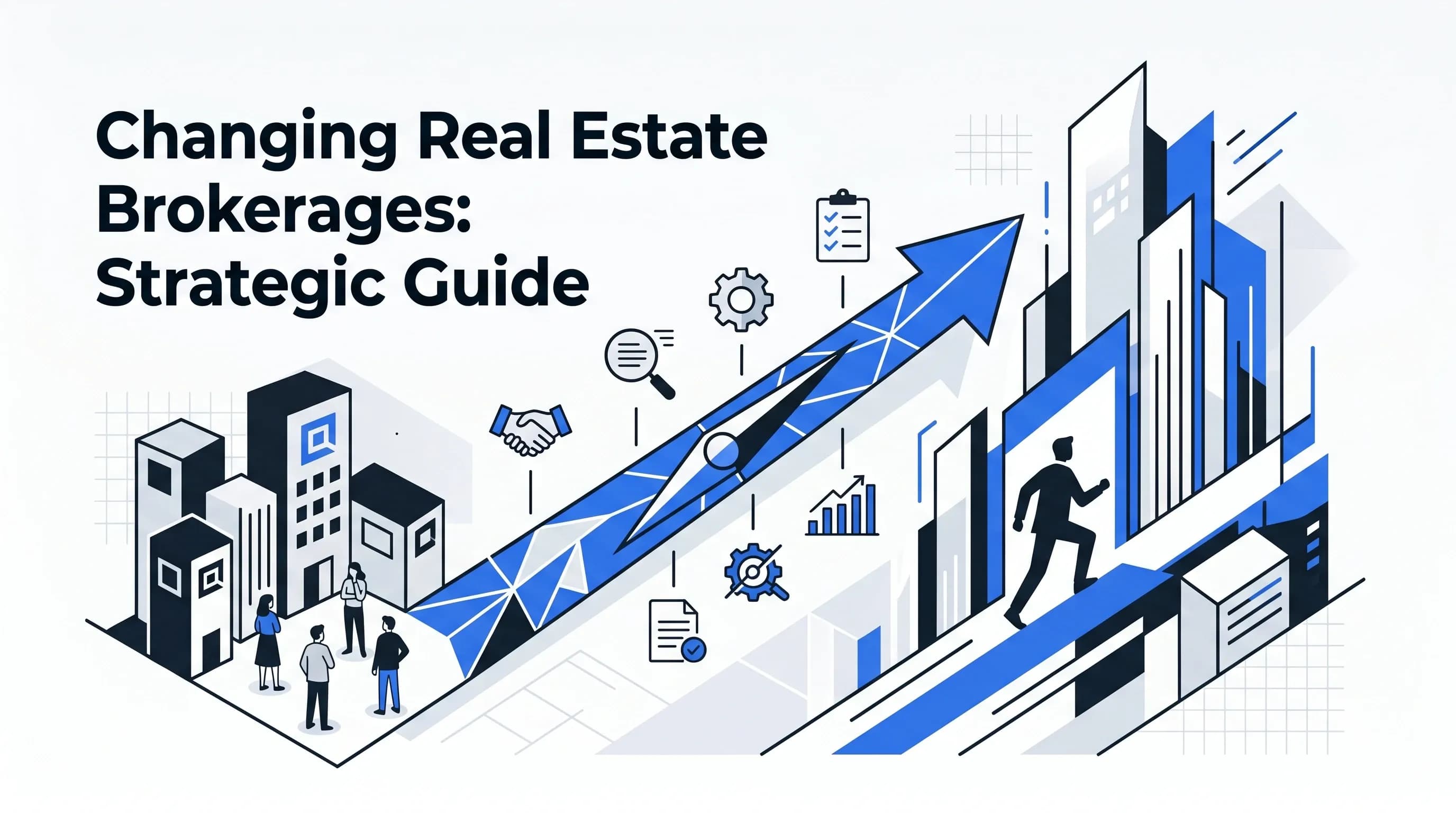
Changing real estate brokerages is one of the biggest business decisions we can make as agents. When we do it well, a brokerage transition can improve our income, support, technology, autonomy, brand alignment, and long-term growth. When we do it poorly, it can create stress, disrupt pending deals, confuse clients, and damage relationships we may need for years.
The good news is that switching real estate brokerages is common. It is not unusual, and in most markets it is completely manageable when we approach it with a plan. The key is to treat the move like a business decision, not just a paperwork task or an emotional reaction.
That mindset matters because a brokerage is a platform we operate on, not our identity. A great brokerage can absolutely help us grow faster, support us better, and give us stronger systems. But simply changing signs will not fix weak habits, poor follow-up, or inconsistent lead generation. At the same time, staying in the wrong place can absolutely hold us back. So the real goal is not to find the “best” brokerage in the abstract. It is to choose the best fit for the business we are trying to build.
In this changing real estate brokerage guide, we’ll walk through how to switch brokerages as a real estate agent, how to evaluate a new firm, how to protect our clients and pipeline, and how to make the move without burning bridges.
Yes. In most jurisdictions, a real estate agent can switch brokerages, and many do. Some agents move early in their careers as they discover what kind of training, mentorship, and accountability they really need. Others change real estate companies later, after outgrowing a model that once worked well.
Because many agents are independent contractors rather than employees, we usually have the right to choose where to affiliate our license. But that does not mean we should leave casually. Our current independent contractor agreement, brokerage agreement, and local regulations may still control important parts of the transition process.
Before we switch real estate brokerages, we need to understand items such as:
So yes, we can switch brokerages as a real estate agent. But we should do it deliberately, with our eyes open.
A real estate brokerage is the licensed entity under which we conduct business. In most places, we cannot legally represent buyers and sellers without being affiliated with a licensed broker.
A brokerage may provide:
But not all brokerages are built the same. Some are small independents. Some are large franchises. Some are cloud-based brokerages built around low overhead and high autonomy. Some are highly supportive and agent-centric. Others are more broker-centric, with rigid policies that put the office brand ahead of the agent brand.
That distinction matters more than many agents realize. If we want to build a strong personal brand, control our real estate business, and market ourselves prominently, we need to know how much flexibility a brokerage really gives us. The consumer usually hires us, not just the logo behind us. That is why changing brokerages is not just an administrative move. It is a strategy decision.
Most agents do not wake up one morning and randomly decide to leave. Usually the reasons build slowly. If we are asking, “Is it time for a change?” there is often a deeper business issue behind that question.
One of the most common reasons agents switch brokerages is frustration with the compensation model. We may feel that the commission split, transaction fees, desk fees, monthly fees, franchise cuts, or office dues no longer make sense relative to the value we receive.
This becomes especially clear as production grows. A structure that felt acceptable when we were new can feel expensive once we are closing more business and realizing how much we are giving up.
Many agents join a brokerage because of promises around training, coaching, mentorship, and broker availability. Then they discover the support was mostly part of the recruiting pitch. If we need practical help with live deals, contracts, scripts, listing presentations, objection handling, or prospecting accountability, theoretical training is not enough.
This is especially important for newer agents. It is very hard to thrive in total isolation. The right environment can accelerate learning dramatically.
Culture sounds soft, but it creates hard results. The office environment affects our confidence, urgency, standards, collaboration, and belief in what is possible. If the culture feels negative, cliquey, political, stagnant, or overly controlling, it can quietly drag down our production.
On the other hand, an energetic, productive, collaborative culture tends to raise performance. Energy breeds energy.
Today’s real estate business depends heavily on technology. If our brokerage has weak CRM tools, clunky transaction systems, outdated marketing support, poor automation, or limited mobile functionality, that can slow us down every single day.
Technology is no longer optional. It is infrastructure.
Sometimes a brokerage was a good fit for one season, but not for the next. We may have outgrown the training, brand positioning, mentorship, team structure, or overall vision. A move can make sense when the environment no longer supports the next version of our business.
Some brokerages push agents into rigid models, control marketing too tightly, route sign calls away from the agent, or prioritize the office brand over the agent’s business. If our long-term goal is to build a recognizable personal brand, this can become a major reason to move brokerages.
When deals get messy, we need fast access to broker support. If the broker of record is hard to reach, disengaged, or inexperienced in real production, that is a real risk. The same is true if we see repeated concerns around compliance, advertising, lead distribution, listing practices, or ethics. Our reputation is tied to the firm we work under.
Not every frustration requires a brokerage switch. Sometimes the problem is structural. Sometimes it is temporary. And sometimes the uncomfortable truth is that we are hoping a new brokerage will solve problems that are actually rooted in our own execution.
Before making the move, we should ask ourselves:
That last question is powerful. Often we are choosing between the short-term pain of change and the long-term pain of regret. A brokerage change should not be impulsive, but discomfort alone is not a reason to stay.
If we decide to leave our current brokerage, the next step is finding the right new brokerage. This is where many agents make a mistake: they focus only on the headline split. That is too narrow.
We should evaluate the full value proposition, including compensation, culture, technology, lead generation, support, branding freedom, and long-term fit.
We need to understand exactly how the brokerage gets paid and what we keep. That means looking beyond the advertised split.
A smart approach is to run our last 12 months of production through both models side by side. Not emotionally. Mathematically. Then compare what we actually net and what support we gain or lose.
We should ask what support actually looks like in practice, not just in recruiting language.
When a transaction gets complicated, we want someone who can help problem-solve, not just quote policy.
We are joining an environment, not just a pay plan. We should speak privately with current agents when possible. Ask whether the culture is collaborative or siloed, positive or cynical, energetic or flat. Look for evidence that agents genuinely advocate for the brokerage rather than simply tolerate it.
This is one of the most useful ways to compare brokerages. An agent-centric model tends to support our personal brand, marketing freedom, and autonomy. A broker-centric model often prioritizes office control, company-first branding, and lead capture by the brokerage.
We should ask:
Many brokerages talk about support, but we should ask a more precise question: how exactly does this brokerage help agents get clients? There is a big difference between branding support and actual opportunity creation.
We should ask about:
Productivity is one of the best indicators of brokerage effectiveness. Not the office décor. Not the recruiting script. We want to know whether agents actually produce more there.
Technology should be evaluated as seriously as commission. We should review the actual tools included:
Just as important, we should ask who owns the CRM data, website, and leads. If we leave later, can we take our systems with us? Low cost alone is not a strategy. Sometimes paying more for better systems creates far more income.
Even in a digital-first world, office presence and brand reputation still influence consumer perception. A visible, respected brand can help us in listing presentations and client trust-building. But we also need to consider whether the brand supports us or overshadows us.
Strong listing inventory and meaningful local market share can also create momentum by giving us more open house opportunities, more brand visibility, and better social proof.
Many agents start changing brokerages because they want a better economic model. That often leads to comparing traditional split firms, flat-fee brokerages, and 100% commission brokerages.
In a traditional model, the brokerage takes a percentage of each commission.
Pros:
Cons:
In a flat-fee model, we typically pay a predictable monthly fee, a per-deal fee, or both, rather than giving up a large split.
Pros:
Cons:
A 100% commission brokerage generally allows us to keep all or nearly all earned commission, with fees replacing the standard split.
Pros:
Cons:
The best option depends on our stage of business. A 100% split is not automatically better if we are isolated, undertrained, and closing less. Value matters more than headline price.
Before we announce anything, we need to review our current independent contractor agreement carefully. This is one of the most important steps in any changing real estate brokerage guide.
Look for clauses related to:
We should not assume we know the rules based on what someone told us when we joined. If anything is unclear, it is worth speaking with a qualified attorney or our local regulatory body. It is far easier to clarify upfront than fight later.
One of the biggest practical risks in a brokerage switch is losing access to brokerage-owned systems quickly, sometimes within hours of giving notice. This is where many agents get caught off guard.
We may lose access to:
That is why we should back up legally permissible information before resigning. This must be done ethically, in compliance with our agreement and privacy rules, but it is essential to protect our pipeline and continuity.
Depending on what we own and are allowed to retain, that may include:
This is also why it is wise, long term, not to build our entire business on brokerage-owned assets. Owning our own domain, business email, and brand assets makes future transitions much easier.
Timing can make a major difference when we switch real estate brokerages. Even if the paperwork is simple, the wrong timing can complicate closings, listings, client communication, and commission handling.
Before making the move, we should assess:
Many agents prefer to complete certain active transactions before leaving, especially if listing ownership clearly belongs to the current brokerage. Choosing the right time helps preserve client confidence and reduce friction.
This is often the most complicated part of switching real estate brokerages. It is also where professionalism matters most.
In many cases, transactions already under contract will remain with the current brokerage and close there. Our contract should explain how commissions are paid in that scenario.
Listings are often owned by the brokerage, not the agent. That means we may not be able to simply move them to the new firm. In some situations, a transfer may be possible, sometimes with a fee, referral arrangement, or formal cancellation and re-listing process. But we need to verify the rules first.
If a buyer wants to continue working with us after the move, a new buyer representation agreement may be needed under the new brokerage, depending on local rules.
If a seller wants to continue with us, the listing agreement may need to be canceled and re-executed under the new brokerage. That can involve legal, practical, and timing issues. Our first responsibility is to handle the situation in a way that protects the client.
The principle is simple: clients should not become collateral damage in our brokerage transition.
For many agents, this is the most emotionally difficult step. But it does not have to be dramatic. In fact, the best approach is usually calm, direct, and respectful.
Best practices include:
Some brokers will be gracious. Some may become defensive. Some may make a counteroffer with a better commission split or more support. If that happens, we should think carefully. If important support only appears once we threaten to leave, that tells us something too.
After the conversation, we should send written notice confirming:
Real estate is a relationship business, and reputations travel fast. One of the strongest themes in top-ranking content is how to switch real estate brokerages without burning bridges, and for good reason.
A clean exit protects:
To leave professionally, we should:
We can be firm about our decision without creating unnecessary conflict. This is a business move, not a war.
Once we have aligned the move with the new brokerage, the next step is to transfer our license affiliation according to local rules. This varies by jurisdiction, so we must follow the official process required by our licensing authority.
Examples include:
Other areas may use a state real estate commission portal, DRE forms, MyWeb, or board-specific systems.
Common compliance tasks include:
We should not publicly represent the new brokerage until the transfer is complete and approved.
Once the move is official, there is a surprisingly long list of items to update. This is where organization helps us hit the ground running instead of creating confusion.
This part can affect lead flow immediately. Old links, outdated email addresses, and stale brokerage references can cost opportunities fast, so it is worth updating them right away.
We should wait until the license transfer is complete before making a public announcement. Once the switch is official, we can share the move with past clients, prospects, referral partners, fellow agents, and our database.
The message should be:
Good announcement angles include:
For top clients and important referral partners, personal calls are usually better than a mass social media post. We should also prepare a short explanation of the move in 30 seconds or less so we can communicate it consistently.
This is one of the most common fears agents have. In many cases, clients are loyal to the relationship more than the brokerage brand. They chose us because of trust, communication, expertise, and service.
Still, we should never assume loyalty. To protect client relationships, we should:
Handled correctly, changing brokerages does not have to cost us business. In some cases, it even strengthens our personal brand because it shows we are serious about growth and service quality.
Before we join a new real estate brokerage, we should ask detailed questions. The more specific we are, the better decisions we make.
If we are considering a flat-fee brokerage or 100% commission brokerage, we should also ask exactly what support is reduced, if any, and what hidden fees might still apply.
Once the move is complete, we should treat the new brokerage as a starting point, not the finish line. A brokerage switch can create momentum, but only if we use the platform well.
To start strong, we should:
This is also where we should remember an important reality check: changing brokerages will not save us if we are not doing the work. A better environment can help. Better systems can help. Better training and culture can help. But we still need discipline, follow-up, prospecting, and consistent execution.
While the overall brokerage transition process is similar in many places, the exact mechanics depend on local law and regulator procedures. That means we should always verify the official process with the state real estate commission, licensing authority, council, or board in our area.
Examples often referenced include DBPR in Florida and RECO in Ontario, but our local process may be different. We should never rely only on recruiting materials or verbal assurances when compliance is involved.
Changing real estate brokerages can be one of the smartest moves of our career if we handle it with planning, professionalism, and clear business logic. The best brokerage for us is not automatically the biggest, cheapest, or most famous. It is the one that matches the business we want to build.
When we make the switch strategically, we protect our client relationships, preserve our reputation, keep our pipeline intact, and create a smoother path toward long-term success.
If we remember the essentials, the process becomes much more manageable:
A well-executed brokerage switch should not feel like chaos. It should feel like a strategic upgrade for a business owner who is choosing a better platform for growth.

Hey, in Propphy we're determined to make a business grow. My only question is, will it be yours?
It's totally free, with no commitments
Hey, in Propphy we're determined to make a business grow. My only question is, will it be yours?
It's totally free, with no commitments