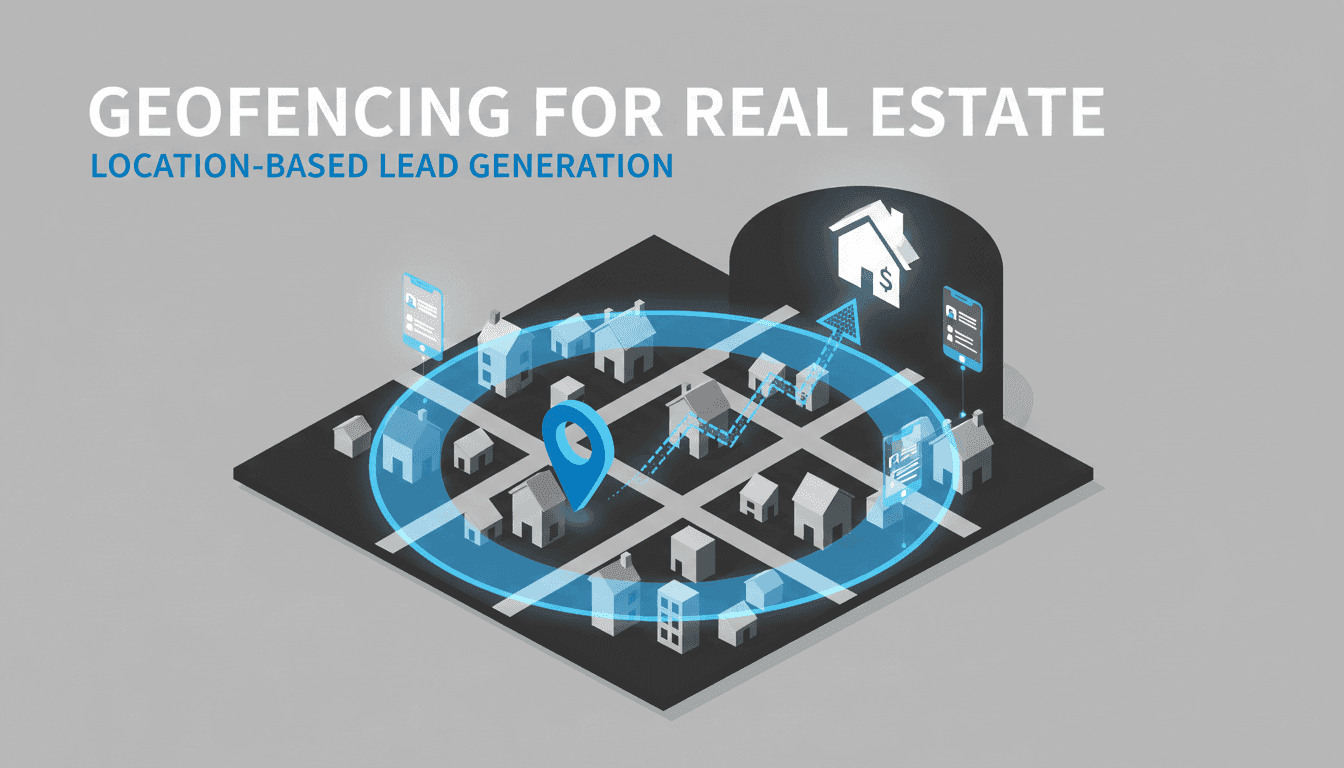
Geofencing for real estate takes the oldest rule in our industry—location matters—and bakes it directly into your marketing. Instead of guessing who might be interested in buying or selling, we target people based on where they actually go: open houses, new construction communities, apartment complexes, bank branches, and even competitor brokerages.
In this guide, we’ll walk through how real estate geofencing works in plain English, why it’s such a strong lead generation channel, and exactly how we’d use it if we were running a serious real estate business today.
What Is Geofencing in Real Estate?
Geofencing is a location-based marketing technology that lets us draw a virtual boundary—a “geo fence” or virtual perimeter—around a real-world place. When a smartphone with location services enabled crosses that boundary, its device ID is added to an audience. From there, we can serve highly targeted ads and messages to that device for days or weeks.
Typical geofencing locations in real estate include:
- Open houses and active listings
- New-construction communities and builder model homes
- Apartment complexes full of long-term renters
- Transitioning or gentrifying neighborhoods
- Banks, credit unions, and mortgage offices
- Competitor brokerages and new developments (geoconquesting)
- Specific households via addressable geofencing
Once a device enters that virtual fence, we can:
- Show mobile display ads in popular apps and websites
- Serve social media ads through custom audiences
- Trigger SMS, email, or app notifications (if we own the app/CRM)
- Track later foot traffic to a listing, model home, or office via “conversion zones”
How Real Estate Geofencing Works (Without the Jargon)
Under the hood, geofencing platforms rely on:
- GPS to determine the phone’s physical location
- Wi‑Fi & cellular data to improve accuracy indoors and in dense areas
- Advertising IDs (IDFA, AAID, app IDs) to recognize devices across apps
The basic flow looks like this:
- We define our fences. We draw circles or precise polygons around locations like open houses, apartment complexes, or competing brokerages using a geofencing platform.
- Devices enter the zone. When a smartphone with location services and opted-in apps crosses the virtual boundary, its anonymous advertising ID is captured.
- An audience is built. Those IDs are grouped into an anonymized audience that we can target across mobile apps, websites, and in many cases, connected TVs.
- Ads follow for days or weeks. We keep serving location-based ads to that device for a set duration (often 14–30 days), long after the user leaves the original location.
- We track conversions. Through conversion zone tracking and analytics, we see which geofenced audiences later visited our office, listings, or landing pages—and which turned into qualified leads.
If you’ve ever walked into a big-box store and immediately gotten a promo in their app, or visited a model home and then saw builder ads “follow” you around the web, you’ve experienced geofencing marketing in action. We’re simply applying that same location-based advertising power to generate real estate leads.
Geofencing vs Geotargeting: Why the Difference Matters for Agents
People constantly mix up geofencing and geotargeting, but for real estate advertising the distinction is crucial.
Geo-Targeting (Broad Location-Based Advertising)
- Think: “show my ads to people within 10–25 miles of this city or ZIP code.”
- Great for broad real estate marketing campaigns and brand awareness.
- Uses city, ZIP, or radius targeting plus demographic/interest filters (where allowed).
- Example: a city-wide campaign to build brand awareness as the local authority in your market.
Geofencing (Hyperlocal, Behavior-Driven Targeting)
- Think: “add people to my audience if they physically step inside this open house, this apartment complex, this bank branch, or this competitor’s sales office.”
- Hyperlocal targeting down to a single building or precise polygon fencing.
- Triggers audiences and ads based on real-time entry/exit from small zones.
- Example: targeting everyone who visits a specific new-construction community this month.
In practice, the strongest real estate geofencing strategies layer both:
- Use geotargeting for wide local reach and brand building.
- Use geofencing to zero in on high-intent locations like open houses, banks, and transitioning neighborhoods for conversions and lead capture.
Why Geofencing for Real Estate Works So Well
Real estate is fundamentally about location and timing. Buyers, sellers, renters, and investors leave a trail of physical behavior that screams “I’m in the market”—they tour homes, visit bank branches, walk into builder models, attend housing expos, and spend time in specific neighborhoods.
Geofencing adds a real‑world timing layer to your marketing and lets us turn those behaviors into qualified leads at scale.
Hyperlocal Precision & Higher Intent
Instead of hoping a platform’s algorithm finds “people interested in real estate” within a 25-mile radius, we’re targeting:
- Visitors inside an open house this Saturday
- Renters living in a specific apartment complex near your farm
- Buyers physically touring a competitor’s new construction community
- Prospects walking into a bank or credit union to talk about loans
This is what we mean by location intelligence and hyperlocal precision: campaigns based on where people actually go, not just what they click on.
Better ROI and Reduced Ad Waste
Because we focus spend on high-intent micro-locations, we see:
- Less wasted budget on people nowhere near buying or selling
- More relevant impressions at the exact moment someone is thinking about real estate
- Click-through rates up to 2x higher than standard display campaigns
- Conversion rates (lead form fills, calls, appointments) up to 3x higher than broad targeting
Typical geofence advertising CPMs land somewhere between $4–$14 per 1,000 impressions for mobile display, which is often very competitive when you compare cost per lead to portal leads, print, or untargeted digital ads.
Increased Engagement, Brand Awareness & Trust
Because messages are timely and context-aware, people tend to engage more:
- “Just toured a home in [Neighborhood]? Here are three similar listings with bigger backyards.”
- “At the bank talking mortgages? Grab our first-time buyer guide tailored to [City].”
- “Nearby apartment renter? See how owning in [Area] compares to your current rent.”
This kind of hyperlocal real estate marketing builds brand recognition in the exact neighborhoods you want to dominate and positions you as the go-to expert with relevant neighborhood insights and market trends.
Actionable Location Intelligence
Over time, geofencing marketing for real estate gives us data we can’t get from any other channel:
- Which neighborhoods and listings generate the most foot traffic
- Which apartment complexes are packed with ready-to-buy renters
- Which competitor communities are attracting the most prospects
- Which geofenced zones correlate with the highest conversion rates and appointment rates
We can then refine our real estate marketing strategy, focus our farming, and reallocate budget toward the high-potential geographic zones that actually move the needle.
Top Geofencing Strategies for Real Estate Lead Generation
Let’s break down the most effective ways to use geofencing for real estate advertising—from residential agents and teams to builders, developers, and property managers.
1. Geofence New Construction Communities & Builder Sales Centers
New-construction communities are loaded with active buyers, many of whom are early in the process and haven’t committed to an agent or builder yet. That makes them prime territory for real estate geofencing campaigns.
How we use it:
- Draw precise polygon fences around multiple builder model homes and sales centers.
- Include nearby competing subdivisions so we can geoconquest their traffic as well.
- Retarget visitors for 14–30 days with:
- “Not working with an agent yet? Get a free new‑construction consult.”
- “Compare incentives and warranties across [Community A], [Community B], and [Your Community].”
- “New-build vs resale in [City]: which wins on price and appreciation?”
We route clicks to a high-converting landing page that:
- Shows available homes and virtual tours
- Explains builder incentives and lender credits
- Offers a clear lead capture: schedule a tour, request a list of upcoming releases, or download a buyer guide
2. Geofence Banks, Credit Unions & Mortgage Offices
People physically visiting lenders tend to be at a critical decision stage. They’re thinking about mortgages, refinancing, or tapping home equity—high-intent signals for both buyers and sellers.
What we do:
- Geofence local bank branches, credit unions, and mortgage companies near our farm areas.
- Serve ads focused on:
- Pre-approval and first-time buyer education
- Negotiation and contract expertise (for agents)
- Better loan structures or rate options (for lenders)
Example creative:
- “Just got pre-approved? See homes that match your budget in [Neighborhood].”
- “Talking refinance? Here’s what your home might really be worth right now in [Area].”
- “5 steps to get pre‑approved without wrecking your credit score.”
3. Geoconquest Competitor Brokerages & Real Estate Offices
Geoconquesting is using geofencing advertising around a competitor’s location to intercept and outmaneuver their traffic. In real estate, that often means targeting competing brokerages, franchise offices, or high-profile listing locations.
How we run geoconquesting campaigns:
- Draw tight virtual boundaries around competitor offices, parking lots, and flagship listings.
- Tag every device that walks in or lingers there.
- Show ads that position us as the more data-driven, tech-forward, or specialized option:
- “Before you sign that listing agreement, compare our marketing plan for [Neighborhood].”
- “See how our digital strategy generates more showings & offers in [City].”
- “Top-rated local team in [Area]—ask us about our average days-on-market vs the competition.”
This approach lets us win a share of their walk-in and referral traffic without awkward in-person poaching. We simply dominate the conversation online after the in-person visit happens.
4. Geofence Open Houses & Active Listings
Geofencing open houses and active listings is one of the simplest and most powerful starting points for agents and teams.
Step-by-step:
- Geofence your open house or listing for the duration of the event (and sometimes the full listing period).
- Capture every device that spends time inside or just outside the property.
- Retarget visitors with:
- Follow-up ads featuring photos, video tours, or 3D walk-throughs
- “Didn’t love that one? Here are three similar homes nearby.”
- “Price improvement” or “offer deadline approaching” alerts
We also frequently geofence other agents’ open houses in the same neighborhood:
- “Touring homes in [Subdivision]? Get a curated list of similar properties, including off‑market options.”
- “Our last 5 buyers in [Area] saved an average of $X—see how we negotiate.”
This approach turns every open house—ours or someone else’s—into a lead capture event, not just a one-time showing.
5. Engage Renters by Geofencing Apartment Complexes
Renters in the right price band are one of the best long-term pipelines for residential agents, builders, and lenders. Geofencing apartment complexes lets us engage them just as their leases and rent hikes become painful.
How we structure renter campaigns:
- Geofence larger apartment communities that match the income level and price range we’re targeting.
- Serve ads speaking directly to the rent-vs-own pain point:
- “Paying $2,000 in rent? You could own a home in [Area] for the same monthly cost.”
- “Stop throwing away rent—see first‑time buyer programs in [City].”
- “Free ‘Rent vs Own’ calculator: discover what you could buy right now.”
Clicks go to landing pages with:
- Rent vs own calculators
- First-time buyer checklists
- Starter-home listings filtered by their likely budget
- Simple lead capture: text, chat, or book a 15‑minute consult
This type of hyperlocal real estate farming is far more precise than blanketing an entire city with generic “stop renting” messages.
6. Include Transitioning & Gentrifying Neighborhoods
Transitioning neighborhoods—areas undergoing revitalization, new transit, or major developments—often attract investors, early adopters, and equity-conscious sellers. They’re perfect candidates for location-based real estate marketing.
Our approach:
- Use polygon fencing to draw virtual boundaries around specific blocks or corridors undergoing change.
- Layer additional fences around:
- New transit stops
- Renovation clusters
- Major new commercial projects
- Run separate creative for different segments:
- Investors: “Cap rates and rent comps in [Neighborhood]. See why investors are moving in.”
- Owner-occupants: “Get ahead of price growth in [Area]—buy here before everyone else does.”
- Sellers: “Homes near [Project] are selling fast. Find out what your property could fetch today.”
We anchor these campaigns with hyperlocal content: neighborhood market reports, before/after photos, zoning updates, and detailed buyer guides for that specific pocket.
7. Zero In on Local Events & Expos
Real estate expos, home shows, community festivals, investor meetups, and chamber events bring dense pockets of your ideal audience into one place. Geofencing those locations can dramatically boost your real estate marketing performance.
At events, we typically:
- Set up fences around the venue and sometimes the surrounding parking areas.
- Collect device IDs for the duration of the event.
- Serve ads:
- Driving traffic to a nearby listing or model home
- Promoting a VIP buyer or investor list
- Offering a downloadable guide (“Top 10 neighborhoods for appreciation in [City]”)
Long after the festival tents come down, we continue retargeting that audience with follow-up campaigns that convert casual interest into showings and offers.
8. Addressable Geofencing: Target Specific Households
Addressable geofencing is one of the most advanced forms of location-based advertising for real estate. Instead of fencing public locations like offices or apartment complexes, we upload a list of street addresses, and the platform automatically draws tiny virtual fences around each parcel.
Use cases for addressable geo-fencing:
- Targeting feeder neighborhoods for a luxury listing
- Running “Just Listed” or “Just Sold” campaigns around specific streets
- Farming owners in specific equity or price bands
- Retargeting your past client sphere with brand-building messages
Example:
- Upload 500 addresses around a new listing in [Neighborhood].
- Residents see ads like: “We just listed a home on your street—see the price and what it means for your property value.”
- We set a conversion zone around that listing’s open house and then show the seller foot-traffic data in our post-campaign report.
This is geo-farming 2.0: you still might use postcards and signs, but now your brand is also building a consistent, digital presence every time those homeowners unlock their phones.
Technology, Channels & Platforms Behind Real Estate Geofencing
Geofencing itself is just the targeting layer. The real leverage shows up when we combine it with the right channels, creative, and tech stack.
Mobile Display, Social Media & Connected TV
- Mobile display ads: Banner and native ads served inside popular apps (weather, news, sports, games) based on the device’s geofenced audience membership.
- Social media ads: We often export or sync geofenced audiences into Facebook/Instagram as custom audiences, then run special ad category lead campaigns focused only on people we know visited specific locations.
- Streaming / OTT advertising: Programmatic platforms now let us serve 15–30 second video ads on connected TVs (Hulu, Disney+, Pluto, etc.) to the same geofenced audiences. CPMs are higher ($40–$180), but the impact of unskippable living-room ads targeted at active home shoppers is huge.
Historically, streaming TV campaigns were out of reach for individual agents and small teams—both from a cost and production standpoint. Now, AI video tools can build property or brand videos by pulling copy and imagery from your site, drafting scripts, and generating credible voiceovers in under an hour. That makes CTV a realistic part of a comprehensive real estate geofencing strategy.
Self-Serve vs Managed Geofencing Platforms
We typically see two main models for real estate geofencing advertising:
Self-Serve Geofence Advertising
- Intuitive dashboards where you draw fences, upload creatives, and set budgets.
- Low or no minimum spend, sometimes starting under a few hundred dollars per month.
- Ideal for solo agents and small teams who want to test mobile geofencing without heavy commitments.
Managed or Agency-Run Campaigns
- Full-service strategy, creative, fence design, optimization, and reporting.
- Access to advanced features like addressable geofencing, conversion zone tracking, foot-traffic attribution, and multi-channel orchestration (display, social, CTV).
- Best for home builders, real estate developers, larger brokerages, and serious teams that want to scale faster without babysitting campaigns daily.
In both scenarios, we strongly recommend integrating your geofencing platform with your CRM so that leads, tags, and follow-up automations stay in sync.
Creative & Campaign Best Practices for Real Estate Geofencing
Hyperlocal targeting is only half the battle. What you say and where you send people after the click is what turns impressions into actual closings.
Align Your Message with Location & Intent
Every fence has a dominant intent. The more we align the offer to that intent, the better our conversion rates.
- “Liked that home? See similar homes nearby before they hit the portals.”
- “Want the full neighborhood report for [Subdivision]? Get it in 1 minute.”
- “Already pre-approved? Get a fast list of homes that match your budget and commute.”
- “5 questions to ask your lender before you make an offer.”
- “If you can afford your current rent, you can probably own in [Area]. See your options.”
- “Down payment help in [City]—see which programs you qualify for.”
- “Interview more than one agent—here’s our track record in [Neighborhood].”
- “See how our average sold price compares to list price in [City].”
We keep copy simple, local, and urgent. Your goal is to feel like a natural continuation of whatever they were just doing in the real world.
Use High-Converting, Hyperlocal Landing Pages
Sending geofenced traffic to a generic homepage is a common CRO (conversion rate optimization) mistake. Instead, we build landing pages tailored to:
- The specific location (neighborhood guide, school info, commuting times)
- The segment (first-time buyers vs investors vs sellers)
- The offer (valuation, showing request, VIP list, guide download)
Effective landing pages for real estate geofencing campaigns typically include:
- Clear headline tied to the fence: “Buying in [Subdivision]?” or “Rent vs Own in [City].”
- Local images or short virtual tours
- Key stats: average price, days on market, appreciation, HOA info
- One primary call-to-action: book a call, schedule a tour, get a valuation, join a list
- Simple forms (3–5 fields max) plus options for SMS or chat
Time Your Campaigns Around Real-World Behavior
Because geofencing is about the right time and place, we also think in terms of dayparting and frequency.
- Open houses & showings: Ramp up impressions on evenings and weekends when people are touring.
- Commuter-heavy markets: Emphasize mobile ads during morning and evening commutes.
- Renters: Push more aggressively around month-end and typical lease renewal periods.
We moderate frequency so people see enough brand impressions to remember us (especially important with CTV) without feeling spammed.
Integrate with CRM & Build Behavior-Based Follow-Up
Real estate geofencing works best when it’s connected to a smart nurture system:
- Tag leads by fence source: “Visited Bank,” “Apartment Renter,” “Builder Community,” “Competitor Office,” etc.
- Trigger targeted email and SMS sequences based on behavior:
- Apartment renter → first-time buyer content, rent-vs-own calculators.
- Bank visitor → financing and negotiation tips, local lender introductions.
- Builder visitor → new construction inspections, resale vs new-build comparisons.
- Seller farm → “Days on market in your neighborhood” updates, valuation offers.
This is how we keep campaigns relevant long after the initial geofenced impression.
Budgets, Costs & Key Metrics for Real Estate Geofencing
Every market and provider is different, but we can outline realistic ranges and KPIs for geofencing for real estate.
Typical Costs & Budget Ranges
- CPM (cost per 1,000 impressions):
- Mobile display / programmatic: typically $4–$14.
- Streaming / OTT video: often $40–$180, depending on inventory quality.
- Modest, single-market test (1–3 fences): often starts around $1,000/month.
- More serious multi-fence strategy with social and some CTV: $2,000–$5,000+/month, depending on goals and market size.
The important comparison is not just CPM or CPC; it’s cost per qualified lead and cost per closing relative to your other channels (portals, direct mail, SEO, PPC, local print, etc.).
Key Metrics & KPIs to Track
- Impressions & Reach: How many times your ads showed and to how many devices.
- Click-Through Rate (CTR): Measures ad relevance and creative performance.
- Cost Per Click (CPC): Helps compare efficiency across campaigns.
- Leads Generated: Forms, calls, SMS opt-ins, chat conversations.
- Cost Per Lead (CPL): One of the most important numbers for ROI.
- Foot Traffic / Conversion Zone Visits: How many tagged devices later walked into your office, model home, or open house.
- Lead Quality & Conversion Rate: How many of those leads become real clients and closings.
We use these metrics to:
- Kill or shrink underperforming fences
- Increase spend in high-ROI neighborhoods and locations
- Test new creative angles and offers
- Refine our real estate farming areas based on evidenced interest, not guesswork
Legal, Privacy & Fair Housing Considerations
Location-based marketing lives under a growing cluster of privacy regulations and housing-specific rules. We want to be aggressive with our strategy but conservative with our compliance.
Privacy, Consent & Location Data Usage
- Users must opt in to location tracking at the device and app level (on both iOS and Android).
- Platforms work with anonymized user data—we see device IDs and aggregated behavior, not names and personal addresses.
- Several U.S. states (and other jurisdictions) have enacted or proposed laws governing geofencing and location data usage, including restrictions on:
- Targeting around sensitive locations (medical, religious, schools)
- How long data can be retained
- What disclosures must appear in your privacy policy
When we control an app or website, we make it clear why we collect location data, how we use it, and how frequently we’ll send messages. If we’re working with a geofencing provider, we verify that their data sources and practices are compliant with current regulations.
Fair Housing Act & Avoiding Discriminatory Targeting
Any real estate advertising—especially precise location-based advertising—must comply with the Fair Housing Act and avoid discriminatory outcomes, even unintentionally.
Our geofence advertising campaigns should never:
- Target or exclude people based on protected characteristics (race, color, religion, sex, disability, familial status, national origin).
- Use geographic targeting as a proxy to include or exclude protected groups.
- Rely blindly on AI or algorithmic optimization that could create “invisible discrimination.”
Practically, this means we:
- Focus on behavior and intent (visited an open house, went to a bank, tours in a specific community), rather than demographic filters.
- Use a mix of locations and accessible channels so that access to our listings and services isn’t limited to a narrow geography.
- Regularly review platform optimization and creative rotation to ensure diverse representation across ads and markets.
If we’re leveraging a real estate digital marketing agency or managed geofencing provider, we explicitly ask how they handle Fair Housing, AI-driven optimization, and audience construction.
Implementation Checklist: Launching Geofencing for Your Real Estate Business
To pull everything together, here’s a practical, step-by-step checklist we follow when deploying geofencing marketing for real estate:
- Clarify Your Objectives
- Lead generation (buyers, sellers, renters, investors)?
- More open house or model home traffic?
- Brand dominance in a specific farm area?
- Choose Your Platform Model
- Self-serve geofence advertising (for testing and smaller budgets)
- Managed/agency-run (for multi-market campaigns and advanced tactics like addressable geofencing and CTV)
- Define Your Fences
- Open houses & active listings
- New construction communities & builder models
- Competitor brokerages and developments
- Banks, credit unions, and mortgage offices
- Apartment complexes & renter-heavy buildings
- Transitioning neighborhoods and high-intent corridors
- Past client & farm households (via addressable geo-fencing)
- Local events, expos, festivals, and investor meetups
- Craft Offers & Creative by Fence Type
- Match each fence to a clear offer (valuation, list of homes, guide, tour, webinar).
- Keep messaging local, timely, and tied directly to where they were.
- Build Matching Landing Pages & Funnels
- Hyperlocal pages for each major neighborhood or segment.
- Simple forms and multiple contact options (phone, SMS, chat, calendar links).
- Tag leads by source fence in your CRM.
- Set Budgets, Bids & Schedules
- Allocate test budgets per fence (don’t spread too thin).
- Adjust dayparting around open house times, commutes, and weekends.
- Decide how much to allocate to display, social retargeting, and CTV.
- Integrate with CRM & Automations
- Pipe leads directly into your CRM and label them clearly.
- Trigger behavior-based email and SMS nurturing sequences.
- Set tasks for personal follow-up on high-intent actions (valuation requests, showing requests).
- Monitor, Optimize, and Scale
- Track impressions, CTR, CPC, CPL, and foot-traffic conversions.
- Pause or adjust poor-performing fences and creatives.
- Scale up spend where you see strong ROI and quality leads.
- Review Compliance Regularly
- Check that your privacy policy describes location-based marketing accurately.
- Ensure Fair Housing compliance in targeting and creative.
- Stay updated on state and platform-level rules for geofence advertising.
Conclusion: Turning Geofencing into a Real Estate Growth Engine
Geofencing for real estate isn’t a gimmick—it’s a way to turn real-world behavior into predictable, scalable lead generation. Instead of throwing money at broad, unfocused advertising, we:
- Identify where our ideal buyers, sellers, renters, and investors actually go
- Capture those visits as anonymized, high-intent audiences
- Follow up across mobile, social, and connected TV with timely, hyperlocal messages
- Measure both online conversions and offline foot traffic back to our properties and offices
Used thoughtfully and ethically, geofencing marketing for real estate becomes a key differentiator—a way to outmaneuver competitors, build a dominant local presence, and get more leverage out of every listing, open house, and community you touch.