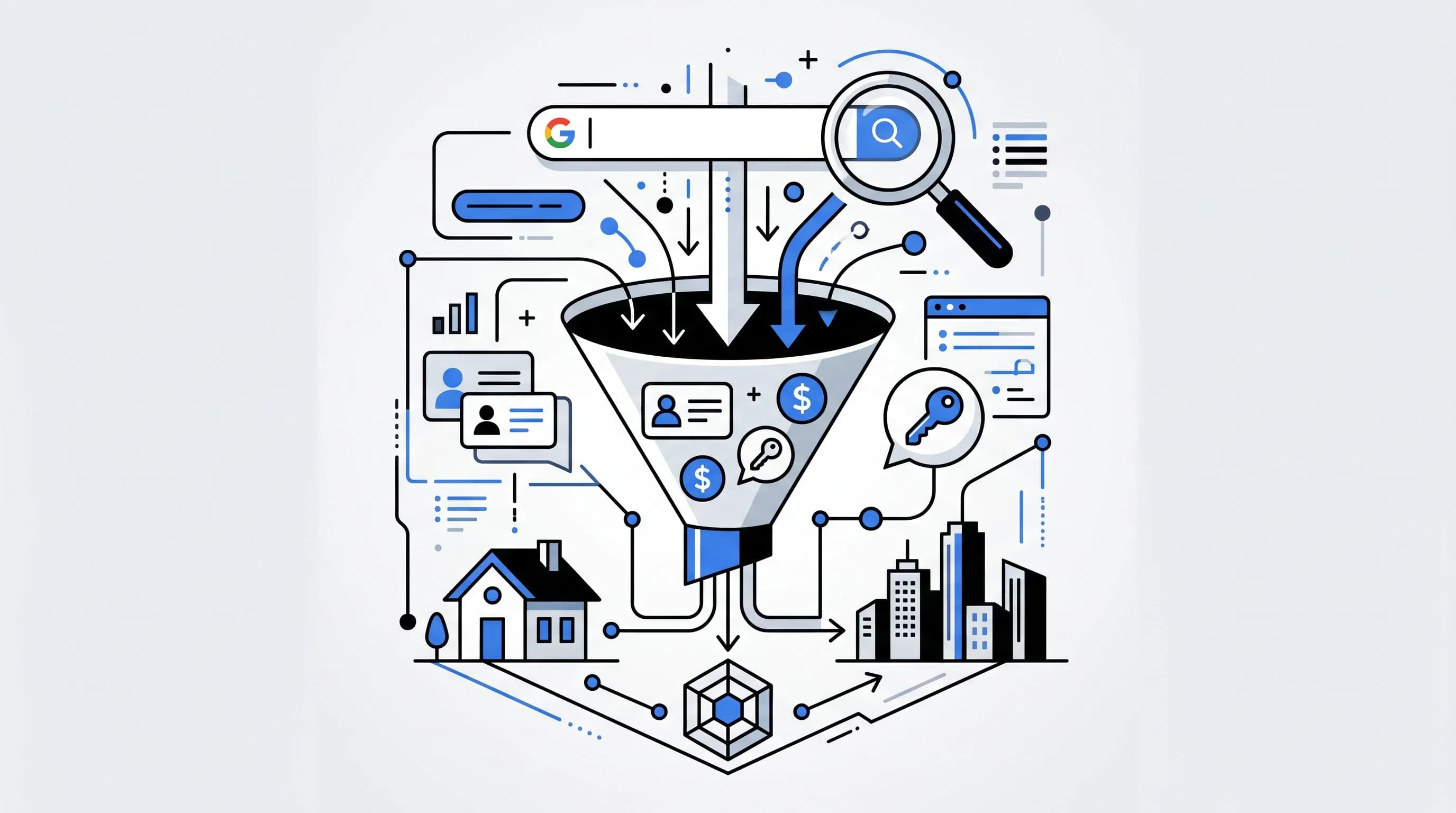
Successful real estate agents do not use Google Ads as a random traffic source. We use it as an intent-capture system: someone searches, we show up with a relevant ad, we send them to a matching landing page, we capture the lead, and we follow up until that lead becomes a conversation, appointment, client, and closing.
That distinction matters. Google Ads are not “magic leads.” They are a way to appear at the exact moment someone types a search like “homes for sale in Winston-Salem NC,” “new construction homes in Calgary,” “sell my house in Austin,” “home value estimate Tampa,” “Condos for sale in Mahogany,” or “best real estate agent near me.”
That person is not being interrupted while scrolling. They are actively looking. And that is why Google Ads for real estate agents can work so well when the campaign is built correctly.
The agents who win with real estate Google Ads are not always the ones with the biggest PPC budget. They are the ones who understand how to match search intent, ad copy, keyword targeting, geo-targeting, landing page relevance, lead capture, CRM follow-up, conversion tracking, and weekly optimization.
Yes, Google Ads can work very well for Realtors, brokers, property agents, and real estate teams. But we need to be honest: they work best when we treat them as a complete lead-generation system, not a shortcut.
Real estate is a high-intent industry. People go to Google when they want to search homes, compare neighborhoods, check property values, research agents, explore new construction, find 55+ communities, view condos, or sell a house. If we can show up at that moment, we are entering the conversation much closer to the transaction than a broad awareness campaign.
Google Ads are especially useful because they provide:
The catch is that Google Ads do not fix a weak sales process. If our landing page does not capture leads, our CRM is messy, our follow-up is slow, or we never call people, then even strong traffic can feel like wasted money.
The core rule: successful real estate agents do not buy clicks. We buy opportunities for conversations.
Google offers several campaign types: Search, Display, YouTube, Demand Gen, Performance Max, and in some markets Local Services Ads. For real estate lead generation, especially on a small or moderate budget, we usually start with Google Search Ads.
Search campaigns let us control intent. We can show our ad when someone types phrases like:
That is direct intent. Someone searches, our ad appears, they click, they land on a relevant IDX page or seller landing page, they register or submit a form, and then we follow up.
Performance Max can be powerful later, especially when we already have good conversion tracking and enough data. But it spreads budget across Search, Display, YouTube, Gmail, Discover, and other Google placements. For newer advertisers, that can create less control and less clarity. Search is simpler, cleaner, and easier to optimize.
The biggest mistake we see is treating Google Ads like a slot machine: put in money, hope leads appear, get frustrated, pause the campaign, restart it later, and repeat.
Successful agents think differently. We build a system around these questions:
When we answer those questions before spending money, Google Ads become much more predictable.
One of the smartest things we can do is not advertise everything at once.
If we have a limited budget and we try to advertise buyers, sellers, luxury homes, condos, townhomes, land, relocation, first-time buyers, downsizers, every city in the MLS, and every neighborhood we serve, we spread our budget too thin. Google gets messy data, and we cannot tell what is working.
Successful real estate agents usually pick one clear campaign theme first, such as:
The goal is to get one campaign producing leads at an acceptable cost, then expand.
A lot of agents build campaigns backward. They think of a clever idea, write a few ads, choose a few keywords, launch the campaign, and then wonder why nothing happens.
We want to verify demand first. Tools like Google Keyword Planner help us see whether people are actually searching for the phrases we want to target.
For example, a broad keyword like “Houston Texas homes for sale” may have thousands of monthly searches. But something extremely specific like “Houston Texas mansions for sale under 10 million” may have little or no search volume.
The sweet spot is a keyword with enough search volume, strong buyer or seller intent, and manageable competition. Often, the best opportunities are not the broadest city terms. They are neighborhood, community, property-type, or lifestyle searches.
| Broad Keyword | More Focused Keyword | Why It Can Work Better |
|---|---|---|
| Homes for sale in Calgary | Homes for sale in Mahogany Calgary | The searcher already has a community in mind. |
| Homes for sale in Tampa | Homes for sale in Hyde Park Tampa | Neighborhood intent is stronger and more specific. |
| Homes for sale in Lakeland | 55+ communities in Lakeland Florida | The search includes a lifestyle and buyer profile. |
| Real estate agent near me | Listing agent in [neighborhood] | The search is tied to a specific service need. |
| New homes | New construction homes in Winston-Salem $300K-$500K | The search includes location, property type, and price range. |
Successful agents often win by being more specific than portals, builders, and generic competitors. Instead of bidding only on huge phrases like “homes for sale in Dallas” or “real estate agent near me,” we can target searches that reveal a clearer need.
Strong real estate PPC niches include:
One smart strategy is to piggyback on existing demand. If a builder is heavily promoting a new community, people may start searching for that community name. A real estate agent can run Search Ads around that demand and send buyers to a filtered IDX page showing available homes, new construction listings, or nearby resale options.
There is no single “best” Google ad format for every agent. The right campaign depends on our goal, budget, market, tracking setup, and follow-up system. But most successful real estate Google Ads strategies use some combination of Search, remarketing, Display, YouTube, Demand Gen, and sometimes Local Services Ads.
Google Search Ads are usually the foundation. These are the text ads that appear when someone searches for a keyword. They are ideal for bottom-of-funnel searches like:
Search Ads work because they capture intent instead of creating it. We are not convincing someone to care about real estate. They already care enough to search.
Google Display Ads are banner or image ads that appear across websites, apps, and Google’s Display Network. They are usually weaker for immediate real estate lead generation, but they are useful for remarketing.
If someone visits our IDX page for “homes for sale in Mahogany” and leaves without registering, Display remarketing can bring us back into their world with an ad like:
“Still searching in Mahogany? View the newest listings updated daily.”
Display works best as a support channel, not the whole strategy.
Real estate decisions take time. A buyer may browse for months. A seller may check home values long before they list. Remarketing helps us stay visible after that first visit.
We can retarget:
A seller remarketing ad might say, “Still wondering what your home is worth? Request a custom local valuation.” A buyer remarketing ad might say, “Get new listings in [city] before they disappear.”
YouTube Ads for real estate are powerful because people want to know who they are dealing with. A text ad can claim expertise. A video can show it.
Agents use YouTube Ads for:
A strong YouTube ad is local, short, and focused. For example: “Thinking about selling in [neighborhood]? Here are three pricing trends we are seeing this month. Click to request a custom home value review.”
Demand Gen campaigns, previously associated with Discovery-style placements, can show ads across YouTube, Discover, and Gmail. These are useful for reaching people who may not be searching for an agent yet but are interested in real estate topics.
They can promote:
We usually do not rely on Demand Gen as the first lead source for a small-budget campaign. Search comes first, then we layer broader campaigns when the funnel is working.
Google Local Services Ads may be available for certain real estate categories in some markets. Availability varies, so we should confirm eligibility before building a strategy around them.
When available, Local Services Ads can help capture local inquiries, but they do not replace the basics: strong Search Ads, relevant landing pages, conversion tracking, call tracking, and fast follow-up.
Google Ads, Facebook Ads, and SEO all have a place in real estate marketing, but they do different jobs.
| Channel | Best For | Main Strength | Main Limitation |
|---|---|---|---|
| Google Search Ads | High-intent buyer and seller leads | Captures people actively searching | Can be expensive without strong targeting and tracking |
| Facebook/Instagram Ads | Awareness, retargeting, list building | Great visual reach and audience building | Interruptive; intent is often lower |
| SEO | Long-term organic lead generation | Compounds over time and builds authority | Takes months to gain traction |
| YouTube | Trust, education, authority | Shows personality and expertise | Requires consistent video creation |
| Direct Mail | Local farming and brand recognition | Builds familiarity in a geographic area | Harder to track than digital campaigns |
A simple way to think about it: Facebook and Instagram are usually push marketing. We push our message into someone’s feed. Google Search Ads are pull marketing. Someone searches for a solution, and we pull them into our website.
The best real estate agents combine channels. Someone may receive our postcard, see our YouTube video, visit our website, and later click our Google ad. That familiarity can improve conversion because real estate is a high-trust decision.
The best Google Ads keywords for Realtors are local, specific, and tied to intent. We do not simply chase the highest search volume. We want keywords that can become real conversations.
In international or multilingual real estate markets, keywords may look different. For example, in the UAE, agents may target:
In markets like Dubai, Abu Dhabi, and Sharjah, separate Arabic and English campaigns can help reach locals, expatriates, and international investors more effectively. The key is not just translation. The keyword, ad, offer, and landing page should feel native to the audience.
Google Ads keyword match types control how closely a search must match our keyword.
| Match Type | How It Works | Real Estate Use Case |
|---|---|---|
| Broad match | Gives Google the most flexibility to match related searches. | Can work with strong conversion data and a deep negative keyword list. |
| Phrase match | Targets searches closely related to the phrase. | Good starting point for focused buyer and seller campaigns. |
| Exact match | Targets very close variations of the exact keyword. | Useful for high-intent, high-value terms with limited waste. |
If we are new, on a small budget, and do not have a strong negative keyword list, we usually start more controlled with phrase and exact match. If we have proven campaigns, reliable conversion tracking, and a deep negative keyword list, broad match can work well.
Regardless of match type, we need to monitor the search terms report. That report shows what people actually typed before clicking our ad.
Negative keywords tell Google when not to show our ads. They are essential for real estate PPC campaigns because Google can match our ads to irrelevant searches if we are not careful.
Common negative keywords for real estate agents include:
Campaign-specific negatives matter too. If we only sell residential homes, we may exclude commercial lease terms. If we do not handle rentals, we may exclude “rent,” “rental,” and “apartments for rent.” But if we are a rental-focused agent, those words may be valuable. Context matters.
We also want to exclude irrelevant property types or locations. If we are advertising homes in Mahogany, we do not want to pay for searches about dog houses, bird houses, unrelated cities, or cheap rentals.
Real estate is local, so geo-targeting is one of the biggest advantages of Google Ads for Realtors.
We can target:
We should also be careful with Google’s location settings. There is a big difference between targeting people who are in or regularly in a location and people who are merely interested in that location.
For many local campaigns, “presence” targeting produces cleaner traffic. But for relocation campaigns, it may make sense to include people outside the city who are searching for homes in that area. For example, if people are moving from California to Texas or from Ontario and British Columbia to Calgary, a relocation-focused campaign may intentionally target those feeder markets.
A clean account structure helps us optimize faster. We should separate campaigns by goal, audience, and geography instead of mixing everything together.
| Campaign | Ad Groups | Purpose |
|---|---|---|
| Seller Leads — [City] | Home value estimate, sell my house, listing agent, neighborhood seller terms | Generate home valuation requests and listing appointments. |
| Buyer Leads — [City] | Homes for sale, condos, new construction, buyer agent, luxury homes | Generate buyer registrations and consultations. |
| Community Campaign — [Neighborhood] | Homes for sale, townhomes, condos, homes under [price], new listings | Capture specific neighborhood demand. |
| Remarketing | Website visitors, listing page visitors, valuation page visitors | Bring warm visitors back into the funnel. |
| YouTube Trust Campaign | Market updates, neighborhood guides, seller tips, property tours | Build authority and familiarity. |
This structure makes it easier to see which campaigns produce real estate leads, which keywords produce conversations, and where we should increase or reduce ad spend.
The landing page is often more important than the ad. Many agents pay for quality traffic and lose the lead because the page is generic, slow, confusing, or mismatched.
If someone searches “new construction homes in Winston-Salem NC $300K-$500K” and clicks an ad promising the same thing, they should not land on a homepage, generic bio page, or broad property search page. They should land on a page showing new construction homes in Winston-Salem around $300K-$500K.
This is called message match. The search term, ad headline, landing page, listings, and lead capture should all feel consistent.
For buyer lead generation, successful agents often send traffic to filtered IDX listing pages instead of homepages.
Examples:
Platforms like Real Geeks, Lofty/Chime, Sierra Interactive, KV Core/BoldTrail, and other IDX-based websites can work if the page loads quickly, shows relevant listings, and captures leads.
Small landing page details matter. In many buyer campaigns, a clean list-view IDX page is easier for consumers than a map-first page. A map can require dragging, zooming, and clicking. A list view immediately shows photos, prices, beds, baths, and property details.
Convenience sells. If someone clicked for “homes under $500K in Calgary,” we should show a clean list of homes under $500K in Calgary right away.
For seller campaigns, a strong landing page usually promotes one specific offer:
A seller landing page should include:
The goal of real estate Google Ads is not just traffic. The goal is leads, conversations, appointments, and closings.
For buyer IDX campaigns, many agents use a forced registration model. A visitor clicks the ad, lands on a relevant list of homes, views a property or a few photos, and then a registration form appears. To continue browsing, they enter their name, email, and phone number.
Some agents worry that forced registration feels pushy. But if we remove the conversion mechanism entirely, we may get traffic with few leads. Since we are paying for the click, we need a realistic way to capture the visitor.
Name and email are useful, but phone number matters. Deals often happen through conversations. One-click signups may capture only name and email, which can be fine for long-term nurture, but if our goal is appointments, we usually want phone numbers too.
Good real estate ad copy is local, specific, and action-oriented. Weak copy says, “Search homes today.” Better copy says, “View Mahogany MLS Listings Updated Every 5 Minutes.”
Strong Google Ads headlines can include:
Here are a few simple ad examples:
| Campaign Type | Example Headline | Example Description |
|---|---|---|
| Buyer IDX | Homes For Sale in [City] | View active MLS listings updated daily. Search by price, area, beds, and property type. |
| New Construction | New Homes in [City] From $400K | See available new construction homes, quick possession options, and builder communities. |
| Seller Leads | What Is Your [City] Home Worth? | Request a custom valuation based on recent sales, local demand, and current market trends. |
| Luxury | Luxury Homes For Sale in [Area] | Explore private tours, premium listings, and local luxury market insight. |
| Community | [Neighborhood] MLS Listings | View homes, condos, townhomes, and new listings in [Neighborhood]. |
Google ad assets, formerly called extensions, can make our ads larger, more helpful, and more noticeable.
Sitelinks are clickable links below the main ad. For a community campaign, we might use:
Each sitelink should go to a matching filtered page. If someone clicks “Condos,” they should see condos. If they click “Homes Under $500K,” they should see homes under $500K.
Callouts are short value statements, such as:
Structured snippets show categories. For example:
Types: Houses, Condos, Townhomes, New Construction
These assets do not guarantee better results, but they can improve visibility and click-through rate when used correctly.
There is no universal Google Ads budget for real estate agents. The right budget depends on market competition, average CPC, target location, property price point, conversion rate, follow-up capacity, and lead goal.
That said, we can use practical ranges:
| Budget Level | Daily Spend | Best Use |
|---|---|---|
| Starter | $15-$20/day | Small test in one focused niche or neighborhood. |
| Stronger Test | $30-$50/day | Enough data for a focused Search campaign. |
| Common Monthly Benchmark | About $1,000/month | A realistic starting point in many markets. |
| Scaling | $50-$100+/day | Increase only after tracking confirms lead quality and follow-up results. |
We have seen agents begin around $15-$20 per day and later scale to $50-$60 per day once the campaign produces predictable lead flow. In one example, cost per lead started around $25-$30 and improved closer to $13 per lead after optimization, producing roughly 120-125 leads per month and two to three closings per month on average. In a strong month, that kind of system can produce even more contracts.
Other markets may see leads at $2-$10, while expensive seller-intent keywords like “best Realtor near me” or “top real estate agent in Dallas” can cost much more, sometimes $40-$80 per click in competitive areas.
The key is not cheap traffic. The key is profitable traffic.
If we spend $2,000 to generate an $8,000 commission, that can be a strong return. But we only know that if we track the full funnel from click to closing.
Google Ads bidding tells Google how to spend our budget. Some strategies optimize for clicks, while others optimize for conversions.
For real estate agents, conversions are usually more valuable than clicks. A conversion could be:
New campaigns may not have enough conversion data for automated conversion bidding to work perfectly right away. We often begin with controlled bidding, track real lead actions, and then move toward conversion-focused bidding once the account has reliable data.
If we cannot tell which keywords produce leads, appointments, and clients, we are guessing. Successful agents set up conversion tracking before scaling spend.
At minimum, we should track:
Advanced tracking can include offline conversions, such as qualified appointments, signed buyer agreements, listing appointments, and closed deals. This helps us understand actual ROI, not just cost per lead.
One major mistake is tracking page views as conversions. A page view is not a lead. We want to track meaningful actions, especially full registrations with name, email, and phone number.
Google Ads can generate leads, but follow-up turns leads into clients. This is where many campaigns succeed or fail.
Online real estate leads often contact multiple agents or browse several sites. Speed matters. We want to respond as quickly as possible, ideally within minutes. At minimum, every lead should receive prompt contact through call, text, and email.
A strong follow-up system includes:
One call is not enough. Many agents call once, get no answer, and decide the lead is bad. But successful agents know that the average lead may need several touchpoints. A practical system might include calling quickly, calling every other day for the first two weeks, then moving the lead into a longer nurture rotation if they do not respond.
“Hey, is this Sarah? This is Nathan with XYZ Realty. I saw you were looking at homes for sale in Winston-Salem and wanted to see if I could help. What caught your attention?”
Or:
“Hey, this is Mike with XYZ Realty. I saw you were checking out new construction homes in Mahogany. Are you just browsing right now, or are you thinking about making a move?”
The goal of the first call is not to hard-close. We want to build rapport, understand motivation, and identify timeline.
Google Ads often build a pipeline, not just instant deals. Some leads are 30 days out. Some are 90 days out. Some are 6-12 months away. Some take longer.
That is why we need a CRM. If we generate 50, 100, or 125 leads per month and try to remember everything manually, leads will slip through the cracks.
A CRM helps us track:
We should also set up listing alerts immediately. If someone registers after viewing new construction homes in Winston-Salem from $300K-$500K, we send alerts for that exact type of property. If someone viewed Mahogany condos, we send condo alerts. If someone browsed a seller valuation page, we send market updates and relevant sales data.
Automation is useful, but it should support human follow-up, not replace it. The best systems automate texts, emails, listing alerts, and market reports while still making sure an agent actually calls.
Some agents avoid buyer Google Ads because they want listings. But many buyer leads are also future seller leads.
A homeowner searching for a 55+ community may need to sell their current home. A downsizer viewing condos may have a larger house to list. A family searching new construction may need to sell before buying. An investor searching properties may own other properties.
That is why our follow-up questions matter:
Direct seller campaigns can be powerful, but they are often more expensive. Buyer search campaigns can create a broader pipeline and uncover listing opportunities indirectly.
Google Ads are not set-and-forget. The best agents treat campaigns as an ongoing experiment.
A strong weekly routine includes:
That last CRM check matters. Integrations can break. If leads stop flowing into our CRM and we do not notice for weeks, we can waste a lot of money.
Most Google Ads failures in real estate come from system problems, not because Google Ads “do not work.”
Real estate advertising is regulated. We need to follow Google Ads policies, brokerage rules, licensing requirements, privacy laws, and fair housing laws.
Agents should:
Even small wording choices can create risk if they imply preference, limitation, or exclusion. A quick compliance review before campaigns go live is always smart.
If we wanted to build a focused real estate Google Ads campaign from scratch, we would follow this framework:
Yes, Google Ads can be worth it for real estate agents when the campaign targets high-intent keywords, uses strong landing pages, tracks conversions, and has fast follow-up. They are not worth it when we send traffic to generic pages, skip tracking, or fail to call leads.
Google Search Ads are usually the best starting point for high-intent real estate leads. Remarketing, Display, YouTube, Demand Gen, and Local Services Ads can support the strategy once the core Search campaign is working.
A small starter budget may be $15-$20 per day, while a stronger test is often $30-$50 per day. Around $1,000 per month is a common benchmark in many markets. Competitive markets or seller-intent keywords may require more.
It depends on the market, keyword, offer, and landing page. Some optimized buyer IDX campaigns may generate leads under $20, while seller and agent-intent keywords can cost much more. Cost per appointment and cost per closing matter more than cost per lead alone.
New agents can use Google Ads successfully if they have a website or IDX landing page, lead capture, CRM, tracking, follow-up process, and enough budget to test. If those pieces are missing, it is better to build the foundation first.
Performance Max can work, but we usually do not start there for small-budget real estate lead generation. Search campaigns provide more control over intent and are easier to understand. Performance Max is better once we have strong tracking and conversion data.
Strong keywords include local buyer terms like “homes for sale in [city],” seller terms like “home value estimate [city],” and service terms like “listing agent in [neighborhood].” Neighborhood, community, price-range, and property-type keywords often perform better than broad terms.
Google Ads often produce stronger intent because users are actively searching. Facebook and Instagram are better for awareness, retargeting, and audience building. The best real estate marketing systems often use both.
Google Ads can start generating clicks and leads within days of launch. However, profitable performance usually takes several weeks of testing, negative keyword refinement, ad copy improvement, landing page optimization, and follow-up tuning.
The biggest mistake is treating Google Ads as just traffic. Successful campaigns require the full system: intent-based keywords, matching landing pages, lead capture, conversion tracking, CRM follow-up, and ongoing optimization.
Successful real estate agents use Google Ads because they capture intent. But the ad is only the front door.
The real system is:
That is how successful real estate agents use Google Ads. Not by chasing hacks, copying random ads, or spending money for a week and hoping. We build a machine. We start focused, track the numbers, follow up like professionals, and keep improving until Google Ads become a predictable source of leads, appointments, listings, buyers, and closings.

Hey, in Propphy we're determined to make a business grow. My only question is, will it be yours?
It's totally free, with no commitments
Hey, in Propphy we're determined to make a business grow. My only question is, will it be yours?
It's totally free, with no commitments