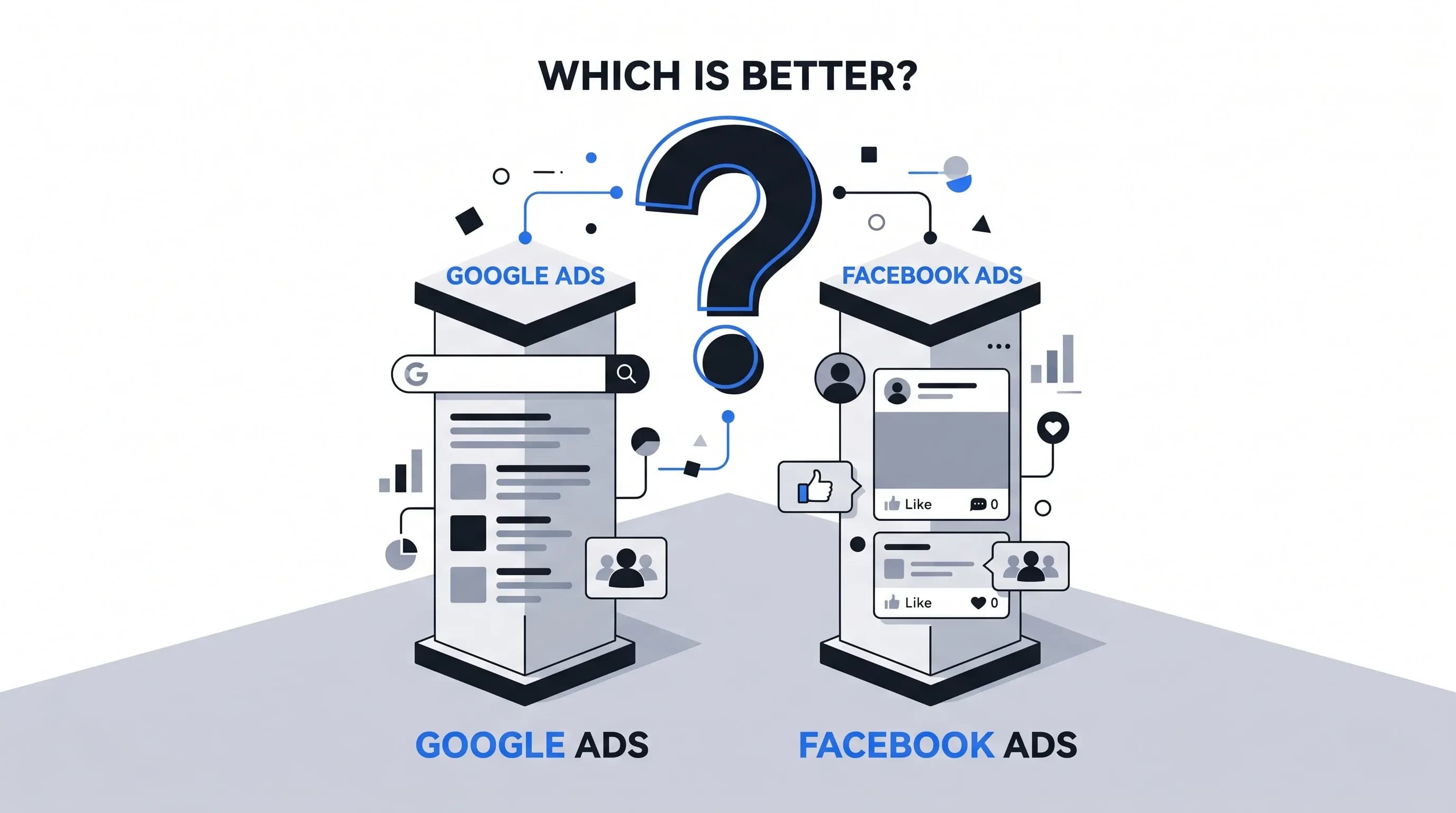
When we compare Google Ads vs Facebook Ads for marketing, the biggest mistake is looking for one universal winner. There usually isn’t one. These platforms do different jobs, reach users in different mindsets, and perform best at different stages of the funnel.
If we want the shortest possible answer, it is this: Google Ads captures existing demand, while Facebook Ads creates and nurtures demand. In other words, this is often a debate between paid search vs paid social, not just two ad dashboards.
That is why the better question is not simply “which is better: Google Ads or Facebook Ads?” but rather: what are we trying to achieve, who are we targeting, and where is our audience in the buying journey?
In this side-by-side comparison, we will break down the difference between Google Ads and Facebook Ads, including buyer intent, targeting options, ad formats, cost comparison, ROI, funnel fit, industry use cases, and how to use both together in a full-funnel strategy.
If we need a practical rule of thumb, it looks like this:
This is the core of google advertising vs facebook advertising: Google is usually stronger for high-intent traffic, while Facebook is usually stronger for discovery-based traffic and brand awareness.
Google Ads is Google’s paid advertising platform. It allows us to run campaigns across multiple properties, including:
Its main advantage is search intent. People go to Google because they want an answer, a provider, a product, or a solution. If someone searches for “realtor near me,” “buy ergonomic office chair,” or “emergency plumber,” they are actively showing interest.
That is why Google Ads is often the easiest platform to monetize early. We are not trying to interrupt someone and persuade them to care. They already care. We simply need strong keyword targeting, relevant ad copy, and a good landing page.
Facebook Ads, now commonly referred to as Meta Ads, is Meta’s paid social advertising platform. Ads can appear on:
Instead of matching ads to keywords, Meta focuses on audience targeting. We can target users based on demographics, interests and behaviors, custom audiences, lookalike audiences, engagement, and website visits using the Meta Pixel.
The platform is built around discovery. People are scrolling, browsing, watching, and engaging socially. They are often not looking for our product at that moment. That means the creative has to do more work: stop attention, make the message relevant, and create desire.
This is why facebook advertising vs google advertising is also a comparison between creative-first demand generation and intent-first demand capture.
The single most important difference in any facebook ads vs google ads comparison is this:
On Google, users tell us what they want through searches. On Facebook and Instagram, we have to put the right message in front of the right person before they start searching.
A useful way to think about it is customer awareness:
Google Ads usually performs best near the bottom of that list. Facebook Ads usually performs best higher up, where education, persuasion, visual storytelling, and repeated exposure matter.
When we compare Google search ads vs Facebook ads, Google usually wins on buyer intent. If someone is searching for a product or service, they are already taking action.
That makes Google especially strong for:
For urgent, need-based services, the difference can be dramatic. People do not usually discover they need a plumber while casually scrolling Instagram. But when they have a leak, they search immediately. In those cases, Google often wins by a wide margin.
That is why many marketers describe Google as the platform for people with their “credit card halfway out.” It captures users close to a decision.
In a google ads or facebook ads decision, Facebook often has the advantage when the audience is not actively searching yet. This is where paid social shines.
Facebook Ads is often better for:
If we are launching something new, selling a product with a strong visual “wow” factor, or introducing an offer that people do not search for by name yet, Meta can outperform because it lets us manufacture interest rather than wait for it.
That is why Facebook often works well for beauty, fashion, home goods, fitness gadgets, lifestyle brands, travel, and lower-priced B2C offers.
One of the biggest differences between Google Ads and Facebook Ads is how targeting works.
Google’s strength is moment-of-need relevance. If someone types a commercial search into Google, we can appear at the exact point of demand.
Meta’s strength is audience granularity. We can start with the person, not the keyword.
So if we ask which platform has better targeting, the honest answer is:
Another key part of comparing Facebook Ads and Google Ads is how ads look and how much the creative matters.
The flagship format is still search ads. They are practical, intent-driven, and often highly effective, but they are less visually immersive than social ads.
On Meta, creative is often the campaign. In practice, the hook, the visual, the angle, and the story act as relevance signals. On Google, creative helps. On Facebook, creative often is the targeting.
That is why teams that are strong in messaging, visuals, UGC, and storytelling often perform better on Meta. Teams that are stronger in search behavior, landing page match, and conversion mechanics often find Google easier to scale profitably.
Cost is one of the most searched angles in any Google Ads vs Facebook Ads cost comparison.
In general:
Typical benchmark references often show Google’s median CPC several times higher than Facebook’s. That difference exists because Google traffic usually carries more immediate purchase intent.
Google can become especially expensive in industries such as:
Facebook is often cheaper for clicks and CPM, which makes it attractive for awareness, testing, audience building, and low-cost retargeting. But cheaper traffic does not automatically mean better traffic.
The right question is not “Which platform has lower CPC?” It is “Which platform gives us the best CPA, ROAS, lead quality, and blended customer acquisition cost?”
When we compare platform performance, conversion rate alone can be misleading.
Google often has a higher conversion rate because users arrive with stronger intent. Facebook often has a lower CPC and sometimes a lower cost per acquisition, even when conversion rates are lower.
So a proper ROI or ROAS analysis should look at:
A blunt but accurate summary is this:
Google benefits from built-in intent. Meta can outperform dramatically, but usually only when creative, tracking, funnel structure, and testing discipline are all strong.
A useful way to decide between Google Ads or Facebook Ads is to map each platform to the funnel.
Facebook Ads usually performs best for:
The middle often works best with a mix of channels, such as:
Google Ads usually dominates for:
This is why a full-funnel strategy often performs better than treating these platforms as either-or choices.
We should lean toward Google Ads when:
Google is often the better fit for local services, B2B acquisition, SaaS, healthcare, legal, consulting, and real estate searches. It is also usually the lowest-hanging fruit when commercial demand already exists.
We should lean toward Facebook Ads when:
Meta is often the better fit for ecommerce launches, lifestyle products, home decor, beauty, travel, lower-priced B2C offers, and products that need demonstration before the user feels interest.
For ecommerce, the answer is rarely absolute.
Facebook Ads is often stronger for:
Google Ads is often stronger for:
In many ecommerce accounts, Meta acts like the creative lab, while Google acts like the demand capture machine. We may learn what hook converts on Facebook, then use that insight to improve product titles, ads, and landing pages on Google.
For lead generation, urgency matters.
Google Ads for conversions is usually stronger when the service is known and in demand now. Think:
Facebook Ads for lead generation can work better when:
In some premium niches, search volume may be small and Google CPCs may be high. In those cases, Meta can produce lower-cost leads at greater scale, even if more filtering is required downstream.
In real estate, both platforms can work well, but they serve different roles.
Google Ads is strong for users searching terms like:
Facebook Ads is often stronger for:
For many real estate marketers, the smartest approach is to use Facebook to generate awareness and repeated exposure, then use Google to capture active search demand when buyers or sellers are ready to act.
In broad terms:
That is because B2B buyers tend to search actively for software, agencies, vendors, and service providers. Search-driven acquisition is a natural fit.
Facebook is often stronger for consumer discovery, especially for lower-ticket or visually attractive products. That said, Meta can still be useful in B2B for awareness, thought leadership distribution, remarketing, and lookalike audiences.
Another practical issue in Google Ads compared to Facebook Ads is scale.
Google Search is constrained by existing demand. If only so many people search a term each month, there is a ceiling.
That is one reason fast-growing consumer brands often push hard into Meta even when Google is profitable. Meta is usually stronger at expanding the market, not just capturing its existing demand.
No modern comparison of Meta Ads vs Google Ads is complete without discussing tracking.
Both platforms have been affected by:
Meta has generally felt these changes more sharply, especially in browser-based attribution. Google often feels easier to trust when GA4, enhanced conversions, UTMs, and first-party data are configured well.
Still, we should avoid relying only on platform dashboards. Better measurement usually comes from combining:
Budget split depends on search demand, margins, sales cycle length, creative resources, and campaign goals. Still, some practical patterns appear often.
We may lean more heavily toward Google Ads when:
We may lean more heavily toward Facebook Ads when:
A common reality is that businesses spend more on Google once search intent proves profitable, but growing brands often invest aggressively in Meta to create future demand and build audience assets.
The strongest answer to google ads vs facebook ads is often: use both together.
That is because buyers rarely convert after one touchpoint. A real journey may look like this:
Or the reverse:
This is why a full-funnel advertising strategy often works so well:
One of the most practical summaries is still one of the best: Meta creates the demand. Google captures it.
If we have to choose just one platform first, we should start with market reality, not preference.
A very practical test is checking whether meaningful commercial search volume exists. If it does, Google deserves serious consideration. If it does not, Meta often becomes the better first move.
If we are forced to give a simple verdict in this Google Ads vs Facebook Ads comparison for marketing, it would be:
So when someone asks, “which platform is best?” our answer should be: it depends on the job.
If demand already exists, start with Google.
If demand needs to be created, start with Facebook.
If we want the strongest long-term system, build both and let each platform do what it does best.
That is the real difference between Google Ads vs Facebook Ads, and that is how we should decide where to put our ad spend.
Hey, in Propphy we're determined to make a business grow. My only question is, will it be yours?
It's totally free, with no commitments
Hey, in Propphy we're determined to make a business grow. My only question is, will it be yours?
It's totally free, with no commitments