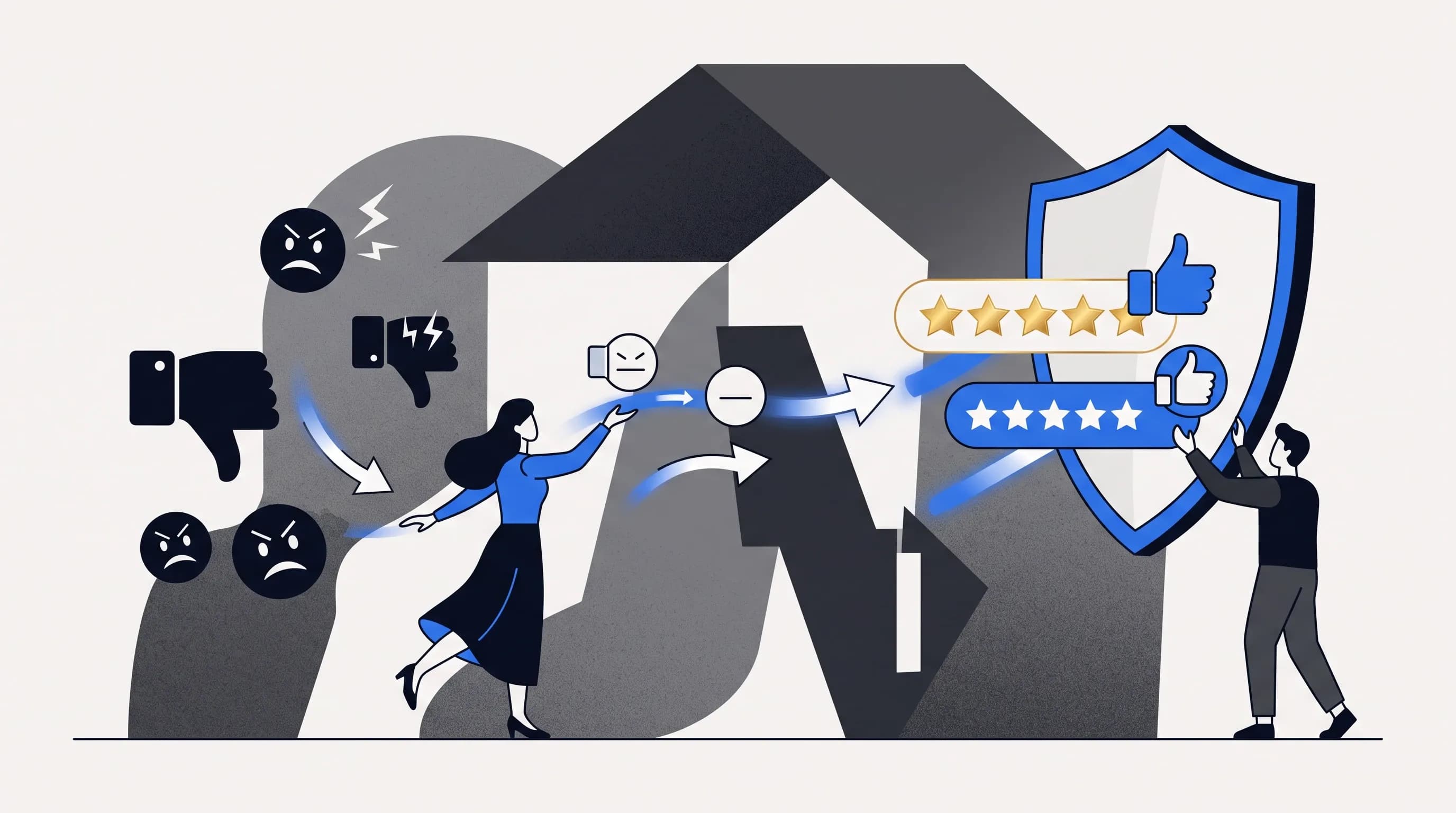
Negative real estate reviews hurt. We can be experienced, professional, responsive, and stacked with five-star testimonials, and a one-star review can still feel like a punch in the gut.
That is especially true in real estate because reputation is currency. Buyers, sellers, landlords, tenants, investors, referral partners, and even vendors are trusting us with homes, money, legal contracts, deadlines, deposits, inspections, repairs, and major life transitions. Before many people call us, they search our name. They check Google reviews, Facebook Recommendations, Realtor.com reviews, Zillow, Yelp, Rate My Agent, social media, brokerage profiles, and local forums.
Here is the good news: a negative review does not automatically destroy our reputation. In many cases, the way we respond matters more than the bad review itself.
A calm, professional, empathetic review response can show future clients that we listen, take accountability, protect privacy, and work toward resolution. A defensive, sarcastic, or hostile response can do more damage than the original complaint.
So let’s walk through how to handle negative real estate agent reviews the right way: what to do first, how to respond, when to take the conversation offline, how to deal with fake reviews, how to request removal, and how to build a stronger online reputation over time.
Online reviews are now part of the real estate decision-making process. People may still ask friends and family for referrals, but they usually verify those recommendations online. They want to know if our real estate agent ratings match what they have heard.
Positive reviews help us:
Negative real estate reviews can hurt because they may:
But we should keep perspective. A few bad realtor reviews are not always fatal. In fact, a review profile with hundreds of perfect five-star ratings and no criticism can sometimes look unrealistic. Consumers understand that no real estate business makes every person happy forever. A mostly strong review profile with an occasional negative review, especially one answered thoughtfully, can look more authentic than a flawless profile that feels manufactured.
The goal is not to avoid criticism forever. If we serve enough people, we will eventually receive negative client feedback. The goal is to manage unfavorable reviews in a way that protects trust.
The worst time to reply to a negative real estate review is the moment we first read it.
That first moment is dangerous. We may feel angry, embarrassed, misunderstood, or defensive. We may want to explain the entire transaction, prove the reviewer wrong, or point out every missing detail. In real estate, where trust and referrals are so personal, negative feedback can trigger ego fast.
Before responding, we should pause and ask:
We are not really writing only to the angry reviewer. We are writing to every future buyer, seller, landlord, investor, tenant, or referral partner who may read the exchange later. If our response is petty, future clients may assume that is how we behave under pressure. If our response is calm and solution-oriented, they see professionalism.
Most bad real estate agent reviews are not really about one isolated mistake. They are often about how the client felt during the process: ignored, confused, rushed, surprised, disrespected, or unsupported.
Poor communication is one of the biggest causes of negative realtor reviews. A buyer may feel abandoned after losing an offer. A seller may feel left in the dark after showings. A tenant may be frustrated because a repair took longer than expected and nobody explained why. A short-term rental guest may be upset because the host did not respond quickly enough.
People can usually tolerate bad news better than silence. What creates resentment is not always the problem itself; it is the feeling that nobody cared enough to explain what was happening.
Bad reviews often follow overpromising. If we promise a seller an aggressive price, guarantee a fast sale, imply repairs will be simple, or make a buyer believe every offer will be accepted, disappointment is likely.
We can be optimistic without being unrealistic. It is better to win trust with honesty than to win the client with promises we cannot control.
Real estate contracts, disclosures, inspection timelines, financing contingencies, appraisal issues, HOA rules, lease terms, repair requests, security deposit deductions, and closing documents can overwhelm clients. If we do not explain what people are signing or what happens next, they may later feel unsupported.
Real estate moves quickly, but clients still need to feel informed. If a buyer feels pressured to waive protections, a seller feels pushed into a price reduction, or a tenant feels surprised by move-out charges, a negative review can follow.
Real estate teams, brokerages, and property management companies often involve several people: agents, coordinators, assistants, showing partners, maintenance vendors, leasing agents, transaction coordinators, lenders, inspectors, and closing staff. If clients do not know who handles what, the experience can feel chaotic.
Some agents disappear after closing. Some property managers go quiet after move-in. Some short-term rental hosts stop caring after checkout. Clients remember that. Post-closing questions, warranty issues, repair follow-up, referrals, and simple check-ins are part of the client experience.
Not every negative review should be handled the same way. Before we reply, we need to classify the review.
| Review Type | What It Looks Like | Best Response Strategy |
|---|---|---|
| Legitimate complaint | A real client had a real bad experience, such as slow communication, unclear expectations, or poor follow-up. | Acknowledge, apologize where appropriate, take it offline, and fix what can be fixed. |
| Misunderstanding | The reviewer is upset about market conditions, lender delays, HOA rules, appraisal issues, inspection outcomes, or something outside our direct control. | Clarify politely without arguing and invite a private conversation. |
| Fake review | We have no record of the person as a client, tenant, guest, customer, lead, or vendor. | Respond calmly, document everything, and flag or report the review if it violates platform policies. |
| Abusive or inappropriate review | The review includes threats, hate speech, private information, harassment, profanity, or off-topic attacks. | Screenshot it, avoid escalation, report it to the platform, and consult the broker or attorney if needed. |
| Retaliatory review | The reviewer threatens a bad review unless they receive money, waived fees, refunds, or special treatment. | Document the threat, keep communication in writing, respond professionally, and report policy violations. |
This classification keeps us from treating every review like an emergency. Some reviews require service recovery. Some require documentation. Some require platform reporting. Some require us to take a breath, respond once, and move on.
A strong negative review response is short, calm, empathetic, and focused on resolution. We do not need to write a courtroom brief. We do not need to prove every point. We need to show future clients that we are professional.
A good review response should include:
Here is a simple structure we can use:
Thank you for sharing your feedback. We are sorry to hear that your experience did not meet expectations. We take concerns like this seriously and would appreciate the opportunity to discuss this directly. Please contact us at [phone/email] so we can better understand what happened and work toward a resolution.
This kind of professional review response does not admit unnecessary liability, does not disclose private details, and does not attack the reviewer. It shows that we are listening.
Even if the reviewer is wrong, exaggerating, or leaving out half the story, we should avoid public responses that make us look combative.
Do not say:
Those responses may feel satisfying for five minutes, but they can damage our reputation for years.
Instead, use language like:
That phrase, “there are details we cannot discuss publicly,” is especially useful in real estate because privacy matters. It signals that there may be more context without exposing confidential information.
Templates help, but we should always personalize them. A robotic response can feel dismissive. A customized response shows that we actually read the complaint.
Thank you for your feedback. We are sorry to hear that your experience did not meet expectations. We take concerns seriously and would appreciate the opportunity to discuss this directly. Please contact us at [contact information] so we can better understand what happened and work toward a resolution.
Thank you for sharing this. We are sorry that communication during your experience did not meet your expectations. Timely updates are extremely important in real estate, and we understand how frustrating it can feel to be left without clear information. We would appreciate the chance to speak with you directly and review what happened. Please contact us at [phone/email].
We apologize for the frustration this caused. You are right that our communication should have been clearer in this situation, and we are reviewing this internally. We appreciate you bringing it to our attention and would welcome the opportunity to make it right. Please contact us directly at [phone/email].
Thank you for sharing your concerns. We are sorry the process felt frustrating. Some parts of a real estate transaction, including financing timelines, inspections, appraisals, HOA rules, and closing requirements, can involve third parties and factors outside an agent’s direct control. That said, we always want our clients to feel informed and supported. Please reach out to us directly so we can discuss your experience and answer any remaining questions.
We take all feedback seriously, but we are unable to locate any record of you as a client, tenant, guest, or customer. If this review relates to an actual interaction with our team, please contact us at [phone/email] so we can better understand and address your concern.
We are sorry to hear that you had a negative impression. We would like to learn more about what happened and see if there is a way to address your concerns. Please contact us directly at [phone/email]. We value feedback and use it to improve our service.
We are sorry to hear about your frustration. Maintenance timing can depend on vendor availability, parts, and access, but we understand how important communication is during that process. Please contact our office so we can review your request and provide an update.
We understand that move-out charges can be frustrating. Our team follows the lease terms and documented move-out condition reports when assessing charges. There are details we cannot discuss publicly, but we would be happy to review the information with you directly.
We are sorry your stay did not meet expectations. Guest experience is very important to us, and we appreciate you sharing your concerns. We have reached out through the booking platform and would like the opportunity to address this directly.
Sometimes the negative review is fair. Maybe we missed a follow-up. Maybe a team member failed to communicate. Maybe listing photos were delayed. Maybe a maintenance vendor dropped the ball. Maybe a client felt disrespected because we missed a cultural expectation, property instruction, or personal boundary.
When we made a real mistake, ownership can be powerful.
A sincere apology does not need to be dramatic. It needs to be honest:
We are sorry that our actions made you feel disrespected. That was not our intention, but we understand why it upset you. Thank you for bringing it to our attention.
In many situations, people are not just looking for compensation. They want acknowledgment. They want to feel heard. We have seen situations where a simple, humble apology changed the entire tone of the conflict and even led the reviewer to update a one-star review to a five-star review.
That is the power of humility in reputation management.
We should almost always take sensitive review conversations offline after a short public response.
Real estate disputes can involve confidential financial information, negotiation details, contract terms, inspection findings, tenant records, guest messages, security deposits, fair housing considerations, fiduciary duties, and brokerage policies. Public comment threads are not the place to unpack all of that.
A simple offline invitation works well:
We would like the opportunity to speak with you directly and better understand what happened. Please contact us at [phone/email] so we can work toward a resolution.
Taking the conversation offline helps us:
Many people are more reasonable one-on-one than they are in a public review thread. But we should still document what happens next.
Documentation matters. This is especially important for property managers, landlords, short-term rental operators, and real estate teams dealing with tenants, guests, residents, vendors, buyers, and sellers.
Phone calls can be useful for de-escalation, but they can also create “he said, she said” problems. When a situation is already tense, we should confirm key conversations in writing.
For example:
Thanks for speaking with us today. To recap, we discussed [issue], and our next step is [action]. Please let us know if we missed anything.
For short-term rentals, it is usually wise to keep communication inside Airbnb, VRBO, Booking.com, or the direct booking platform whenever possible. For property management, use tenant portals, maintenance request systems, email, and written notices. For real estate agents, confirm important decisions and instructions by email or through the CRM.
If someone later leaves a fake, misleading, or retaliatory review, documentation may be what helps us dispute it.
Fake negative reviews are frustrating, but we need to handle them strategically. We should not respond with anger or accusations. Instead, we should stay factual, document everything, and use the platform’s reporting tools.
A review may be fake or policy-violating if:
Before reporting the review, we should:
A good public response to a fake review is:
We take feedback seriously, but we do not have a record of working with anyone by this name. If this review relates to an actual interaction with our team, please contact us at [phone/email] so we can better understand and address your concern.
This raises doubt about the review’s legitimacy without sounding hostile.
Sometimes, but not just because it is negative. Review platforms usually do not remove bad reviews simply because they are unfair, harsh, or incomplete. They typically require a policy violation.
We may be able to request removal when a review includes:
When asking for removal, we should be concise and evidence-based:
This review appears to violate the platform policy because [specific reason]. We have no record of this person as a client, tenant, guest, or customer. Attached are screenshots and records showing [evidence]. Please review for removal under your content policy.
If the review includes serious defamation, threats, private information, or legal risk, we should consult our broker, compliance officer, or attorney before taking further action.
Each review platform has different rules, but the reputation management principles are the same: monitor regularly, respond professionally, protect privacy, report clear violations, and keep building positive reviews.
Google reviews are often the first reviews prospects see when searching for our name, real estate team, brokerage, or property management company. We should respond through Google Business Profile as soon as we have reviewed the facts.
Google may remove reviews that are spam, fake, off-topic, profane, discriminatory, harassing, or based on a conflict of interest. But Google usually will not remove a review just because it is unfavorable.
Facebook Recommendations can spread quickly because they are tied to personal networks. Page admins can respond publicly and report content that violates Facebook’s community standards.
Turning off reviews may be possible in some cases, but it can make us look like we are hiding criticism. A better approach is usually transparency, thoughtful responses, and consistent review generation.
Realtor.com reviews may go through moderation, but negative reviews can still appear. We should monitor our professional dashboard and respond in a way that is brief, client-safe, and compliant with brokerage policy.
Zillow reviews influence buyers and sellers comparing agents. We should keep our profile complete, respond to feedback professionally, and avoid discussing transaction details that could expose private information.
Yelp has its own review filtering and content policies. We should avoid asking for Yelp reviews in ways that violate Yelp’s guidelines and should report content that is fake, abusive, or irrelevant.
Rate My Agent, brokerage pages, and local real estate directories can also influence trust. These platforms are easy to forget, so they should be part of our review monitoring checklist.
If we operate short-term rentals, reviews on Airbnb, VRBO, Booking.com, and direct booking sites can directly affect occupancy and pricing. Keeping guest communication on-platform is important because it creates a record if a guest later leaves a retaliatory or policy-violating review.
This is a major warning for real estate professionals, landlords, property managers, and short-term rental operators: we should not put language in leases, management agreements, guest agreements, or client contracts that punishes people for leaving negative reviews.
The Consumer Review Fairness Act protects consumers’ ability to share honest opinions about businesses. Contract clauses that penalize people for posting negative reviews can create serious legal and reputational problems.
Trying to suppress criticism can lead to:
We cannot build a trustworthy real estate brand by silencing people. We build it by delivering good service, responding professionally, fixing what we can, and letting the full pattern of our reviews speak for itself.
Reviews are not just ratings. They are data.
Even unfair reviews can reveal something useful. Maybe our onboarding process needs work. Maybe our listing presentation overpromised. Maybe our maintenance updates are too slow. Maybe our move-out instructions are unclear. Maybe our team handoff creates confusion. Maybe our short-term rental listing sets the wrong expectations. Maybe our pricing conversations need better framing.
After every negative review, we should ask:
If one person complains about communication, it may be an outlier. If five people complain about communication, we have a communication problem. If multiple tenants complain about maintenance, we may have a vendor, staffing, or response-time issue. If multiple sellers say they felt ignored after listing, our listing communication system needs work.
Negative reviews are painful data, but they are still data. Use them.
The best way to handle negative real estate reviews is to reduce the chance of receiving them in the first place. That does not mean avoiding feedback. It means improving the client experience.
At the beginning of the relationship, explain:
Give clients an easy way to raise concerns before they go public. Include a direct phone number or email address in email signatures, onboarding materials, buyer packets, listing presentations, tenant portals, guest instructions, and website contact pages.
Do not wait until closing to learn the client was unhappy. Ask:
Reviews are often created during high-emotion moments: first inquiry, showings, negotiations, inspections, repair requests, maintenance delays, move-in, move-out, pricing conversations, closing day, and post-closing follow-up.
Train the team to overcommunicate during these moments. A delayed repair with a clear update is frustrating. A delayed repair with silence becomes a bad review.
The best defense against one bad review is a strong base of authentic positive reviews. If we only have three reviews and one is negative, that one review can hurt. If we have 150 reviews and one is negative, it barely moves the average.
We should not wait until we receive a bad review to start caring about review management.
Good times to ask for positive reviews include:
Make the process simple. Send direct review links for Google Business Profile, Realtor.com, Zillow, Facebook, Yelp, Rate My Agent, or the brokerage review page. Do not make people search.
Subject: Quick favor?
Hi [Name],
We are so happy we had the opportunity to work together, and we really enjoyed helping you through the process.
No pressure at all, but reviews go a long way for a real estate business. If you would be open to sharing your experience, we would be very grateful.
You can leave a review here: [Review Link]
No need to respond, and no worries at all if you would rather not.
Thanks again,
[Your Name]
Hi [Name], we loved working with you. If you are open to it, would you mind leaving a quick review about your experience? It helps future clients feel confident reaching out. Here is the link: [Review Link]. Thank you again.
Use a CRM, transaction checklist, or post-closing sequence to make review requests consistent. Add a task after closing. Track who has been asked. Track which platforms need more reviews.
We should not only show up when something goes wrong. Responding to positive reviews shows gratitude and reinforces our brand.
A good positive review response can mention the type of service, location, or client experience naturally:
Thank you, [Name]. It was a pleasure helping you sell your home in [City/Neighborhood]. We are grateful for your trust and so glad you had a positive experience with our real estate team.
Positive reviews can also be used as marketing assets, depending on platform rules and client permission. We can feature client testimonials on our website, listing presentations, buyer guides, email campaigns, social media, ads, and lead nurture sequences.
A steady flow of fresh positive reviews naturally pushes isolated negative reviews into the background.
We should not reinvent the wheel every time a bad review appears. A simple standard operating procedure keeps us from reacting emotionally.
Handling one negative review matters. Building a durable reputation system matters more.
For strong online reputation management for real estate agents, teams, brokerages, property managers, and real estate service businesses, we should:
We should also remember that our review responses are marketing. Future clients reading our reviews are asking themselves: Will this agent listen? Will this company take responsibility? Will they disappear if something goes wrong? Are they respectful? Are they fair? Can I trust them with my property, money, or transaction?
Our response answers those questions.
We should respond calmly, thank the reviewer, acknowledge the concern, avoid arguing, protect confidential details, and invite the person to contact us privately. The response should be professional and written for future clients as much as the reviewer.
Yes, when the platform allows it. An unanswered negative review can make it look like we do not care. A thoughtful public response shows that we are attentive, professional, and willing to address client complaints.
Sometimes. Google may remove reviews that violate its policies, such as fake reviews, spam, harassment, hate speech, conflicts of interest, off-topic content, or private information. Google usually will not remove a review just because it is negative or unfair.
We should screenshot the review, search our records, gather evidence, respond professionally if appropriate, and use the platform’s flagging or reporting process. When reporting, explain the specific policy violation clearly and provide documentation.
We can say: “We take feedback seriously, but we are unable to locate any record of working with anyone by this name. If this review relates to an actual interaction with our team, please contact us directly so we can better understand your concern.”
Only after we have genuinely addressed the concern, and we should never pressure them. A simple, low-pressure request is fine: “We are glad we were able to talk through this. If you feel the issue has been resolved, you are welcome to update your review, but there is absolutely no pressure.”
They can, especially if they show patterns like poor communication, lack of follow-up, or unprofessional behavior. But a few negative reviews surrounded by many positive reviews and answered professionally may not significantly hurt lead generation. In some cases, they can make the review profile look more authentic.
Yes, if they are rare and handled well. Consumers do not expect perfection. They expect professionalism. A thoughtful response to criticism can show future clients how we handle pressure and conflict.
No. We should not offer compensation in exchange for changing or removing a review. That can violate platform policies and create legal or ethical problems. We can make things right when appropriate, but review manipulation is risky.
We can ask satisfied clients at the right moments, send direct review links, use CRM follow-up tasks, respond to existing reviews, and make review requests part of the closing or post-service process. The key is consistency and authenticity.
Handling negative real estate reviews is not about pretending every client is right. They are not. It is not about letting people bully us. We should not. It is not about admitting fault for things we did not do. That can be dangerous.
It is about responding with maturity, documentation, empathy, and strategy.
The formula is simple:
A negative review does not have to define our real estate career, brokerage, property management company, or service business. In many cases, the way we respond to criticism says more about us than the criticism itself.
People do not expect perfection. They expect professionalism. When future clients see that we are calm, fair, accountable, and committed to resolution, one bad review can become less of a liability and more of a public demonstration of how we handle pressure.

Hey, in Propphy we're determined to make a business grow. My only question is, will it be yours?
It's totally free, with no commitments
Hey, in Propphy we're determined to make a business grow. My only question is, will it be yours?
It's totally free, with no commitments