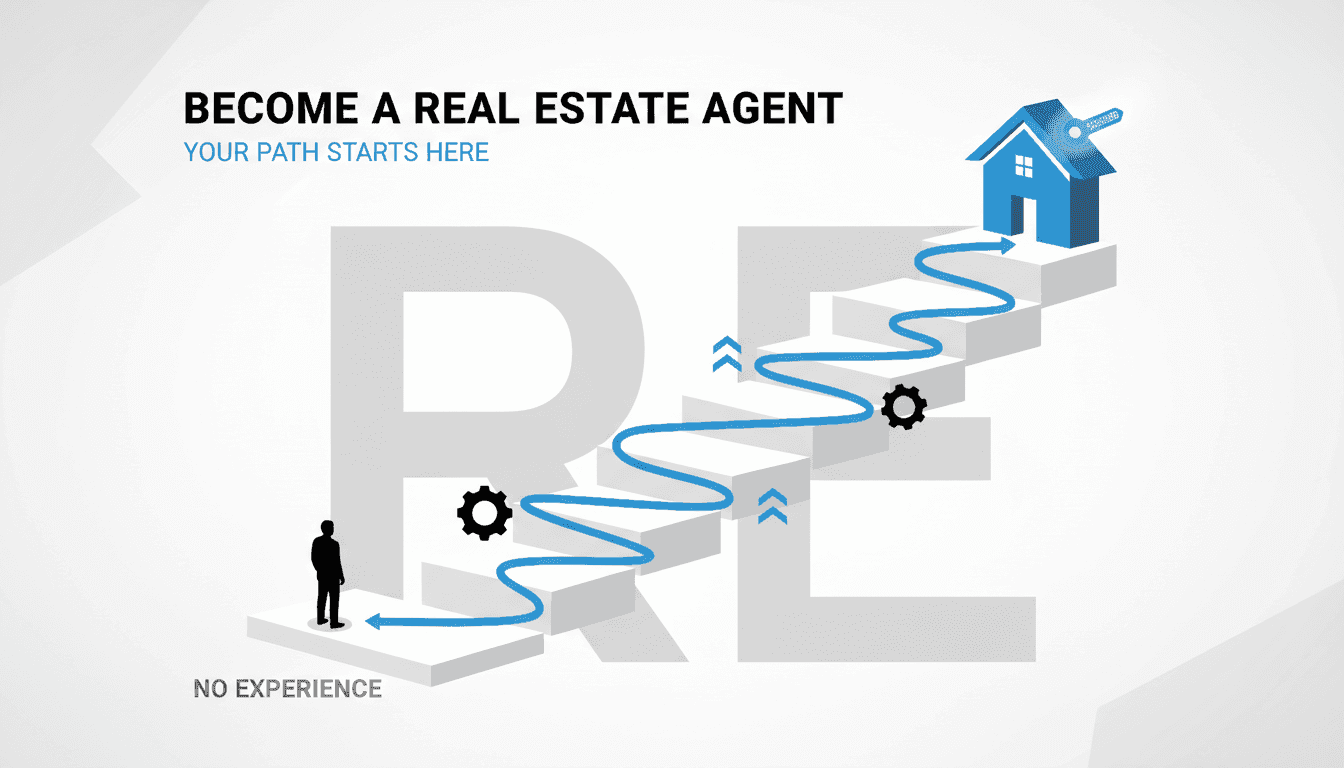
We’re going to walk you through a realistic, step-by-step guide to becoming a real estate agent with no experience at all—no sales background, no degree, no contacts. We’ll cover how to get your real estate license, how to choose a brokerage, and how to actually get clients and build a six-figure real estate career from scratch.
This isn’t theory; it’s the same roadmap working agents, brokers, and coaches use in competitive markets. Think of it as a startup playbook: you’re not getting “a job,” you’re launching a commission-only business.
Is Real Estate a Good Career for You (With No Experience)?
Before you Google “how to become a real estate agent” or sign up for a pre-licensing course, you need to be brutally honest about whether this career fits you.
Who should NOT become a real estate agent
- You need a paycheck in the next 2–4 weeks and have no savings.
- You need a boss watching you to get anything done.
- You quit as soon as something feels hard for more than a few days.
- You’re convinced you can “figure it out alone” and won’t accept coaching.
Real estate is 100% commission in most markets. As a brand-new real estate agent with no experience, you’re likely looking at 3–6 months (sometimes more) before your first closing and first commission check.
Who should consider a real estate career
- You’re okay working hard for 6–12 months before things really click.
- You’re self-motivated and can set and hit your own daily activity goals.
- You actually like people and solving problems (not just “liking houses”).
- You’re coachable and willing to stick to a plan even when it’s uncomfortable.
If that sounds like you, then a step-by-step guide to becoming a real estate agent with no experience is exactly what you need next.
What a Real Estate Agent Actually Does All Day
Most people imagine a real estate agent spending their time unlocking pretty homes and cashing big commission checks. In reality, especially in your first year, your job looks very different.
Core responsibilities of a real estate agent
- Lead generation: finding and qualifying buyers and sellers.
- Client education: explaining the process, market, and contracts.
- Property work: scheduling and attending showings and open houses.
- Negotiation: price, terms, repairs, closing timelines.
- Coordination: lenders, inspectors, appraisers, title/escrow, attorneys.
- Compliance: disclosures, deadlines, legal paperwork, record-keeping.
How real estate agents get paid
Almost everywhere, your income is commission-only:
- Homes typically sell with a total commission around 5–6% of the sale price.
- That commission is split:
- Listing (seller’s) brokerage
- Buyer’s brokerage
- Then between each brokerage and its agent (your “commission split”).
Example: $400,000 sale at 6% total commission
- Total commission: $24,000
- Listing side: $12,000; buyer side: $12,000
- If your commission split with your brokerage is 70/30 on the buyer side:
- You: $8,400
- Brokerage: $3,600
Understanding commission rates, commission splits, fees, and taxes upfront keeps you from panicking later.
Step 1: Get Your Finances Ready Before You Start
Becoming a real estate agent with no experience doesn’t require a degree, but it does require money and a financial runway. Every working agent we know wishes someone had stressed this earlier.
Typical startup costs for a new real estate agent
- Real estate pre-licensing course: $300–$600 (varies by state/provider)
- Real estate licensing exam fee: $15–$100
- License application & fingerprints/background check: $75–$200+
- Board of Realtors / Association dues (if you become a Realtor): $500–$1,000+ first year
- MLS access: often a few hundred dollars plus quarterly dues
- Errors & Omissions (E&O) insurance: sometimes built into brokerage fees, sometimes separate
- Basic business tools and marketing: signs, open house materials, lockboxes, CRM or spreadsheet, cards
Altogether, most new agents spend around $1,000–$2,500 to get fully up and running, depending on location and brokerage.
Build a runway (especially if you’re full-time)
- Aim for 3–6 months of essential living expenses saved if you’re going full-time.
- If that’s not realistic, start as a part-time real estate agent while keeping your job.
- Plan on 6–12 months before you rely solely on commission income.
Knowing your numbers (rent/mortgage, utilities, food, car, kids) is non-negotiable if you want to survive your first year in real estate.
Step 2: Learn Your Local Licensing Requirements
The steps to become a real estate agent are similar everywhere, but the details—education hours, fees, exam structure—are set by your local licensing authority.
Typical real estate agent requirements (U.S. states)
- Be at least 18 or 19 years old (varies by state).
- Have a high school diploma or GED.
- Be a U.S. citizen or legal resident authorized to work.
- Complete state-approved pre-licensing education (often 40–150+ hours).
- Pass the real estate licensing exam (national + state portions).
- Undergo fingerprinting and a background check.
- Submit a real estate license application, often with sponsorship from a brokerage.
If you’re in Dubai or planning to work there
The step-by-step guide to becoming a real estate agent in Dubai looks a bit different:
- Obtain a UAE residency visa (for foreigners)—you must be a legal resident to get a real estate agent license in Dubai.
- Complete DREI certified training:
- Dubai Real Estate Institute (DREI) “Certified Training for Real Estate Brokers” course (typically 4 days).
- Covers Dubai real estate laws, RERA regulations, ethics, market structure.
- Pass the RERA exam:
- Minimum passing score: usually 85%.
- Cost of the RERA exam: approx. AED 750–1,110 (varies by qualification).
- RERA exam validity is typically one year.
- Apply for your real estate license in Dubai via the Dubai Land Department (DLD) / Department of Economy and Tourism (often through the Trakheesi portal).
- Join a licensed real estate brokerage:
- You cannot be a freelance real estate agent in Dubai; you must work under a licensed broker.
- Dubai real estate commission is often 2–5% depending on the transaction and company policy.
Wherever you are, your first action step is: go to your state real estate commission or regulating authority website and read the “how to become a real estate agent / salesperson” page carefully. This is your legal blueprint.
Step 3: Complete a Real Estate Pre-Licensing Course
This is the formal educational step required before you can take your real estate licensing exam.
Choosing the right real estate school
Look for:
- State approval: the course must be approved by your state licensing authority.
- Pass rates and reviews: check how many students pass on their first try.
- Format: online real estate course versus in-person/live Zoom.
- Extras: exam prep questions, practice tests, instructor access.
Online vs in-person pre-licensing courses
Online real estate pre-licensing course (most common now):
- Self-paced; you can finish in a few weeks if focused.
- Usually cheaper.
- Requires more self-discipline—no one is making you log in.
In-person or live virtual classes:
- Set schedule and structure can help if you struggle with self-paced study.
- Often more expensive.
- Access to live Q&A and classmates.
What you’ll learn in pre-licensing
- Real estate principles and practices.
- Property ownership, rights, and land use controls.
- Contracts and agency relationships (how you legally represent clients).
- Real estate finance and mortgages.
- Fair housing and anti-discrimination laws.
- Ethics and professional conduct.
- State-specific real estate laws and regulations.
As a new real estate agent with no experience, treat this as job training, not just a hoop to jump through. Start a glossary of terms and practice explaining them in plain language—the way you’ll talk to future clients.
Step 4: Pass the Real Estate Licensing Exam on the First Try
Your real estate pre-licensing course gets you to the starting line; the real estate licensing exam gets you across it.
Real estate exam structure
In most U.S. states, the real estate licensing exam has two parts:
- National (general) portion: real estate principles, finance, agency, contracts.
- State-specific portion: your state’s laws, regulations, and forms.
Passing score is often in the 70–75% range for each section, but check your state’s requirements.
How to study efficiently (especially with no prior background)
- Finish the course quickly: get through all modules once instead of getting stuck trying to learn every detail perfectly.
- Focus heavily on practice questions:
- Use your school’s question bank and exam prep modules.
- Use extra tools like free exam prep videos on YouTube (PrepAgent is a crowd favorite).
- Master vocabulary: almost every working agent will tell you that if you know the terms cold (and how they’re used), you can pass the exam.
- Target your weak spots: if you keep missing questions on math, agency law, or estates, go back to those sections in your course and then re-test.
Exam day tips
- Schedule the exam soon after finishing your course so material is fresh.
- Sleep properly the night before; last-minute all-night cramming usually backfires.
- Read each question carefully—many are written to test whether you understand nuances.
- If the exam feels “easier than expected,” don’t freak out; many well-prepared students feel that way and still score high.
If you fail a portion of the exam, don’t panic. Many states let you retake just that portion after a short waiting period, for an extra fee. Use the score breakdown to surgically attack what you missed.
Step 5: Apply for and Activate Your Real Estate License
Passing the exam doesn’t automatically make you a licensed real estate agent. There’s still paperwork to do.
Typical real estate license application process
- Submit your license application to your state real estate commission or department.
- Provide proof of completed pre-licensing education and exam results.
- Complete fingerprinting and a background check (if not done before the exam).
- Obtain or arrange Errors & Omissions (E&O) insurance (either individually or via your brokerage).
- Pay the required license fees.
- In some states, list your sponsoring broker so your license can be activated under a brokerage.
Processing times vary from a few days to a few weeks. Once approved, you’ll receive your license number and status (sometimes inactive until a broker sponsors you).
Write down your license number and expiration date, and note your continuing education (CE) requirements so renewal doesn’t surprise you later.
Step 6: Choose the Right Brokerage as a New Agent with No Experience
Joining a real estate brokerage is mandatory in most places: as a new real estate salesperson or agent, you must “hang your license” under a licensed real estate broker. But this is more than paperwork; the brokerage you choose can make or break your first year.
What a real estate brokerage actually does for you
- Holds and supervises your license (legal and compliance responsibility).
- Provides training, mentorship, and office/broker support (varies widely).
- Gives you access to key tools:
- CRM and lead management systems.
- Standard contracts and forms.
- MLS access process, lockboxes, marketing templates.
- Handles trust accounts and transaction compliance in many cases.
What to look for as an agent with no experience
Too many new agents chase the highest commission split and ignore the training. In your first 12 months, your priority should be learning and doing deals, not squeezing every last percentage point.
When you interview brokerages, ask:
- Training and mentorship
- Do you have a structured new-agent training program?
- Is there a formal mentorship program? How are mentors compensated?
- How many training sessions per week on contracts, lead generation, and negotiations?
- Commission splits and fees
- What is the base commission split for new agents (50/50, 60/40, 70/30)?
- Are there monthly desk, technology, or office fees?
- Are there per-transaction fees or caps (maximum you’ll pay in a year)?
- Leads, tools, and support
- Does the brokerage provide leads? If yes, how are they distributed?
- What CRM or software do you provide, and is training included?
- Can I get broker or manager help quickly when I’m writing my first contracts?
- Culture and expectations
- How many deals do new agents typically close in their first year here?
- What do your top agents do differently from everyone else?
- Is this more of a training-focused or “sink-or-swim” environment?
Brokerages like Keller Williams, eXp, and strong local boutiques often invest heavily in training and systems, but every market has different standouts. The right partner is the one that takes new agents seriously and has a clear success path—not just recruiting scripts.
Mentorship and teams: the “cheat code” for new agents
As a real estate agent starting with no experience, working closely with a mentor or joining a real estate team can fast-forward your career by years. You may give up a bigger portion of each commission, but you gain:
- Hands-on training:
- Opportunities to assist on listing appointments and buyer consultations.
- Chances to host open houses and do showings for experienced agents.
- Contract review and guidance on every step of the transaction.
- Someone to call when an inspection or appraisal goes sideways.
A few heavily mentored deals in year one usually beat zero deals on your own.
Step 7: Build Your Personal Brand as a New Real Estate Agent
Real estate is a reputation and relationship business. When you have no experience, you build trust by being professional, prepared, and plugged into the right people and systems.
Personal branding fundamentals
- Professional image
- Get a clean, professional headshot (it doesn’t have to be expensive).
- Use a simple, professional email ([email protected] or [email protected]).
- Set up a clear voicemail greeting that actually mentions you’re a real estate agent.
- Basic online presence
- Complete your profile on your brokerage’s website.
- Create or clean up your LinkedIn profile to reflect your real estate career.
- Optional: set up a simple website or landing page with your bio, services, and contact info.
How to position yourself when you have “no experience”
You don’t need to pretend you’ve sold 50 homes. Instead, lean into things that are true:
- Your energy and availability (“I have time for you; you’re not just a number to me”).
- Your backing by a strong brokerage (“Supported by the experience and resources of [Brokerage]”).
- Your commitment to over-communication and education (“We’ll make sure you understand every step”).
Real people respond more to honesty and effort than to flashy statistics they can’t verify.
Step 8: Start Networking and Lead Generation Immediately
Once your license is active and you’ve joined a brokerage, the real work begins. As a new real estate agent with no experience, your number-one job is lead generation—talking to people who might buy or sell real estate now or soon.
Start with your existing network (your “sphere of influence”)
Your sphere includes friends, family, colleagues, neighbors, people from school, church, gym, kids’ activities, past jobs, and more.
Reach out personally (text, call, DM) with a human message, for example:
“Hey [Name], quick update: I just got my real estate license and joined [Brokerage] here in [City]. I’m focusing on helping [first-time buyers / families / people in X neighborhood]. If you or anyone you know is even thinking about buying or selling this year, would you send them my way? I’m happy to be a resource, no pressure.”
Follow that with a simple announcement on your main social media platforms, but don’t rely only on a single post—people forget fast.
Expand your network in the real estate industry
- Attend local Realtor association or real estate board events.
- Join business networking groups or local chambers of commerce.
- Introduce yourself to mortgage lenders, attorneys, inspectors, appraisers, and contractors.
These professionals can become a powerful referral network once they see you’re serious and reliable.
Leverage social media the right way
Instead of flooding feeds with “I’m so excited” selfies, focus on being useful:
- Short posts or videos on:
- “3 things first-time buyers in [Your City] should know before house hunting.”
- “How much cash you really need to buy a $X home in [Your City].”
- “What to expect at a home inspection.”
- Behind-the-scenes content:
- Studying contracts or attending training at your brokerage.
- Previewing homes for a buyer.
- Hosting open houses (with your client’s or team’s permission).
The goal: when anyone in your network thinks “real estate,” they automatically think of you.
Step 9: Gain Real Estate Experience When You Have None
As a new agent, you might feel stuck—“I need experience to get clients, but I need clients to get experience.” The solution is to borrow experience from your brokerage and mentors while building your own.
Practical ways to gain experience fast
- Assist experienced agents
- Host open houses for their listings.
- Help with showings if they’re double-booked (per local law and broker policy).
- Assist with marketing (flyers, social media posts, database updates).
- Shadow real meetings
- Ask to sit in silently on buyer consultations and listing presentations.
- Watch how your mentor or broker explains terms and handles objections.
- Role-play regularly
- Practice scripts, pricing conversations, and objection handling with other agents.
- Rehearse how you’ll explain the buying and selling process in plain language.
- Volunteer at community events where your brokerage has a presence—this gets you comfortable talking real estate with strangers.
Your first deals: what to expect
Your first transaction will probably feel slow, confusing, and a little scary. That’s normal. Use your support system:
- Have your mentor or broker review every contract and addendum.
- Ask questions about every step: earnest money, contingencies, inspections, appraisals, closing timelines.
- After closing, debrief: what went well, what broke, what to improve next time.
Document what you learn into simple checklists (buyer onboarding, listing prep, contract-to-close) so each deal gets smoother.
Step 10: Treat Your Real Estate Career Like a Business
Becoming a real estate agent with no experience is essentially starting a small business. You’re an independent contractor, not an employee.
Track actions, not just outcomes
You can’t control when someone is ready to buy or sell, but you can control your daily activities. For example, set targets like:
- 15–20 real estate-related conversations per day (calls, texts, DMs, in person).
- 3–5 follow-ups to existing leads every day.
- 3 posts or pieces of helpful content per week.
- 1–2 open houses per weekend (hosting your listings or others’).
If you consistently do the activities, the results follow with a delay.
Time-block your week like a pro
A simple schedule for a new agent:
- Morning (9–12): lead generation, follow-ups, prospecting, networking.
- Afternoon (1–4): training, contract practice, admin, previewing homes.
- Evenings/weekends: client showings, open houses, buyer/seller appointments.
The biggest trap for new agents with no experience is “getting ready to get ready”: organizing business cards, rearranging your desk, watching endless videos—but never actually talking to potential clients. Block out prospecting time and protect it.
Set up your business structure and finances
At first, most agents simply operate as sole proprietors and receive 1099 income from their brokerage. As income grows, many create an LLC or elect S-corp status for tax and liability reasons (with guidance from a CPA).
Regardless of your entity, do this early:
- Open a dedicated business checking account for commission income and business expenses.
- Consider a business savings account to hold:
- Estimated taxes (many set aside 25–30% of net income).
- Future dues and license renewals.
- Marketing and growth funds.
- Use a spreadsheet or bookkeeping software to track:
- Every commission check.
- Every expense (MLS dues, board fees, gas/mileage, marketing, education, coaching).
This keeps tax season from becoming a disaster and helps you see which activities are actually profitable.
Step 11: Understand Real Estate Career Paths and Next Steps
Once you’re licensed and closing deals, you’ll start to see different real estate career paths beyond being a basic buyer’s agent.
Real estate agent vs broker vs Realtor
- Real estate agent / salesperson: entry-level license to represent buyers and sellers under a broker.
- Real estate broker: a higher license level (after additional experience and education); can run a brokerage and supervise other agents.
- Realtor: a licensed agent or broker who is a member of the National Association of Realtors (NAR) and agrees to a specific Code of Ethics.
Should you become a Realtor?
In most U.S. markets, joining your local Realtor association and NAR to become a Realtor has benefits:
- Access to certain MLS systems and forms (varies by region).
- Professional credibility and a recognized brand.
- Networking opportunities and educational resources.
There are dues, so weigh the cost versus the benefits in your specific area and brokerage. Many firms require or strongly encourage agents to become Realtors.
Alternative and advanced real estate career options
As you gain experience, you might explore:
- Becoming a real estate broker and opening your own firm.
- Specializing in investment property, luxury homes, or commercial/industrial brokerage.
- Related fields: property management, leasing agent, real estate appraiser, transaction coordinator.
All of these paths become more realistic once you’ve mastered the basics as a salesperson.
Step 12: Summary of the Dubai Real Estate Agent Path (If Relevant)
If your goal is specifically to become a real estate agent in Dubai, here’s the condensed step-by-step guide:
- Obtain a UAE residency visa so you can legally work.
- Enroll in a DREI-approved broker course (Dubai Real Estate Institute “Certified Training for Real Estate Brokers”).
- Attend and pass the RERA exam:
- Know the minimum score (typically 85%).
- Budget for the cost of the RERA exam (around AED 750–1,110 depending on circumstances).
- Be aware that the RERA exam is valid for a limited time (often one year).
- Apply for your Dubai real estate license online via the Dubai Land Department (DLD) and Trakheesi portal.
- Join an approved real estate brokerage—freelancing is not allowed under RERA rules.
- Understand Dubai’s real estate commission structure (2–5% is typical, but your share depends on brokerage agreements).
The same principles apply as in other markets: choose a brokerage with strong training, lean on experienced colleagues, and treat lead generation as your main job.
Step 13: Realistic Timeline & 90-Day Plan for New Agents
Here’s a practical timeline from “no experience” to “working real estate agent.”
Typical overall timeline
- Months 0–3: research requirements, complete pre-licensing, pass the exam, apply for license.
- Months 3–6: join a brokerage, finish onboarding and training, start aggressive networking and lead generation, assist on other agents’ deals.
- Months 6–12: close your first several deals, refine your systems, and identify a niche (first-time buyers, specific neighborhoods, investors, etc.).
Simple 90-day action plan for brand-new agents
Weeks 1–4
- Confirm your state or country’s real estate agent requirements on the official website.
- Enroll in a state-approved pre-licensing course (online or in-person).
- Study 2–3 hours a day, 5–6 days per week.
- Start using exam prep questions (don’t wait until the end of the course).
- Schedule your real estate licensing exam for shortly after you finish the course.
Weeks 5–8
- Take (and pass) the licensing exam.
- Complete fingerprinting, background check, and submit your license application.
- Interview at least three brokerages with a focus on training and mentorship.
- Select your brokerage and begin onboarding/training as soon as your license is active.
Weeks 9–12
- Join your local Realtor board and MLS (if required and appropriate).
- Set up your email, voicemail, contact database/CRM, and online profiles.
- Personally inform your entire sphere that you’re now a real estate agent.
- Commit to a daily lead-generation target (for example, 15–20 meaningful conversations).
- Shadow your mentor or team leader on as many appointments as possible.
At the end of 90 days of consistent steps, you’re no longer just “thinking” about becoming a real estate agent—you’re a functioning agent building momentum, even if you started with absolutely no experience.
Quick FAQ: Common Questions About Becoming a Real Estate Agent with No Experience
Do I need a degree to become a real estate agent?
No. In most places you only need to meet age and education minimums (often a high school diploma or equivalent) and complete the required pre-licensing education and exam.
How long does it take to get a real estate license?
In many U.S. states, if you treat it seriously, you can go from zero to licensed in about 2–3 months. In Dubai and other regulated markets, timelines vary based on DREI courses, RERA exam dates, and licensing processing times.
Can I start in real estate part-time?
Yes, many agents start part-time while keeping another job to cover living expenses. Just be honest about your availability and be prepared to work evenings and weekends.
Is real estate a good career with no experience?
It can be. Real estate offers high income potential, a flexible schedule, and no degree requirement. But it’s also high pressure, inconsistent, and unforgiving if you’re disorganized or unwilling to prospect. If you’re self-motivated and coachable, it’s one of the fastest paths to a six-figure career without a traditional resume.
Final Step-by-Step Checklist to Become a Real Estate Agent with No Experience
- Decide if real estate fits your personality, finances, and risk tolerance.
- Research your state/country (or Dubai) real estate licensing requirements.
- Build a small cash cushion or plan to start part-time.
- Enroll in a state-approved real estate pre-licensing course.
- Study smart: focus on practice questions and vocabulary.
- Pass the real estate licensing exam (national + state or local).
- Submit your license application, background check, and fees.
- Interview and join a real estate brokerage that actually trains new agents.
- Get a mentor or join a team to accelerate your learning.
- Set up your personal brand and simple online presence.
- Start networking and lead generation immediately (sphere + social + local events).
- Assist experienced agents, host open houses, and shadow real appointments.
- Run your business like a startup: track your activities, finances, and learning.
- Keep leveling up with continuing education, coaching, and advanced skills.
Follow these steps consistently, and you can go from zero experience to a productive real estate career faster than you think—without guessing or reinventing the wheel.