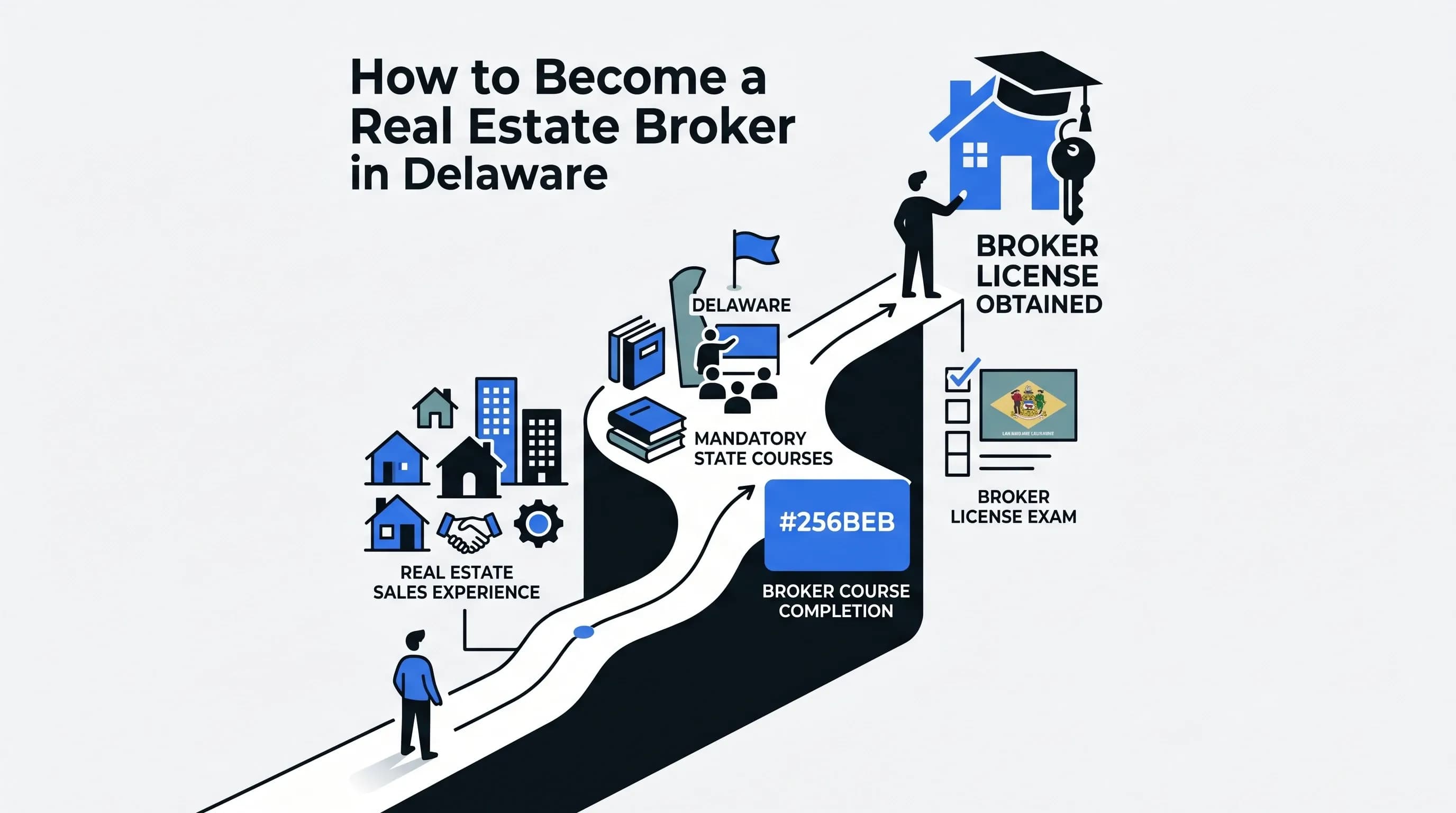
Becoming a Delaware real estate broker is a big step up from simply getting a real estate license. It means more independence, more responsibility, and usually a more serious commitment to the business side of real estate. In Delaware, broker and associate broker licensure are regulated by the Delaware Division of Professional Regulation and the Delaware Real Estate Commission (DREC), and the application process runs through DELPROS.
If we want the honest version, this is not an entry-level move. Most people first become licensed as a Delaware real estate salesperson or agent, spend time learning the business under a sponsoring broker, and then move toward broker licensure when they have the experience, judgment, and systems to handle more responsibility.
In this guide, we’ll walk through the full process, explain the difference between broker and associate broker paths, cover Delaware broker license requirements, and talk about what actually helps someone become ready for broker-level work.
In Delaware, applicants may pursue licensure as either a:
Those two categories are closely related, but they are not identical. Delaware’s official licensing structure treats them together in many places, while also making clear that there are additional requirements if we want to be licensed specifically as a Broker.
That distinction matters because many people search for how to become a real estate broker in Delaware when they are really still at the salesperson-to-broker stage of planning. In practice, the usual path looks like this:
So before we focus on the Delaware broker application process, it helps to be clear about one thing: broker is the second phase of a real estate career, not the first.
When we apply for a Delaware real estate broker license, the main entities we need to know are:
Delaware’s official materials emphasize that all applications are submitted through DELPROS. Once we begin an application, we can save it and come back later, but only for a limited period. The state indicates we have six months to submit after starting an application, and we can monitor progress through the e-License dashboard using the View Application Status feature.
This matters more than it sounds. A lot of licensing delays happen because people assume they can start an application and casually circle back later. Delaware gives flexibility, but not forever. If we are not organized with documents, education records, and other requirements, the process can drag out unnecessarily.
One of the biggest points of confusion in Delaware real estate licensing is the way people casually use the words agent, salesperson, and broker as if they mean the same thing. They do not.
Most people start by earning a Delaware real estate salesperson license, working under a broker, learning contracts, disclosures, client communication, prospecting, and transaction flow. Only after building real experience do they move toward broker and associate broker licensure.
That progression is important because a broker is not just an agent with a nicer title. A broker may supervise agents, manage compliance, run office systems, review risk, and carry more legal and operational responsibility. So if our long-term goal is to become a licensed Delaware real estate broker, we should think in terms of career progression, not just licensing steps.
Before moving toward any Delaware real estate licensing path, we should make sure we meet the basic qualifications. Delaware-specific licensing guidance commonly points to these baseline standards:
If there is any issue in our background that could affect licensure, it is smart to verify that with the appropriate Delaware licensing authority before spending money on classes, exam prep, or application fees. Guessing is a bad strategy when licensure is involved.
Even though broker candidates are usually beyond the beginner stage, this still matters because background and documentation issues can affect the application process at any level.
A broker license is built for experienced professionals. The Delaware broker education ecosystem strongly suggests that meaningful field experience is expected before taking this step. One of the clearest examples is broker course marketing aimed at licensed Delaware REALTORS® with 5+ years of experience.
That does not just sound impressive in a brochure. It reflects reality. To qualify for broker licensure and actually succeed in the role, we should already be comfortable with:
In short, before we become a broker, we should first become a strong agent. That usually means learning the business in the field, not just in the classroom.
The official Delaware licensure page repeatedly emphasizes three actions before applying:
That is the right mindset for any Delaware broker licensure application. The state groups the process into requirements for:
So our exact route depends on how we qualify. If we are applying through the standard path, we need to satisfy the exam applicant requirements. If we hold a license elsewhere and qualify through a reciprocal route, we need to meet the separate reciprocity applicant standards.
Because rules, fees, and supporting documentation can change, the safest approach is always to verify the current details on the official Delaware DPR broker and associate broker licensure page before we file anything.
Many applicants searching for a Delaware broker license discover that Delaware also licenses associate brokers. That can be confusing, so here is the practical takeaway:
If we are unsure which one fits our career plan, the right move is to check the Delaware Real Estate Commission’s current definitions and licensing criteria. The state’s terminology matters. Using general real estate advice from another state can create confusion because broker structures vary a lot from one jurisdiction to another.
Yes, education is a major part of the process. The Delaware sources point to a 99-hour Delaware Real Estate Broker Licensing Course as a core piece of broker preparation.
This is one of the most important keyword themes across the top-ranking results for a reason. If we want to become a licensed Delaware real estate broker, we should expect substantial broker-level education, not a quick seminar.
One strong example from the Delaware market is a 99-hour Delaware real estate broker course approved by the Delaware Real Estate Commission. The cited program included:
Schedules and pricing vary, but this tells us what to expect from real broker licensing education in Delaware: serious time commitment, structured classes, and a course designed for working professionals moving into the next phase of their career.
When looking for Delaware-approved pre-licensing course providers or broker-level education providers, local associations are often one of the best starting points. Delaware REALTORS® points people toward local associations and education opportunities in:
Beyond local associations, Delaware real estate schools and commercial education vendors may also offer relevant classes, exam prep, and continuing education. Still, we should always confirm that any course we choose is approved for the licensing purpose we need.
Some people searching this topic are not actually ready for the broker phase yet. If that is us, the first milestone is getting a Delaware real estate salesperson license.
That entry-level path commonly includes:
This is worth mentioning because many future brokers make the mistake of thinking only about the end goal. A better strategy is to use the early years intentionally: learn under a reputable broker, shadow experienced agents, understand contracts, build a CRM, track your numbers, and develop the kind of professional judgment that broker-level work actually requires.
The official state materials include a section for Additional Requirements for Exam Applicants. That tells us some broker candidates must qualify by examination rather than reciprocity.
If we are on the exam route, we should expect the process to include:
The source material provided here does not spell out every broker exam detail or vendor instruction, so this is one area where final verification through official Delaware sources is especially important. We should never rely entirely on a third-party summary when an exam and license eligibility are on the line.
Delaware also separates out reciprocity applicants. If we already hold licensure from another jurisdiction, we may not follow the exact same path as exam applicants.
In that situation, we should review:
Reciprocity is one of those areas where assumptions cause delays. Even if another state’s requirements seem comparable, Delaware will still expect us to follow its own process exactly.
Once we are ready, the DELPROS broker application is the center of the process. Delaware makes it clear that broker and associate broker applications are filed online.
We have six months to submit after starting the application. That sounds generous, but it goes quickly if we are still chasing transcripts, education records, or other supporting materials.
A practical rule is simple: do not begin your DELPROS application until you are genuinely ready to assemble the whole file.
Delaware’s licensing language repeatedly stresses the need to attach and acknowledge documents. While the exact list depends on the applicant type, we should generally be prepared for documents related to:
It helps to have documents scanned clearly, saved in acceptable formats, and named in a way that makes them easy to recognize. Something as small as a blurry upload or incomplete attachment can slow down a broker application.
Delaware real estate licensing guidance commonly includes fingerprinting and background check steps in the broader licensing process. Even though people often first hear about this at the salesperson level, the bigger lesson applies at every level: be accurate, be complete, and do not leave anything to guesswork.
If there is a question about a criminal record, licensure issue, or anything else that might affect eligibility, it is far better to clarify it in advance than to hope it will not matter. Broker licensure is built on trust, compliance, and professional responsibility. The application should reflect that from the beginning.
Another common mistake is confusing the state application fee with the cost of the education itself.
These are separate expenses:
The exact state fee was not included in the research provided, so we should check the current Delaware fee schedule directly before applying.
After submission, DELPROS allows us to monitor the application online. This is not just a convenience feature. It is one of the best ways to avoid delays.
We should use the dashboard to:
Many applications are delayed not because the applicant is unqualified, but because a required document is missing, incomplete, or not acknowledged correctly. Fast follow-up matters.
The honest answer is that the broker timeline depends on where we are starting.
If we are not licensed yet, the initial Delaware real estate agent license or salesperson path may take roughly 7 to 14 weeks in faster cases, or several months if we move more slowly, need a retake, or wait on scheduling. That phase can include pre-licensing, exam prep, the licensing exam, background steps, and application processing.
If we are already licensed and asking specifically about the Delaware broker upgrade, the timeline is longer because broker licensure is normally a second-stage career move. We need time to gain experience, complete broker education, meet the applicable requirements, and file a complete application.
So the practical answer is this: becoming a broker in Delaware takes more than passing a class. It takes licensure, experience, education, and readiness for greater responsibility.
If our long-term plan is to become a broker, the brokerage where we start can shape everything that follows. New licensees often focus too heavily on the commission split, but that is usually the wrong priority at the beginning.
Support matters more than split when we are learning the business. A strong brokerage can help us build the habits that later make broker licensure realistic.
If we plan to become a broker someday, we should learn under people who handle compliance, reputation, and ethics the right way. Real estate is a relationship business, and reputation compounds over time.
The best preparation for broker licensure happens while we are actively practicing real estate. The most successful long-term professionals usually build broker-level readiness by doing the basics consistently and well.
That often includes:
This may sound like agent advice, but it directly supports the broker path. Brokers need business discipline, not just licensing knowledge. If we want to supervise agents or run a brokerage one day, we should start acting like a business owner early.
Real estate education pages often focus on licensing steps, but the financial side deserves just as much attention. Getting licensed, building experience, and moving toward broker status all cost money.
Depending on where we are in the process, expenses may include:
One practical lesson from Delaware real estate training advice is that many new agents spend over $1,000 before earning meaningful income. That reality still matters later when planning a broker move. If we eventually want to operate at broker level, we should already be practicing financial discipline:
Broker status can increase opportunity, but it also increases responsibility. Good money habits are part of broker readiness.
Getting licensed is not the finish line. Delaware real estate licenses renew every two years, and renewal ends on April 30 of even-numbered years. The Delaware REALTORS® education information indicates that renewal requires 21 credit hours of continuing education.
That is one of the key continuing education and license renewal themes across the search results, and it matters for brokers just as much as for other license types.
We should also remember:
That is why it is wise to treat compliance as an ongoing system, not a once-every-two-years scramble.
Strong brokers do more than just satisfy the minimum legal requirements. Delaware’s education ecosystem also points toward broader professional development that can improve skill, trust, and career longevity.
If we are REALTORS®, we may also need to complete Code of Ethics training. The referenced materials note a 2.5-hour ethics requirement in recurring cycles, with the cited deadline running through December 31, 2027 for that cycle.
This is separate from state licensure, but it still matters. If we want to stay active in REALTOR® organizations, ethics compliance is part of professional credibility.
Delaware REALTOR® education resources also highlight Realtor® safety training. For brokers, safety is not just personal. It becomes part of office operations, agent training, open house procedures, and risk management.
Designations and certifications can also help a broker specialize and grow authority in areas like luxury, investment property, relocation, or buyer representation. These are optional, but they can be a smart next step once the licensing foundation is in place.
Delaware’s licensing pages include warnings about scams involving impersonators claiming to be investigators, board members, or government officials. In some cases, spoofed calls may even appear to come from official numbers.
If we receive suspicious communication about a real estate license, application, or investigation, the best response is simple:
This is one more reason official state sources should always control the final decision-making process. Third-party schools and blogs are useful for orientation, but the Delaware Division of Professional Regulation remains the authority for current rules, fees, procedures, and eligibility.
If we want the process in a clean, simplified format, here is the practical roadmap.
If we boil the whole process down, becoming a licensed Delaware real estate broker is about more than satisfying a checklist. Yes, there is a formal licensing process: education, application, documentation, exam or reciprocity requirements, DELPROS filing, and renewal. But there is also a professional reality behind it.
The people most prepared for broker licensure are usually the ones who already treat real estate like a real business. They build systems. They learn contracts. They track their numbers. They maintain ethics. They choose good mentors. They stay financially disciplined. And they keep learning even after the license is in hand.
So if our goal is to become a licensed Delaware real estate broker, the smartest approach is to move in order: get the right foundation, gain experience, complete approved broker education, verify the current Delaware Real Estate Commission requirements, and apply through DELPROS with a complete and well-organized file.
That path takes effort, but it is manageable when we approach it systematically.

Hey, in Propphy we're determined to make a business grow. My only question is, will it be yours?
It's totally free, with no commitments
Hey, in Propphy we're determined to make a business grow. My only question is, will it be yours?
It's totally free, with no commitments