Becoming a real estate broker in Florida is one of those career moves that quietly changes everything. You’re no longer just closing deals as an agent—you’re stepping into true business ownership, with the ability to run your own firm, hire agents, structure commission splits, and build long-term income streams.
Florida makes the process very doable, but it is also very specific. If we follow the steps in order and treat this like a professional pathway—not a side hobby—we can avoid most of the detours and frustrations that trip people up.
In this 6-step guide, we’ll walk through exactly how to get your Florida real estate broker license, from eligibility and education to the state exam, license activation, and what it really takes to succeed once you’re a broker.
Broker vs. Sales Associate in Florida
Before we jump into the steps, it helps to be clear on what makes a Florida real estate broker different from a sales associate (agent).
- Sales Associate – Works under the direction and control of a broker. Can list and sell real estate, but cannot operate independently.
- Broker – Can perform all real estate brokerage services for others and for compensation, but also:
- Open and manage a brokerage office
- Supervise sales associates and broker associates
- Handle escrow and trust accounts
- Take full responsibility for advertising and compliance
- Broker Associate – Has a broker license but chooses to work under another broker’s company.
In practical terms, becoming a broker is a step up in both responsibility and earning potential. Instead of just doing deals, we can build a brand, create systems, and design a business that outlives any individual transaction.
Florida Real Estate Broker License Requirements
Florida doesn’t let us jump straight to a broker license just because we passed the sales associate exam. Before we invest in a 72-hour broker pre-licensing course or schedule the Florida broker exam, we need to confirm we qualify.
Basic personal requirements
To qualify for a Florida real estate broker license, we must:
- Be at least 18 years old
- Have a high school diploma or GED (or equivalent)
- Have a U.S. Social Security number
- Be of good moral character (our fingerprints and background check must meet DBPR standards)
Florida residency is not required, which is why many out-of-state real estate professionals choose to add a Florida real estate broker license to their credentials.
Experience requirement (where many applicants get tripped up)
The experience requirement is where we see many agents get surprised. To qualify as a broker applicant, we must:
- Hold an active sales associate license (Florida or a state with mutual recognition)
- Have at least 24 months of active real estate licensure during the preceding 5 years
A few key clarifications:
- The 24 months must be active experience, not just time we held a license while being inactive.
- We can earn those 24 months under one or multiple licensed brokers.
- If we’re licensed in another state, we’ll need an official license history from that state showing:
- Initial exam type and date
- Current license status
- Any disciplinary actions
- Documented months of active experience in the last 5 years
If we’re at 18–20 months of experience now, we can still start planning our upgrade—and even take the pre-license course—but we won’t be able to activate our Florida broker license until we truly hit the 24-month mark.
Mutual recognition for out-of-state licensees
Florida has mutual recognition agreements with several states (currently Alabama, Arkansas, Connecticut, Georgia, Illinois, Kentucky, Mississippi, Nebraska, Rhode Island, West Virginia). If we hold a license in one of these states and are non-residents of Florida, we may:
- Qualify for an equivalent Florida license (sales associate or broker) without repeating full pre-licensing education
- Still need to pass the Florida real estate law exam (40 questions; need 30 correct to pass)
Even with mutual recognition, once we’re licensed in Florida we must follow the same post-license and continuing education (CE) rules as every other Florida licensee.
The 6-Step Florida Broker Licensing Process
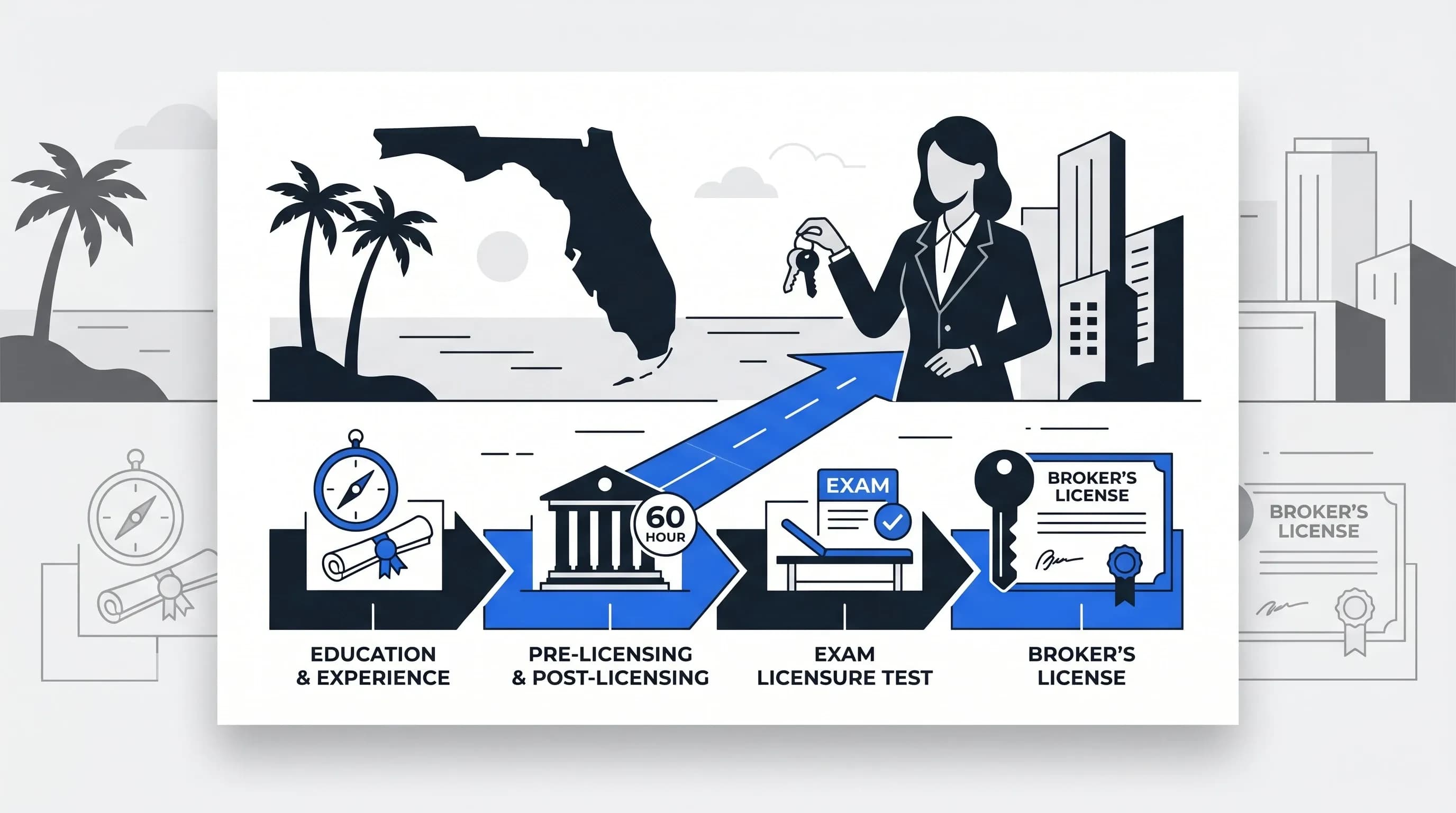
Here’s the big-picture path for how to become a real estate broker in Florida:
- Confirm eligibility and enroll in the 72-hour Florida broker pre-license course.
- Apply to the Florida DBPR for a broker license.
- Complete electronic fingerprinting and background check.
- Finish the 72-hour course and pass the school exam.
- Schedule and pass the Florida broker state exam with Pearson VUE.
- Activate your broker or broker-associate license and complete required post-licensing.
Now let’s walk through each step in detail.
Step 1: Confirm You’re Eligible & Choose a 72-Hour Broker Pre-License Course
The smartest move is to confirm we’re actually eligible before we start paying exam fees or blocking off weeks to study. Once that’s clear, we can treat the 72-hour broker pre-licensing course as our broker business bootcamp rather than just a checkbox.
A. Double-check your experience timeline
To recap, Florida requires:
- 24 months of active experience as a licensed sales associate or broker during the last 5 years
- Experience can be in Florida or a mutual recognition state, as long as the license is current and in good standing
We want to be realistic here. If we’re a few months short, it’s often smart to:
- Plan when those 24 months will officially be complete
- Start our education and exam prep so that by the time we hit 24 months, we’re ready to activate quickly
B. Choose a Florida real estate broker pre-licensing course
Florida law requires us to complete a 72-hour FREC-approved broker pre-licensing course. This is more advanced than the 63-hour sales associate pre-license course—we’re moving from “how to do deals” to “how to run the brokerage that supports those deals.”
The broker pre-licensing course typically covers:
- Advanced Florida real estate license law and FREC rules
- Brokerage management and operations
- Escrow and trust account requirements, audits, and liability
- Office policy, supervision, and recordkeeping
- Real estate investment analysis and finance
- Brokerage relationships, agency compliance, and disclosures
- Ethics, discipline, and risk management
We can take this course:
- Online – Self-paced or live virtual; best if we need flexibility around our current production.
- In person – Good if we know we perform better with structure and live interaction.
Most schools keep our enrollment valid for about a year. Once we complete the content, we’ll take the course final exam at the school level to earn our Course Completion Certificate.
Many agents underestimate this course because they already close deals, but experience alone doesn’t teach us the rules and liabilities of running a brokerage. Treating the class like a serious step into ownership gives us an edge when we reach the state exam and, more importantly, when we’re managing real clients’ money and agents’ careers.
Step 2: Apply for Your Florida Broker License with DBPR
We can (and usually should) apply to the state while we’re completing the pre-licensing course. That way, the background check and application can be processing in parallel instead of adding weeks of delay.
A. Where and how to apply
All licensing is handled by the Florida Department of Business and Professional Regulation (DBPR), under the Florida Real Estate Commission (FREC).
To apply for a Florida real estate broker license:
- Go to www.myfloridalicense.com
- Create or log in to a DBPR account
- Find the Real Estate Broker application in the Real Estate section
- Submit the application online (recommended) or download the paper form and mail it
On the application we’ll be asked to:
- Provide personal information (name, address, SSN, etc.)
- Disclose criminal or disciplinary history, if any
- Document our prior licensing and experience
- Pay the broker application fee (commonly listed around $70; we should always verify current fees on the DBPR site)
B. Processing time and status
DBPR processing usually takes about 10–30 days once they receive:
- Our complete application
- Supporting documents (like any court records, if applicable)
- Our fingerprints (more on that in Step 3)
We can track the status of our application inside our myfloridalicense.com account. If our background and paperwork are straightforward, this part tends to be uneventful—but getting it started early keeps us from sitting around waiting after we’re done studying.
Step 3: Complete Fingerprinting & Background Check
Florida requires all real estate sales associates and brokers to undergo a criminal background check via electronic fingerprints. This is where the “good moral character” requirement gets verified.
A. How to get fingerprinted
If we’re in Florida, we’ll use an approved Live Scan fingerprint vendor. Typical process:
- Schedule an appointment with a Live Scan provider (many allow online scheduling)
- Bring a valid government-issued ID
- Provide the correct ORI number when requested
Costs usually run around $55–$60, depending on the vendor.
If we’re outside Florida, we can request a fingerprint card from DBPR, have our prints taken locally, and mail the card back as instructed.
B. Use the correct ORI number
For a Florida real estate license background check, we must use the ORI: FL920010Z. This code tells the fingerprinting provider and the Florida Department of Law Enforcement that our prints are specifically for a real estate license under DBPR.
C. Timing strategy
To avoid delays, it’s smart to do fingerprints while our DBPR broker application is already submitted or underway. That way, the application review and background check can line up, and we can receive exam authorization closer to when we finish the 72-hour course.
Step 4: Complete the 72-Hour Broker Course & Pass the School Exam
Before we can sit for the Florida broker state exam, we must complete the broker pre-licensing course and pass the course final exam administered by our school.
A. Finishing the broker pre-licensing course
To successfully complete the 72-hour Florida broker course, we need to:
- Complete all required modules and hours (online or classroom)
- Satisfy any attendance or time-on-task requirements set by the school
Even though a lot of the content feels like an extension of what we do daily as agents, the broker material goes deeper into how to supervise others, handle escrow funds, and avoid disciplinary action. Treating this as training for our future brokerage rather than just a test-prep course makes it much more valuable.
B. Passing the course exam
Most broker pre-license courses use a 100-question multiple-choice exam at the school level.
- Minimum passing score: generally 70% (70 out of 100)
- Once we pass, we receive a Course Completion Certificate
- This certificate is typically valid for 2 years and is required to sit for the state broker exam
If we don’t pass on the first attempt:
- We must wait at least 30 days before retaking the school exam
- If we fail the school exam twice, Florida requires us to repeat the entire 72-hour course before trying again
Because re-taking the whole course costs time and money, it’s worth treating the school exam like the first serious dress rehearsal for the state exam. By now, we want to be comfortable with licensing law, brokerage operations, and exam-style questions.
Step 5: Schedule and Pass the Florida Broker State Exam
The state exam is the big hurdle in the Florida real estate broker licensing process. Experience helps, but this is ultimately a rules-and-details test, not just a test of how good we are at listing or selling.
A. Getting authorization to test
Once DBPR approves our broker application, the background check clears, and we’ve passed the 72-hour course exam, our information is sent to Pearson VUE, the exam provider.
We’ll receive an Authorization to Test or exam approval notice that includes our:
- Candidate ID or FLREAPP number (typically 9 digits)
We use this ID to schedule the Florida real estate broker exam.
B. Scheduling with Pearson VUE
To schedule the state broker exam, we can:
Key details:
- Exam fee is typically around $57.75 per attempt (we should verify the current fee)
- Our exam authorization is generally valid for 2 years from the date of approval
- If we fail and need to retest, we can reschedule but must pay the exam fee each time
The Florida real estate broker exam is a computer-based test administered at Pearson VUE testing centers.
- Length: 3.5 hours
- Questions: 100 multiple-choice questions
- Passing score: 75% (we need at least 75 correct answers)
Exam content is generally weighted across:
- Florida real estate license law and FREC rules
- Brokerage relationships and agency law
- Brokerage operations, escrow, and trust accounts
- Real estate finance and investment analysis
- Property rights, titles, conveyances, and closings
- Federal and state laws affecting real estate (fair housing, advertising, etc.)
- Real estate math, closing statements, tax and fee calculations
D. How to prepare effectively (beyond just experience)
We often see that real-world experience alone doesn’t pass the Florida broker exam. The exam is about understanding and applying Florida-specific real estate laws, numbers, and definitions under time pressure.
An effective exam prep plan usually includes:
- Taking a focused exam prep/cram course tailored to the Florida broker state exam
- Doing plenty of broker-level practice questions that mirror Pearson VUE’s style
- Drilling:
- Brokerage relationships (single agent, transaction broker, no brokerage; and duties that apply to all)
- Escrow and trust account rules, timelines, and dispute resolution
- Advertising rules and prohibited practices
- Homestead, property tax concepts, and exemptions
- Required disclosures (lead-based paint, material defects, environmental issues, flood zones)
- Commission math, transfer taxes, doc stamps, and typical closing costs
- FREC powers, disciplinary actions, and penalties
- Practicing under timed conditions to be comfortable with the 3.5-hour limit
At the test center, we’ll receive unofficial pass/fail results immediately. Knowing we’ve treated the first attempt like our only shot gives us the best chance of walking out with a passing score and no need to reschedule.
Step 6: Activate Your Broker or Broker-Associate License
Passing the state exam and receiving our broker license number doesn’t automatically mean we can start practicing as a broker. The license is issued but not usable for brokerage activities until it’s properly activated in the DBPR system.
A. Choose your path: Broker vs. Broker Associate
We have two main options for how to use our Florida broker license:
- Broker Associate – We hold a broker license but work under another broker’s company (much like a sales associate, but with higher credentials).
- Good if we:
- Want the broker credential for credibility
- Prefer to learn more about brokerage operations inside an established firm
- Don’t want the full overhead and risk of running a brokerage yet
- Broker (running our own brokerage) – We act as the qualifying broker and may:
- Operate as a sole proprietor, or
- Register a corporation, LLC, or partnership that is authorized to act as a broker
- Hire sales associates and broker associates
- Keep the brokerage portion of all commissions and build a team
Under Florida Statute s. 475.15, any corporation, LLC, or partnership acting as a broker must:
- Register with the Florida Real Estate Commission
- Maintain at least one active broker (often the qualifying broker) at all times
- Update its registration if the qualifying broker’s license goes out of force, or the entity’s registration can be canceled
B. How to activate your broker license
To activate our license, we or our employing broker must file the proper information with DBPR. This can be done:
- Online via our myfloridalicense.com account:
- If we’re becoming a broker associate, our employing broker links our license to their brokerage
- If we’re opening our own brokerage, we register the firm and designate ourselves as the qualifying broker
- Or via DBPR forms:
- Individual change or activation forms (such as broker status changes)
- Entity registration forms for corporations, LLCs, or partnerships
Once DBPR processes the activation, our license status will show as Active in the online system, and we can legally perform brokerage services in Florida.
After Licensing: Post-License Education, CE, and Staying Compliant
Getting our broker license is the start of a new chapter, not the end of the story. Florida has very specific post-licensingcontinuing education requirements to keep a Florida real estate broker license active and in good standing.
A. Broker post-license education (first renewal)
For our first renewal period as a Florida broker, we must complete:
- 60 hours of broker post-licensing education (often offered as two 30-hour courses: Broker Investment and Broker Management)
This must be completed before our first broker license expiration date. If we fail to meet this requirement:
- Our broker license becomes Null and Void
There is an exemption for individuals with a 4-year degree (or higher) in real estate, but we’d need to submit official transcripts to the Division of Real Estate for verification.
B. Continuing education after the first renewal
After we complete the initial broker post-licensing requirement, every active broker in Florida must complete:
- 14 hours of continuing education (CE) every two years, including:
- A 3-hour Core Law course
- Additional specialty topics to reach the full 14 hours
Florida Bar members in active good standing may be exempt from the standard CE, but still need to handle renewal on time.
C. Renewal deadlines and “involuntary inactive” status
Florida broker licenses typically expire on either March 31 or September 30, depending on our assigned group. By the expiration date, we must have:
- Completed all required education (post-license or CE)
- Paid the renewal fees through DBPR
If we miss the education or fee deadline, our license can become Involuntarily Inactive. In that status, we can’t legally practice until we:
- Complete a 28-hour reactivation course (for some inactive scenarios)
- Pay any required reactivation or late fees
If we stay in that status too long without meeting requirements, the license may become Null and Void, and we’d have to meet current requirements and reapply as if new.
D. Hardship extensions
Florida does allow for hardship extensions for certain education requirements (like broker post-licensing or the 28-hour reactivation course) in genuine hardship situations. These requests must be submitted in writing, with supporting documentation, to the Division of Real Estate’s Hardship Section.
Special Case: Out-of-State Brokers & Mutual Recognition
If we’re licensed as a broker or sales associate in a mutual recognition state, we may be able to:
- Obtain a Florida real estate broker license via mutual recognition rather than starting from scratch
- Skip the full pre-licensing course in some cases, but still pass the 40-question Florida law exam with at least 30 correct
We still need to go through DBPR’s application process, fingerprinting, and exam authorization, and once licensed we follow the same post-licensing and CE rules as in-state brokers.
From Zero to Broker: If You’re Just Getting Started
If we’re brand new and not yet licensed at all, our path to becoming a Florida real estate broker is a two-stage journey:
- Stage 1: Become a Florida Real Estate Sales Associate (Agent)
- Complete a 63-hour sales associate pre-license course
- Pass the school exam (70% or better)
- Apply to DBPR for a sales associate license (application fee, fingerprints, background check)
- Pass the Florida sales associate state exam (100 questions; need 75% to pass)
- Activate the license under a broker
- Stage 2: Gain Experience & Upgrade to Broker
- Work as a sales associate, accumulating 24 months of active licensure in the last 5 years
- Follow the 6-step broker licensing process we’ve outlined
This is where thinking ahead matters. If we know early on we want to become a broker, we can choose brokerages, training, and production goals that set us up to hit the 24-month requirement with solid experience and a strong client base.
Typical Costs to Become a Real Estate Broker in Florida
Costs vary by school and vendor, but here’s a ballpark breakdown for the Florida real estate broker licensing process:
- DBPR broker application fee: about $70
- Fingerprinting/background check: around $55–$60
- State broker exam fee (Pearson VUE): about $57.75 per attempt
- 72-hour broker pre-license course: varies (often a few hundred dollars, depending on provider and format)
- Broker post-licensing & CE courses: additional ongoing costs every renewal cycle
We should always verify current fees directly on:
Turning Your Florida Broker License into a Real Estate Career Upgrade
Getting the Florida broker license gives us options—but whether it becomes a real career upgrade depends on what we do in the first year.
Many agents get their broker license, hang a shingle, and then drift: minimal production, no recruiting, and overhead that eats into profits. To make this move actually pay off, we want to approach it with the mindset we’d expect from a serious professional, not just someone collecting titles.
A. Decide what kind of broker you want to be
Before we choose between broker associate vs independent broker, it helps to answer a few questions:
- Do we want to be a high-producing solo broker with minimal staff?
- Are we aiming to build a small, tight-knit team?
- Do we want a larger recruiting-focused brokerage with many agents?
Our answer will shape:
- How we structure splits and compensation
- What systems we need (recruiting, onboarding, training, leads)
- How we allocate our time between personal production and managing others
B. Build systems, not just a business card
As brokers, we’re responsible for more than our own transactions. To avoid chaos, we want systems for:
- Lead generation (for ourselves and possibly our agents)
- Transaction management (checklists, file compliance, deadlines)
- Escrow handling (policies that fully align with FREC rules)
- Marketing templates (so agents don’t inadvertently violate advertising laws)
- Training & onboarding (if we bring on agents or broker associates)
Treating our first year as a broker like a “training camp” where we build and refine these systems usually pays bigger dividends than chasing a few extra one-off deals.
Quick Checklist: How to Become a Real Estate Broker in Florida (6 Steps)
To wrap everything into a simple reference, here’s the full 6-step Florida real estate broker license checklist.
- Confirm Eligibility
- 18+ years old with a high school diploma or GED
- U.S. Social Security number
- Active sales associate (or broker) license in Florida or a mutual recognition state
- At least 24 months of active licensure during the last 5 years
- Background clear enough for DBPR standards
- Complete the 72-Hour Florida Broker Pre-License Course
- Enroll in a FREC-approved 72-hour broker course (online or classroom)
- Finish all course modules and time requirements
- Pass the school exam (typically 70% or better)
- Obtain and keep your Course Completion Certificate
- Apply to DBPR for a Broker License
- Go to myfloridalicense.com
- Submit the Florida real estate broker application online or by mail
- Pay the broker application fee (around $70; confirm current amount)
- Disclose any criminal or disciplinary history and attach documents
- Complete Fingerprinting & Background Check
- Schedule fingerprints with a Live Scan provider or request a fingerprint card
- Use ORI FL920010Z for Florida real estate licensing
- Allow time for DBPR and FDLE to process your background check
- Pass the Florida Broker State Exam
- Receive exam authorization and Candidate ID from Pearson VUE
- Schedule the exam and pay the exam fee
- Take the 100-question, 3.5-hour state broker exam
- Score at least 75% to pass
- Activate Your License & Plan Your Broker Career
- Decide whether to work as a broker associate or open your own brokerage
- Activate your license and (if applicable) register your brokerage entity with DBPR
- Complete 60 hours of broker post-licensing before your first renewal
- After that, complete 14 hours of CE every 2 years
If we follow these steps in order—treating the broker license like the professional upgrade it is—we’ll not only obtain a Florida real estate broker license, we’ll be positioned to use it to build a stronger, more scalable real estate business in the Sunshine State.