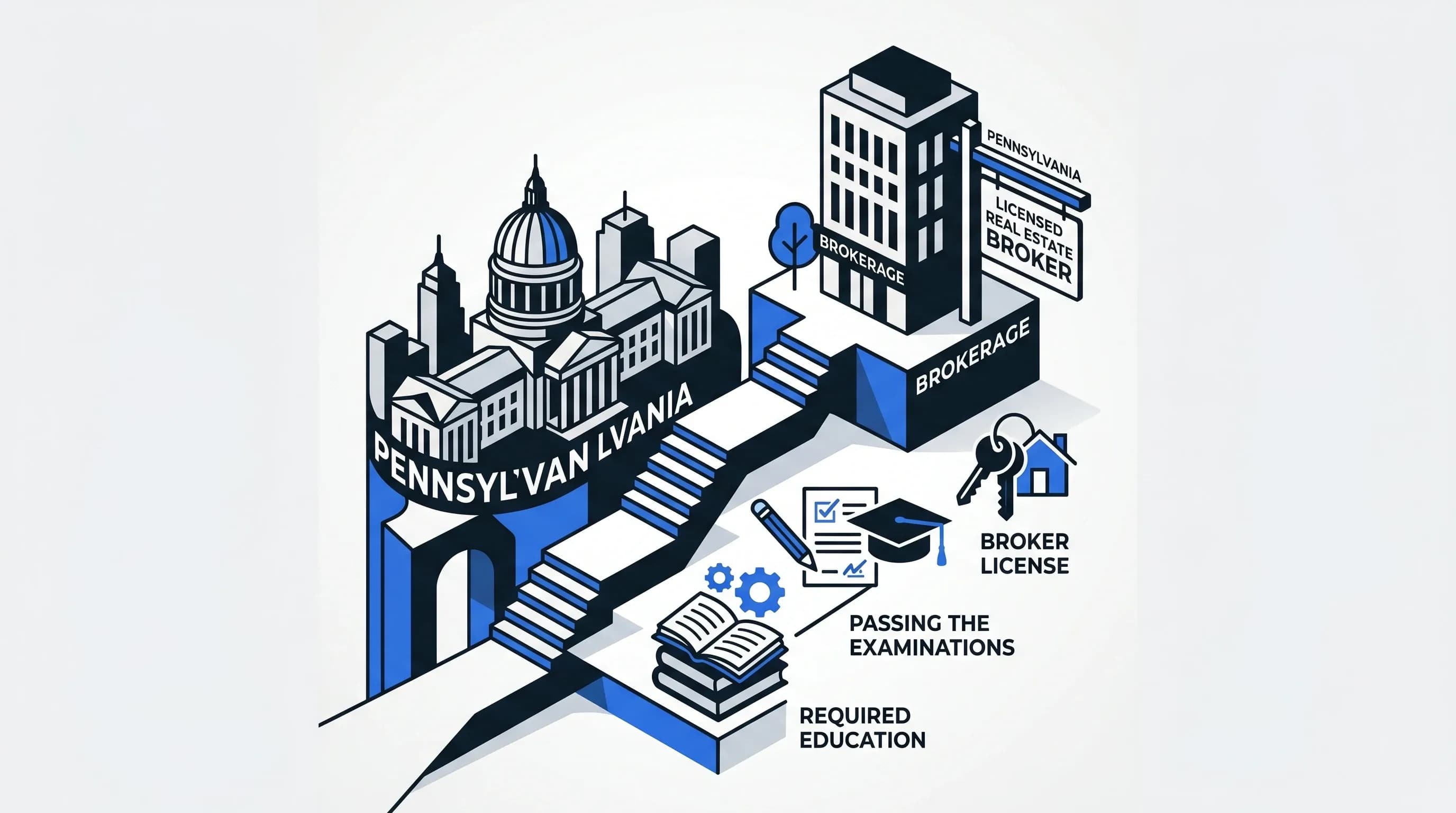
If we want to become a licensed broker in Pennsylvania, we need to think of the process in two stages. First, we become licensed as a real estate salesperson. Then, after building experience and completing additional education, we qualify for a Pennsylvania real estate broker license. On paper, the path is straightforward. In practice, the professionals who move through it successfully usually combine the licensing steps with smart career decisions about training, mentorship, lead generation, and long-term business growth.
In this guide, we’ll walk through the real estate broker license requirements in Pennsylvania, including eligibility, the 240 hours of education, the 3 years of experience, the broker examination, the broker application process, fees, continuing education, reciprocity, and the differences between an associate broker, broker of record, and sole proprietor broker.
A broker in Pennsylvania has more authority than a salesperson. Once we obtain our broker’s license, we may negotiate or assist with the purchase, sale, lease, exchange, financing, optioning, and management of real estate interests. A broker can also supervise other licensees and, depending on the license type, run a brokerage business.
That is why many agents eventually pursue broker licensure. For some, it is about income potential. For others, it is about independence, leadership, and the ability to build a business instead of only working within one.
To become a licensed broker in Pennsylvania, we generally must meet these broker licensure requirements:
If we are just starting from scratch, we cannot skip directly to broker. We must first get licensed as a Pennsylvania salesperson and build the practical foundation that supports broker qualification.
This is one of the most important points to understand early. If our end goal is to open our own brokerage, become a broker of record, or supervise agents, we still begin with the salesperson license. Pennsylvania’s standard broker license is not an entry-level credential.
That matters because the best future brokers tend to use those early years well. They do not just wait out the clock for three years. They use that time to learn contracts, negotiation, inspections, financing issues, disclosures, timelines, and client management. They also learn something the licensing process does not teach very well: how to generate business consistently.
Before we can apply for a PA real estate broker license, we need the underlying experience that comes from working as a licensed salesperson. For many people, this is the stage where the real career habits are formed.
At the salesperson level, applicants generally need to be at least 18 years old, have a high school diploma or GED, complete the required pre-licensing education, pass the licensing exam, and satisfy any background requirements. Some sources also reference legal residency and background review as part of the process.
Pennsylvania typically requires 75 hours of approved pre-licensing education for the salesperson license. In many cases, this is broken into:
These courses are often available online or in person. For many working adults, online classes are the easiest fit because they offer flexibility. The bigger issue is usually not whether the material is impossible. It is whether we stay disciplined enough to finish.
A practical budget to get started as a salesperson often falls around $600 to $1,000 total when we factor in education, exam fees, background check costs, application fees, and possible brokerage startup expenses.
The years before broker status are where we build the experience Pennsylvania expects us to document later. They are also where many people learn a hard truth: getting licensed is not the same as building a successful real estate career.
New agents often focus too much on the commission split when choosing a brokerage. In reality, training, mentorship, systems, and lead generation support usually matter more. A brokerage with a flashy split but weak support can leave us with 100% of very little. A supportive office or team can help us gain transaction experience faster and avoid preventable mistakes.
For standard broker licensure in Pennsylvania, the core eligibility requirements are clear:
The Pennsylvania State Real Estate Commission is the authority that controls these standards, so we should always confirm current forms, fees, approved course providers, and examination procedures before applying.
One of the biggest broker license requirements in Pennsylvania is education. The state requires 16 credits of professional real estate education, which equals 240 hours of instruction.
This is a major step up from salesperson education, and it is meant to reflect the broader responsibilities of a broker. The coursework is not just a box to check. It prepares us for brokerage operations, legal obligations, management issues, and more advanced real estate decision-making.
The broker education must include:
In addition, at least 6 of the remaining 12 credits must come from three or more approved broker course topics.
Approved broker courses may include topics such as:
When we choose courses, we should double-check that they are broker-approved courses recognized by the Commission. Not every real estate class counts toward broker licensure.
Some applicants may satisfy the broker education requirement through educational equivalency. This may apply if we hold:
A general degree does not automatically waive the education requirement. If we plan to rely on educational equivalency, we should verify eligibility directly with the Commission before assuming our transcripts will qualify.
Pennsylvania also requires practical experience. In general, we must have been engaged as a licensed real estate salesperson for at least three years, unless the Commission determines some other experience or education is equivalent.
Applicants are also commonly expected to show at least 200 experience points. These points are usually based on transactions that were initiated and successfully completed.
The experience-points concept matters because it reflects actual field activity, not just time holding a license. This is one reason the early brokerage environment matters so much. If we spend three years in an office with little support, poor lead flow, or no practical training, it can slow down both our competence and our documented progress toward broker eligibility.
That is why many new agents benefit from asking better questions before joining a brokerage:
Broker candidates should keep careful records of transactions, production activity, and supporting details. When it is time to file the broker application, the summary of experience is much easier to prepare if we have tracked it all along.
Here is the clearest roadmap for how to become a licensed broker in Pennsylvania.
We must be at least 21 years old and have a high school diploma or equivalent.
We need at least 3 years of experience as a licensed real estate salesperson, plus enough practical activity to support the required experience summary. This is where strong habits make a difference: lead generation, follow-up, relationship building, and transaction management all contribute to real career growth and to the experience Pennsylvania expects to see.
We must complete the full 16 credits of approved broker education unless we qualify for an educational waiver or equivalency. Many candidates complete these courses online at their own pace, which can help if we are balancing work, family, and active transactions.
Before submitting anything, we should prepare:
To sit for the broker exam, we typically need approval first. That means completing the Broker Examination Approval Application and filing it with the Pennsylvania State Real Estate Commission along with supporting documentation.
We should not assume we can schedule the exam immediately. The Commission reviews the application and, once approved, authorizes us to move forward with testing.
For standard broker licensure, we generally must pass both parts of the examination:
Some references describe the broker exam as multiple choice and note that it can be deceptively tricky. In other words, it is not usually impossible, but it does reward careful reading and intentional preparation.
After passing the exam, we complete the remaining application steps and choose the broker role that fits our goals:
The broker exam is one of the final major hurdles. Pennsylvania typically requires standard broker applicants to pass both the national and PA-specific sections of the exam.
Some training materials and provider references describe the broker licensing exam as including:
Because testing vendors and exam formatting can change, we should always verify the current examination requirement with the Commission or the current approved testing provider.
The exam is very passable, but we should not rush into it the moment we finish class. Candidates often do better when they:
If we do not pass on the first try, that does not predict failure in the profession. Many successful agents and brokers needed a retake. The smarter response is to adjust the study strategy and try again.
Broker applicants may also need to complete background review steps. Some licensing guidance references fingerprinting and background checks through Pennsylvania systems, and timing can matter. For example, background documents may need to fall within a certain validity period when we submit the application.
If we have any criminal history or concerns about eligibility, it is wise to contact the Commission before spending significant time and money on courses and application fees. Reviews are often handled case by case.
One of the most common search questions is cost. Here is a practical broker license fee breakdown based on the standard fee schedule referenced in current guidance.
| License or Fee Type | Amount |
|---|---|
| Broker Sole-Proprietor | $169.50 |
| Broker Corporation, LLC, or Partnership | $179.50 |
| Broker Multi-licensee / Broker of Record | $119.50 |
| Associate Broker | $97.00 |
| Broker Examination Fee | $40.00 |
Fees can change, so we should always confirm the latest amounts before applying.
Pennsylvania broker licenses renew on a biennial renewal cycle. Continuing education is not required for the initial broker license, but it is required for renewal.
To renew a standard broker license, we generally must complete:
| Renewal Type | Broker Renewal Fee |
|---|---|
| Broker Sole-Proprietor, Broker Corporation/LLC/Partnership, or Broker Multi-Licensee | $126.00 |
| Associate Broker | $96.00 |
It helps to treat renewal planning as part of running a real business. Strong brokers build systems early: calendar reminders, CE tracking, document retention, CRM use, and regular skill development.
After we obtain licensure, we need to choose the structure that fits our goals.
An associate broker is licensed at the broker level but works under another broker’s supervision. This is often a good fit if we want the credibility and authority of broker status without immediately opening our own firm.
A broker of record is the qualifying broker for a corporation, LLC, or partnership. If we plan to build an entity-based brokerage, this role becomes especially important.
A sole proprietor broker operates independently. This option offers the most direct control, but it also brings the most responsibility for compliance, supervision, systems, and business development.
For many professionals, the best choice depends less on ego and more on readiness. Do we want support while growing into leadership, or are we prepared to run the full operation ourselves?
Pennsylvania also has pathways for certain out-of-state licensees.
A person who holds a current real estate license from another state and whose principal place of business is outside Pennsylvania may be eligible for a reciprocal license under Pennsylvania law.
Act 41 helps certain out-of-state professional licensees obtain licensure in Pennsylvania through endorsement, provided they are:
If we have been actively licensed as a broker in another state within the last five years, Pennsylvania may require us to take only the Pennsylvania portion of the examination. Likewise, a reciprocal licensee converting to a standard broker license may only need the state portion.
This is one of the most important areas to verify directly with the Commission, because reciprocity and endorsement cases can turn on technical details about license status, jurisdiction, and timing.
The timeline depends on where we are starting.
So the shortest realistic path is usually a little over three years from the beginning, and often longer depending on how quickly we complete education and accumulate experience.
The licensing rules tell us how to qualify. They do not always tell us what slows people down. These are some of the biggest issues future brokers should watch for:
One of the clearest lessons from real-world agent development is that relationships and follow-up matter just as much as credentials. Many transactions are won long after the first conversation. If our long-term goal is broker status, that business discipline matters now, not later.
If we want the most practical version of the process, it looks like this:
Generally, no. The standard path requires us to first hold a salesperson license and then gain the required experience before applying for broker licensure.
We need 16 credits, equal to 240 hours of instruction, in approved professional real estate education.
We generally need 3 years of experience as a licensed real estate salesperson, plus enough documented activity to satisfy the Commission’s practical experience expectations, commonly described as 200 experience points.
No. Continuing education is not required for the initial broker license, but it is required for renewal.
The referenced broker examination fee is $40.00, though we should verify the current amount before scheduling.
Possibly. Reciprocal license options and Act 41 licensure by endorsement may apply, and some out-of-state brokers may only need to pass the Pennsylvania portion of the exam.
If we want to become a real estate broker in Pennsylvania, the formula is simple but not instant: get licensed correctly, build real experience, complete the required broker education, pass the broker exam, and choose the broker role that matches our goals.
The bigger opportunity is not just getting the Pennsylvania broker license. It is becoming the kind of professional who can actually use it well. The strongest brokers are usually the ones who learned how to be competent, ethical, productive agents first. They focused on training, relationships, follow-up, and business systems long before they filed the broker application.
So if we are serious about becoming a licensed broker in Pennsylvania, the smartest path is to treat every stage with intention: salesperson first, experience second, broker licensure next, and sustainable business building all the way through.

Hey, in Propphy we're determined to make a business grow. My only question is, will it be yours?
It's totally free, with no commitments
Hey, in Propphy we're determined to make a business grow. My only question is, will it be yours?
It's totally free, with no commitments