Becoming a real estate agent in Dubai is one of the lowest‑barrier, highest‑upside career moves you can make. But just like in any property market, it’s also one of the easiest careers to drift in, stall out, and quietly quit without ever “technically” leaving.
In this beginner’s guide, we’ll walk you through exactly how to start a real estate career in Dubai and the wider UAE: from RERA licensing and choosing a brokerage to commissions, skills, technology, and what your first 6–12 months will really feel like. We’ll keep the tone casual, but we’ll be brutally honest—because this is a commission‑based sales and marketing business, not a TV show about driving clients around in a G‑Wagon.
Why Dubai Is One of the Best Places to Start a Real Estate Career
Dubai is one of the most dynamic real estate markets in the world, and for beginners it offers a mix of opportunity and structure that many other cities can’t match.
- Huge and growing demand: A rising population, constant inflow of expats, and strong foreign investment all keep transaction volumes high.
- Iconic projects & diverse inventory: From Dubai Marina apartments to Palm Jumeirah villas and off‑plan master communities, there’s a niche for every type of agent.
- Well‑regulated market: Dubai Land Department (DLD) and the Real Estate Regulatory Agency (RERA) enforce clear rules, escrow requirements, and standard contracts, which protects both clients and agents.
- High earning potential + no personal income tax: Commission‑based earnings can far exceed typical salaried roles, and the lack of personal income tax means you keep more of what you make.
- International exposure: You deal with buyers, tenants, and investors from all over the world, which is career‑building experience you can’t easily replicate elsewhere.
The flip side: competition is fierce, and your results depend entirely on your skills, work ethic, and ability to build trust. This is not a “post pretty listings on Instagram and wait for DMs” kind of job. It’s a lead‑generation business first, a home‑tour business second.
What a Real Estate Agent in Dubai Actually Does
On paper, a Dubai real estate agent (often called a property consultant or broker) helps people buy, sell, and rent property. In practice, most of your day revolves around finding clients and managing deals from first contact to handover.
Core Responsibilities in the Dubai / UAE Property Market
- Prospecting & lead generation
Calling leads, following up portal inquiries, talking to walk‑ins, networking at events, and nurturing your database. In reality, this is the bulk of your job—if no one knows you exist, nothing else matters.
- Client consultation
Understanding whether someone is an investor or end‑user, their budget, time frame, risk appetite, lifestyle, and preferred communities. Then we translate that into a shortlist of areas (Dubai Marina, Business Bay, JVC, Arabian Ranches, etc.) and specific properties.
- Property sourcing & securing listings
Calling landlords and owners, meeting them, and winning exclusive or semi‑exclusive listings. You’ll advise on pricing, marketing strategy, and realistic timelines based on actual market data, not wishful thinking.
- Marketing properties
Creating high‑quality listings with photos, videos, and descriptions; arranging virtual tours and open houses; using social media and portals to maximize exposure. This is where embracing prop‑tech and AI tools for SEO‑ready listings makes a tangible difference.
- Conducting viewings
Scheduling and managing property tours, explaining building facilities, community pros/cons, service charges, and practical details like parking, noise levels, and commute times.
- Negotiation
Mediating price, terms, handover, and payment plans between buyers and sellers or tenants and landlords. You’re the bridge that keeps deals alive when emotions run high.
- Transaction management
Coordinating contracts, deposits, RERA forms, DLD registration, escrow accounts, mortgage approvals, and final handover. You’ll be liaising with developers, conveyancers, banks, and government portals.
- After‑sales & relationship management
Supporting clients after closing, helping with snagging, move‑in logistics, and minor issues—then staying in touch for future deals and referrals.
Success here depends as much on soft skills—communication, negotiation, empathy, time management, and resilience—as on your knowledge of RERA rules and community price per square foot.
Eligibility & Requirements to Become a Real Estate Agent in Dubai
Before you can legally work as a real estate agent in Dubai, you must meet some basic criteria.
Personal Requirements
- Age: At least 21 years old.
- Education: Minimum of a high school diploma. A degree in business, finance, marketing, or real estate is useful, but not required.
- Residency status: You need a valid UAE residence visa (typically sponsored by your brokerage or your own company structure). Tourists cannot get a broker license or legally act as agents.
- Clean record: You’ll go through background checks as part of visa and licensing; serious offenses can be an obstacle.
Compared with many careers that require multi‑year degrees, this is a relatively low formal barrier. The difficult part is not getting into the business—it’s staying in and becoming consistently productive.
RERA Course, Exam & Licensing: How to Get a Dubai Broker License
In Dubai, you’re regulated by the Real Estate Regulatory Agency (RERA), which operates under the Dubai Land Department (DLD). You cannot legally broker deals without a valid RERA broker card associated with a licensed brokerage or your own trade license.
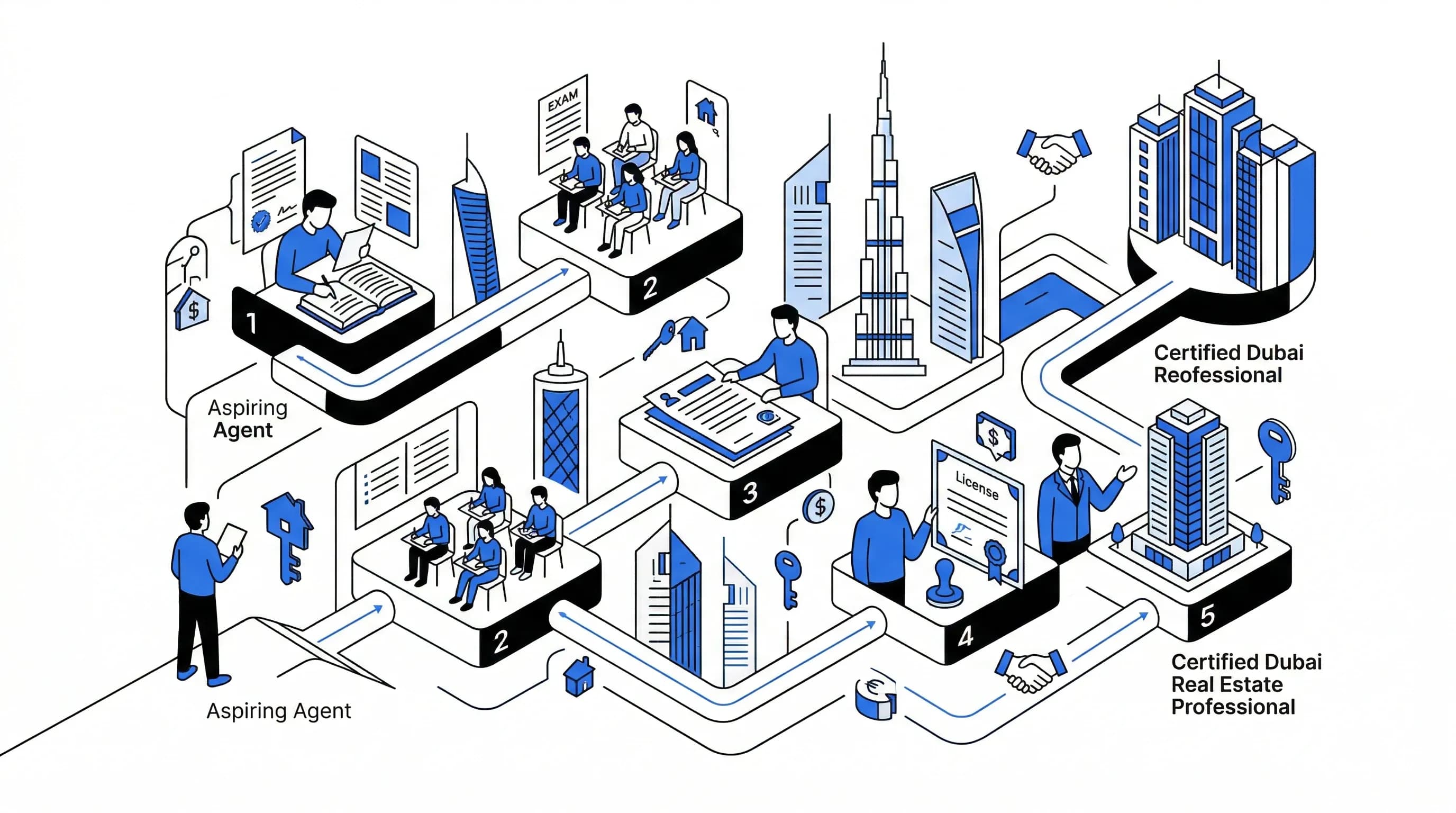
Step‑by‑Step: Dubai Real Estate Agent Licensing Process
- Join (or align with) a brokerage
Technically you can do your RERA course first, but in practice most beginners start by securing a job offer from a reputable brokerage. The company then sponsors your visa and often handles your RERA application. We’ll cover how to choose a brokerage shortly.
- Complete the RERA / DLD broker training course
This is usually a 2–4 day course delivered in person or online through approved providers. You’ll cover:
- Dubai real estate laws and regulations
- Freehold vs. leasehold rules
- RERA code of ethics and professional standards
- Standard forms and contracts
- Procedures for sales and leasing, including escrow
- Pass the RERA exam
The exam is typically a multiple‑choice (MCQ) test of around two hours. Key points:
- Passing score is usually around 75%.
- Questions focus heavily on definitions, legal procedures, and ethics.
- Practice questions and exam‑style drills are far more useful than memorizing every paragraph of the course—just like in many other licensing systems.
- Apply for your RERA broker card
Once you pass, your brokerage will typically submit your documents through DLD/RERA systems. After approval, you receive your broker ID / RERA card, which legally authorizes you to broker property within Dubai.
- Renew annually
Your broker license must be renewed each year, which may involve a refresher course and renewal fees. Letting it lapse can disrupt your ability to transact, so treat renewals like a non‑negotiable business expense.
Note that a Dubai RERA license is valid only in Dubai. Abu Dhabi, Sharjah, and other emirates have separate regulators and licensing requirements.
How Long & How Much Does It Take to Become a Real Estate Agent in Dubai?
- Timeline:
- RERA course: usually 2–4 days.
- Exam scheduling & completion: often within a couple of weeks.
- License processing: generally a few weeks once paperwork and your visa are in order.
- Typical cost (Dubai, excluding visa): roughly AED 10,000–15,000 when you add up:
- RERA training course fees
- Exam fees
- License issuance and administrative charges
Visa, health insurance, and some administrative costs are usually handled by your brokerage if you’re an employee. If you set up on your own, budget additional funds for trade license and company setup.
Choosing Your Path: Join a Real Estate Agency or Work Independently?
Once you’re licensed (or often before), you need to decide whether to:
- Join a real estate brokerage as an agent; or
- Set up your own structure and operate independently (once you meet all regulatory requirements).
Why Most Beginners Should Join a Reputable Brokerage
For new agents, joining an established brokerage in Dubai or the wider UAE is almost always the smarter move. Here’s why:
- Brand credibility: Well‑known agencies are already trusted by landlords, developers, and buyers, making it easier to secure listings and close deals.
- Visa sponsorship: Most brokerages will sponsor your UAE residence visa and handle the paperwork you don’t want to learn the hard way.
- Training & mentorship: A good company doesn’t just give you a desk; they give you market orientation, sales scripts, and senior agents to shadow on real deals.
- Lead flow: Large agencies invest heavily in portals, SEO, marketing, and call centers. You’ll still need to prospect, but you’re not starting with a completely empty pipeline.
- Tools & systems: Access to CRM systems, listing portals, professional marketing templates, and administrative support for contracts and DLD registrations.
Think of it this way: getting a RERA license is the easy part. Learning how to survive your first 6–12 months—avoiding the common “get licensed, do nothing, quietly disappear” pattern—requires a strong environment and people around you who are producing now, not 20 years ago.
Working Independently or Setting Up Your Own Company
Operating as a freelance real estate agent in Dubai or launching your own brokerage gives you autonomy and potentially higher commission splits, but it comes with more risk and responsibility.
Pros:
- You keep a larger share of the commission after costs.
- You control your brand, positioning, and strategy.
- You choose your own tech stack, marketing channels, and niche.
Cons:
- You must handle trade license, company setup, and compliance yourself.
- No guaranteed leads—you are your own marketing department from day one.
- Higher upfront costs and more admin, right when you should be focused on mastering the market and generating clients.
In mature markets worldwide, relatively few true beginners succeed by going fully independent immediately. The same reality applies in Dubai and the UAE: build your skills and pipeline inside a solid brokerage first, then consider your own structure later if it still makes sense.
Choosing Your Niche: Rentals vs Sales, Off‑Plan vs Secondary, Residential vs Commercial
Dubai’s property market is broad. You don’t have to specialize from day one, but picking a focus early gives you a sharper learning curve and a stronger value proposition.
Rentals vs. Sales for New Dubai Agents
Rentals are where many beginners cut their teeth:
- Deals close faster, so you build experience and confidence quickly.
- You meet lots of tenants and landlords, which seeds a future sales pipeline.
- You get to know building layouts, community vibes, and price sensitivities the hard way—which is the best way.
Sales generally pay more per deal but:
- Take longer to close.
- Require deeper market knowledge and stronger negotiation skills.
- Often involve more complex financing and legal considerations.
A practical strategy is to start with rentals in one or two communities, then gradually move into sales as you become known in that area.
Primary (Off‑Plan) vs. Secondary (Resale / Ready) Market
Primary / off‑plan:
- Properties sold directly by developers, often before completion.
- Attractive payment plans, launch prices, and marketing campaigns.
- Your role is to explain developer reputation, project timelines, payment schedules, and escrow protections clearly and honestly.
Secondary / resale:
- Ready or nearly ready properties owned by individuals.
- Immediate or quick handover; clients can see and touch the product.
- Your role is to price realistically using comparables, understand days on market, and negotiate fair terms.
Many top agents eventually combine both: off‑plan for investors with a longer horizon, secondary for end‑users and immediate movers.
Residential vs. Commercial
- Residential (apartments & villas): More emotional decisions, larger pool of potential clients, and a relatively shorter learning curve for beginners.
- Commercial (offices, retail, warehouses, industrial): More technical, fewer but more sophisticated clients, and often larger commissions per transaction—but it can be harder for complete beginners.
For most starters, a residential focus in a small set of communities (e.g., Jumeirah Village Circle rentals, Dubai Marina apartments, or Business Bay offices for one niche) is the most logical path.
Dubai Real Estate Agent Commission Structure & Income Potential
Your income as a Dubai real estate agent is primarily commission‑based. Think of yourself as a business owner whose revenue is tied directly to performance.
Typical Commission Structure in Dubai
- Sales
- Commission is commonly around 2% of the property value, though it can vary.
- This commission is paid to the brokerage by the seller or buyer (depending on agreement), then split between the brokerage and you.
- Rentals
- Commission is often around 5% of the annual rent (sometimes one month’s rent).
- Again, it is typically paid to the brokerage, then shared with the agent.
Agent–brokerage splits vary widely by company and your experience level:
- Some offer a small basic salary + moderate commission split.
- Some are commission‑only with higher splits.
- Top producers may negotiate very favorable splits or caps.
How Much Do Real Estate Agents Make in Dubai?
Publicly available ranges and industry experience paint a similar picture:
- Entry to mid‑level agents: often in the range of AED 120,000–300,000 per year, if they are working consistently and closing deals.
- Experienced and specialized agents: commonly in the AED 300,000–500,000+ per year band, especially in high‑demand communities.
- Top performers & luxury specialists: can earn far more, with some agents crossing AED 100,000+ per month in strong market periods.
But we should be clear: the average agent income is pulled down by a large number of agents doing very few deals. Just holding a RERA license doesn’t guarantee earnings—consistent lead generation and disciplined follow‑up do.
Because income is volatile, we strongly recommend going into your first year with a 3–6 month financial cushion or another stable source of income you can taper off over time. Many new agents worldwide underestimate how long it can take to go from “licensed” to “paid.”
Skills & Mindset You Need to Succeed as a Real Estate Agent in Dubai
The formal requirement to become a real estate agent in Dubai is modest: age, basic education, visa, and a RERA license. The real differentiators are your skills, habits, and mindset.
Core Skills
- Communication & listening: Clients rarely tell you everything in the first conversation. You need to ask the right questions and read between the lines to understand their true priorities.
- Sales & persuasion: Presenting properties as solutions to problems, not just features. Explaining value, not just price per square foot.
- Negotiation: Balancing buyer and seller or tenant and landlord interests, finding win‑win outcomes on price, terms, and handover dates.
- Time management & organization: Juggling multiple leads, viewings, and transactions without forgetting callbacks or missing key dates. A simple CRM— even a spreadsheet at first—can save deals.
- Analytical thinking: Interpreting comparable sales, days on market, inventory levels, and rental yields. Dubai’s market can move quickly, and your advice has to reflect current reality, not last year’s news.
- Technology comfort: Using CRM systems, property portals, WhatsApp, and social media effectively; experimenting with AI‑assisted tools for better listings and marketing.
Personal Traits That Separate Top Agents
- Resilience: You’ll face rejected offers, lost clients, and deals falling apart at the last minute. You must be able to reset quickly and keep prospecting.
- Self‑motivation: Even in a supportive brokerage, no one is going to fill your calendar forever. You’re responsible for building your own pipeline.
- Ethics & integrity: Dubai is a relationship‑driven market. Reputation spreads fast. Walking away from a bad deal for a client is often the best long‑term business decision.
- Curiosity: The market, regulations, and client expectations change. The agents who keep learning, asking questions, and updating their playbook are the ones who stay relevant.
Think of Dubai real estate as an elite sales career: your upside is significant, but it demands professional‑level skill and discipline—not hobby‑level effort.
Understanding the Dubai Property Market: Areas, Laws & Trends
To be taken seriously, especially by seasoned investors and high‑net‑worth clients, you need to move beyond generic descriptions and become genuinely knowledgeable about the Dubai property market.
Freehold vs. Leasehold
- Freehold: Foreigners can own the property outright in designated freehold zones.
- Leasehold: Ownership is via long‑term lease (e.g., 99 years) rather than full freehold title.
You should be able to quickly explain which communities are freehold, what rights an investor has, and any ownership restrictions relevant to specific nationalities.
Key Communities & What They Offer
- Dubai Marina & JBR: High‑rise waterfront living, popular with young professionals and short‑term rental investors.
- Downtown Dubai & Business Bay: City‑center lifestyle close to offices, Dubai Mall, and major landmarks.
- Jumeirah Village Circle (JVC), Jumeirah Village Triangle (JVT): Mid‑priced, family‑friendly communities with strong rental demand.
- Arabian Ranches, Dubai Hills Estate, and other villa communities: Suburban family areas with villas, townhouses, schools, and parks.
- Palm Jumeirah & premium waterfronts: Luxury and ultra‑luxury segments with significant interest from international investors.
Beyond naming communities, aim to know:
- Average prices and rents by bedroom count.
- Typical service charges and how they affect net yields.
- Traffic patterns and commute times.
- Nearby schools, hospitals, malls, and transport links.
- Developer reputations and build quality.
Off‑Plan Regulations & Investor Protection
Dubai’s regulators enforce strict rules around off‑plan sales—escrow accounts, construction milestones, and registration—all of which you must understand well enough to explain to first‑time investors.
You also need at least a working knowledge of:
- Transfer fees and registration costs.
- Rules around rental increases and eviction procedures.
- Developer obligations for handover and snagging.
- Recent or upcoming regulatory changes announced by RERA or DLD.
Following government announcements (like the Dubai 2040 Urban Master Plan), visa reforms (Golden Visa), and new infrastructure projects (metro lines, highways) helps you spot opportunities and give smarter long‑term advice.
Step‑by‑Step: How to Start Your Real Estate Career in Dubai
Let’s stitch everything into a concrete roadmap.
- Confirm eligibility
Make sure you’re 21+, have at least a high school diploma, and can obtain or already hold a UAE residence visa.
- Research the Dubai / UAE market
Spend some time on property portals, read DLD/RERA resources, and visit key communities in person. This early groundwork makes interviews with brokerages more productive.
- Shortlist brokerages
Look for:
- Strong online presence and visible listings.
- Clear training and onboarding for new agents.
- Transparent commission structure and fee policies.
- A culture where agents actively collaborate instead of quietly competing over every lead.
- Prepare your CV & personal story
Highlight any sales, customer service, or negotiation experience, plus languages you speak (English is essential; Arabic, Russian, Hindi, Mandarin, and others are significant advantages in the UAE). A clean, professional headshot matters more here than in many other industries.
- Interview multiple agencies
When you meet potential brokers, ask:
- What does your training for new agents look like in the first 90 days?
- How are leads distributed? What proportion are company‑generated vs. self‑generated?
- What is the commission split, and are there caps or progression paths?
- Who will I call when I’m stuck on a deal? Is there real mentorship or just a “broker of record”?
- Secure a position & residence visa
Once you choose a brokerage, they typically handle your visa sponsorship (if you need one) and start the RERA course registration process with you.
- Complete RERA training & pass the exam
Take the course seriously, but focus your deeper study time on exam‑style questions and practical application—laws, ethics, and procedures you’ll actually use in transactions.
- Obtain your RERA broker card
After passing the exam and submitting all documents, you receive your broker ID. Now you’re officially allowed to operate as a real estate agent in Dubai.
- Set up your tools & daily routine
Get comfortable with:
- Your brokerage’s CRM and lead‑management systems.
- Your professional email, WhatsApp, and signature.
- Your social media profiles—as business assets, not just personal accounts.
Then, build a daily schedule that prioritises lead generation over everything else.
- Pick an initial niche
For example: “JVC rentals,” “Dubai Marina one‑bedroom apartments,” or “Business Bay off‑plan investors.” You can expand later, but focus accelerates learning.
- Start prospecting and learning in parallel
Split your time between:
- Active outreach to leads, landlords, and your personal network.
- Shadowing senior agents on viewings and negotiations.
- Studying market data and recent transactions in your chosen area.
Your first six months will be a blend of structured learning and a lot of uncomfortable but necessary outreach. Treat it like building a business from scratch rather than just “having a real estate job.”
Building Your Network & Generating Leads in the Dubai Property Market
In real estate, who knows you is as important as what you know. Dubai’s expat‑heavy, transient population makes networking even more critical.
Who Should Be in Your Network?
- Other agents and brokers (inside and outside your company).
- Developers’ in‑house sales teams.
- Mortgage brokers, bankers, and financial advisors.
- Lawyers, conveyancers, and corporate service providers.
- Relocation consultants and HR managers of large companies.
- Past and current clients (including tenants and landlords, not just buyers).
Practical Ways to Build and Leverage Your Network
- Inside your brokerage: Learn from top performers. Offer to support their listings or cover viewings when they’re double‑booked. You gain experience and exposure to real‑world deals.
- Developer launches & events: Attend project launches and property exhibitions. Collect details of both end‑users and investors and follow up promptly with specific opportunities, not generic “let me know if you need anything” messages.
- Online platforms: Use LinkedIn to connect with investors, executives, and professionals moving to or living in Dubai. Share concise, useful updates—not just listing spam.
- Referrals & follow‑up: After successfully placing a tenant or selling a unit, ask for introductions to friends or colleagues. Then stay visible through occasional check‑ins, newsletters, and tailored market updates.
Track your networking like you would track any sales activity—how many new people you meet, how many meaningful conversations you have, and how many follow‑ups you complete each week.
Becoming an Area Expert in Dubai or the UAE
Most top agents are known as “the person” for a particular community or segment. In Dubai, being an area specialist is a massive trust shortcut for both landlords and buyers.
What “Area Expert” Really Means
- You know current asking and achieved prices per square foot, not just rough narratives.
- You’ve physically been inside many of the buildings and unit types you’re recommending.
- You can quickly tell a client:
- Which towers rent fastest, and why.
- Which views or floorplans carry a premium.
- Typical service charges and how they affect net yield.
- Average days on market for a 1‑bed vs. 2‑bed in that area.
How to Become an Area Expert as a Beginner
- Physically spend time in your chosen community—walk around, sit in cafes, observe who lives there.
- Preview as many properties as you can, even if they’re not your listings. Take notes on layout, views, finishing, and building maintenance.
- Maintain your own spreadsheet of recently closed deals (prices, sizes, dates) and compare it with portal asking prices.
- Talk to residents and building staff; you’ll learn details that never show up in marketing brochures.
If possible, living in or near your focus area makes all of this easier—you naturally pick up on small changes, hear informal gossip about upcoming projects, and meet potential clients in everyday life.
Using Technology, Social Media & AI as a Dubai Real Estate Agent
Dubai’s buyers and tenants are highly digital. They expect fast responses, rich media, and accurate information. Embracing technology and prop‑tech tools isn’t optional anymore; it’s the baseline.
Essential Tools
- Property portals: Your brokerage should give you access to the major UAE portals. Learn how to post optimized, compliant listings that stand out.
- CRM system: Use it religiously to track every lead, follow‑up, and conversation. The agents who try to manage everything in their head usually leave money on the table.
- Social media: Instagram, TikTok, YouTube, and LinkedIn can all work if you treat them as lead‑generation and education channels, not vanity platforms.
- Marketing & AI tools: Leverage AI‑assisted copywriting for listings, automated email campaigns, and video editing tools to speed up your content production.
Content That Actually Helps You Win Clients
- High‑quality listings: Clear photos, well‑shot videos or virtual tours, and honest descriptions with full details—size, fees, views, and pros/cons.
- Short educational videos: Explain concepts like freehold vs. leasehold, buying off‑plan vs. ready, hidden costs of buying in Dubai, or best areas for certain budgets.
- Market updates: Even simple monthly posts about price trends, new launches, or regulatory changes help position you as an informed professional rather than a random agent with a phone.
Modern marketing shouldn’t replace prospecting; it should amplify it. Early on, aim for a mix: heavy daily outreach + a steady rhythm of useful content that nurtures the people you reach.
Common Challenges New Dubai Agents Face (and How to Overcome Them)
1. Income Instability
Problem: Commission‑only or commission‑heavy compensation makes cash flow unpredictable, especially in your first year.
Solutions:
- Start with at least 3–6 months of living expenses saved, or maintain part‑time/remote work during your ramp‑up phase.
- Keep personal spending lean until you’ve built a consistent pipeline.
- Treat each prospecting action (calls, messages, meetings) as planting seeds that will pay you 3–6 months down the line, not tomorrow.
2. High Competition
Problem: Plenty of agents carry a Dubai RERA card, and many compete over the same leads and listings.
Solutions:
- Differentiate through hyper‑local expertise and better service, not by promising unrealistic prices.
- Niche down by area, property type, or language group (e.g., specializing in Russian‑speaking investors, GCC families, or first‑time expat tenants).
- Deliver what most agents don’t: consistent follow‑up, clear expectations, and honest advice—even when it isn’t what the client wants to hear.
3. Steep Learning Curve (Laws, Procedures, Market)
Problem: RERA rules, DLD portals, contracts, and community‑by‑community knowledge can feel overwhelming.
Solutions:
- Shadow senior agents on real viewings, negotiations, and transfers.
- Attend ongoing training—brokerage sessions, DLD workshops, and beginner‑friendly real estate courses available in the UAE.
- Focus first on mastering one area + one main segment (e.g., rentals in JVC) instead of trying to cover all of Dubai.
4. Client Expectations
Problem: Some landlords want above‑market rents; some buyers expect “distress deals” on prime properties.
Solutions:
- Use hard data—recent sold/rented comparables—to set expectations.
- Communicate regularly, even when there’s no news, so clients never feel ignored.
- Be willing to walk away from clients who insist on unrealistic pricing that will waste both your time and theirs.
The Future of Real Estate Careers in Dubai & the UAE
Dubai’s long‑term development plans and regulatory improvements suggest real estate will remain a major economic pillar. Key trends new agents should watch:
- Urban expansion and infrastructure: The Dubai 2040 Urban Master Plan, new metro lines, and emerging communities create fresh niches and investment stories.
- Tech & prop‑tech growth: From AI‑generated listings to virtual reality tours, technology is reshaping how agents market properties and manage clients.
- Sustainability & smart homes: Green buildings, smart home features, and energy efficiency will matter more to buyers and tenants, particularly in higher‑end segments.
- Regulatory refinement: RERA and DLD continue to refine laws for rental increases, eviction, off‑plan sales, and escrow protections—raising professional standards and client expectations.
Agents who commit to continuous learning—about laws, tech, and market trends—will be well‑positioned as the UAE property sector matures.
FAQs About Becoming a Real Estate Agent in Dubai
How long does it take to become a real estate agent in Dubai?
Assuming you already have or can obtain a residence visa, you can typically:
- Finish the RERA course in 2–4 days.
- Pass the exam and complete licensing in a few weeks afterward.
The bigger time factor is how long it takes to generate your first closed deal—often 3–6+ months of consistent work.
How much does it cost to become a real estate agent in Dubai?
Excluding visa and living expenses, plan for around AED 10,000–15,000 to cover the RERA course, exam, and licensing fees. Visa, health insurance, and company setup (if you go independent) add to that.
Is it necessary to have a university degree?
No. A high school diploma is sufficient for Dubai’s real estate agent requirements. Degrees in business, finance, or marketing can help but are not mandatory.
Can foreigners work as real estate agents in Dubai?
Yes, foreigners can absolutely work as property agents in Dubai, provided they:
- Have a valid UAE residence visa.
- Pass the RERA broker exam.
- Work under a properly licensed brokerage or have their own compliant business setup.
Do I need to speak Arabic to succeed?
No. English is the primary working language in Dubai real estate. However, additional languages (Arabic, Russian, Hindi/Urdu, French, Mandarin, etc.) are a big competitive edge for specific client segments.
Should I focus on rentals or sales as a beginner?
Many new agents in Dubai start with rentals because:
- Deals close faster, giving quicker experience and some early commission.
- They’re a strong way to meet both tenants and landlords, who may later buy or sell.
As you gain confidence and area knowledge, you can transition into or add sales, which typically provide higher commission per deal.
Is Dubai a good place to start a real estate career as a beginner?
Yes—if you approach it like building a serious sales and consulting business. The upside is substantial due to high transaction values and tax‑free income, but the failure rate is also high for people who underestimate the need for consistent prospecting, learning, and financial planning.
Your Next Steps
If you’re serious about a real estate career in Dubai or the wider UAE, here’s a simple action checklist:
- Verify you meet the basic eligibility (age, education, visa route).
- Shortlist 3–5 reputable brokerages and schedule interviews.
- Decide whether you’ll go full‑time immediately or maintain a transitional income source for your first 6–12 months.
- Commit to passing the RERA course and exam quickly instead of dragging it out.
- Once licensed, build a daily routine that prioritises:
- Lead generation and follow‑up.
- Area and market study.
- Skill development in sales, negotiation, and technology.
Dubai’s real estate market rewards agents who combine regulatory knowledge with relentless consistency, ethical advice, and modern marketing. With the right brokerage support, a clear plan for your first year, and a willingness to treat this as a business—not a side hobby—you can build a stable, scalable, and highly rewarding career as a real estate agent in the UAE.