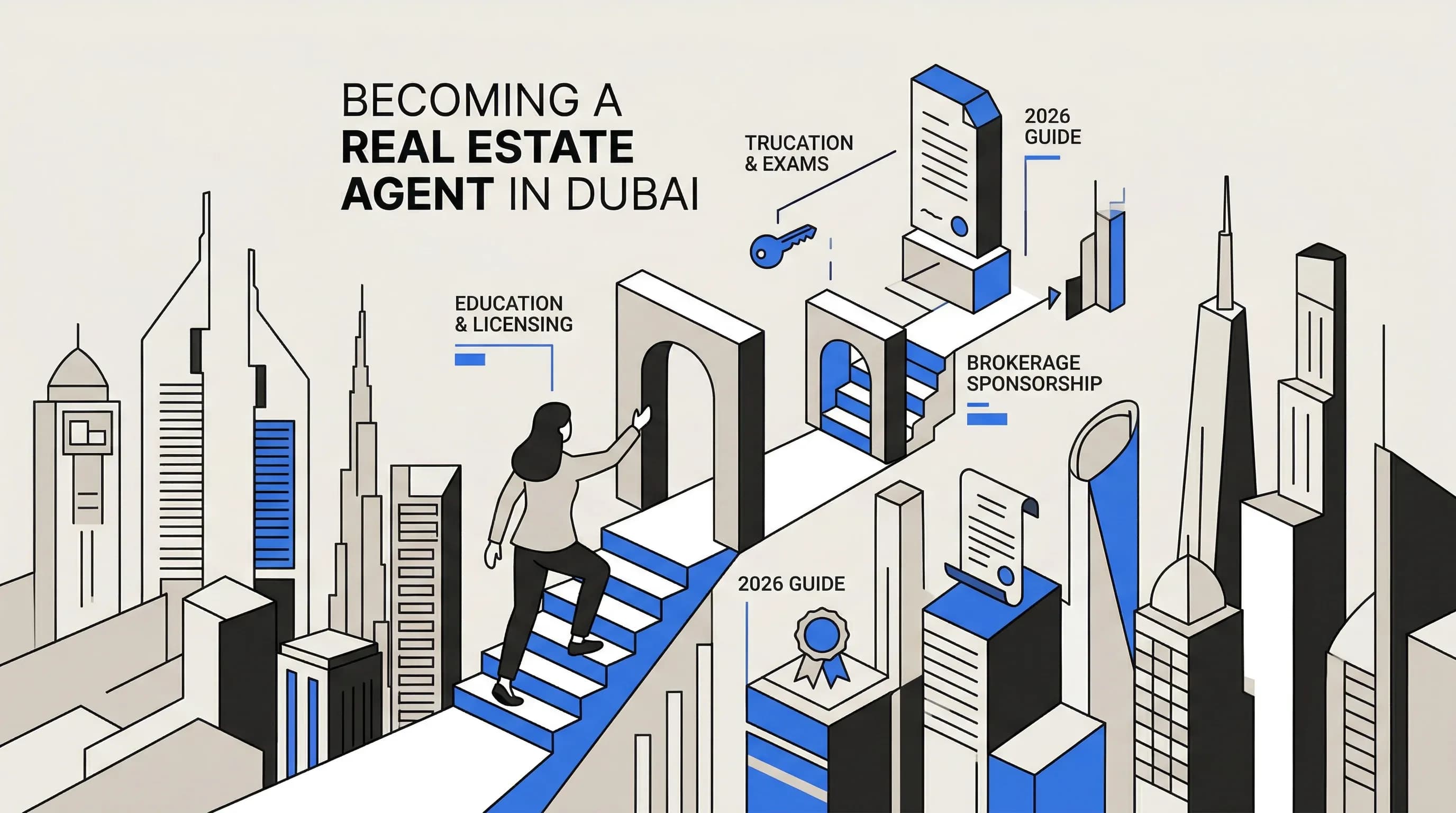
Becoming a real estate agent in Dubai looks glamorous from the outside: luxury penthouses, international investors, big commissions. In reality, it’s a simple business with low formal barriers to entry—but it’s not easy. It’s sales, it’s entrepreneurship, and it’s a mental game. If you go in with clear eyes and a real plan, you can absolutely build a six‑ or even seven‑figure real estate career in the UAE from scratch.
In this beginner’s guide, we walk you through how to start a real estate career in Dubai and the wider UAE: requirements, RERA license, costs, salary, skills, and the daily work that actually gets you paid.
Why Dubai Is One of the Best Places to Start a Real Estate Career
Dubai is one of the most active and globally visible real estate markets in the world. When people search for how to become a real estate agent in Dubai, they’re usually attracted by three things: income potential, lifestyle, and growth.
- High demand & constant inflow: A growing population, continuous expat inflow, and strong foreign investment mean a steady stream of buyers and tenants.
- Iconic, diverse inventory: From studios in Jumeirah Village Circle to villas in Arabian Ranches and luxury units in Dubai Marina or Downtown Dubai, there’s a niche for almost every client profile.
- Well‑regulated market: The Dubai Land Department (DLD) and the Real Estate Regulatory Agency (RERA) create a relatively transparent, rules‑based market compared to many global hubs.
- Tax advantage: No personal income tax means your commission‑based earnings go much further than in many Western countries.
- Global exposure: You work with investors and end‑users from all over the world—Europe, GCC, CIS countries, India, China, Africa, and beyond.
At the same time, we need to be blunt: opportunity is huge, but competition is intense. You are paid purely for performance. You “eat what you kill.” That’s true whether you’re in the US, Europe, or Dubai—the fundamentals of the job don’t change: your income depends on your ability to generate leads and build trust.
What a Real Estate Agent in Dubai Actually Does Day to Day
On TV it looks like “show nice apartments, sign a contract, collect commission.” On the ground, being a Dubai real estate agent is much more about lead generation and client management than it is about marble countertops.
Core Responsibilities in the Dubai Property Market
- Prospecting & lead generation: Calling leads from portals, responding to online inquiries, networking, following up with previous clients, door‑knocking buildings, talking to landlords.
- Client consultations: Understanding whether someone is an investor or end‑user, their budget, visa status, time horizon, risk appetite, and preferred communities.
- Property sourcing & listings: Securing exclusive listings from landlords and sellers; advising on realistic pricing using recent transactions and current demand.
- Marketing properties: Creating high‑quality, SEO‑friendly listings with photos, videos, descriptions, floor plans, and sometimes 360° virtual tours.
- Viewings & presentations: Scheduling and conducting tours, highlighting lifestyle and investment benefits, honestly explaining drawbacks like construction noise or high service charges.
- Negotiation: Finding win‑win deals around price, payment plans (especially for off‑plan), handover dates, inclusion of furniture, and contract clauses.
- Transaction management: Coordinating contracts, deposits, NOCs, bank approvals, escrow accounts, transfer appointments at DLD, tenancy contracts (Ejari) for rentals, etc.
- After‑sales service: Supporting handover, move‑in, minor snagging issues, and staying in touch for future deals and referrals.
Key Soft Skills for Dubai & UAE Real Estate
- Communication & active listening with international clients who may be unfamiliar with UAE systems.
- Negotiation & persuasion that balances cultural nuances and expectations.
- Time management across multiple listings, viewings, and transactions.
- Resilience to handle slow months, rejected offers, and difficult clients.
- Integrity & ethics—your reputation is your long‑term currency; one bad deal can cost years of future referrals.
Whether you’re closing deals in Dubai Marina or a suburban community, the underlying work is the same as any serious market: consistently finding people who want to buy, sell, or rent—and guiding them safely through the process.
Eligibility & Requirements to Become a Real Estate Agent in Dubai
To legally start a real estate career in Dubai, you must meet specific eligibility criteria before you even think about commissions.
Basic Personal Requirements
- Age: At least 21 years old.
- Education: Minimum high school diploma (or equivalent). A university degree in business, finance, marketing, or real estate is helpful but not mandatory.
- Residency status: You need a valid UAE residence visa. Tourists and visitors cannot legally work as real estate brokers or obtain a RERA broker license.
- Clean record: You’ll typically need standard background checks; serious criminal records can be an issue.
Can Foreigners Become Real Estate Agents in Dubai?
Yes. Many of the most successful agents in the Dubai real estate market are foreigners. The key is securing:
- A valid residence visa (usually through your employer/brokerage or your own company setup), and
- Your RERA broker license issued under a licensed Dubai real estate brokerage.
You do not need to speak Arabic to succeed; English is the working language of the Dubai property market. That said, speaking Arabic, Russian, Hindi, Urdu, Chinese, French, or other widely used languages in Dubai can be a significant advantage for building your client base.
RERA Course, Exam & Licensing: How to Get Your Dubai Real Estate License
To work as a real estate agent in Dubai, you must be officially licensed by the Real Estate Regulatory Agency (RERA), under the Dubai Land Department (DLD). Think of this as the UAE equivalent of state licensing in the US: without it, you simply cannot legally broker deals.
Step‑by‑Step: How to Get a RERA Broker License
-
Join or coordinate with a real estate brokerage
While you can book the RERA course yourself, in practice most beginners connect with a brokerage first. Just like in many markets where your license must “hang” under a broker, in Dubai your broker ID will be associated with a specific company.
-
Complete the RERA/DLD Broker Training Course
- Duration: typically 2–4 days.
- Content: UAE and Dubai real estate laws, RERA regulations, contracts, escrow rules, broker ethics, procedures for sales and leasing, freehold vs leasehold, off‑plan rules.
- Format: in‑person or online sessions via approved training providers.
-
Pass the RERA Exam
- Format: multiple‑choice questions (MCQs).
- Time: around 2 hours.
- Passing score: commonly around 75%.
- Focus: legal framework, forms, ethical obligations, Dubai Land Department procedures, basic market knowledge.
We recommend you treat it like a serious professional exam—skim the course for big concepts and definitions, then spend most of your preparation time on realistic practice questions, just as you would with US state licensing exams.
-
Apply for your RERA Broker License
Once you pass, your brokerage (or you, through the appropriate portal) submits your documents to DLD/RERA for license issuance. After approval, you get your broker ID, which allows you to legally represent clients in Dubai property transactions.
-
Renew annually
Your RERA license must be renewed every year. This usually involves renewal fees and sometimes refresher training.
How Long Does It Take to Become a Real Estate Agent in Dubai?
- Training: 2–4 days.
- Exam scheduling & result: can be a few days to a couple of weeks.
- License processing: typically a few weeks, often handled in coordination with your brokerage.
Realistically, if you already have (or are getting) your residence visa and you move quickly, you can go from “beginner” to legally licensed Dubai real estate agent in roughly one to two months.
How Much Does It Cost to Get a RERA License?
Figures vary by year and specific setup, but sources commonly quote a total of around AED 10,000–15,000 per individual agent for:
- RERA/DLD course fees
- Exam fees
- License issuance and related services
This does not include your residence visa, health insurance, or general living expenses. Some brokerages will cover parts of the licensing cost; others expect the agent to pay. Either way, you want to plan a realistic startup budget, the same way any new agent in any country must cover licensing, association, and basic marketing expenses up front.
Dubai vs Other Emirates: Where Should You Base Your Real Estate Career?
Dubai is the most searched and globally recognised market, but the UAE has other active emirates.
- Dubai: Highest international visibility, deep off‑plan and luxury markets, intense competition, strong regulations via DLD/RERA.
- Abu Dhabi: Separate regulatory authority and licensing framework, more government and corporate tenants, different fee structures.
- Sharjah, Ajman, Ras Al Khaimah, etc.: Lower price points, different demographics, and local rules.
Licensing is emirate‑specific: a Dubai RERA broker license does not automatically allow you to broker in Abu Dhabi or Sharjah. For most beginners chasing international investors and high‑value deals, Dubai is the logical starting point.
Should You Join a Real Estate Agency or Work Independently in Dubai?
Technically, once you’re properly licensed and have the right trade licenses and structures, you could operate independently. In practice, especially as a beginner, joining an established Dubai real estate brokerage is by far the better move.
Why Most Beginners Should Join a Brokerage
- Brand credibility: A well‑known brokerage logo on your card instantly reduces friction with landlords and buyers.
- Visa sponsorship: Many brokerages sponsor your residence visa, which is a prerequisite for RERA licensing.
- Training & mentorship: Scripts, role‑plays, structured onboarding, shadowing senior agents—exactly the kind of support that helps new agents anywhere survive their first months.
- Lead flow: Access to portal leads, walk‑ins, website inquiries, and sometimes call‑center generated prospects.
- Tools & technology: CRMs, listing systems, photographers, video teams, administration, in‑house legal/procedural guidance.
This is similar to how new agents in North America are advised to join a solid, well‑capitalized brokerage or team instead of going entirely solo from day one. You are essentially buying speed, systems, and proven processes with a share of your commission.
Working Independently (Freelance / Own Company)
Operating as a freelance real estate agent or under your own property company in Dubai gives you more control but also more responsibility.
- You keep a larger chunk of each commission.
- You must handle your own company setup, trade license, and overhead.
- You are fully responsible for lead generation, marketing, and legal compliance.
This path suits experienced agents with a strong personal brand, solid savings, and a stable network. For a genuine beginner’s guide to being a real estate agent in Dubai, we recommend you treat “independent” as a phase two goal—after you’ve learned the ropes under a reputable brokerage.
Dubai Real Estate Agent Commission Structure and Income Potential
Whether you’re in Dubai or Los Angeles, real estate is overwhelmingly a commission‑based business. Your income is performance‑based, not time‑based.
How Commission Works in Dubai
- Sales: Typical total commission is often around 2% of the property value (sometimes more in specific cases), usually paid by the seller or buyer depending on the agreement.
- Rentals: Commission is often around 5% of the annual rent, paid by the tenant or landlord per market customs and contract.
The brokerage receives the full commission and then pays you your share based on the agreed commission split. Splits vary widely:
- Some agencies: small basic salary (e.g., AED 4,000–5,000) + moderate commission percentage.
- Others: no basic salary but a much higher commission split.
- Team structures: you might split with the team leader when they provide leads, systems, or mentorship.
How Much Do Real Estate Agents Make in Dubai?
You’ll see a wide range of figures because performance varies dramatically:
- Average or early‑stage agents: Rough guides put income around AED 120,000 – 200,000 per year once you get going.
- Growing mid‑career agents: Around AED 200,000 – 500,000 per year, especially once you move from rentals into sales or luxury stock.
- Top producers: Well‑positioned agents in luxury segments can earn the equivalent of six or seven figures in USD, with peak months north of AED 100,000.
The real pattern is the same as in any competitive market: most agents make modest incomes or quit; a minority who treat it like a real business and master lead generation make multiples of a typical salary job.
Financial Reality for Beginners
- Expect 3–6 months before meaningful and consistent commission checks.
- You need a financial cushion or side income to survive your first months without desperate decision‑making.
- Budget not only for licensing, but also for transport, phone, basic marketing, and living costs.
If you approach Dubai real estate the way serious new agents approach any commission‑only market—by saving a cushion, tracking costs, and being honest about the ramp‑up time—you massively improve your odds of staying in the game long enough to win.
Understanding the Dubai Property Market: Primary vs Secondary, Freehold vs Leasehold
To be taken seriously by investors and end‑users, you need more than a license; you need market literacy.
Primary (Off‑Plan) vs Secondary (Ready / Resale)
- Primary / Off‑Plan:
- Units sold directly from developers.
- Often attractive payment plans and launch prices.
- Key topics: developer reputation, escrow account rules, construction timelines, handover quality, and exit strategy.
- Secondary / Resale:
- Existing properties owned by individuals or companies.
- Immediate or near‑immediate move‑in or rental.
- Key topics: realistic valuation, recent comparables, days on market, current rental yields.
A strong Dubai real estate agent can clearly articulate the pros and cons of off‑plan vs secondary for each client’s situation, instead of pushing whatever stock is easiest to sell.
Freehold vs Leasehold
- Freehold areas: Foreigners can own property outright (title deed in their name), such as many communities in Dubai Marina, Downtown Dubai, Palm Jumeirah, JVC, etc.
- Leasehold areas: Ownership is via long‑term leases (e.g., 99 years), with specific use and renewal conditions.
You must know which communities are freehold and be able to explain clearly how ownership works for international buyers.
Community & Lifestyle Knowledge
Clients don’t just buy bricks and mortar; they buy a lifestyle and future cash flow. You need to understand:
- Urban high‑rise hubs: Downtown Dubai, Business Bay, Dubai Marina—appeal to professionals, investors, and short‑term rental operators.
- Family villa communities: Arabian Ranches, various Emaar and Nakheel villa projects—appeal to families wanting schools, parks, and quieter suburban living.
- Emerging areas: Communities with improving infrastructure and attractive price points where yields can be strong.
Your credibility comes from concrete, on‑the‑ground knowledge: commute times, traffic at rush hour, nearest schools and hospitals, typical service charges, and who actually lives there today.
Skills & Mindset You Need to Succeed in Dubai Real Estate
Licensing gets you into the arena; skills and mindset determine whether you stay. Across markets, the top agents we learn from have a similar toolkit.
Core Skills for Dubai Real Estate Agents
- Sales & communication: Starting conversations with strangers, asking good questions, and clearly explaining options.
- Negotiation: Balancing the interests of buyers, sellers, landlords, and tenants while keeping deals alive.
- Market & data literacy: Reading price trends, rental yields, days‑on‑market, and communicating them in plain language.
- Organisation: Using calendars, CRMs, and checklists to juggle multiple deals without dropping the ball.
- Tech comfort: Using property portals, CRM systems, WhatsApp, digital signature tools, basic photo and video workflow, and increasingly, AI tools for listings and follow‑up.
Mindset Traits That Separate Top Dubai Agents
- Resilience: You will have months where you work hard and do not close a deal yet.
- Self‑motivation: No one checks whether you actually prospect today. Your bank account simply reflects it.
- Ethics & long‑term thinking: Sometimes the right move is to tell a client not to buy or rent a property. Protecting them protects your brand.
- Learning mindset: Constantly improving your scripts, negotiation tactics, and market knowledge.
Real estate in Dubai, like anywhere, rewards people who show up every day, do the uncomfortable outreach, and treat it as a serious business rather than a side‑hustle fantasy.
Step‑by‑Step: How to Start Your Real Estate Career in Dubai
Let’s put it all into a practical, beginner‑friendly roadmap.
-
Check your eligibility
Ensure you’re 21+, have at least a high school diploma, and either have or can get a UAE residence visa.
-
Decide your base market (Dubai)
Licensing is emirate‑specific. This guide assumes you’re choosing Dubai because of its depth and global prominence.
-
Research and shortlist brokerages
Look for firms with:
- Strong online presence and solid Google reviews
- Visible top producers and active listings
- Structured training for new agents
- Transparent commission splits and low hidden fees
-
Prepare your CV and story
Highlight sales, customer service, language skills, and any exposure to property or investments. Be ready to explain why you’re choosing a commission‑only, performance‑based career path.
-
Interview multiple brokerages
Ask about:
- Commission split, bonuses, and payment timelines
- Lead sources (portals, walk‑ins, developer deals)
- Onboarding: first 30–90 days training, mentorship, ride‑alongs
- Who reviews your first contracts and supports you during transfers
- Visa sponsorship and assistance with RERA licensing
-
Secure a role and start visa process
Once you accept an offer, the brokerage typically initiates your residence visa if you don’t have one already.
-
Complete RERA course & pass the exam
Treat the RERA exam as your professional entry ticket. Study definitions, laws, and processes; then drill practice questions until you’re consistently above the pass mark.
-
Obtain your RERA broker ID
After passing, your company or you complete license formalities. Once you have your broker ID, you can legally transact.
-
Set up your tools & routines
- Learn your company CRM inside out.
- Set up professional email, WhatsApp Business profile, LinkedIn, and one or two social channels where your clients hang out.
- Prepare scripts for introductions, follow‑ups, and consultation calls.
-
Choose your niche and focus area
Start by specialising:
- Rentals vs sales: Many beginners start with rentals to learn faster.
- Specific communities: e.g., Dubai Marina, JVC, Business Bay, or a villa community.
- Off‑plan vs secondary: Developers vs resale focus.
-
Prospect aggressively and consistently
Build a daily schedule that allocates several hours just to:
- Calling new leads and past inquiries
- Following up with warm prospects
- Contacting landlords and owners to secure listings
- Attending viewings and open houses to learn and meet people
-
Track everything and improve weekly
Measure:
- Number of conversations per day
- New appointments per week
- Offers written, deals closed, and why deals were lost
Review with a senior agent or manager regularly, adjust your scripts and targeting, and double down on what works.
Building Your Network & Generating Leads in the Dubai Property Market
In real estate, “who you know” and “who knows you” are as important as what you know. Dubai is no exception.
Who to Network With
- Other agents and brokers (even competitors)
- Developers’ sales teams
- Mortgage brokers and bankers
- Lawyers, conveyancers, corporate service providers
- Relocation consultants and HR departments of major companies
- Existing and past clients
Practical Lead‑Generation Channels in Dubai
- Portal leads: Property portals generate a huge volume of inquiries. Your speed of response and follow‑up discipline convert them into real clients.
- Area farming: Focusing on a handful of buildings or communities, regularly contacting owners and residents, and becoming the visible “go‑to” agent for that area.
- Open houses & events: Hosting or attending property open days, developer launches, and community events to meet potential buyers and investors.
- Social media content: Providing educational, non‑spammy content about Dubai real estate, visa changes, payment plans, and area spotlights.
- Referrals: Delivering great service to initial clients so they feel comfortable referring friends and colleagues.
Just as in any market, your job is to pick a handful of lead sources that fit your personality, then execute them consistently for months—not dabble in everything for a week and then give up.
Becoming an Area Expert in Dubai
Top Dubai agents rarely try to cover “all of Dubai.” They specialise and become area experts.
What Being an Area Expert Actually Means
- You know typical prices per square foot/metre for studios, 1‑beds, 2‑beds, etc.
- You can tell a client which towers rent fastest and which have chronic vacancy.
- You know which units have the best views, floor plans, and noise levels.
- You can explain building‑by‑building service charges and maintenance reputations.
- You have a feel for the resident mix: families, young professionals, short‑term rental operators, etc.
How to Become a Community Specialist
- Walk and drive the area regularly; visit as many listings as possible, even if they’re not yours.
- Track your own data: recent sales, rentals, price changes, days on market.
- Talk to security staff, owners, and tenants to understand real‑world pros and cons.
- If feasible, live near or in the community you specialise in; it naturally deepens your insight.
When you can answer questions like “What’s a fair rent for a 2‑bed in this tower today?” without checking your phone, clients start to see you as a trusted advisor rather than “just another agent.”
Using Technology, Prop‑Tech & AI to Market Yourself and Your Listings
The Dubai real estate market is highly digital. To stand out, you need to stack technology in your favour rather than fight it.
Essential Tech Tools for New Dubai Agents
- CRM (Customer Relationship Management): To track leads, follow‑ups, tasks, and deal stages so no opportunity slips through the cracks.
- Property portals: Your brokerage will usually provide access; learn how to optimise listing titles, descriptions, and media for visibility and conversions.
- Social media platforms: Instagram, TikTok, YouTube, and LinkedIn are powerful for showcasing listings and building your expert brand.
- Digital signatures & document tools: To streamline offers, tenancy contracts, and addenda for international clients.
- AI tools: For drafting SEO‑ready listing descriptions, summarising market reports, or creating content ideas—always reviewed and adapted by you so it stays accurate and compliant with RERA advertising regulations.
Content That Works in Dubai
- High‑quality listing content: Professional photos, daytime and evening shots, video tours, and honest descriptions that mention both highlights and limitations.
- Educational posts: “Freehold vs leasehold,” “How RERA protects Dubai property buyers,” “Off‑plan vs ready—what’s right for you?”
- Market updates: Short, clear breakdowns of price trends, rental yields, or new government initiatives like visa reforms and the Dubai 2040 Master Plan.
- Behind‑the‑scenes content: Showings, area walks, “day in the life” snippets that humanise you and demonstrate your work ethic.
The goal isn’t to look like an influencer—it’s to look like a competent, trustworthy advisor who understands the Dubai real estate market better than the average agent.
Mastering Sales, Negotiation & Client Service in Dubai
Your RERA license gets you in the game, but closing deals and getting referrals is about what happens in conversations, not in classrooms.
Client‑Focused Sales in the Dubai Context
- Start every conversation by clarifying goals: investment vs own use, time horizon, exit strategy, visa plans, family situation.
- For investors, focus on:
- Expected rental yields and occupancy
- Capital appreciation potential
- Developer credibility and asset liquidity
- For end‑users, focus on:
- Daily lifestyle: commute, schools, amenities
- Community vibes and demographics
- Future projects that may affect noise, views, or traffic
Being honest when a property is not right for a client may cost you a short‑term commission, but it builds the kind of trust that keeps you in business for decades.
Negotiation Principles for Dubai Agents
- Arrive with data: recent comparable sales or rentals, current inventory, and days‑on‑market.
- Prepare both sides for realistic outcomes; don’t promise miracle prices just to win a listing.
- Use trade‑offs: price vs handover speed, furniture inclusion, payment schedule, minor repairs.
- Stay calm and professional; heated arguments and emotional pressure nearly always backfire.
Building Trust & Long‑Term Relationships
- Communicate proactively; don’t make clients chase you for updates.
- Explain each step of the process: MOU, deposits, transfers, Ejari, utilities, etc.
- Be transparent about fees, including DLD transfer fees, commission, and service charges.
- Follow up months after closing; check how the property is doing, and offer help if needed.
In a city where many agents burn out quickly, delivering consistent, ethical, client‑first service is your best long‑term competitive advantage.
Common Challenges for New Dubai Agents (and How to Handle Them)
1. Income Instability
Problem: Commission‑only income feels exciting when you see big numbers on Instagram; it feels brutal when you’ve gone three months without a closing.
Solutions:
- Start with a 3–6 month financial buffer if possible.
- Keep personal and business expenses lean in year one.
- Build a non‑negotiable daily prospecting routine so your pipeline is always in motion.
2. High Competition
Problem: Dubai has thousands of active agents. Many chase the same hot listings and leads.
Solutions:
- Differentiate through area expertise, responsive communication, and educational content.
- Carve out a niche: specific communities, property types, or language groups.
- Outwork competitors: more conversations, better follow‑up, and deeper preparation.
3. Steep Learning Curve
Problem: Laws, DLD/RERA procedures, contracts, and fast‑moving prices can feel overwhelming early on.
Solutions:
- Shadow experienced colleagues on real deals.
- Focus on mastering one area and segment before trying to cover the entire city.
- Attend regular trainings, workshops, and masterclasses beyond the minimum RERA requirements.
4. Balancing Real Estate with Another Job
Some beginners try to start a real estate career in Dubai part‑time while holding another job. Technically possible, but you must be realistic:
- Client availability is often evenings and weekends.
- Viewings, inspections, and transfer appointments can conflict with office hours.
- Poor availability leads to poor service and damaged reputation.
If you need the security of a day job initially, consider partnering with a full‑time agent: you focus on marketing and lead generation; they cover daytime showings and transaction management in exchange for a split of the commission. That way, clients get full‑time service while you ramp up.
Future of Real Estate Careers in Dubai & the UAE
Looking ahead, Dubai’s property sector is shaped by several long‑term trends:
- Dubai 2040 Urban Master Plan: Expansion of green spaces, new urban hubs, and transit‑oriented communities will keep creating new investment pockets.
- Visa reforms: Golden Visa, retirement visas, and long‑term residency programs continue to draw international capital and new residents.
- Smart homes & sustainability: Energy‑efficient buildings, smart systems, and ESG considerations are becoming more important to investors and end‑users.
- Prop‑tech & AI: From virtual tours and digital contracts to AI‑assisted valuations and marketing, technology will keep raising the bar for what “good service” looks like.
For new agents, this means two things: the opportunity pool remains deep, and the standard of professionalism and tech fluency expected from you will keep rising. Continuous learning is not optional; it’s how you future‑proof your Dubai real estate career.
FAQs: Becoming a Real Estate Agent in Dubai
How long does it take to become a real estate agent in Dubai?
Assuming you can secure a residence visa quickly, you can usually complete the RERA course and exam within a few days and get your broker license processed within a few weeks. Realistically, plan for about 1–2 months from deciding to start to being fully licensed and active.
How much does it cost to become a real estate agent in Dubai?
Expect to invest roughly AED 10,000–15,000 in RERA/DLD course fees, exam fees, and licensing. Add your living expenses, transport, basic marketing, and any visa or medical costs not covered by your employer.
How much do real estate agents earn in Dubai?
Income is 100% performance‑based. Many new agents who stick with it and close deals earn roughly AED 120,000–200,000 per year, with more experienced or specialised agents reaching AED 200,000–500,000+. Top producers in luxury segments can go far beyond that.
Is Dubai a good place to start a real estate career as a beginner?
Yes—if you’re ready for hard work, competition, and variable income. The market is dynamic, international, and well‑regulated, with high upside for those who master lead generation and build a strong reputation.
Do I need a university degree to be a real estate agent in Dubai?
No. A high school diploma is sufficient for RERA licensing. A university degree can help with general business skills and credibility, but it is not a formal requirement.
Do I need to speak Arabic to work as a real estate agent in Dubai?
No. English is widely used and is usually enough to work effectively. Additional languages like Arabic, Russian, Hindi, Urdu, or Mandarin help you stand out and serve specific client groups better.
Should I focus on rentals or sales as a beginner?
Many new Dubai real estate agents start with rentals because:
- Transactions typically close faster, giving you experience and cash flow sooner.
- You quickly build a database of landlords and tenants that can later become sales clients.
As your skills grow, you can gradually shift more into sales, where each deal tends to pay more and where you can position yourself for larger, sometimes life‑changing commissions.
Your Next Steps
If you’re serious about starting a real estate career in Dubai or the wider UAE, here’s how we’d summarise your action plan:
- Assess your financial runway and decide whether you can go full‑time or need a structured part‑time strategy.
- Shortlist and interview reputable Dubai real estate brokerages that truly invest in new agents.
- Commit to obtaining your RERA license quickly and mastering the basics of Dubai property law and procedures.
- Choose a clear niche (area + segment) instead of trying to do everything everywhere.
- Build a simple, consistent daily routine around prospecting, learning, and follow‑up.
Becoming a beginner real estate agent in Dubai is not about luck or looks; it’s about clear expectations, disciplined execution, and a long‑term mindset. If you treat it like a real business from day one, the Dubai real estate market can absolutely reward you with the income, freedom, and opportunities you see top agents enjoying.