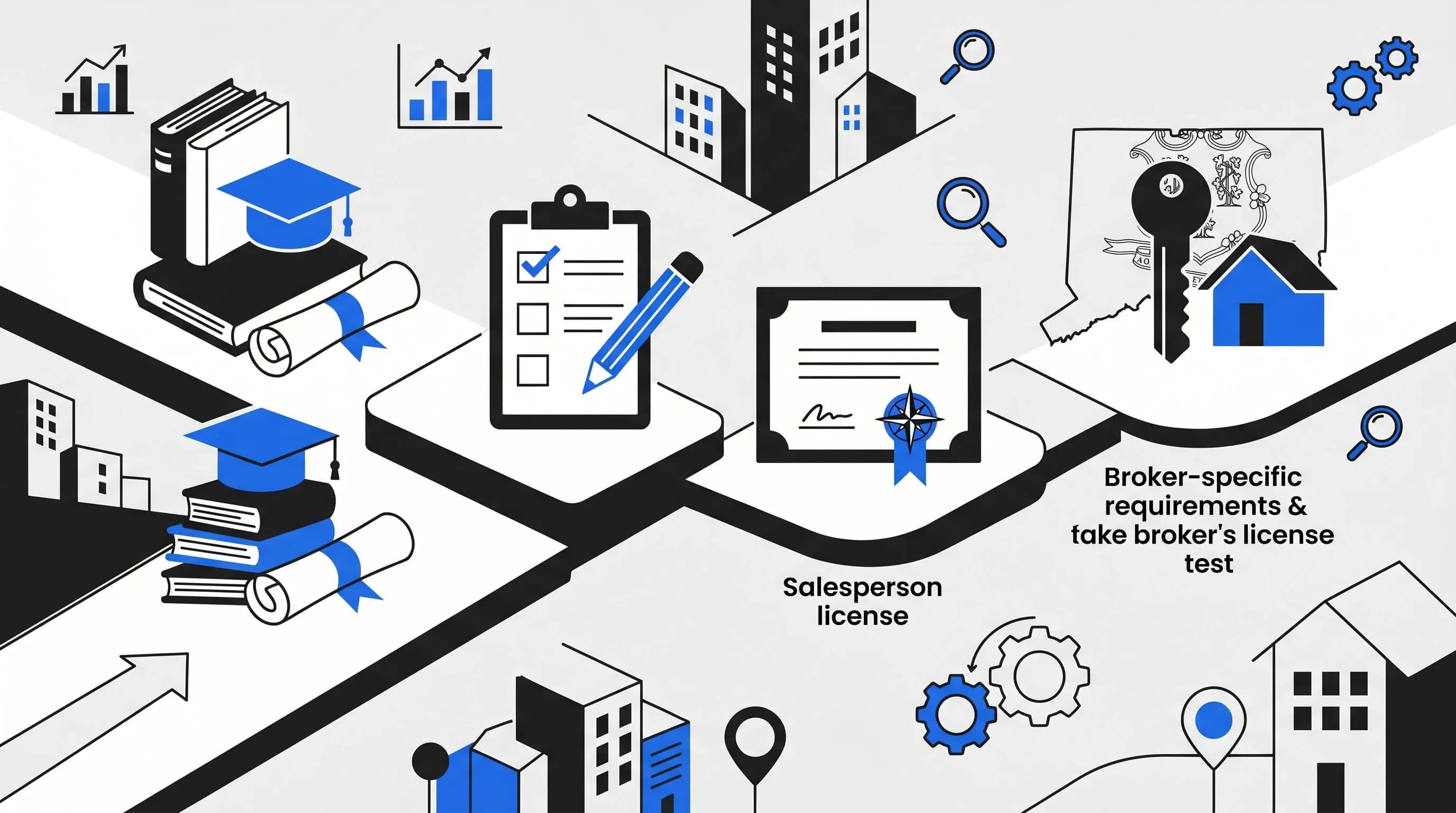
If you want to become a real estate broker in Connecticut, you’re really talking about a two‑stage journey: first becoming a strong licensed salesperson, then “leveling up” into the broker role with more responsibility, independence, and income potential. In this guide we’ll walk through exactly how the Connecticut real estate broker license works, the formal CT broker license requirements, and what it actually takes in practice to succeed.
What a Connecticut Real Estate Broker Really Does
In Connecticut, a licensed real estate broker is more than just an experienced agent. By law, a broker can:
- Represent buyers, sellers, landlords, and tenants in real estate transactions
- Open and manage a real estate brokerage office
- Hire and supervise real estate salespersons (agents)
- Handle trust and escrow accounts for client funds
- Advertise the brokerage and be responsible for compliance with CT real estate law
Compared with a salesperson, a broker carries higher responsibility and liability. When something goes wrong with contracts, money, or marketing, the broker is the one the Connecticut Department of Consumer Protection (DCP) and the Connecticut Real Estate Commission look to first.
Before we chase the “broker” title, we always ask ourselves (and our own agents):
- Do we actually want to build and lead a business, or just sell more houses?
- Are we ready for paperwork, supervision, liability, and training other agents?
If the answer is yes, the Connecticut real estate broker license can be one of the best career moves you make.
High‑Level Path: How to Become a Real Estate Broker in CT
At a high level, the path to a Connecticut real estate broker license looks like this:
- Become and work as a licensed real estate salesperson in Connecticut
- Meet the CT broker experience and education requirements
- Complete broker pre‑license courses at a Connecticut‑approved real estate school
- Submit the Real Estate Broker – Initial/Exam application to the DCP
- Get DCP approval and then schedule the PSI Connecticut real estate broker exam
- Pass the broker licensing examination
- Pay the broker license activation fee and decide whether to open your own brokerage or act as an associate broker
- Maintain your license via renewal and continuing education (CE) every cycle
Stage 1: Become a Licensed Real Estate Salesperson in Connecticut
Connecticut will not let you jump directly to broker. You must first get a CT real estate license as a salesperson, work in the field, and build real transaction experience.
Salesperson basic eligibility
To start the licensing journey in CT, you should expect to need to:
- Be at least 18 years old
- Have a high school diploma or GED
- Be a U.S. citizen or lawfully admitted alien
If any of these are an issue, solve those first before you invest in pre‑licensing courses.
Complete the 60‑Hour “Real Estate Principles and Practices” Course
The mandatory foundation for your Connecticut real estate license is the 60‑hour Real Estate Principles and Practices course, an approved Connecticut real estate pre‑licensing course for salespersons.
Key facts about this class:
- Minimum 60 hours of classroom or live online instruction
- Must be taught by a Connecticut‑approved real estate school
- Meets minimum requirements set by the Connecticut Real Estate Commission
- You must attend all required hours and pass the school final exam with at least 70%
The content typically covers:
- Land use controls and regulations
- Property ownership and interests
- Agency and contracts
- Market analysis and pricing
- Financing and mortgages
- Transfer and passage of title
- Closings and settlement procedures
- Ethical practices and fair housing
- Connecticut real estate license law and regulations
This is the same “Real Estate Principles and Practices” course you’ll see on college continuing education sites, workforce development listings, and CT state‑approved school pages. It’s designed to give you a baseline for the state licensing exam, not to make you an expert overnight.
Choose a Connecticut‑Approved Real Estate School
Whatever course provider you pick, make sure it appears on the DCP’s approved list for brokers and salespersons – schools and courses:
We always verify a school here before enrolling. If it’s not on this list, the DCP can reject your education when you apply for your license (or later, your broker upgrade).
Pass the Connecticut Real Estate Salesperson Exam
After you pass the school final for Principles and Practices, you’ll be cleared to schedule the Connecticut real estate salesperson exam with the state’s testing vendor (PSI). The exam is computer‑based and covers both national real estate principles and Connecticut‑specific law.
In practice, we’ve found the best way to prepare is to:
- Skim your course content, focusing on summaries and key terms rather than rereading every page
- Use a dedicated exam prep program with a large question bank and timed simulations
- Drill vocabulary (fair housing terms, ownership types, finance concepts) until it’s automatic
- Answer hundreds of practice questions so the real exam feels familiar
You’ll get your pass/fail result immediately at the test center, which lets you move straight into licensing steps if you’re successful.
Background check, fingerprints, and salesperson license application
Before your Connecticut real estate license is issued, you’ll complete the DCP’s required background check and fingerprinting. We recommend doing this while you’re studying or just after you pass your course final so it doesn’t delay your license activation.
Once you have:
- Your course completion certificate
- Your exam pass notice
- Background check and fingerprinting completed
- A willing sponsoring broker (see below)
you’ll submit the state’s salesperson license application with all documentation and fees. When the DCP approves and issues your license, you’re officially a Connecticut real estate salesperson.
To activate your salesperson license, you must park it under a licensed real estate broker in Connecticut. This decision affects how long you survive in the industry and how well you will eventually understand brokerage operations.
We always suggest interviewing multiple firms and asking:
- What new‑agent training and mentoring do you offer?
- Is there a structured curriculum or just “shadow some agents”?
- Who answers questions when we’re stuck on a contract at 8 pm?
- What are the commission splits, monthly fees, and caps?
- Do you offer leads, office time, or team opportunities?
- How would you describe the culture – collaborative or cutthroat?
During your salesperson years you’re not just learning how to sell; you’re studying how real brokerages actually function: compliance, supervision, risk management, and the systems that keep things running. That knowledge becomes priceless when you step into the broker role yourself.
Stage 2: Connecticut Real Estate Broker License Requirements
Once you’re a practicing salesperson, you can start working toward your Connecticut real estate broker license.
Core eligibility to become a broker in CT
Connecticut law and the DCP’s Real Estate Broker – Initial/Exam page outline the broker license requirements. You should always confirm details on the official CT.gov site because regulations can change, but generally you can expect to need:
- A valid (or recently valid) Connecticut real estate salesperson license or qualifying equivalent from another state
- A minimum period of active real estate experience as a salesperson (typically 2+ years within a recent window, with real closings – not just holding a license)
- Completion of broker pre‑licensing education from a DCP‑approved school
- Approval from DCP to sit for the Connecticut real estate broker exam administered by PSI
The DCP clearly states that the Real Estate Broker – Initial/Exam application is only for individuals who have already completed pre‑license real estate broker courses from a Connecticut‑approved school. Experience and education both matter.
Why your salesperson experience matters
On paper, broker licensing is about hours and exams. In reality, your salesperson years are where you:
- Learn to generate business in different markets
- Manage offers, negotiations, inspections, and closings
- Handle the emotional highs and lows of inconsistent income
- Watch how brokers deal with compliance, complaints, and risk
We encourage future brokers to use those years intentionally: aim for consistent production, seek out complex transactions, and pay attention to how your current broker structures policies, supervises agents, and handles escrow and trust accounts. That’s the real preparation for opening your own brokerage.
Broker Pre‑Licensing Education in Connecticut
Before you can apply for the broker initial exam, you must complete broker pre‑license courses at a Connecticut‑approved real estate school.
Use only DCP‑approved broker courses
To satisfy Connecticut broker license requirements, your education must come from a provider listed on the same DCP school and course search used for salesperson classes:
When we plan an upgrade to broker, we always:
- Filter that list specifically for broker pre‑licensing courses
- Confirm the course explicitly states it satisfies CT broker pre‑licensing education
- Check whether the school provides proper completion certificates or transcripts
What broker pre‑licensing courses typically cover
While the DCP doesn’t publish every syllabus, broker‑level real estate education in Connecticut usually goes deeper into:
- Advanced agency and brokerage relationships
- Broker supervision duties over salespersons and teams
- Trust/escrow account handling and record‑keeping
- Connecticut license law, discipline, and compliance requirements
- Brokerage operations, advertising rules, and risk management
- Advanced contracts, commercial basics, and investment fundamentals
The format is similar to salesperson education: a defined number of classroom or live virtual hours, exams or assessments, and minimum passing scores as specified by the Connecticut Real Estate Commission.
Keep every education document
For every pre‑licensing or CE course you complete (salesperson and broker), we recommend keeping:
- Completion certificates
- Transcripts or grade reports
- Receipts and course outlines
You’ll need proof of broker pre‑license education when you submit the broker initial exam application and potentially for audits or reciprocity applications in the future.
The Real Estate Broker – Initial/Exam Application
Once your broker pre‑license education is complete, the next step is to file the Real Estate Broker – Initial/Exam application with the DCP’s License Services Division.
Where to find the CT broker license application
Go to the official DCP site:
On that page you’ll see sections like:
- Individual Broker License Requirements and Applications
- Real Estate Broker – Initial/Exam
- Brokerage – Legal Entities (LLC, Corporation, etc.)
What the broker initial/exam application does
The broker initial/exam application allows the DCP to:
- Verify that you meet Connecticut broker license requirements for education and experience
- Determine your eligibility for the PSI Connecticut real estate broker exam
- Create your broker candidate record in CT’s license system
The DCP is clear: you must be approved before you can register and schedule the examination with PSI. You cannot skip straight to PSI and book the broker test on your own.
Typical required documentation
The exact checklist is on the application form, but in practice you should expect to provide:
- Proof of completed broker pre‑license courses from a CT‑approved school (certificates or transcripts)
- Evidence of your current or prior Connecticut real estate salesperson license
- Verification of required , often in the form of signed statements or forms from your sponsoring broker(s)
- Personal identification details as requested (name, address, SSN, etc.)
- Any documentation needed if you’re claiming qualifying experience from another state
We double‑check name spelling and license numbers across every document before submitting, because inconsistencies are a common reason for delays.
For application questions, the DCP License Services Division can be reached at:
- Email: [email protected]
- Mailing address:
Connecticut Department of Consumer Protection – Real Estate Division
450 Columbus Blvd., Suite 901
Hartford, CT 06103
Scheduling and Taking the PSI Connecticut Real Estate Broker Exam
DCP approval, then PSI scheduling
After you submit your broker initial/exam application, the DCP will:
- Review your education and experience
- Approve or deny your eligibility
- If approved, send you written instructions on how to register and schedule the exam with PSI
Only after receiving that approval and instructions do you create or use your PSI account to pick an exam date, time, and location (or remote option, if available).
The DCP site links to PSI Test Administration Information for Connecticut real estate exams. In the PSI Candidate Handbook for the Connecticut Real Estate Broker exam, you’ll find details on:
- Registering online or by phone
- Available PSI testing centers in and near Connecticut
- Exam fees, time limits, and number of questions
- Identification required on test day
- Rescheduling, cancellation, and no‑show policies
What the Connecticut broker exam covers
The PSI broker licensing exam usually has two portions:
- A national portion on general real estate principles and practices
- A state‑specific portion on Connecticut law and regulations
Topics commonly tested include:
- Property ownership, interests, and forms of holding title
- Agency relationships, duties, and disclosures
- Contracts, offers, and counteroffers
- Financing, loan types, and closing procedures
- Transfer of title and recording
- Connecticut licensing law for salespersons and brokers
- Brokerage operations, advertising rules, and trust accounts
- Broker supervision, discipline, and risk management
We always revisit fundamentals from Real Estate Principles and Practices (ownership, contracts, finance, and math) and layer on the broker‑specific supervision and escrow rules from our broker coursework.
How we recommend preparing for the broker exam
Practical exam prep for Connecticut broker candidates usually includes:
- Reviewing broker course notes, especially Connecticut license law and brokerage management sections
- Using broker‑level exam prep tools with large question banks and state‑specific questions
- Taking full, timed practice exams that mimic PSI’s format
- Focusing hard on definitions, legal responsibilities, and “what would the broker do?” scenarios
Just like for the salesperson test, repetition is key. Doing hundreds of practice questions helps you recognize the way exam writers frame issues around supervision, escrow handling, and advertising.
Activating Your Connecticut Real Estate Broker License
Passing the broker exam doesn’t automatically make you an active broker. You still must complete the state’s activation steps and pay the license fee.
Broker license fee and activation
The DCP’s broker page states that a $1,150.00 license fee is required to activate your Connecticut real estate broker license. This fee is due as part of your final licensing step after you’ve passed the PSI exam and received instructions from DCP.
Once your payment is processed and any final paperwork is approved, the DCP will issue your Connecticut Real Estate Broker License. At that point, you can:
- Operate as an individual broker under your own name
- Act as an associate broker under another broker’s firm
- Begin the process of licensing a brokerage entity like an LLC or corporation (see below)
Opening a Brokerage in Connecticut (LLC, Corporation, etc.)
Many people pursue a CT broker license specifically so they can open their own brokerage rather than work under a sponsoring broker. Connecticut regulates these brokerage entities as well.
Brokerage – legal entities
The DCP’s Real Estate Brokers page has a section titled “Brokerage – Legal Entities (LLC, Corporation, etc.)”. The general process looks like this:
- Obtain your individual Connecticut broker license
- Form and properly register your business entity with the Connecticut Secretary of the State (LLC, corporation, etc.)
- Apply for a brokerage license in the name of that entity through DCP
- Designate a broker of record—a CT‑licensed broker (often you) who will be responsible for supervising all real estate activity conducted by the company
We advise planning your brokerage model during your salesperson years: decide what services, splits, training, and culture you’ll offer, and watch how successful firms in Connecticut structure these elements.
Connecticut Real Estate License Reciprocity
If you already hold a real estate broker or salesperson license in another state, you may qualify for a Connecticut reciprocal real estate license rather than going through the full education and exam path from scratch.
Reciprocal broker and salesperson licenses
The DCP provides a dedicated reciprocity section:
Under reciprocity, depending on your current state and license type, you may:
- Skip repeating the full 60‑hour Principles and Practices course
- Have portions of the national exam waived
- Be required to pass only the Connecticut state‑specific portion of the exam
The key is to use the reciprocal license application, not the standard broker initial/exam application, if reciprocity applies to you.
Broker License Renewal and Continuing Education in Connecticut
Getting your broker license is only the beginning. To keep it active, you must comply with renewal and CE requirements set by the DCP and the Real Estate Commission.
Connecticut broker license renewal cycle
The DCP clearly notes:
All real estate broker licenses expire on November 30th of every even year.
That means:
- Broker licenses run on a fixed two‑year cycle anchored to even‑numbered years
- Your first renewal may be for a shorter period if you’re licensed midway through a cycle
Continuing education (CE) for CT brokers
Each renewal cycle, brokers must complete a certain number of Board‑approved continuing education hours. While specific hour counts and required topics can change by cycle, you’ll typically see:
- Mandatory topic courses (for example, fair housing, Connecticut law updates, ethics)
- Elective CE in areas like brokerage management, investment, commercial basics, or property management
CE can be obtained through:
- State‑approved CE providers and real estate schools
- REALTOR® associations like Connecticut REALTORS® (CTR) and local boards
- Online CE platforms approved for CT
We strongly recommend tracking your CE completion as you go rather than scrambling at renewal. Keep certificates organized in case of audit.
How “Real Estate Principles and Practices” Still Matters at Broker Level
You might think of Real Estate Principles and Practices as “just” the salesperson’s pre‑licensing course, but its foundations carry straight into broker licensing:
- The national portion of the broker exam still leans heavily on the principles taught in that 60‑hour course
- Core topics like property ownership, passage of title, financing, contracts, and ethical practice remain central—only the scenarios become more complex
- Broker pre‑licensing education assumes you’re solid on these basics and moves into supervision and management
Some schools even offer a Real Estate Principles and Practices Review course that doubles as CE and exam review. While marketed toward salespersons, we’ve seen broker candidates use it strategically as a quick refresher on math concepts, agency, and contract issues before tackling the broker test.
Salesperson vs Broker in Connecticut: What’s the Real Difference?
From an exam and license standpoint:
- A salesperson must work under the supervision of a broker and cannot operate independently
- A broker can work independently, supervise salespersons, and open a brokerage firm
From a day‑to‑day perspective, the differences go further:
- Salespersons primarily focus on production: lead generation, client service, offers, and closings
- Brokers add layers of leadership and liability: training agents, policy setting, compliance checks, trust account oversight, and sometimes less selling and more managing
We’ve found that brokers who thrive in Connecticut tend to:
- Have already proven they can generate their own business consistently
- Enjoy teaching and mentoring other agents
- Take regulations and paperwork seriously rather than seeing them as a nuisance
Institutions and Authorities You’ll Work With
On the way to your Connecticut broker license, you’ll interact—directly or indirectly—with multiple institutions:
- Connecticut Department of Consumer Protection (DCP) – regulates real estate licensing, processes applications, and oversees enforcement
- DCP License Services Division – handles your broker initial/exam application, reciprocal applications, renewals, and changes to license status
- Real Estate Commission – sets minimum education requirements and sometimes mandates specific CE topics
- PSI – exam administrator for the Connecticut real estate broker and salesperson licensing exams
- Connecticut REALTORS® (CTR) and local REALTOR® boards – not required for licensing but key for networking, ongoing education, and staying on top of legal and market changes
Practical Timeline: From Newcomer to Connecticut Broker
Phase 1 – Become and work as a salesperson
- Months 0–3:
- Complete the 60‑hour Real Estate Principles and Practices course
- Pass the school final (≥ 70%) and schedule your CT salesperson exam
- Prepare with exam prep tools and practice questions
- Pass the state exam and submit your salesperson license application
- Choose and join a sponsoring broker
- Months 3–24+:
- Work as a licensed salesperson under a CT broker
- Focus on closing a meaningful number of transactions each year
- Study how your brokerage manages compliance, escrow, training, and agent support
- Consider joining a productive team if you want more structure and reps
Phase 2 – Prepare for and obtain your broker license
- Months 24–36+ (depending on your experience):
- Confirm you meet the current Connecticut broker experience requirements on the DCP site
- Enroll in broker pre‑licensing education at a CT‑approved school
- Complete the broker coursework and exams
- After education completion:
- Submit the Real Estate Broker – Initial/Exam application with all documentation
- Wait for DCP approval and broker exam scheduling instructions
- Register with PSI, schedule, and pass the broker exam
- Pay the $1,150 broker license activation fee
- Decide whether to open your own brokerage or become an associate broker
Is Becoming a Connecticut Broker Really for You?
It’s worth being honest about what this path demands. We’ve seen people chase the broker license just for the title, then get overwhelmed by the responsibility.
You may want to reconsider becoming a broker if you:
- Expect quick, easy money without sustained effort
- Struggle with self‑motivation and need constant supervision
- Dislike paperwork, details, and compliance
- Regularly quit when things get uncomfortable or challenging
On the other hand, if you:
- Are willing to work hard and be coached
- Can handle delayed gratification and variable income
- Want to build something bigger than your own production—like a team or full brokerage
- Take pride in running a compliant, ethical operation
then the Connecticut real estate broker license can open doors to leadership, ownership, and long‑term wealth building that a salesperson license alone can’t match.
Step‑by‑Step Summary: How to Become a Real Estate Broker in Connecticut
To recap, here’s the full path in compact form.
Phase 1 – Get and use your CT real estate salesperson license
- Verify you meet basic eligibility (age, education, legal status)
- Complete the 60‑hour Real Estate Principles and Practices course at a CT‑approved school
- Pass the school final (≥ 70%)
- Complete required background check and fingerprinting
- Study with exam prep tools and pass the CT real estate salesperson exam
- Choose a sponsoring broker and submit the salesperson license application
- Work actively as a salesperson and build real‑world experience with transactions
Phase 2 – Upgrade to a Connecticut real estate broker license
- Confirm on the DCP site that you meet current CT broker license experience requirements
- Enroll in and complete broker pre‑licensing education at a CT‑approved school
- Gather completion certificates, transcripts, and experience verification
- Submit the Real Estate Broker – Initial/Exam application to the DCP
- Once approved, schedule and pass the PSI Connecticut real estate broker exam
- Pay the $1,150 broker license fee to activate your license
- Optionally license an LLC or corporation as your brokerage and designate yourself as broker of record
- Complete required continuing education (CE) and renew by November 30 of every even year
If you follow these steps—building solid salesperson experience first and then meeting all Connecticut broker license requirements—you’ll be well positioned not just to get your broker license in Connecticut, but to actually thrive as a broker in the long term.