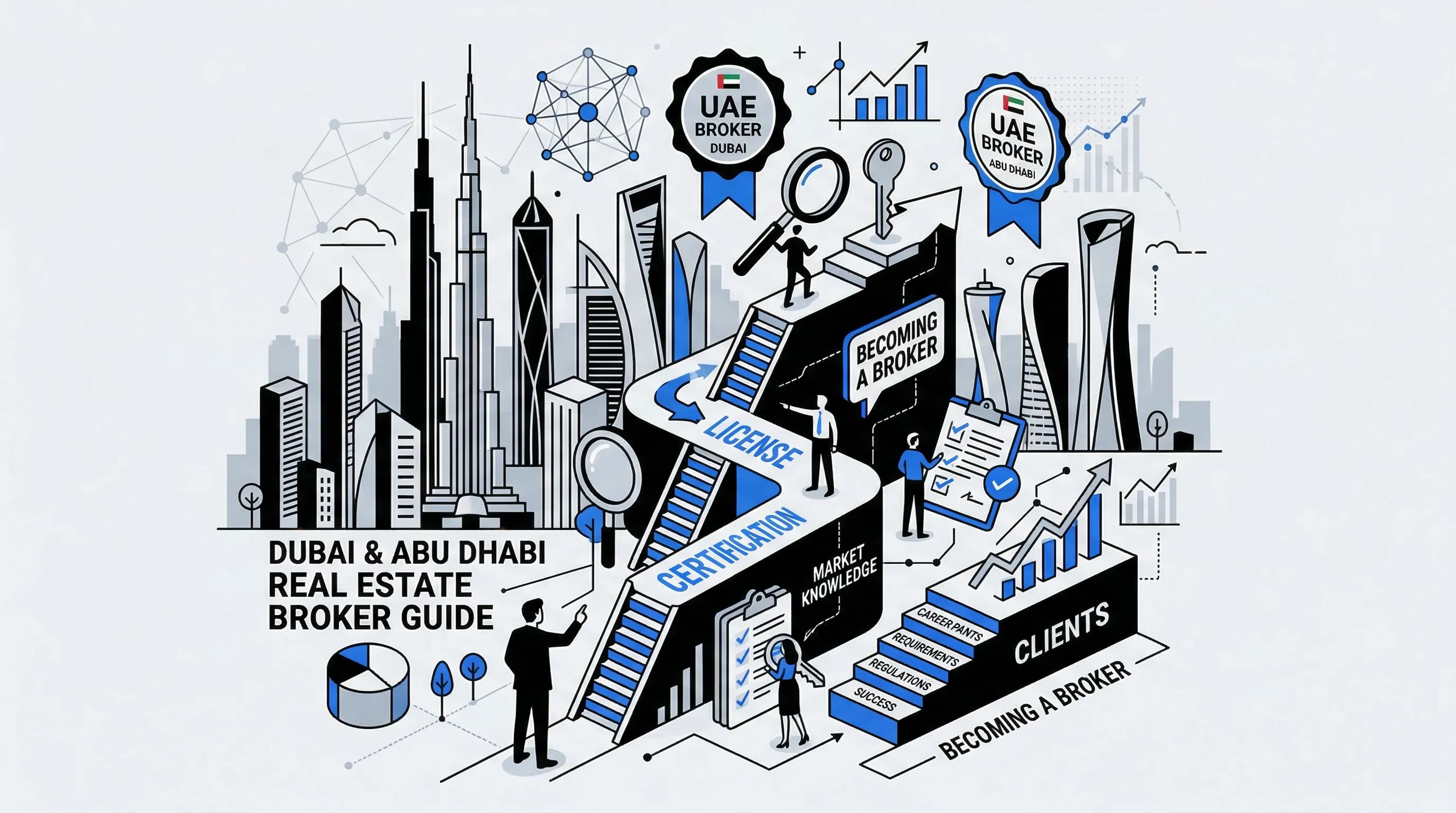
If we’re serious about learning how to become a real estate broker, we have to treat it as much more than “getting a better license.” We’re talking about the shift from being one salesperson among many to being the person who actually runs the real estate business: responsible for compliance, marketing, systems, and often other agents’ results.
In this guide, we’ll walk through what a real estate broker does, how the broker path works in practice, how to obtain your license step by step (with a focus on Dubai and Abu Dhabi processes where broker licensing is tightly regulated), and how to build a sustainable real estate career that can actually support you once you have that broker card or broker ID.
What Does a Real Estate Broker Actually Do?
A real estate broker is a licensed intermediary between property sellers/landlords and buyers/tenants, but with more responsibility and legal authority than a typical agent. In many markets the word “broker” is used for any licensed professional, but in practice there’s a clear difference between the person doing the day‑to‑day sales work and the person who is accountable for the entire brokerage.
On the transaction side, real estate brokers:
- For buyers and tenants
- Understand budgets, locations, and property requirements
- Shortlist and present suitable homes or investment properties
- Advise on pricing, legal steps, and required documentation
- Negotiate offers, coordinate contracts, and manage timelines
- For sellers and landlords
- Advise on fair market value and realistic timeframes
- Recommend marketing channels (portals, social media, signage, email)
- Host viewings and qualify prospects
- Negotiate terms and drive the deal through to closing
But when we talk about becoming a real estate broker, we’re also talking about stepping into a role where we:
- Take legal responsibility for how the brokerage operates
- Ensure compliance with real estate laws and code of conduct
- Oversee escrow, trust accounts, and documentation standards
- Recruit, train, and supervise agents and support staff
- Build and maintain the systems that generate leads and revenue
That’s why most jurisdictions require experience, training, and a broker exam before allowing someone to run a brokerage independently.
Real Estate Agent vs. Broker: The Licensing Ladder
Before we dive into “how to get a real estate broker license,” we need to be clear on the titles we’re aiming at. The details vary by country and even by emirate or state, but the structure is similar.
Entry-Level: Salesperson or Real Estate Agent
The entry point in most markets is an agent or salesperson license. In practice, that means:
- We complete pre‑licensing education
- We pass a regulatory exam
- We must work under a licensed brokerage to practice
Our main job at this stage is sales and leasing: meeting clients, showing properties, handling negotiations, and learning the ropes.
Broker or Managing Broker
The broker tier is the next level up. Depending on local law, there are two common patterns:
- Tiered system (salesperson → broker)
We start as an agent, build experience for a minimum period, complete additional training, and then pass a broker exam to qualify as a broker who can open a brokerage and supervise others.
- Single license with broker levels
Everyone technically holds a broker license, but only “managing” or “principal” brokers are allowed to run an office and supervise agents. That higher role usually requires extra education and documented experience.
In the UAE, the terminology is a bit different but the intent is the same. In Dubai and Abu Dhabi, for example, any practicing “broker” or “agent” must be licensed and hold an active broker card or broker ID from the relevant authority. We can’t freelance; we must be linked to a registered real estate brokerage company.
Is Becoming a Broker the Right Move for You?
There’s a reason a high percentage of new agents vanish within their first two years: they underestimate the work, overestimate the speed of results, or try to do everything alone without a system or mentor. Since the broker path is a step beyond that, it’s worth doing an honest self‑check.
We probably shouldn’t aim for this path if we’re:
- Chasing “easy money” and hoping property sales are a shortcut to quick cash
- Uncomfortable with rejection, delayed income, or irregular working hours
- Unwilling to take coaching or follow proven systems
- Quick to quit when a few deals fall through
On the other hand, the broker path makes sense if we:
- Enjoy people, problem‑solving, and negotiation
- Are willing to trade 6–12 months of hard work for long‑term upside
- Can accept full responsibility for our income and results
- Like the idea of building something bigger than our own personal sales pipeline
Key Skills and Traits of a Successful Real Estate Broker
Whether we’re in Dubai, Abu Dhabi, or any other major market, the same broker skills come up again and again in official training programs, RERA courses, and broker licensing guides.
Negotiation and Persuasion
Brokers manage offers, counter‑offers, and high‑emotion decisions on both sides of a transaction. We need to be able to:
- Balance interests of buyers and sellers or landlords and tenants
- Find win–win solutions around price, payment plans, and move‑in dates
- Keep deals alive when emotions run hot or last‑minute issues appear
Honesty, Integrity, and Ethics
Every serious licensing course pushes this point: sustainable success depends on trust.
- We must be transparent about property conditions, pricing, and legal status
- We need to disclose material facts rather than hiding them to “save” a deal
- We’re expected to follow a code of conduct enforced by regulators (RERA in Dubai, ADREC in Abu Dhabi, state commissions elsewhere)
Legal and Regulatory Knowledge
Even unintentional violations can lead to fines, license suspension, or worse. Brokers are expected to understand:
- Real estate laws, ownership rules, and tenancy regulations
- Standard contracts and addenda, including what can and can’t be modified
- Advertising rules, commission practices, escrow and trust account handling
- Compliance with Dubai Land Department (DLD), Real Estate Regulatory Agency (RERA), Abu Dhabi Real Estate Center (ADREC), and similar authorities elsewhere
Communication and Client Care
From first contact to closing, strong brokers:
- Listen actively and ask good questions instead of immediately pitching
- Explain complex legal or financial concepts in clear, simple language
- Guide discussions and keep everyone focused on solutions rather than blame
- Maintain a calm, professional tone even under pressure
Market and Area Expertise
In competitive cities, the “area expert” has a major advantage. We want to build a deep understanding of:
- Typical prices, rents, and yields in specific neighborhoods
- Inventory levels and time on market
- Local schools, malls, transport, community amenities, and upcoming projects
Sales, Marketing, and Technology
Modern brokers are as much marketers as they are negotiators. We’re expected to:
- Create strong listings with professional photos, videos, and virtual tours
- Use portals, social media, and email marketing to reach the right audience
- Follow up systematically with leads and past clients via CRM tools
- Measure what’s working in our marketing instead of guessing
Licensing vs. Working: How Brokerage Really Works
In almost every regulated market, “becoming a broker” is a combination of licensing requirements and business realities.
- We must pass mandatory training and exams to obtain a broker license
- We must be associated with a registered real estate company to practice (no freelancing, especially in Dubai and Abu Dhabi)
- We must maintain our license through annual renewals and ongoing education
So the question isn’t only how to get a real estate broker license—it’s also how to build a functioning business once we have it. That’s why the path usually starts with working as an agent under an existing brokerage, then transitioning into a full broker role when we’ve proven we can generate business and manage systems.
How to Become a Licensed Real Estate Broker in Dubai
Dubai has one of the clearest and most standardized broker licensing processes in the region, managed primarily by the Dubai Land Department (DLD) and its Real Estate Regulatory Agency (RERA). If our goal is to get a real estate broker license in Dubai, this is the path we follow.
Eligibility Requirements for a Dubai Real Estate Broker License
Before we enroll in any RERA course or apply for a broker card, we need to meet DLD’s baseline criteria:
- Minimum age: 21 years
- Education: At least a high school diploma (attested if issued abroad)
- Residency: Valid UAE residency visa and Emirates ID (tourist visas don’t qualify)
- Good Conduct: Police clearance / Good Conduct Certificate from Dubai Police
- Training: Completion of certified broker training from Dubai Real Estate Institute (DREI) or an accredited provider
Step 1: Join a Registered Real Estate Brokerage and Secure Residency
We cannot operate independently in Dubai. The first practical step is to be linked to a licensed brokerage:
- Apply to RERA‑registered real estate companies that match our goals (sales, leasing, off‑plan, luxury, etc.)
- Once hired, our employer typically sponsors our:
- Residency visa
- Emirates ID
Only after we have residency and are tied to a brokerage can we move forward with the broker license in Dubai.
Step 2: Complete Certified Training for Real Estate Brokers (RERA Course)
The core training requirement is a broker licensing course approved by DREI. Many institutes offer this in Dubai, including Innovation Experts Real Estate Institute (IEREI) and other accredited providers.
Typical features of a Dubai real estate broker course:
- Duration: Around 4 days, 20+ hours of training
- Format: In‑class, online, or blended
- Language options: Often multiple languages to accommodate expat brokers
- Curriculum topics:
- History and structure of Dubai’s real estate market
- Real estate laws and regulations (DLD and RERA framework)
- Brokerage practices, ethics, and code of conduct
- Sales and leasing cycles, contracts, and documentation
- Roles and responsibilities of brokers and real estate agents
- Course cost: Generally in the AED 1,575–2,520 range (including VAT), depending on provider and extras such as practice exams
On completion, we receive a Real Estate Brokerage Training Certificate that makes us eligible to sit for the RERA broker exam.
Step 3: Pass the RERA Broker Exam
The RERA exam is the official assessment required for a Dubai real estate broker license. It tests our knowledge of laws, ethics, and practical brokerage skills.
Typical structure (based on current guidelines):
- Multiple‑choice questions (MCQ)
- Around 30 questions
- Exam duration roughly 2 hours
- Passing score of 75%
- Exam fee around AED 785–786
Many training providers offer optional practice exam courses to help us familiarize ourselves with the question style and boost our chances of passing on the first attempt.
Step 4: Obtain a Good Conduct Certificate
A police clearance or Good Conduct Certificate is mandatory in Dubai’s licensing process. We typically:
- Apply through Dubai Police channels (online app or service centers)
- Pay the fee (around AED 220, subject to change)
- Receive a certificate confirming we have no disqualifying criminal record
Step 5: Apply for a Broker Card via Trakheesi
The broker card—also known as the broker ID or BRN (Broker Registration Number)—is our practical proof of being a licensed real estate broker in Dubai. The application runs through the Trakheesi system operated by DLD/RERA.
The process generally looks like this (our brokerage often handles it, but it’s useful to understand):
- Create or log into a Trakheesi account with the brokerage’s details
- Select the relevant service for a new real estate broker license or broker card
- Fill in personal and employment details accurately
- Upload required documents:
- Passport copy
- Residency visa and Emirates ID copies
- Recent passport‑sized photograph
- Attested high school diploma or equivalent
- Broker training certificate (DREI / accredited provider)
- RERA exam result
- Good Conduct Certificate
- Any additional documents requested by DLD or relevant economic department
- Submit the application and wait for review
- Pay the broker card issuance fee (around AED 536) and any administrative charges
- Download our digital broker ID / BRN once approved—usually within about two working days
After this, we officially hold a Dubai real estate broker license and can practice as a licensed real estate agent or broker under our company’s name.
Dubai Real Estate Broker License Costs: Full Picture
When people ask “how much does it cost to get a real estate broker license in Dubai,” they’re often only thinking of the exam fee. In reality, we have several components:
- Broker course (RERA training): Around AED 1,575–2,520
- RERA Brokerage Practice Exam: Around AED 785–786
- Good Conduct Certificate: Approximately AED 220
- Broker Card issuance fee: Around AED 536
- Emirates ID typing/processing: Around AED 385
On top of that, we should factor in:
- Visa and medical costs (usually handled by our employer, but still real money)
- Any additional training or practice exam fees
- Early marketing and advertising expenses (signage, portals, social media)
- Our living expenses while we build a pipeline and wait for commissions
Once everything is included, many agents realistically invest AED 10,000–15,000 (or more) to fully launch a real estate career in Dubai, depending on their situation and how much support the brokerage provides.
Broker License Validity and Renewal in Dubai
The Dubai real estate broker card is not a lifetime credential. We need to keep it active.
- Validity: Typically 1 year from issuance
- Renewal window: We should renew at least a month before expiration to avoid penalties or the need to retake a full DREI course
The renewal process generally involves:
- Completing any required renewal training or refresher RERA exam (laws and regulations update)
- Ensuring our residency visa and Emirates ID are valid
- Submitting a renewal request via Trakheesi with updated documents
- Paying renewal fees (often in the AED 500+ range for license/card components)
- Receiving our renewed broker card / BRN and continuing practice legally
How to Become a Licensed Real Estate Broker in Abu Dhabi
Abu Dhabi has its own framework and terminology for real estate broker licensing, centered around ADREC and the DARI/TAMM platforms. The approach is similar to Dubai in spirit—mandatory training, broker licensing, and annual renewal—but with distinct procedures.
Key Institutions: ADREC, DARI, TAMM, and ThinkProp
- ADREC – Abu Dhabi Real Estate Center, the main regulatory authority for property activities
- DARI and TAMM – Government platforms through which we manage licenses, renewals, and transactions
- ThinkProp Training Institute – A recognized educational provider delivering the official Abu Dhabi Real Estate Broker Licensing Course, aligned with ADREC requirements
Abu Dhabi Real Estate Broker Licensing Course
The Abu Dhabi Real Estate Broker Licensing Course (for example, the one offered by ThinkProp) is often the first formal step toward becoming a licensed broker in Abu Dhabi.
Core elements of the course include:
- Target students:
- Aspiring brokers new to the industry
- Students or recent graduates exploring property careers
- Career switchers from banking, sales, or customer service
- Licensed brokers in other emirates who want to operate in Abu Dhabi
- What we learn:
- Foundations of real estate and its impact on UAE welfare
- Abu Dhabi’s property market structure and outlook
- Broker roles, responsibilities, and specializations
- Legal frameworks, ethics, and code of conduct
- Sales and leasing cycles and customer experience
- Marketing strategy and personal branding for brokers
- Commission and profit calculation
- Company structures, governance, and operations
- Format and duration: Around 32 hours of face‑to‑face training, in English, often with strict attendance rules (cameras must remain on during virtual classes)
- Cost: Around AED 1,785 (incl. VAT), sometimes with installment options
On completion, we receive a participation certificate recognized by ADREC, which we use when applying for our Abu Dhabi real estate broker license.
Abu Dhabi Broker License Requirements
To obtain an Abu Dhabi broker license, we typically need to:
- Be employed by or associated with a registered real estate company in Abu Dhabi
- Complete the mandatory broker licensing course (e.g., ThinkProp’s program)
- Hold valid identification and residency status (passport, Emirates ID, visa)
- Meet any ADREC‑specified fitness, ethical, or background conditions
Freelancing is not allowed; we must be linked to an authorized corporate entity to receive a license.
Step-by-Step: Abu Dhabi Real Estate Broker License via DARI/TAMM
- Join or establish a registered brokerage
We either join an existing Abu Dhabi brokerage or work within a company that’s setting up a real estate division.
- Enroll in the official licensing course
We complete all required modules and attendance for the Abu Dhabi Real Estate Broker Licensing Course.
- Receive the participation certificate
This certificate is our proof of training and one of the key documents for the license application.
- Apply for the broker license through DARI or TAMM
We submit our certificate and supporting documents (ID, visa, company details) through the online platform according to ADREC’s guidelines.
- Await ADREC approval
Once ADREC reviews and approves our application, they issue our official broker license.
- Renew annually
To stay compliant, we must complete the Abu Dhabi Real Estate Broker License Annual Renewal Course and keep our documents updated before renewing via DARI/TAMM each year.
Beyond the License: Building a Real Estate Career That Actually Works
The day we get a broker license or broker ID, nothing magical happens by itself. We still wake up needing leads, signed listings, and closings. The license allows us to operate, but our systems and habits determine whether we thrive.
Understanding Commission Structures and Income Potential
In Dubai and similar markets, typical commissions look like:
- Sales: Around 2% of the property’s sale price (subject to agreement)
- Rentals: Around 5% of the annual rent
Each brokerage structures splits differently:
- We might receive a base salary plus a lower commission share
- Or we might be fully commission‑based with a higher split
- Some companies offer bonuses or performance tiers for top agents
In Dubai, for example, many agents realistically average around AED 15,000 per month in total income when they combine base pay and commissions, while top performers can reach AED 100,000 per month or more. The absence of personal income tax and real estate tax in the UAE makes net earnings attractive, but the competition and performance demands are intense.
Lead Generation: The Core Broker Skill
Whether we hold a broker license in Dubai, Abu Dhabi, or anywhere else, our income tracks one primary skill: lead generation. We can pay with time or pay with money, but either way, we must make the phone ring or the inbox fill.
Some of the most powerful lead generation channels we see brokers and agents rely on include:
- Organic marketing – neighborhood videos, community tours, local market updates on YouTube, TikTok, Instagram, and LinkedIn
- Outbound prospecting – calling property owners, following up with portal leads, door knocking in target communities
- Open houses and events – especially useful in markets with high walk‑in traffic
- Paid advertising – search and social ads optimized to generate inquiries for specific property types or areas
- Referral networks – relationships with mortgage brokers, lawyers, corporate HR departments, and past clients
Before we ever consider owning a brokerage, we want to prove that we can generate leads consistently for ourselves. That’s the foundation we’ll later use to support other agents.
Tracking Inputs, Not Just Closings
Income lags behind effort. To stay motivated and improve our odds of success, it helps to track daily and weekly activities we can control:
- Number of new conversations with potential buyers, sellers, landlords, or tenants
- Follow‑up calls and messages sent to existing leads
- Listings taken, property tours scheduled, and offers written
- Content produced and published (videos, posts, emails)
This kind of tracking is essential if we want to grow from being just one productive agent into a broker who can build a repeatable system for an entire team.
From New Agent to Broker: A Practical Multi-Year Roadmap
To connect “how to get a broker license” with “how to become a successful broker,” it helps to think in stages. We can adapt the details to our market (Dubai, Abu Dhabi, US, UK, etc.), but the overall progression stays similar.
Phase 1: Licensing and Launch (0–6 Months)
- Complete pre‑licensing education (DREI, ThinkProp, or our local authority’s requirements)
- Pass the regulatory exam (RERA exam in Dubai, ADREC‑aligned exams in Abu Dhabi, or equivalent)
- Join a brokerage that offers real training rather than just a desk and a login
- Set up basic tools: CRM, email templates, and a simple content plan
- Start marketing ourselves immediately, even if we’re only handling rentals at first
Phase 2: Foundation and Survival (6–24 Months)
- Focus on closing our first wave of deals and proving we can survive on commission
- Test different lead sources: portals, open houses, organic social media, referrals
- Build financial reserves equal to at least 6 months of living costs
- Track key performance indicators (calls, appointments, listings, closings)
- Learn the full transaction lifecycle from listing to transfer at the land department or registry
Phase 3: Professionalization and Listings Focus (Years 2–4)
- Shift our business mix toward being listing‑heavy rather than purely buyer‑heavy
- Design processes and checklists for how we handle leads, listings, showings, and contracts
- Start informally mentoring newer agents in our office and sharing what’s working
- Refine our area specialization and market knowledge so we’re seen as the local expert
- Optimize personal branding and digital presence around our chosen niche
Phase 4: Broker Preparation and Transition (Years 3–5+)
- Ensure we meet the formal experience requirements to sit for a broker exam where applicable
- Complete any additional broker‑level training or licensing courses
- Study for the broker exam with the same focus we brought to our original licensing, emphasizing laws, supervision duties, and trust account handling
- Decide on our brokerage model: boutique independent office, team under a larger brand, or a cloud brokerage structure
- Plan our systems, staffing, and financial runway carefully so we don’t become a “broke broker” weighed down by fixed expenses and legal risk
How to Verify a Broker’s License (Example: Dubai)
Once we’re licensed, we receive a Broker Registration Number (BRN) in Dubai, or similar identifiers elsewhere. Clients can and should verify that we are properly registered. It’s important that we know how this works, both for our own credibility and to protect consumers from unlicensed operators.
In Dubai, for example, clients can:
- Go to the Dubai Land Department website or open the Dubai REST app
- Navigate to RERA Services and select the broker or agent verification service
- Enter the broker’s name, agency name, or BRN
- See if the broker is actively registered and in good standing
This transparency is a key part of raising standards in the Dubai real estate market and is one of the reasons RERA broker licensing is taken so seriously by established brokerages.
Quick Roadmaps: Dubai and Abu Dhabi at a Glance
Dubai – Real Estate Broker License in 8 Steps
- Confirm eligibility (21+, high school diploma, clean record)
- Secure a UAE residency visa and Emirates ID (typically via a brokerage employer)
- Enroll in a DREI‑approved RERA broker course
- Pass the RERA real estate broker exam
- Obtain a Good Conduct Certificate from Dubai Police
- Apply for a broker card / BRN through the Trakheesi system with all required documents
- Pay licensing and card fees and receive our broker ID (usually within about two working days)
- Practice under our brokerage, then renew the license annually with any required refresher training
Abu Dhabi – Real Estate Broker License in 6 Steps
- Join a registered real estate company or set one up in Abu Dhabi
- Enroll in and complete the Abu Dhabi Real Estate Broker Licensing Course (e.g., via ThinkProp, aligned with ADREC requirements)
- Receive a participation or completion certificate
- Apply for our broker license on DARI or TAMM using the certificate plus ID and residency documents
- Obtain license approval and start practicing under our company
- Complete the annual renewal course and renew through DARI/TAMM every year to stay compliant
Next Steps: Turning the Broker Goal into a Concrete Plan
Becoming a broker isn’t something we do overnight. It’s the natural result of stacking three things over several years:
- A clean, completed licensing track (agent → broker license)
- A proven record of generating business and handling transactions professionally
- The ability and desire to manage systems, compliance, and people—not just our own deals
If we’re just starting out, our first priority is to satisfy local licensing requirements, find a brokerage that will train us in real‑world selling and leasing, and then build habits around lead generation, follow‑up, and learning the legal and ethical framework of our market. If we’re already licensed and thinking about the next step, we can begin documenting our processes, mentoring newer agents, and preparing for broker‑level exams and responsibilities.
With a clear roadmap, solid training, and consistent work, “how to become a real estate broker” stops being an abstract question and becomes a series of practical steps we can follow—one license, one course, one client, and one system at a time.