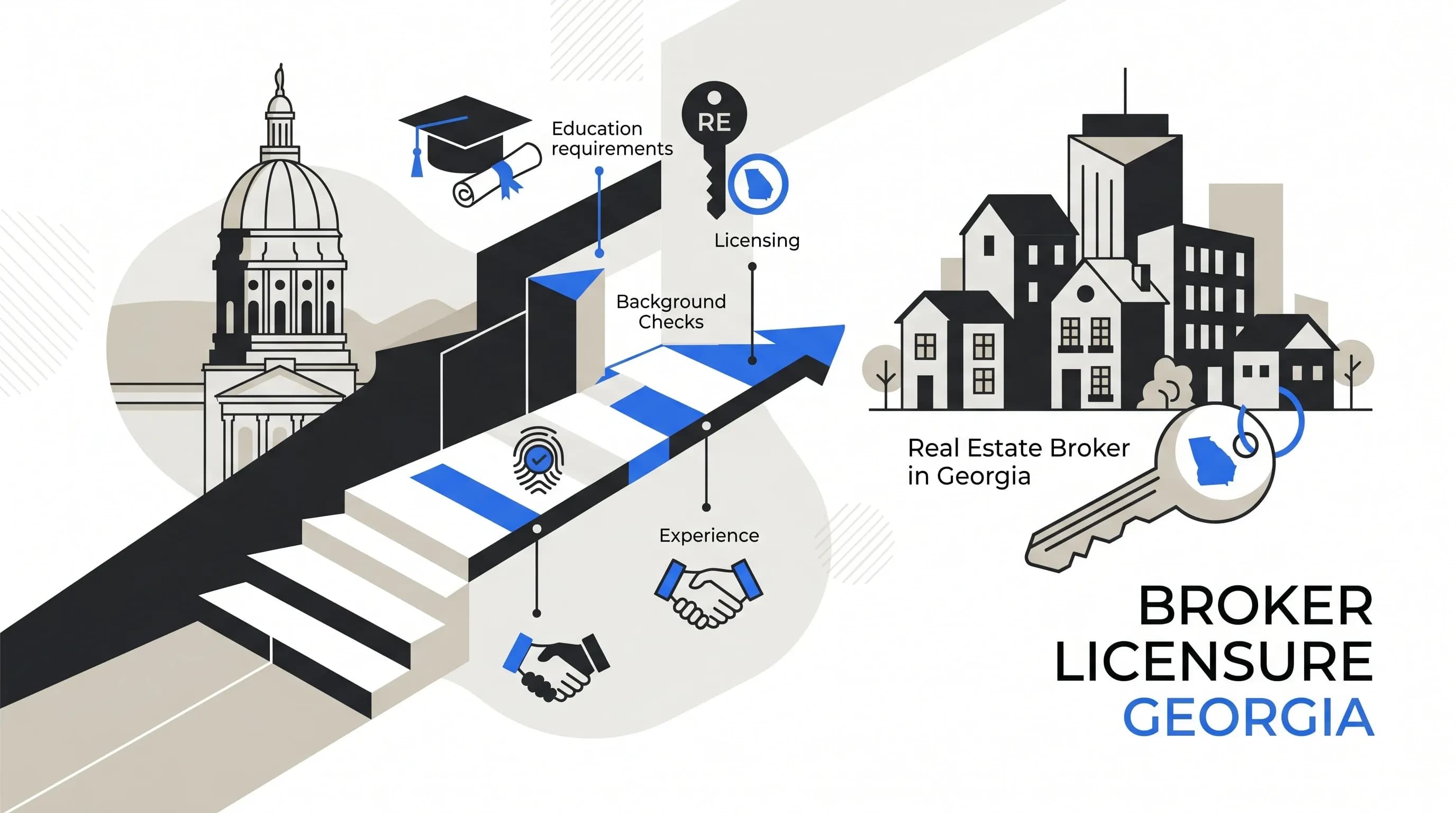
When we talk about how to become a real estate broker in Georgia, we’re really talking about two overlapping journeys: getting through the Georgia broker licensing process and building a real estate career that’s strong enough to support you once you upgrade from salesperson to broker or associate broker.
In this guide, we walk through every step to getting your Georgia real estate broker license—from eligibility and broker pre-licensing courses to the PSI broker simulation exam, licensing fees, and what it actually takes in the real world to move from agent to broker-level producer or broker-owner.
What a Georgia Real Estate Broker Actually Does
Before we dive into Georgia broker license requirements, we need to be clear about the role you’re working toward.
In Georgia, a real estate broker or associate broker can perform any real estate brokerage act that requires a license, including:
- Listing and selling real property
- Negotiating sales, leases, or exchanges
- Holding and disbursing client funds in trust/escrow accounts
- Supervising salespersons and other licensees (for qualifying brokers)
Key distinctions we keep in mind when planning a broker career in Georgia:
- Broker vs. firm: Both individuals and companies can be licensed as brokers. To be active, an individual broker must be affiliated with a licensed brokerage firm.
- Qualifying broker: The broker designated to run the firm and supervise affiliated licensees. This is the person who ultimately signs off on deals and compliance.
- Associate broker: Holds a broker license but chooses to work under another qualifying broker instead of opening their own office.
So when we talk about “becoming a broker,” we’re really choosing between two paths:
- Upgrade to an associate broker and level up under an existing brokerage, or
- Become a qualifying broker and eventually open your own brokerage or take over as the broker in charge of a firm.
That decision should be based on your appetite for risk, management, and building systems—not just a desire for a shinier title.
Reality Check: Is a Broker Career in Georgia the Right Move?
Before we talk broker pre-licensing or PSI exams, we like to step back and ask: is a real estate broker career in Georgia actually a fit for the way you’re wired?
From working with new licensees and watching who sticks around long enough to even qualify for a Georgia broker license, the patterns are consistent.
Real estate & brokering are probably not for you if:
- You need money quickly and can’t handle delayed paychecks.
- You’re hoping to “do this part-time” and get rich with minimal availability.
- You rely on a boss to tell you exactly what to do every day.
- You quit easily when you hit rejection or confusion.
You’re likely a good match if:
- You can work hard for months with no guaranteed income.
- You’re willing to treat your first year like a boot camp for sales skills.
- You want to own a business, not just switch to a different job.
That mindset matters, because Georgia’s broker requirements assume you’ve already pushed through the grind of being an active salesperson for several years. The license is just the paperwork; the career is what you build between now and then.
Georgia Real Estate Broker License Requirements
To get your Georgia real estate broker or associate broker license, the Georgia Real Estate Commission (GREC) sets out specific eligibility criteria.
Basic eligibility: age and education
- Age requirement: You must be at least 21 years old to be licensed as a broker or associate broker in Georgia.
- General education requirement: You must have at least a high school diploma or a GED (certificate of equivalency).
Broker experience requirement in Georgia
Georgia does not let you jump straight to a broker license. You must first build experience as a salesperson or CAM.
- You must have held an active salesperson license (or Community Association Manager – CAM license) for at least 3 of the 5 years immediately preceding your broker application.
- This experience can be in Georgia or another state, but it must have been in active status.
In practice, that means we’re looking at a multi-year plan: first get your salesperson license, then spend several years actually doing transactions before you can upgrade your Georgia salesperson license to broker.
Special path for CAM licensees
If you hold a Community Association Manager (CAM) license:
- Your CAM experience can count toward the 3-out-of-5-year active experience requirement.
- You still must complete broker pre-licensing education and pass the Georgia broker licensing exam.
Georgia Broker Pre-Licensing Education Options
Once you’re eligible by age and experience, your next step is to meet Georgia’s broker pre-licensing education requirement. This is where most future brokers start asking about course options, costs, and how to fit everything around a busy production schedule.
Option 1: 60-hour Georgia broker prelicense course
The most common path is the 60-hour broker prelicense course at a GREC-approved school. This is often called the “broker pre-license” or “broker pre-licensing” course.
Key points:
- Must be at least 60 hours of broker prelicense coursework.
- Must be a commission-approved broker pre-licensing course.
- Includes a proctored final exam you must pass before you can sit for the state broker exam.
Georgia broker prelicense schools and providers often include:
- Georgia MLS Real Estate School
- Atlanta REALTORS® School of Real Estate / Capitus Real Estate Learning Center
- Online schools like The CE Shop and Colibri Real Estate, when GREC-approved
Many of us prefer flexible online Georgia broker pre-license courses because we’re already juggling client appointments. But we’ve also seen agents who know they need a classroom and a live instructor to stay accountable. Be honest about your learning style—there is no point in saving a few hundred dollars on tuition if you end up dragging this out for months.
Option 2: Real estate-related college or law school coursework
Instead of a broker prelicense class, Georgia allows certain higher-education coursework to substitute:
- At least 9 semester hours or 15 quarter hours of real estate–related coursework.
- Completed at an accredited college, university, or law school.
- Topics must be real estate-related; continuing education (CE) courses do not count.
- You must send official transcripts with your exam application.
This path tends to be used more by people who already have a degree in business, finance, law, or real estate.
Option 3: Out-of-state broker prelicense course
If you completed broker pre-licensing education in another state:
- You can use it if it totals at least 60 hours and was approved by that state’s regulatory agency.
- You’ll need a verification letter from that state’s licensing authority to submit with your Georgia broker exam application.
GCIC Background Check and Compliance
Whether you’re becoming a broker or associate broker, Georgia requires a criminal history check as part of the licensing process.
- You must obtain a Georgia Crime Information Center (GCIC) criminal history report.
- Get it from a local sheriff’s office or police department in Georgia.
- The report must be no more than 60 days old on the date you use it for licensing.
- You bring it with you to the PSI testing center when you get your license issued (do not send directly to GREC).
If your GCIC report shows any crimes, convictions, or sanctions from a licensing or regulatory agency, the Georgia Real Estate Commission may investigate and decide whether to approve, condition, or deny your broker license. We’ve seen agents with minor issues still licensed, but it usually requires full disclosure and patience.
The Georgia Broker Licensing Exam (PSI Simulation Format)
The Georgia broker licensing exam is very different from the salesperson exam. Instead of standard multiple-choice, you’ll sit for a simulation exam administered by PSI.
Registering for the Georgia broker exam
To take the Georgia broker state exam you must:
- Register in advance (no walk-ins).
- Submit proof of having met the broker pre-licensing education requirement.
- Pay the exam fee (sources show around $119–$121; always confirm current fees in the PSI candidate handbook).
You can register:
- Online via PSI’s candidate portal, or
- By mail/phone using the forms in the Georgia Real Estate Broker Candidate Handbook.
PSI has testing centers throughout Georgia, often the same locations used for the salesperson exam. Because your business life is already busy, we like to schedule the exam strategically—far enough out to prepare well, but close enough that your broker prelicense course content is still fresh.
The Georgia broker exam runs 3 hours and consists of 11 simulations. Each simulation has three parts:
- Scenario – You’re given a detailed situation: property type, parties, and context.
- Information-gathering – You choose which pieces of information are relevant to solving the problem.
- Decision-making – You make judgment calls based on law, ethics, and brokerage practice.
Important quirks we always emphasize when preparing for the Georgia broker simulation exam:
- Sometimes more than one answer seems “right”—you must choose the best answer.
- You’re scored on both your information-gathering and your decision-making.
- The format rewards people who think like a broker in charge, not just an agent following orders.
Broker exam content areas
Simulations can involve one or more of the following content areas:
- Agency relationships and property representations
- Fair housing and discrimination issues
- Governmental regulations and compliance
- Handling money: trust/escrow accounts, earnest money, deposits
- Training and supervision of licensees
- Contracts and contract law
- Freehold and leasehold property interests
- Real estate finance
- Private restrictions (easements, covenants, CC&Rs)
- Land description and measurement
- Valuation and appraisal basics
- Conveyance and title transfer
- Real estate math and calculations
- Ethical behavior and professional standards
PSI and GREC offer resources that we strongly recommend you use:
- Sample simulations for the Georgia broker exam (PSI’s website).
- “A Study Guide for the Georgia Broker Simulation Examination” published by GREC.
Agents who prepare specifically with these simulation-style materials have a much easier time adjusting from the multiple-choice world of the salesperson exam.
Scoring and retakes
- Your broker exam is usually scored immediately at the testing center.
- If you pass, you’ll receive a score report and a Certificate of Accuracy Statement.
- If you fail, the report will show how you performed in different areas so you can target your next round of studying.
Because this exam is more advanced and scenario-heavy, we approach studying differently than we do for the salesperson test: instead of memorizing definitions, we focus on thinking like a qualifying broker—risk management, supervision, and compliance.
Applying for Your Georgia Broker or Associate Broker License
Once you pass the state broker exam, you still need to formally apply for your broker or associate broker license with GREC.
Application timing
- You generally have 12 months from the date you pass the broker exam to apply for your license.
- If you miss that 12-month window, you’ll need to retake and pass the exam.
- To keep costs down, it’s smart to apply early; Georgia has different license fee tiers depending on how soon you apply.
What goes into your broker license application package
To apply for a Georgia real estate broker or associate broker license, you’ll typically need:
- Certificate of Accuracy Statement – Issued by PSI when you pass the exam.
- Sponsoring Broker Statement (for associate brokers) – Signed by the qualifying broker of the firm you’ll affiliate with.
- GCIC criminal history report – No more than 60 days old.
- Old salesperson license documents – Wall certificate and pocket card, which you surrender when upgrading.
- License fee – Paid to the Georgia Real Estate Commission.
Broker licensing fees in Georgia
Current typical structure (always verify with GREC):
- $170 if you apply within the first 90 days after passing the broker exam.
- $340 if you apply after 90 days but within 12 months.
That initial fee usually covers your entire four-year license period. Payment methods vary but commonly include cashier’s check, money order, or credit/debit card at the PSI center.
Choosing Your Role: Associate Broker vs. Qualifying Broker
Once you’re approved and hold a Georgia real estate broker license, you must decide how you want to practice.
Associate broker: upgrade your career under an existing brokerage
An associate broker has a broker license but affiliates under another qualifying broker’s firm. This is often the best move for high-producing agents who want to:
- Increase their credibility with clients and agents.
- Take on more leadership and supervision within an office or team.
- Avoid the full weight of running a brokerage (compliance, payroll, recruiting).
To activate as an associate broker, you’ll need a Sponsoring Broker Statement signed by the qualifying broker who’s taking responsibility for you. From a reality standpoint, we often see top agents become associate brokers first, then decide later whether they really want to open their own shop.
Qualifying broker and opening your own brokerage
If your goal is to open your own brokerage or become the qualifying broker of an existing firm, your broker license is just step one.
Broadly, the process looks like this:
- Your personal license may initially be issued as an inactive broker license.
- You or your company file an “Open a Firm” application with GREC to create a new brokerage entity, or a “Change of Qualifying Broker” application for an existing firm.
- The brokerage firm itself—whether it’s a sole proprietorship, corporation, partnership, or LLC—must become a licensed Georgia broker.
Only once the firm is approved can your license operate in active brokerage status as the qualifying broker.
This is where we remind would-be broker-owners: running a brokerage is a different business than selling houses. It means:
- Recruiting and training agents.
- Creating and enforcing office policies and supervision.
- Overseeing trust accounts and risk management.
- Handling compliance with GREC rules.
Some of us absolutely thrive on that; others realize we’d rather be high-producing agents under someone else’s platform. There is no “one right answer,” but it’s crucial to be honest about which game you actually want to play.
Broker Continuing Education and Renewal in Georgia
After you get your Georgia broker license, you’ll need to maintain it through ongoing education and timely renewal.
- All active licensees first licensed after January 1, 1980 must complete at least 36 hours of continuing education (CE) every four-year renewal period.
- Courses must be GREC-approved, and many brokers choose CE that focuses on supervision, risk management, and ethics.
- GREC periodically reviews and updates CE requirements, sometimes with broker-specific proposals, so we always check the current rules before a renewal cycle.
If you fail to complete your CE in time, you may be unable to renew as active—and if you keep practicing real estate with a non-compliant license, you risk disciplinary action. For that reason, we treat CE like a non-negotiable part of our business plan, not a last-minute chore.
Costs of Georgia Broker Pre-Licensing and Licensing
To budget properly for upgrading to a Georgia broker or associate broker license, it helps to break down the typical costs.
- Broker prelicense course tuition: Varies by provider; classroom and premium online courses cost more than bare-bones options. Georgia broker prelicense course prices often range from a few hundred dollars to higher for bundled packages with exam prep or cram courses.
- Exam fee (PSI): Around $119–$121 for the Georgia broker licensing exam (verify current amount).
- GCIC criminal history report: Local law enforcement agency fee (usually modest).
- Initial broker licensing fee: $170 if you apply within 90 days of passing, $340 if after 90 days (within 12 months).
- Optional exam prep or broker cram course: Great investment if you prefer structured review.
On top of these, there are the ongoing costs of being in the broker-level game: board dues, MLS fees, brokerage overhead if you open your own office, insurance, and technology platforms. We treat all of this like an investment in a business, not a random stack of fees.
From Salesperson to Broker in Georgia: The Full Career Path
Because Georgia requires several years of active practice before you can upgrade to broker, we like to zoom out and look at the entire journey.
Phase 1: Get and use your Georgia salesperson license
You can’t become a broker in Georgia without first being a salesperson (or CAM). For the salesperson license you must:
- Be at least 18 years old.
- Have a high school diploma or GED.
- Complete a 75-hour Georgia salesperson pre-license course at a GREC-approved school.
- Pass the school final exam (usually proctored in person).
- Pass the Georgia salesperson licensing exam with PSI.
- Complete your background check and application package.
- Activate your license with a sponsoring broker.
In the real world, this is where we see most people either commit to the grind or drift away. Those who treat the pre-licensing course and exams like a serious first step—not a casual “see what happens”—tend to build enough experience to eventually qualify for broker.
Smart exam prep habits that carry into broker-level studying
We’ve noticed that the agents who pass their salesperson and later broker exams on the first try usually do a few things consistently:
- They start studying on day one of the course instead of cramming at the end.
- They build a realistic study schedule (for example, 5 days a week, 2 hours per day) and treat it like a work shift.
- They lean heavily on practice questions and topic videos rather than trying to brute-force the textbook alone.
- They use state-specific PSI outlines and practice tests to mirror the real exam style.
Those same habits are exactly what you’ll need later for the more advanced Georgia broker simulation examination, where you’re tested on judgment and application, not just memorization.
Phase 2: Survive and thrive in your first 12–24 months as an agent
To meet Georgia’s broker experience requirement, you need years of active practice as a salesperson. But we don’t just want years; we want productive years. The agents who are broker-ready the fastest tend to treat their early months like a boot camp.
A structure we often recommend for your first 30 days after activation:
- 5 hours per day: Training & skill-building – Scripts, contracts, MLS practice, role-playing, learning Georgia forms.
- 5 hours per day: Prospecting & lead follow-up – Sphere-of-influence calls, networking, online leads, social media outreach.
- 2 hours per day: Admin & appointments – Office tasks, showings, meetings with your broker or mentor.
We know not everyone can literally do 12-hour days, but even a scaled-down version of this schedule keeps you focused on what matters: mastering communication and consistently creating new business. That’s what builds the track record you’ll need when you later choose between associate broker and qualifying broker paths.
Phase 3: Choose the right brokerage for your broker-level goals
Choosing your sponsoring broker as a salesperson—and later, your environment as an associate broker—is a major factor in whether you’re ready for broker responsibilities.
When we interview brokers in Georgia, we focus less on the split and more on:
- Training & mentorship: Is there a structured curriculum for new agents? Real supervision for licensees?
- Lead generation systems: Sphere, cold calling, online leads, open houses—which do they actually teach and support?
- Culture: Do agents collaborate or hoard information? Are there teams for extra support?
- Support: Who answers contract questions at 8 PM when something blows up?
The answers here hint at how they develop future leaders. Brokerages that invest in training and supervision tend to produce stronger associate brokers and future qualifying brokers.
Phase 4: Upgrade to Georgia broker or associate broker license
Once you meet GREC’s requirements—age, education, and active experience—you’re ready to move into the broker pre-licensing and exam phase we covered earlier:
- Confirm you qualify (3 of the last 5 years as active salesperson or CAM, age 21+, high school diploma or GED).
- Complete broker pre-licensing education via a 60-hour course, college coursework, or approved out-of-state program.
- Obtain your GCIC criminal history report (within 60 days of license application).
- Register for and pass the PSI Georgia broker simulation exam.
- Apply for your broker or associate broker license within 12 months, paying the appropriate fee.
- Decide your role: associate broker under a qualifying broker, or qualifying broker opening or leading a firm.
From there, your career becomes less about “How do I get my license?” and more about “How do I build a scalable, compliant real estate business?”—which is exactly how a broker should be thinking.
Georgia Broker Exam Prep Strategies That Actually Work
Because the Georgia broker exam is simulation-based, we prep a little differently than we did for the salesperson multiple-choice exam.
- Use broker-specific materials: Focus on PSI’s sample simulations and GREC’s broker simulation study guide—not just generic real estate flashcards.
- Practice information-gathering: On every practice scenario, ask, “What facts do I actually need before I decide?” and train your eye to spot red flags.
- Think like a qualifying broker: In decision-making sections, choose answers that protect clients, the public, and your firm from risk—even when a more aggressive sales answer looks appealing.
- Emphasize supervision and trust accounts: Georgia broker exam content leans heavily on supervising licensees and handling client funds correctly.
We’ve watched many strong salespeople struggle here because the exam doesn’t care how many homes you’ve sold; it cares whether you can handle the responsibility that comes with being a Georgia qualifying broker or associate broker.
Quick FAQ: Georgia Broker Licensing at a Glance
- How long does it take to become a broker in Georgia?
At minimum, you’ll need 3 years of active salesperson or CAM experience in the last 5 years, plus time to complete a 60-hour broker prelicense course (or alternative education), prepare, and pass the PSI broker exam. Realistically, many agents plan a 4–5 year journey from first getting licensed to becoming a broker.
- Can I get a Georgia associate broker license instead of opening a firm?
Yes. An associate broker holds a broker license but affiliates under another qualifying broker. It’s a common, lower-risk way to level up your real estate broker career in Georgia.
- Do I need a college degree to become a broker?
No. You only need a high school diploma or GED. College coursework is one optional way to meet the broker education requirement, but a standard 60-hour GREC-approved broker pre-licensing course is enough.
- Is the Georgia broker exam harder than the salesperson exam?
It’s different rather than simply “harder.” The simulation format tests your ability to gather facts and make broker-level decisions, especially around supervision, trust accounts, and compliance. Good preparation with simulation-style practice makes a big difference.
Step-by-Step Checklist: How to Become a Real Estate Broker in Georgia
To wrap it all together, here’s a concise roadmap:
- Get licensed as a Georgia salesperson (75-hour course, exams, background check, sponsoring broker).
- Work actively for at least 3 of the next 5 years as a salesperson or CAM, building real transaction experience.
- Decide your broker path – associate broker vs. qualifying broker / brokerage owner.
- Complete broker pre-license education:
- 60-hour Georgia broker pre-licensing course, or
- 9 semester/15 quarter hours of real-estate-related college or law school coursework, or
- 60 hours of out-of-state broker pre-license education with regulatory verification.
- Get your GCIC report from a local law enforcement agency (no more than 60 days old at time of license issuance).
- Register with PSI for the Georgia broker simulation exam; pay the exam fee and schedule your date/location.
- Study specifically for simulations using PSI and GREC materials; focus on supervision, trust accounts, ethics, and Georgia law.
- Take and pass the broker exam; collect your Certificate of Accuracy Statement.
- Apply for your broker or associate broker license within 12 months:
- Include your certificate, sponsoring broker statement (if associate), GCIC report, old salesperson license, and fee ($170 in first 90 days, $340 afterward).
- Activate in your chosen role:
- Associate broker under a qualifying broker, or
- Qualifying broker with an Open a Firm or Change of Qualifying Broker application and firm license.
- Maintain your license with at least 36 hours of CE every 4 years and on-time renewals.
If we treat each phase as both a licensing requirement and a business-building opportunity, we don’t just become Georgia real estate brokers on paper—we become the kind of brokers who can actually lead agents, protect clients, and build long-term, sustainable careers.