When we talk about how to become a real estate broker in Illinois, we’re really talking about two things at once:
- The official licensing process set by the Illinois Department of Financial and Professional Regulation (IDFPR)
- The real‑life business reality of starting a 100% commission, client‑driven career
Illinois is a little different from many states: the entry‑level license is called a Real Estate Broker license (what most people casually call a “real estate agent”). You’ll work under a Managing Broker, follow the Illinois Real Estate License Act of 2000, and complete a state‑approved 75‑hour broker pre‑licensing curriculum before you can even schedule the exam.
In this guide, we’ll walk through the full Illinois real estate licensing process—from eligibility, education, and the PSI exam to choosing a sponsoring brokerage, completing post‑licensing, and actually surviving your first months in the business.
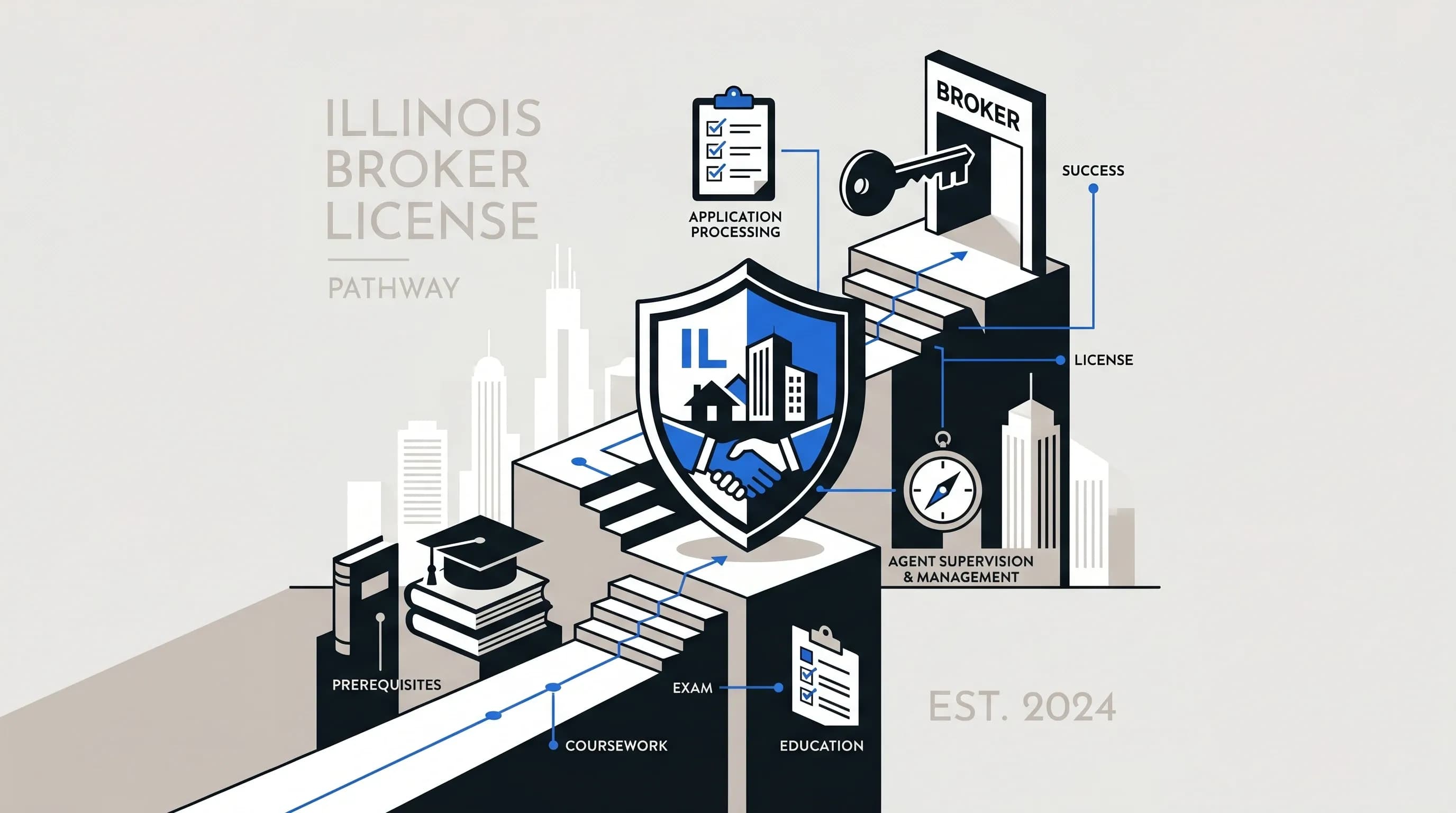
The Illinois Real Estate Broker Licensing Path at a Glance
Here’s the high‑level path to becoming a real estate broker in Illinois:
- Confirm you meet Illinois broker eligibility requirements
- Choose a state‑approved real estate school
- Complete the mandatory 75 hours of Illinois broker pre‑license education
- Pass any course finals and get your completion certificates
- Study for and pass the Illinois Real Estate Broker Examination (PSI)
- Complete fingerprinting and background check
- Interview and choose a sponsoring Managing Broker/brokerage
- Apply for your Illinois broker license through IDFPR
- Join the appropriate REALTOR® associations & MLS
- Complete required 45 hours of broker post‑licensing before your first renewal
- Maintain your license with ongoing continuing education (CE) and timely renewals
What “Real Estate Broker” Means in Illinois
In Illinois, “broker” is the entry‑level real estate license. Once you’re licensed and sponsored by a Managing Broker, you can:
- Represent buyers and sellers in residential purchases and sales
- Work with landlords and tenants on rentals and leasing
- Participate in commercial, industrial, farm, and vacant land transactions
- Earn commissions for helping clients buy, sell, or lease property
You must be licensed as a broker if you are, for others and for compensation, involved in the sale, exchange, leasing, or management of real property in Illinois. This is all governed by the Illinois Real Estate License Act of 2000 and its Administrative Rules.
On paper the path sounds simple—take a class, pass a test, sell houses. In reality, you’re stepping into a field that is 100% commission‑based, often with slow money at first and a lot of self‑discipline required. From day one, you’re effectively starting your own micro‑business inside a brokerage: you’re your own marketing department, scheduler, and collections team.
Basic Eligibility Requirements for an Illinois Broker License
To qualify for an Illinois real estate broker license, you must:
- Be at least 18 years old
- Have a high school diploma or equivalent (GED)
- Have a Social Security number or ITIN
- Be of good moral character as defined by IDFPR
A criminal record does not automatically disqualify you. IDFPR will require full disclosure and may ask for additional documentation, but many people with prior issues are still approved. If that’s your situation, we recommend planning ahead for extra paperwork time in your licensing timeline.
Complete the 75‑Hour Illinois Broker Pre‑Licensing Education
Every aspiring Illinois broker must complete 75 hours of state‑approved pre‑licensing education with an approved education provider listed by the Illinois Department of Financial and Professional Regulation (IDFPR).
The curriculum is standardized across providers and broken into two parts:
- 60‑Hour Broker Pre‑License Topics
- 15‑Hour Broker Pre‑License Applied Real Estate Principles
60‑Hour Broker Pre‑License Topics Course
The 60‑hour “Topics” course (you’ll see course codes like PROED 1130 or “Real Estate Broker Pre‑License Topics”) covers the core concepts of real estate practice:
- Real property concepts, ownership, and estates
- Land use controls, zoning, and environmental issues
- Agency relationships and brokerage responsibilities
- Listing agreements and buyer representation
- Contracts: purchase agreements, leases, contingencies
- Financing basics, mortgages, and lending practices
- Title, deeds, and transfer of ownership
- Fair housing and anti‑discrimination laws
- Illinois Real Estate License Act and state‑specific regulations
- Property valuation and appraisal basics
- Real estate math (commissions, prorations, taxes, interest)
Format options typically include:
- Online self‑paced real estate classes
- Hybrid broker license classes (part online, part live webinar or on‑campus)
- Evening or weekend schedules geared to working adults
- Accelerated 75‑hour programs that compress everything into about 8–9 weeks
Most schools require you to complete all modules and pass a course final exam (often at 70–75% minimum) to receive your completion certificate. Without that certificate or transcript, you will not be allowed to sit for the state broker exam.
15‑Hour Broker Pre‑License Applied Real Estate Principles
The 15‑hour Applied Real Estate Principles course is where you move from theory to practice. Under Illinois law, this portion must be interactive—it cannot be 100% self‑study.
Acceptable formats include:
- In‑person classroom sessions
- Live virtual classroom / webinar (Zoom or similar) with real‑time instructor interaction
In this course you’ll work through:
- Real‑world scenarios and case studies
- How to apply agency, disclosure, and advertising rules
- How escrow and earnest money must be handled
- Common transactional problems and how to resolve them
Many students underestimate how important this part is. Beyond satisfying the law, it’s your best chance to ask practical “What would I actually do in this situation?” questions before you’re in front of a live client.
How Long the Pre‑License Education Takes (and What It Costs)
Typical timelines we see for the 75‑hour Illinois broker pre‑license curriculum:
- Fast track: 4–6 weeks with steady effort
- Standard pace: 2–3 months for people studying nights/weekends
Your course completion is usually valid for two years. Within that window, you must pass the Illinois broker exam and apply for your license, or you may have to repeat the pre‑licensing education.
On cost, most Illinois real estate schools fall into this range:
- $300–$700 for a 75‑hour broker pre‑licensing package, depending on:
- Whether it includes exam prep, textbooks, and extras
- Online self‑paced vs. live instructor‑led or hybrid formats
Some providers run promotions, bundled exam prep, or “pass or don’t pay” guarantees. It’s worth shopping around reputable, IDFPR‑approved real estate schools rather than grabbing the very first ad you see.
Choosing an Approved Illinois Real Estate School
To satisfy licensing requirements, your education provider must be approved by IDFPR. Well‑known options include:
- Illinois REALTORS® partner schools and education affiliates
- Real Estate Institute / Aceable (Education Provider #515.000001)
- College of DuPage and other community college real estate programs
- Other state‑approved online and hybrid Illinois real estate schools
When we help people evaluate schools, we focus on:
- Format (online, in‑person, hybrid) and how it fits your schedule
- Support—access to instructors for questions
- Exam prep included or offered as an add‑on
- Student reviews specific to Illinois broker licensing, not just generic feedback
Some Illinois real estate education foundations, like the Illinois Real Estate Educational Foundation (REEF), offer scholarships and grants that can offset pre‑licensing tuition. If cost is tight, build a little time into your plan to research and apply for those options.
Preparing for and Passing the Illinois Real Estate Broker Examination
Once your 75 hours are complete (and any provider finals are passed), you’re eligible to sit for the Illinois Real Estate Broker Exam, administered by PSI Exams.
Broker Exam Structure: National and State Portions
The Illinois broker exam is split into two sections:
- National portion – around 100 graded questions plus a few unscored test items
- Illinois (state) portion – around 40 graded questions plus some unscored items
You must pass each portion separately. Typical minimum passing scores are:
- National portion: about 70%
- State portion: about 75%
If you pass one part and fail the other, you keep the passing score and only retake the failed portion within the allowed window (often up to four attempts within one year before you may be required to retake pre‑license education).
What’s Covered on the Illinois Broker Exam
The exam tests both broad real estate knowledge and Illinois‑specific law. Expect questions on:
- Property ownership, land use controls, and environmental issues
- Agency relationships, duties, and disclosure requirements
- Contracts, purchase agreements, leases, and contingencies
- Financing, lending practices, and closing processes
- Fair housing, ethics, and professional responsibilities
- Real estate calculations (commissions, taxes, prorations, loan math)
- Illinois Real Estate License Act of 2000 and Administrative Rules
- Advertising rules, escrow handling, discipline, and license maintenance
Many Illinois real estate schools offer broker exam prep courses or cram sessions that focus on this content, plus practice tests formatted like PSI’s exam. Those can be especially helpful if you haven’t taken a standardized test in a while.
Exam Registration, Fees, and Scheduling
Once your school reports your completion (or once you have your certificates), you can:
- Create an account with PSI Exams
- Register for the Illinois Broker Examination
- Pay your exam fee (commonly in the $58–$100 range, depending on how PSI and IDFPR structure it)
- Choose a test center, date, and time
We strongly recommend that you:
- Give yourself enough time to study properly before you schedule
- Avoid no‑shows—a missed exam often counts as a failed attempt and still uses one of your allowed tries
On exam day, you’ll typically need:
- Two forms of valid ID (e.g., driver’s license and a bank/credit card or passport)
- A simple non‑programmable calculator
- Your PSI confirmation details
The exam is multiple choice, and you’ll see your pass/fail result immediately when you finish. If you fail a portion, it’s not the end of the road—many successful Illinois brokers failed once or more. It just means you need to adjust your study strategy and retake within your eligibility window.
Study Strategy: Passing Sooner (and Cheaper)
Retakes cost money and time, so we like to approach exam prep methodically:
- Review your course materials, especially agency, contracts, Illinois law, and math
- Use flashcards for vocabulary, key numbers (deadlines, days, percentages), and core definitions
- Take multiple practice exams until your scores are consistently above the target passing thresholds
- Consider a dedicated Illinois exam prep course if your practice scores aren’t where you want them
- Study actively: teach concepts out loud to someone else or to yourself—that forces you to really understand them
Fingerprinting and Background Check
Passing the exam alone doesn’t make you licensed. Illinois also requires a fingerprint‑based background check via a state‑approved Live Scan vendor.
Plan to:
- Locate an approved fingerprint vendor near you
- Schedule an appointment and bring valid ID
- Pay the vendor fee (around $50 in most cases)
- Ensure your prints are transmitted correctly to the state
Keep your fingerprint receipt or tracking number—IDFPR or your sponsoring brokerage may ask for proof that this step was completed as part of the license application process.
What It Really Costs to Become a Real Estate Broker in Illinois
Licensing requirements cover the education and exam, but the real‑world cost of getting up and running in Illinois real estate goes beyond that. Many new brokers underestimate this and feel blindsided when the bills start stacking up.
Core Licensing Costs
| Item |
Typical Range (USD) |
| 75‑hour broker pre‑license course |
$300 – $700 |
| Broker exam (PSI, national + state) |
~$58 – $100 per attempt |
| Fingerprinting / background check |
~$50 |
| Initial broker license application (IDFPR) |
~$125 |
Subtotal just to become licensed: roughly $530–$975, before you’re actually in practice or a member of any professional organizations.
Association Membership and MLS Access
To operate effectively in most Illinois markets, you’ll likely join:
- The National Association of REALTORS® (NAR)
- Illinois REALTORS®
- A local REALTOR® association/board that provides MLS access
Membership dues vary by association and are often prorated if you join mid‑year, but a realistic combined budget for NAR, state, local, and MLS in your first year is around:
- $1,200–$1,500 (sometimes a bit more, sometimes a bit less)
Brokerage Fees and Business Setup
Your sponsoring brokerage may charge:
- Monthly office/tech/desk fees – often $50–$300/month
- Transaction fees – per closed deal
- E&O insurance – sometimes built into monthly or per‑deal fees, commonly $200–$500/year
On top of that, plan for basic business and marketing expenses such as:
- Professional headshots: $100–$300+
- Business cards and basic print materials: $50–$150
- Optional: personal website, social ads, signs and lockboxes (if not supplied by your brokerage), upgraded CRM tools
When we add everything up for most new Illinois brokers—licensing, associations, brokerage fees, and basic marketing—a realistic first‑year startup budget is typically in the $1,500–$2,500 range or more. It’s very common for that first big commission check to mostly fill back in what you already spent getting launched.
Applying for Your Illinois Real Estate Broker License
After you’ve:
- Completed the 75‑hour pre‑license education
- Passed the Illinois broker exam (both national and state portions)
- Completed fingerprinting and background check
…you’re ready to apply for your Illinois broker license with IDFPR.
IDFPR Broker License Application Process
You’ll apply online through the IDFPR – Division of Real Estate portal for a Real Estate Broker license. Expect to provide:
- Personal and contact information
- Education details (school, completion dates for the 75 hours)
- Exam results (confirmation from PSI)
- Fingerprint/background check details
- Disclosure of any criminal or disciplinary history
- Payment of the license application fee (around $125)
- Sponsoring Managing Broker information (more on this below)
You cannot practice independently as a new broker, so your license needs to be associated with a sponsoring Managing Broker or firm before it can be activated.
Picking your first brokerage is a business decision, not just a formality. Your Managing Broker will be legally responsible for supervising your practice and practically responsible for how quickly you learn the ropes.
We see a lot of new brokers focus only on “Who gives me the highest split?” But if you’re not closing deals yet, a high split doesn’t matter. Training, mentorship, and systems often matter more than a few extra points on hypothetical commission checks.
What to Look For in Your First Illinois Brokerage
When you interview brokerages (and yes, you’re interviewing them as much as they’re interviewing you), ask pointed questions in these areas:
1. Mentorship and Day‑to‑Day Support
- Do you have a formal mentorship program for new Illinois brokers?
- How many deals will a mentor realistically walk me through?
- When I’m in a live deal and stuck, who can I call or text, and how quickly will they respond?
You want more than a friendly office—look for a structure that guarantees guidance in those first critical transactions.
2. Training, Systems, and Tools
- Is there a structured new‑agent training curriculum (not just sporadic office meetings)?
- Do you train specific skills: lead generation, conversion, contracts, negotiation?
- Are training sessions live, recorded, or both? How often each week?
- What technology stack do you provide (CRM, marketing platform, transaction management, e‑signature, etc.)?
A brokerage that takes education seriously can effectively extend the foundation you got from your 75‑hour pre‑licensing education and 45‑hour post‑licensing courses.
3. Money, Splits, and Fees
Ask these questions clearly and get the answers in writing if possible:
- What’s my commission split as a brand‑new Illinois broker?
- Is there a cap on company dollars, and what happens when I hit it?
- What are the monthly fees (desk, tech, office)?
- What transaction fees are charged per closing?
- Is E&O insurance included, or billed separately?
- Are there any startup or onboarding fees when I join?
Then weigh those costs against the real training and support offered. In many cases, a slightly lower split with excellent systems and coaching can get you to an actual income faster than a high split with zero help.
4. Leads and Opportunities
Every brokerage claims to have “lots of leads.” Dig for specifics:
- Do you actually provide leads? If so, how many per month can a new agent realistically expect?
- How are leads distributed—round‑robin, performance‑based, team‑based?
- What is the split or referral fee on company‑generated leads?
- Are there teams in the office that a new broker can join for more immediate deal flow?
Remember that many “leads” are really cold inquiries that still require a lot of skill and persistence to convert, and the splits on those deals are often lower to compensate for the lead source.
Realistic Expectations for Your First Year in Illinois Real Estate
The licensing process is objective and predictable. The first 6–12 months of your Illinois real estate career are not—and that’s where managing expectations matters.
Income Timeline and Cash Flow
Because real estate in Illinois is 100% commission‑based, you should expect:
- No income until you close a transaction
- A gap of 30–60 days from contract to closing on many deals
- Ongoing fees and expenses even when no closings are happening
For many new brokers, a common pattern looks like:
- 0 closings in the first 3–6 months
- First few commission checks mostly covering startup costs and fees
- Consistent income beginning closer to months 6–12, once they’ve built real momentum
This is why we often suggest keeping a steady income on the side or adequate savings while you ramp up, rather than quitting your job the day you pass the exam.
Workload, Schedule, and Self‑Discipline
Successful Illinois brokers treat the business like a serious, full‑time commitment—even if they’re starting part‑time. In practice, that means:
- Showing homes evenings and weekends, when clients are actually free
- Answering calls and texts at odd hours during negotiations and inspection periods
- Blocking time daily for prospecting and follow‑up, not just reacting to whoever calls you
There is no boss telling you to prospect, practice scripts, or study contracts. If you struggle to motivate yourself without someone over your shoulder, this is the piece to work on early, before you rely on real estate as your sole income.
Safety and Professional Boundaries
As a broker, you’ll meet strangers in empty properties. That’s part of the work, but it’s also a reason to take safety seriously:
- Whenever possible, meet new clients at your office or a public place first
- Avoid first‑time showings alone at night with people you know nothing about
- Share your showing schedule and locations with someone you trust
- Keep your phone charged and with you, and trust your instincts if something feels off
Illinois Broker Post‑Licensing: 45 Hours Before Your First Renewal
Getting licensed is not the end of your education. Illinois requires newly licensed brokers to complete 45 hours of post‑licensing education before their first broker license renewal.
These 45 hours are typically structured as three 15‑hour courses that cover:
- Applied brokerage principles – everyday application of laws and rules
- Risk management and discipline – fair housing, disclosures, escrow, antitrust, harassment prevention
- Transactional issues – working with buyers and sellers, pricing, CMAs, offers, inspections, closings, property management
Providers like community colleges and Illinois REALTORS® education partners offer state‑approved 45‑hour post‑license packages specifically designed for new Illinois brokers.
These courses are mandatory for keeping your license active through your first renewal. Skipping or delaying them can trigger issues at renewal time, including a lapsed or inactive license.
Ongoing Continuing Education (CE) and Broker License Renewal in Illinois
After your first renewal (once you’ve completed the 45‑hour post‑licensing requirement), you’ll move into the standard continuing education (CE) pattern required for each renewal cycle.
Illinois sets specific CE requirements and broker renewal deadlines that can change over time, but they typically include:
- A set number of CE hours per cycle, with some mandatory core topics (like ethics, fair housing, or agency)
- Additional elective CE hours you can choose based on interest or specialty
- Online or in‑person CE options, including self‑paced, webinar, or classroom formats
Illinois REALTORS®, local REALTOR® associations, and other approved education providers usually offer:
- CE course catalogs and schedules
- CE lookup tools to track completed hours
- License renewal reminders and blog posts about upcoming deadlines
To maintain your Illinois broker license, you’ll use IDFPR’s online license renewal system to submit renewal applications and affirm your CE completion by the required deadlines. Missing these deadlines can result in late fees, an inactive license, or more paperwork, so it’s wise to set personal reminders well before each renewal window.
Key Legal and Regulatory References in Illinois
Throughout your education and career, you’ll hear repeated references to a few core regulatory anchors:
- Illinois Real Estate License Act of 2000 – the primary law governing real estate brokerage, licensee duties, disciplinary actions, and licensing requirements.
- Administrative Rules – adopted to implement the License Act and flesh out procedural and education details.
- Illinois General Assembly – where you can find the full text of the Act and Rules online.
- Illinois Department of Financial and Professional Regulation (IDFPR – Division of Real Estate) – the regulator that oversees broker, managing broker, leasing agent, and firm licenses, approves education providers, and handles enforcement.
From IDFPR’s Real Estate Brokerage page, you’ll be able to:
- Look up license information for brokers, managing brokers, leasing agents, and real estate firms
- Access approved education providers and courses
- Review curriculum documents and education requirements
- Download license applications and instructions
- Use the online renewal portal when your license is due
Advancing from Broker to Managing Broker in Illinois
Your first step into Illinois real estate is the broker license. If you decide later that you want to supervise other brokers, open your own real estate office, or run a real estate firm, you’ll look at becoming a Managing Broker.
The high‑level path usually includes:
- Holding an active broker license and meeting the experience requirements (e.g., a certain number of years as an active broker—check current IDFPR rules)
- Completing the required Managing Broker pre‑license education
- Passing the Illinois Managing Broker Examination
- Applying for a Managing Broker license with IDFPR
Becoming a Managing Broker is less about a title upgrade and more about running a company. It comes with more responsibility, more liability, and obligations to supervise other licensees, maintain firm compliance, and manage trust accounts and policies.
Condensed Step‑By‑Step Checklist: How to Get Your Illinois Real Estate Broker License
To bring everything together, here’s your streamlined checklist for becoming a real estate broker in Illinois:
- Confirm eligibility
- 18 or older, high school diploma or GED, SSN/ITIN, acceptable background
- Choose an IDFPR‑approved Illinois real estate school
- Enroll in the 75‑hour broker pre‑licensing program (60‑hour Topics + 15‑hour Applied Principles)
- Decide on online, in‑person, or hybrid format based on your schedule and learning style
- Complete the 75 hours of pre‑license education
- Finish the 60‑hour Topics course and pass the provider exam, if required
- Attend and complete the mandatory interactive 15‑hour Applied Principles course
- Obtain your completion certificates or transcripts
- Prepare for the Illinois broker exam
- Review course materials, use flashcards, and take practice tests
- Consider an Illinois‑specific exam prep course if you need extra support
- Schedule and pass the PSI Illinois Broker Examination
- Register with PSI and pay the exam fee
- Take and pass both the national and state portions (keeping any passed portion if you need to retake the other)
- Complete fingerprinting and background check
- Use an approved Live Scan vendor
- Pay the fingerprinting fee and retain your receipt/details
- Interview and select a sponsoring Managing Broker/brokerage
- Evaluate mentorship, training, commission splits, fees, and lead opportunities
- Confirm they’re ready to sponsor your license application
- Apply to IDFPR for your Illinois broker license
- Submit your online application with all supporting details
- List your sponsoring brokerage and pay the license application fee
- Wait for approval and verify your license status
- Join REALTOR® associations and MLS (if applicable)
- Apply to NAR, Illinois REALTORS®, and a local association
- Set up MLS access and attend any required orientations
- Launch your business and complete post‑licensing
- Invest in headshots, business cards, and basic marketing
- Plug into your brokerage’s training and mentorship immediately
- Finish the 45‑hour broker post‑licensing requirement before your first renewal
- Maintain your Illinois broker license
- Track CE hours and renewal deadlines
- Use IDFPR’s online renewal system and your provider’s CE tracking tools
Final Thoughts: Is Becoming a Real Estate Broker in Illinois Right for You?
From a licensing standpoint, becoming a real estate broker in Illinois is straightforward: meet the age and education requirements, complete a state‑approved 75‑hour pre‑licensing program, pass the PSI broker exam, secure a sponsoring Managing Broker, and apply to IDFPR.
The harder part is what happens after you’re licensed. Because the business is commission‑only with delayed income, your success will depend heavily on your ability to:
- Manage your finances and cover 3–6 months of living and startup costs
- Stay motivated without a traditional boss or fixed schedule
- Learn sales, lead generation, and negotiation skills quickly
- Choose the right brokerage environment and training support
If you’re willing to treat it like the entrepreneurial career it is, align yourself with a strong Illinois broker training program, and follow through on your education and CE requirements, you’ll be well positioned to build a long‑term real estate career in Illinois—from new broker all the way to potential Managing Broker down the road.