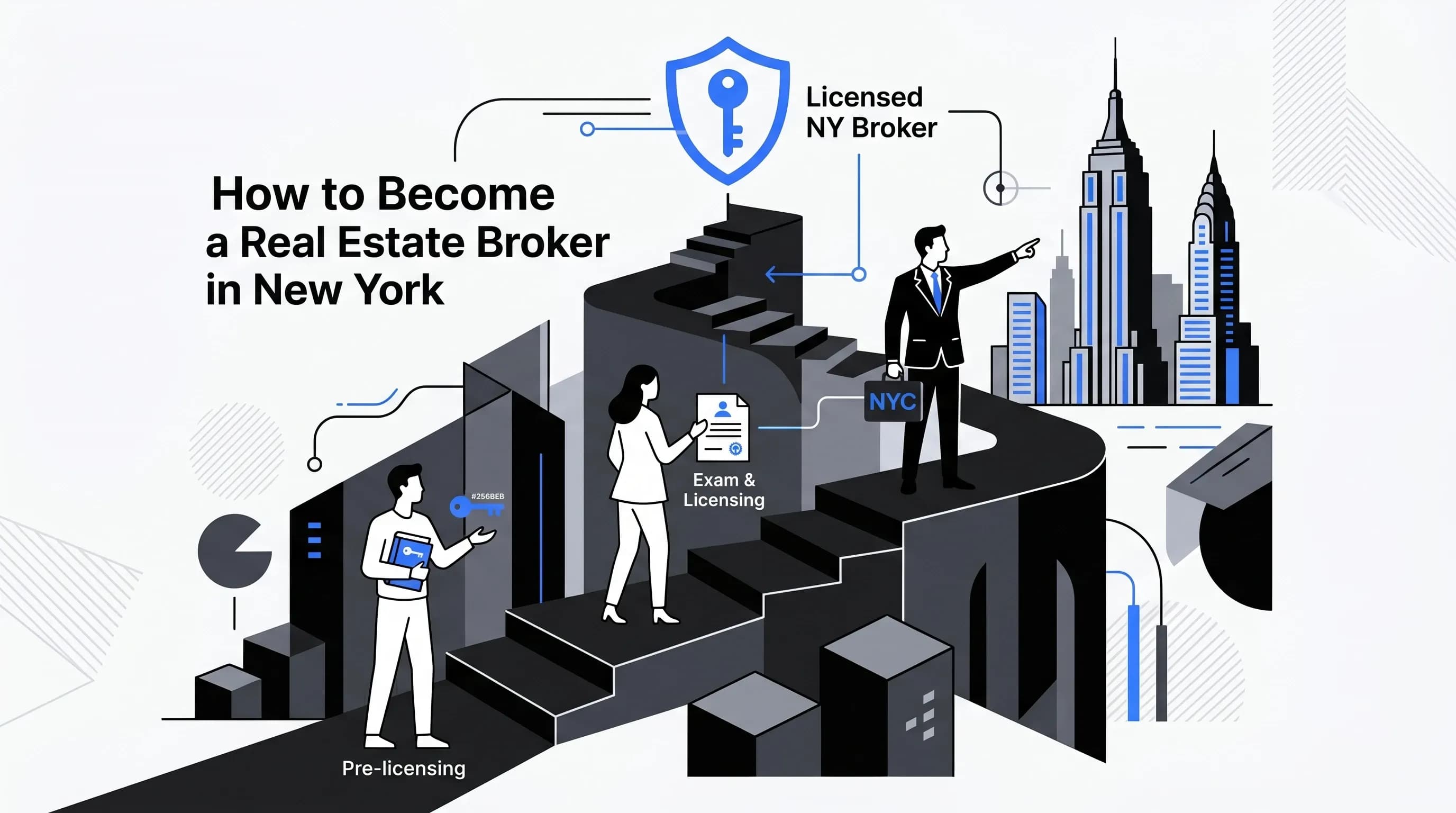
Becoming a real estate broker in New York is one of the biggest upgrades you can make in your real estate career. It’s more income potential, more authority, and far more control over your business. It’s also where a lot of salespeople stall out because the requirements and process for getting a New York real estate broker license aren’t always laid out clearly in one place.
In this guide we’ll walk through, in plain English, exactly how to become a real estate broker in New York: eligibility, education (including the 152‑hour requirement), the New York broker exam, the broker license application, and what to do with your license once you have it. We’ll also talk practically about whether you should become an associate broker under an existing firm or open your own brokerage as the principal broker.
Under New York’s Real Estate License Law (Article 12‑A of the Real Property Law), a real estate broker is someone who, for another and for a fee, can:
Where things really change compared with a salesperson is authority and responsibility. As brokers we can:
A real estate salesperson in New York must:
One point we emphasize with aspiring brokers: getting your broker license does not force you to open your own company. It makes you eligible to do so, and it positions you as a more experienced professional in the eyes of clients, loan officers, and other agents. You can remain an associate broker under someone else’s company and never be the principal broker if that’s the better fit.
New York broker licenses are issued for a two‑year term. To keep your broker license active, you’ll need to meet continuing education requirements and renew on time with the NYS Department of State (DOS) Division of Licensing Services.
New York has both baseline eligibility and experience rules for real estate broker licensing. Before you worry about the 75‑hour broker course, eAccessNY, or exam sites, make sure you can clear these hurdles.
If you do have a criminal record, it’s not always an automatic disqualification. New York looks at things case by case and recognizes tools like Certificates of Relief from Disabilities and Certificates of Good Conduct. In that situation, speak with an attorney and review DOS guidance before investing in education.
New York doesn’t hand out broker licenses to brand‑new agents. You must document relevant real estate experience in a way that meets DOS standards. In practice this means one of the following:
The “general real estate field” can include activities like:
New York assigns points for different types of transactions and responsibilities. It’s not enough to say “I’ve been around real estate for three years”; you must reach a minimum points threshold based on documented activity. When we work with agents planning the jump to broker, we recommend they keep an organized log of closed deals, leasing volume, units managed, and role in each transaction so the DOS experience forms are easy to complete.
To be eligible for broker licensure, you must have already completed the state‑approved salesperson qualifying education
New York now expects broker candidates to have a total of 152 hours of qualifying real estate education on file with the Department of State. How you hit that 152‑hour mark depends on when and how you first got licensed as a salesperson.
Most newer agents fall into this group. To qualify for a New York real estate broker license you will need:
That brings you to the required 152 hours (75 + 75 + 2). Many approved schools have already baked the cultural competency content into their salesperson or broker qualifying courses, but you want to confirm that your total NY‑approved hours line up on paper before you apply.
If you’ve been licensed in New York for a long time and originally did a 45‑hour salesperson course, you’ll need to “bridge” up to the modern standard. Typically that means:
The exact path can vary by person. Broker schools that know the New York rules well (including regional REALTOR® schools and larger New York real estate institutes) will look at your old certificates and recommend the most efficient mix of remedial, bridge, and broker classes so you don’t repeat unnecessary hours.
On paper, “75‑hour broker course” sounds like just a longer version of the salesperson class, but the depth is noticeably different. Expect heavier emphasis on:
When we walk candidates through this course, we encourage them to pay particular attention to the topics that carry the most liability later: escrow and trust accounts, agency relationships, fair housing law, and supervision requirements. That content matters a lot more in real life than just “passing the test.”
New York’s Division of Licensing Services has specific rules for qualifying courses:
Most better schools provide significant exam prep: large practice question banks, quizzes after each module, and sometimes tutoring or live Q&A. Take advantage of that. We’ve seen a big difference between students who “click through” just to satisfy hours and those who really master the qualifying education—they perform much more confidently on the New York broker exam and run stronger brokerages afterward.
Your qualifying education completion certificates are valid for 8 years from the date of completion. That means you must submit your broker license application within eight years of finishing the broker course—or you’ll end up retaking it.
We like to think of that as a built‑in clock: once you finish the broker course and pass the school exam, don’t drag your feet for years on the state exam and license application.
New York requires you to use state‑approved real estate schools for both pre‑licensing and continuing education. You can verify providers through:
When comparing broker pre‑licensing options, we look at:
Many New York brokers knock out the 75‑hour broker course in 2–6 weeks, depending on how many hours a week they can realistically devote. If you’re juggling clients and closings, building a study schedule upfront keeps the course from dragging on for months.
Now let’s walk through the full New York broker licensing process—from salesperson to licensed broker—in practical order.
Before you spend money on broker pre‑licensing, confirm:
If you’re not sure whether your background qualifies, it’s worth a quick call to the DOS Licensing Services information line at (518) 474‑4429 or a careful read of the broker application instructions on the DOS website. We’ve seen people lose time and money by guessing at the experience rules instead of confirming them upfront.
Once you know you’re eligible, your next milestone is finishing the education that the New York State Department of State expects from a broker: a total of 152 qualifying hours that combine salesperson and broker coursework.
In practice, this usually looks like:
At this stage, don’t rush past the curriculum just to “get to the exam.” A real broker in New York is legally responsible for their agents’ actions and trust accounts, and the qualifying education is where you first see how serious that responsibility is.
eAccessNY is the DOS online licensing portal. You use it to:
To get started:
Make sure your eAccessNY profile information (name, address, email) matches what you’ll use on your exam and broker license application to avoid headaches later.
Once you complete your qualifying education and pass the school final, you’re eligible to sit for the New York real estate broker written exam.
The DOS publishes a list of real estate exam sites and exam site policies. Always double‑check the location and arrival time, especially if you’re not in or near New York City.
This is where using good exam prep pays off. Many New York real estate schools offer state & school exam preparation packages, tutoring, and practice state exams. We like to see broker candidates scoring consistently in the high 80s or 90s on practice tests before they sit for the state exam; that extra margin gives you breathing room when nerves kick in.
Allowed items typically include:
Prohibited items usually include:
Exam misconduct—cheating, removing materials, ignoring proctor instructions, or causing disturbances—can result in dismissal from the exam site and further disciplinary action by the DOS.
If you need special testing arrangements:
New York provides this form and various other licensing forms in multiple languages, including Spanish, Haitian‑Creole, Italian, Korean, Russian, Chinese, and Bengali, to make access easier.
Once you’ve taken the New York real estate broker exam, your results will be posted to your eAccessNY account:
If you don’t pass on your first attempt, you can log back into eAccessNY, pay another exam fee, and reschedule. We’ve seen many candidates use the first attempt as a diagnostic, then tighten up their study plan for a successful second try.
After you pass the broker exam, the final hurdle is the broker license application itself. This is where your experience, education, and business plans all come together.
Your first decision is what role you want to play once licensed:
New York’s application process accommodates both. If you choose the associate broker route, your sponsoring broker’s information will appear on your application and they’ll confirm the relationship through eAccessNY or via paper forms as required.
If you’ll be the principal broker operating under a business name, there’s an important step before filing your broker application:
This prevents problems with misleading or duplicative brokerage names and keeps you aligned with New York’s rules on firm naming and advertising.
Depending on your situation, your application packet may include:
Many of these forms—including credit card authorization, DMV Consent, and special testing arrangements—are available in multiple languages, making the application process more accessible if English is not your first language.
All fees for your New York real estate broker license must be paid to the Department of State. The DOS specifies:
Fee amounts can change, so always verify the current fee schedule on the DOS site or in the broker application instructions before you apply.
New York gives you two primary ways to apply:
For many candidates, this is the fastest and cleanest route—everything is linked digitally to your exam results and education record.
If you’re filing on paper (or if the DOS instructions direct you to do so), you’ll:
If you’re using a courier like UPS, FedEx, or DHL, send it to the DOS physical address:
NYS Department of State – Division of Licensing Services
1 Commerce Plaza, 99 Washington Avenue, 6th Floor
Albany, NY 12231
For status questions, the DOS Licensing Services line at (518) 474‑4429 and the online licensing contact form are your official points of contact.
Once the Department of State approves your application, you will be issued a New York real estate broker license. From here you can:
At this point you’ve accomplished what many New York agents talk about but never finish: you’ve upgraded from salesperson to broker in New York and opened the door to higher‑level opportunities—management, team building, branch offices, or simply stronger personal branding.
Your New York real estate broker license is valid for a two‑year license term. Before your expiration date, you’ll need to:
To renew your broker license, New York currently requires:
Those 22.5 hours must include mandated subjects—often:
You can fulfill CE through any approved New York continuing education school in classroom, livestream, or online formats, as long as the provider is on the DOS approved list. Many brokers choose to bundle CE into larger training offerings that also cover business planning, investing, property management, or other niches they’re building into their brokerage model.
There are situations where someone has completed the broker course or even passed the New York broker exam, but isn’t ready to apply as a broker and instead needs to renew or reinstate a salesperson license. In those scenarios, part of the broker qualifying education can often be counted as continuing education for salesperson relicensing—typically:
As always, confirm the current CE breakdown with DOS or an updated state‑approved course catalog, because required content can change.
Once you have your New York broker license in hand, the decision that will shape your day‑to‑day life isn’t “Should I be a broker?” anymore—it’s how you want to use that license.
As an associate broker, you:
This path is ideal if you enjoy listing, selling, and client work more than managing an office. Agents who choose this route often want the advanced knowledge, credibility, and negotiating power of a broker license without shifting into full‑time owner‑operator mode.
If you decide to open your own brokerage or become the broker of record, your responsibilities expand quickly. As a principal broker in New York, you’re on the hook for:
This is where all the discipline and habits you built as a salesperson matter. If you struggled to hold yourself accountable for prospecting and follow‑up as an agent, being responsible for a whole office can be overwhelming. On the other hand, if you’ve already treated your sales business like a 12‑hour‑a‑day startup—driving lead generation, tracking numbers, building systems—owning your own brokerage becomes a natural next step.
New York’s experience requirement—those two years as a salesperson or three years in the general real estate field—is there for a reason. It’s your apprenticeship from both a legal and business standpoint. How you use that time will determine whether your broker license becomes a profit engine or just a certificate on the wall.
During your salesperson years, we recommend focusing intentionally on:
As you prepare to become a broker, you’re essentially collecting a list of “systems that work” and “mistakes I won’t repeat” from the shops you’ve worked in. That list becomes the foundation of your own brokerage policies or leadership style as an associate broker.
Real estate in New York is competitive and often unforgiving. Many new salespeople don’t make it to year three because they treat it like a flexible hobby rather than a business. Before you decide to be responsible for other people’s careers and compliance, it’s worth asking:
The agents who later become successful brokers usually spent their salesperson years mastering structure and discipline, not just learning contract clauses by rote.
If you choose to use your New York broker license to open your own firm, you’ll want to think through your structure before you recruit a single agent.
In a state full of big brands and established independent firms, why would a new or experienced agent join you? Your value might be:
Having a broker license is the entry ticket; a clear value proposition is how you actually build a producing office.
One of the biggest mistakes we see new brokers make is recruiting agents into chaos. Instead, design your systems first:
Well‑designed systems make it much easier to maintain compliance with New York’s Real Estate License Law and protect your license as your office grows.
With a broker license in New York, you’re held to a higher standard of knowledge and responsibility. It’s smart to invest early in:
The same laws that show up on your broker exam (Article 12‑A, Real Estate License Law, relevant regulations) are exactly what DOS looks to if there’s ever a complaint or investigation into your firm.
Timelines vary, but a common, realistic progression for someone starting from scratch looks like this:
You need a total of 152 hours of New York‑approved qualifying education, which includes your salesperson education plus broker‑level coursework and required topics like cultural competency. On top of that you must meet the DOS experience requirement and pass the broker exam.
If you already have your salesperson experience:
From starting the broker course to holding your New York broker license, many motivated agents can finish in three to six months.
Yes, as long as the provider is a DOS‑approved New York real estate school. Many offer:
Always confirm that the specific broker pre‑licensing course you choose is approved for New York broker qualifying education.
No. You can remain as or switch to an associate broker under an existing firm. Having a broker license simply gives you the option to open your own brokerage or become a principal broker later.
You need 22.5 hours of CE every two years, with specific required topics (such as recent legal matters and ethics) set by the DOS. CE must be taken from state‑approved continuing education schools.
If you use this as your roadmap and treat every step—experience, education, exam prep, and post‑licensing planning—as part of building a real business, becoming a real estate broker in New York becomes less of a mystery and more of a clear, manageable project.

Hey, in Propphy we're determined to make a business grow. My only question is, will it be yours?
It's totally free, with no commitments
Hey, in Propphy we're determined to make a business grow. My only question is, will it be yours?
It's totally free, with no commitments