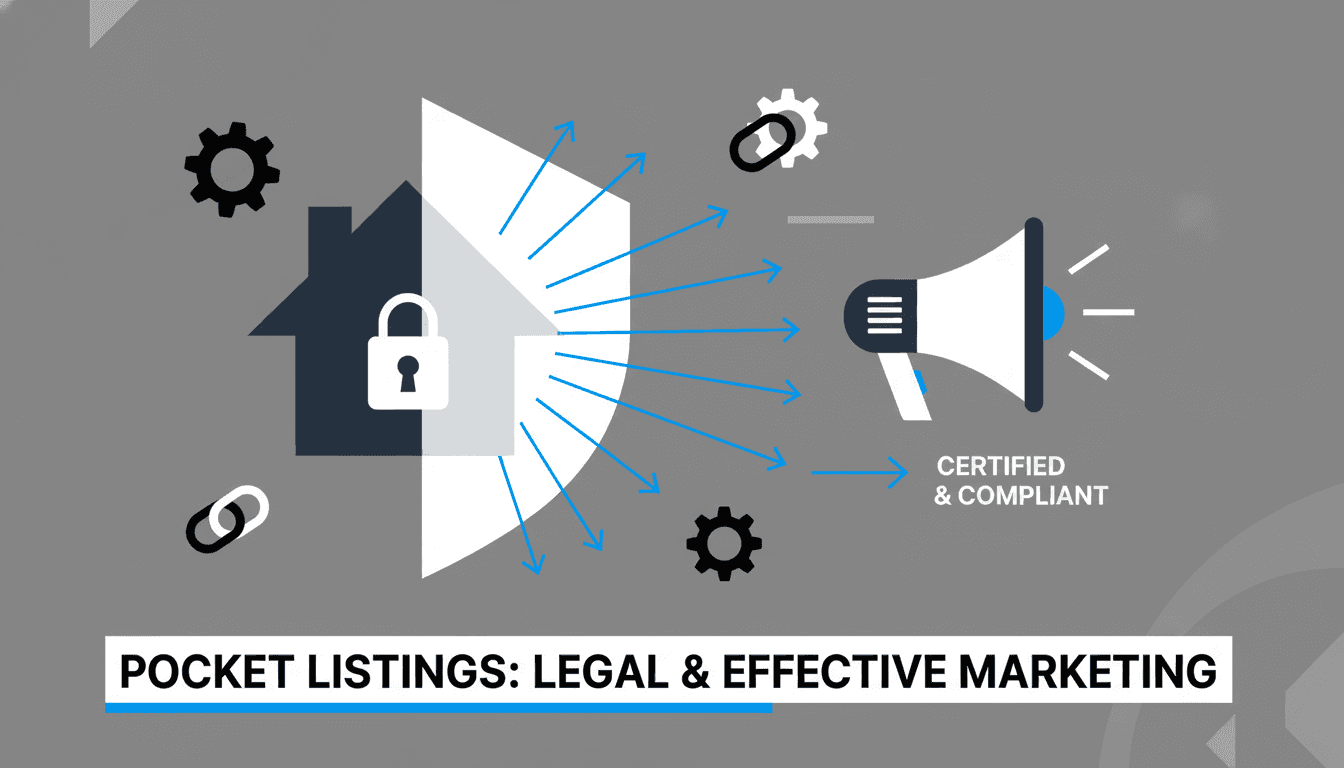
Pocket listings feel like a secret club. They’re the off‑market homes everyone wishes they could see before they hit the MLS, the quiet deals investors flip for five‑ and six‑figure spreads, and the “back‑pocket” listings agents love to brag about.
But most agents either waste months chasing unmotivated “I’ll sell if I get $2.5M” fantasy sellers, or they sit around hoping someone randomly hands them a unicorn off‑market deal. Both approaches fail.
In our experience, the real secret to marketing pocket listings is simple:
- Be ruthless about which pocket listings you accept
- Know exactly what counts as a legitimate off‑market or office‑exclusive listing under your rules
- Run a disciplined, micro‑launch that maximizes results from minimum exposure
In this guide, we’ll walk through how pocket listings work, when to use them, and exactly how to market them discreetly—step by step.
What Is a Pocket Listing in Real Estate?
Let’s get clear on definitions first, because this is where a lot of agents get burned.
A true pocket listing (also called a private listing, off‑market listing, exclusive listing, office exclusive, off‑MLS home) is:
- A property with a signed listing agreement with a licensed real estate agent or brokerage
- Intentionally excluded from the MLS (or only visible in a brokerage’s internal system)
- Marketed through private, controlled channels instead of public portals and mass advertising
It is not:
- “I know a guy thinking about selling, bring me a buyer”
- A handshake deal with no paperwork
- A property you casually mention on Instagram while hoping no one asks about Clear Cooperation
From a risk perspective, we treat anything without a signed listing agreement and an MLS exclusion/waiver as not a pocket listing at all—it’s just a lead.
MLS vs Pocket Listings: What’s the Real Difference?
On the MLS (Multiple Listing Service), we get:
- Maximum exposure to the broadest pool of buyers and agents
- Automatic syndication to public listing platforms
- A visible market history: days on market, price reductions, etc.
With pocket listings and off‑market properties, we give that up in exchange for:
- Privacy and discretion for the seller
- Control over who sees the home and when
- The ability to test pricing without leaving a public price‑reduction trail
The secret to marketing pocket listings is accepting that we’re trading the “megaphone” of the MLS for hand‑picked, targeted exposure—and then doing the work to make that targeted exposure actually effective.
Legal & Regulatory Basics: Staying Inside the Lines
Before we talk about secret marketing tactics, we have to talk rules. We can’t help a seller “sell quietly” if we wreck our license in the process.
NAR’s Clear Cooperation Policy & Office Exclusives
If you’re a REALTOR® in the U.S., the Clear Cooperation Policy is key:
- Once you publicly market a listing (yard sign, public website, social media, email blast to non‑clients, etc.), you typically must enter it into the MLS within a short window (often 1 business day).
- There’s an exception for office exclusives: properties you market only inside your brokerage and to your existing private clients, with proper seller instructions and MLS waiver forms.
This means we can’t claim something is a pocket listing and simultaneously run Google Ads and Instagram campaigns featuring the address and photos. If it’s public marketing, it’s not a pocket listing anymore.
What You Must Have in Place
For any pocket, off‑market, or exclusive listing strategy, we always start with:
- Signed exclusive listing agreement with the seller
- Signed MLS exclusion/waiver or office‑exclusive form per your local board
- Written acknowledgment from the seller that:
- Limited exposure = smaller pool of potential buyers
- Fewer offers and lower chance of bidding wars
- Potential risk of a lower sale price compared to full MLS exposure
We also clarify local rules on dual agency / multiple representation, so we’re not accidentally stepping into a conflict of interest when we find the buyer through our own private network.
When Pocket Listings Actually Make Sense
We learned early that not every “off‑market opportunity” is worth taking. In fact, most pocket listing “opportunities” fall into three buckets:
- Fantasy sellers who want way over market and refuse exposure
- Legitimate privacy‑driven sellers with real motivation and realistic pricing
- Loose verbal offers with no paperwork and no clear intent
We walk away from #1 and treat #3 as seller leads, not listings. The only ones we market as pocket listings are #2.
Common Legitimate Reasons to Sell Off‑Market
- Privacy & security
- High‑profile individuals (executives, celebrities, politicians)
- Clients with safety concerns or valuable collections
- Sensitive life events
- Divorce, estate sales, health issues
- They don’t want neighbors or coworkers dissecting their situation on Zillow
- Tenant/occupancy complications
- Landlords who haven’t informed tenants about selling
- Units that are difficult to show without disruption
- Timing & condition
- Homes mid‑renovation or pre‑staging
- Owners not ready for full public launch but open to selling if the right buyer appears
- Testing the market
- Sellers wanting to “test the waters” at a certain price point without public price cuts
- Investors gauging demand for a unique asset
In all those scenarios, our pitch is consistent: we’ll get maximum results from minimum exposure and we’ll control exactly who sees the home, when, and under what conditions.
Our Non‑Negotiables Before Accepting a Pocket Listing
We put every potential pocket listing through a quick filter. We only proceed when:
- The seller signs a written exclusive listing agreement
- We’re within a realistic price range based on market data
- There’s a clear, rational reason for staying off the MLS (not just ego)
- We agree on a time horizon: a defined private‑marketing period followed by a decision checkpoint
If any of that is missing, we assume we’re being set up for the classic “bring me a buyer, but I don’t really want to sell” scenario—and we pass.
Pros and Cons of Pocket Listings for Sellers & Agents
High‑quality marketing starts with honest positioning. We never sell pocket listings as a magic shortcut; we present them as a strategic option with clear trade‑offs.
Benefits of Pocket Listings
- Privacy and discretion
- No public photos for neighbors, co‑workers, or tenants to analyze
- Less attention from the curious public and “looky‑loos”
- Control over exposure
- Sellers can decide exactly who steps inside their home
- We pre‑qualify buyers financially and behaviorally before showings
- Reduced disruption
- No public open houses
- Fewer showings, more predictable schedules
- Flexibility on pricing
- We can test price points and adjust off‑market
- No public record of price reductions or days on market
- Exclusivity appeal
- Some buyers love the idea of “secret listings” and off‑market opportunities
- We can position the property as a hidden gem accessible only to a select group
Risks and Downsides
- Smaller pool of buyers
- No full MLS exposure
- Less chance of multiple offers and bidding wars
- Potentially lower sale price
- With fewer competitive offers, we may lose some upside
- Especially risky in hot seller’s markets where MLS listings routinely get offers above asking price
- Ethical and legal scrutiny
- Fair‑housing concerns if the marketing pool is too narrow
- Dual agency / dual representation conflicts if not handled transparently
- Seller regret
- Some sellers will always wonder, “Could I have gotten more on the open market?”
- We manage this by documenting the pros and cons up front
In other words, pocket listings are a tool, not a default. Our credibility comes from recommending them only when they clearly serve the client’s goals.
The Core Strategy: Treat Pocket Listings Like a Micro‑Launch
A pocket listing fails when it’s treated like a secret we whisper once and forget. We’ve seen too many agents “have” off‑market listings that just sit because there’s no actual plan.
Our approach is to treat every pocket listing like a micro‑launch:
- Same level of preparation as a public MLS launch
- Tightly defined audience instead of a mass blast
- Clear start date, clear review date, clear next step
Step 1: Set the Rules and Timeline With the Seller
We start every private listing with a written game plan that answers:
- What’s allowed?
- Share within our brokerage’s internal system?
- Email private client list?
- Show only to pre‑approved buyers?
- What’s not allowed?
- No yard sign?
- No public social media posts with address/photos?
- No syndication to public portals?
- What’s the time window?
- Example: 14–30 days as an exclusive or office‑exclusive listing
- Then we either:
- Adjust price and continue off‑market, or
- Go live on the MLS, or
- Pause the sale based on life circumstances
This protects us legally, sets expectations, and creates genuine urgency: the private window is a limited privilege, not an infinite holding pattern.
Step 2: Build a Stealth Marketing Kit
Even though the listing is private, we still build high‑quality marketing assets—just housed behind controlled access.
- Teaser property brief (one‑pager or PDF)
- General location (“Prime [Neighborhood]” rather than exact address)
- Bed/bath/approx. size, lot size, parking
- Key features, story, and what makes it “a hidden gem”
- Approximate price or price band (if seller allows)
- Showing parameters (by appointment only, proof of funds, etc.)
- Private media set
- Professional photos, floor plan, 3D tour, or walkthrough video
- Hosted on a password‑protected page or unlisted link
- Access shared only once we’ve vetted the buyer or agent
- “Perfect buyer” profile
- Who this home is ideal for (lifestyle, budget, timeline)
- This guides our targeting and outreach scripts
We often use AI to multiply our own ideas here: feeding in specifics about the home and target buyer to generate multiple email templates, phone talk tracks, and short blurbs tailored to different audiences (investors, move‑up buyers, relocation clients, etc.). We’re still driving the strategy; AI just accelerates the content creation.
The 3 Core Channels for Marketing Pocket Listings
When we looked at where actual off‑market buyers come from—not theory, but real transactions—the pattern was clear. They don’t usually appear from random social posts or pretty print ads. They come from three main channels.
Channel 1: Your Own Database & Warm Sphere
This is your number‑one asset for off‑market deals. We rely heavily on:
- Past buyers and sellers
- Active buyer clients and hot leads in our CRM
- High‑net‑worth contacts and local business owners
- Professional partners: CPAs, attorneys, financial planners, wealth managers
For pocket listings, we avoid spammy blasts and focus on targeted, personal outreach.
How We Use Email for Off‑Market Listings
We segment our list into groups like:
- VIP buyers (cash, strong financing, short timelines)
- Move‑up buyers in the right price band
- Investors looking for specific cap rates or neighborhoods
- Past clients who’ve said, “Tell me if something special comes up”
Then we send short, private‑sounding emails such as:
Subject: Quiet opportunity in [Neighborhood] (not on MLS)
Hi [Name],
I’m handling a private sale in [Neighborhood] that isn’t on the MLS or any public site. It’s a [brief description – beds/baths/type] in the [price range] range, and it’s a strong fit for someone who wants [key benefit – yard, views, walkability, rental potential, etc.].
Because of the seller’s privacy, I can’t share details widely, but if you’d like to know more, reply to this email and I’ll send a private brief. Please don’t forward this; it’s for you as a client only.
– [Signature]
This keeps us firmly in a private‑marketing lane while still creating curiosity and demand.
How We Use Text and Calls
For top‑tier buyers and key referrers, we’ll use text or a quick call:
“Hey [Name], I just took on a private listing in [Area] that fits what you told me you wanted almost perfectly. Not on the MLS. Want the quick rundown?”
The tone is conversational, one‑to‑one, and very clear that this is an off‑market opportunity, not a mass blast.
Channel 2: Other Agents (Done Strategically)
Despite all the noise on social media, most serious buyers already have an agent, and most of the high‑end or time‑sensitive deals we see are brought together by professionals on both sides.
Instead of spamming every licensee in our MLS with “Got a buyer?” emails, we identify a short list of agents who:
- Regularly close in the relevant price range and neighborhood
- Have reputations for representing qualified buyers, not just lookers
Then we reach out personally with a tight script. For example:
“Hey [Agent], I thought of you immediately on this. I’ve got an office‑exclusive / off‑MLS [property type] in [neighborhood], around [price range]. Seller wants privacy, so I can’t blast it out, but it feels like something your [X type of buyer] would jump on. Have anyone it might fit?”
Because we’ve done the homework on who we call, this doesn’t feel like spam. It feels like we’re handing them a chance to look like a hero to their own clients.
Where our brokerage offers an internal “private collection” or “office exclusive” system, we use that too—but we never rely on the system alone. We still layer personal calls and messages to the most relevant colleagues.
Channel 3: Investors & Specialist Networks
For certain off‑market properties—distressed homes, heavy fixers, vacant properties, homes with code issues—the best buyer is often a real estate investor or a specialist buyer, not an owner‑occupant.
We maintain and continually refine an internal list of:
- Local flippers active in specific neighborhoods
- Buy‑and‑hold investors and small landlords
- Wholesalers who actually close or assign reliably (not just blast lists)
- 1031 exchange buyers and family offices for higher‑end stock
Our messaging to them is different. Instead of lifestyle hooks, we focus on numbers and structure:
- ARV (after‑repair value) ranges
- Estimated renovation scope and budget bands
- Rent potential and cap rate ranges
- Seller’s preferred terms and non‑price priorities (timeline, contingencies, etc.)
We also set clear boundaries up front:
“This is a confidential off‑market opportunity. Please do not shop the address around. If you’re serious and the numbers work, we’ll set a private showing and verify proof of funds/financing before we talk offers.”
This filters out tire‑kickers and protects the seller’s confidentiality, while still tapping into a buyer pool that thrives on off‑market deals.
Tactical Playbook: How to Market Pocket Listings Discreetly
With the strategy and channels in place, here’s how we actually execute—step by step.
Tactic 1: Hyper‑Target the Immediate Neighborhood
Neighbors are an underrated off‑market buyer source. They love the area, and many know friends or family who want in. For pocket listings, we use:
- Hand‑delivered letters or notes
- We avoid exact addresses in writing and use phrasing like:
- “A nearby homeowner has asked us to quietly gauge interest in a property that isn’t on the public market yet.”
- “If you or someone you know would love to live in this neighborhood, contact us for discreet details.”
- Neighbors‑only previews
- Small, invite‑only gatherings—no public signage, no open‑house announcements
- This often surfaces “my sister has been dying to move onto this street” type buyers
- Calls to key contacts in our geographic farm
- “We’ve been asked to quietly find the right buyer for a home on your street. Anyone come to mind?”
We’re careful to avoid anything that crosses from private into “public advertising” under our board’s definitions. Specific details stay in private conversations, not in mass mailers.
Tactic 2: Segmented, Discreet Email Marketing
Our CRM is central to pocket listing marketing. Rather than emailing our entire list, we build tight segments and craft messaging that emphasizes confidentiality and exclusivity.
Key moves:
- Tagging buyers by:
- Neighborhood and price band
- Property type (luxury condos, multifamily, single‑family homes)
- Investor vs owner‑occupant
- Using subject lines like:
- “Off‑market option in [Area] for my VIP list only”
- “Private listing: [general description] in [Neighborhood]”
- Explicitly stating that details are not to be forwarded widely
Email is one of the easiest channels to keep within the bounds of an office‑exclusive or private marketing agreement because we control exactly who gets what.
Tactic 3: Sponsor & Work High‑Value Events
Some of our best pocket listing introductions have come from environments that don’t look like “real estate marketing” on the surface—charity galas, art shows, business breakfasts, private wine events.
At those events, we’re not pitching specific listings publicly. Instead, we position ourselves as:
“The person you call when you or your clients need to buy or sell quietly, without their home being paraded all over the internet.”
This subtly markets our off‑market capability, so privacy‑sensitive sellers and high‑net‑worth buyers naturally think of us when a confidential transaction is needed.
Tactic 4: Highly Targeted Google Ads for “Off‑Market Access” (Where Allowed)
In some markets and under some MLS interpretations, we can’t advertise a specific pocket listing publicly—but we can market the service of getting exclusive access to off‑market properties.
When rules allow, we run tightly targeted Google Ads like:
- “Access off‑market homes in [City] before they hit the MLS”
- “Exclusive listings not on MLS – by invitation only in [Neighborhood]”
These don’t mention a specific address or show identifiable photos. Instead, they drive to a landing page that:
- Briefly explains our private listing program
- Collects buyer criteria and contact info
- Promises a 1:1 follow‑up if we have a fit
The moment a lead opts in, everything shifts back into private, one‑to‑one communication—and we’re fully in our off‑market playbook.
Tactic 5: Exclusive Website Areas for Private Listings
One of the most powerful tools for marketing pocket listings discreetly is a website that can hide and reveal information on our terms.
We routinely use:
- Password‑protected property pages
- Full photo galleries, videos, and details visible only to people we’ve given access codes to
- Useful for both luxury pocket listings and sensitive investment properties
- VIP client login areas
- Member‑only sections that showcase off‑market and pre‑MLS listings
- Segmented by price, neighborhood, or property type
- Invitation‑only links
- Time‑limited URLs we send directly to vetted buyers or partner agents
- Create urgency: “Access expires on [date]”
This setup not only impresses clients (it feels like a private club), but it also helps with compliance: we’re not publishing private listings on public pages indexed by Google; we’re controlling access to members and invitees only.
Pocket Listings as a Strategic Decision, Not a Flex
We’ve seen agents get intoxicated by the idea of “secret listings.” The problem is that when ego leads, ethics and strategy follow far behind.
Our rule of thumb is simple: if a pocket listing clearly serves the client better than an immediate full MLS launch—and we can do it legally and ethically—we’ll use it. If not, we recommend MLS exposure, even if it means fewer Instagram brags for us.
When We Advise Against Pocket Listings
- Very hot seller’s markets
- When bidding wars are the norm, MLS exposure usually produces more offers and higher prices
- Risk‑averse, second‑guessing sellers
- If a client is likely to obsess over “what if” scenarios, we’d rather avoid limited‑exposure strategies
- Unrealistic pricing + no exposure
- If the seller wants way above market and won’t allow MLS, we politely decline and move on
- Situations where dual agency pressure is too great
- If it feels like the whole point is for one agent to “double‑end” the deal at the seller’s expense, we don’t touch it
Paradoxically, saying “no” to poor‑fit pocket listings has gotten us more respect (and better off‑market referrals) than saying “yes” to everything ever would.
Building a System So Pocket Listings Find You
Occasional pocket listings are a side effect of a healthy real estate business. Consistent access to off‑market properties is the result of a deliberate system.
Position Yourself as the “Discreet Option”
We don’t plaster “We do secret deals!” all over social media. Instead, we weave it into the parts of our business that matter most:
- Listing presentations
- We outline both options: standard MLS launch vs private window
- We show sellers when and why a pocket listing might make sense
- Professional introductions (attorneys, CPAs, wealth managers)
- We make it clear we can quietly help clients who can’t go public—for legal, personal, or security reasons
- Referral messaging
- “If you ever know someone who needs to sell but really can’t have their home on every website, that’s exactly where we specialize.”
Over time, this turns us into the go‑to resource for private real estate sales—the agent you call when a standard MLS blast isn’t appropriate.
Hunting “Hidden Inventory” Intelligently
Not all off‑market opportunities come from direct referrals. We also work upstream sources like:
- Vacant property registries
- Code enforcement and nuisance property lists
- Tax‑delinquent and probate records
These owners typically don’t want prolonged, public exposure or dozens of showings. Some of our best pocket listing candidates have been:
- Estate executors overwhelmed with a property they don’t want to manage
- Out‑of‑state owners paying vacant property fees
- People embarrassed by the condition of their home who still want a fair, market‑based outcome
We approach them first as potential seller clients, then—where appropriate—as candidates for a private listing strategy that gives them privacy and control.
Using AI to Scale Your Pocket Listing Workflow
We’ve found AI especially useful for the repetitive but crucial parts of off‑market marketing, such as:
- Generating tailored email and text sequences for:
- VIP buyers interested in exclusive listings
- Top agents in our market
- Investors by price and area
- Drafting seller‑friendly explanations of:
- MLS vs pocket listings
- Why we recommend a 14–30 day private window before going public
- Producing variations of property briefs for:
- Investors (numbers‑driven)
- Owner‑occupants (lifestyle‑driven)
- Referral partners (high‑level overview)
We still bring the market knowledge, pricing sense, and relationship strategy. AI just compresses the time it takes to get the right words in front of the right people.
Step‑by‑Step Checklist: How We Market a Pocket Listing
To pull everything together, here’s the process we follow whenever we take on a pocket listing or office exclusive.
- Qualify the seller and the situation
- Motivation to sell is clear and credible
- Pricing is aligned with market reality (within a reasonable range)
- There is a legitimate privacy or timing reason to stay off MLS
- Lock down paperwork and compliance
- Exclusive listing agreement signed
- MLS exclusion / office‑exclusive form signed
- Written summary of trade‑offs reviewed with the seller
- Define the private‑marketing window and rules
- Private period of 14–30 days (or similar)
- What we may and may not do in terms of exposure
- Clear “decision day” at the end of the window
- Build the stealth marketing kit
- Property brief (PDF/one‑pager)
- Private photo/video package
- Ideal‑buyer profile and talking points
- Launch to our three main channels
- Segmented email and calls to our database & VIPs
- Personal outreach to a curated list of top buyer agents
- Targeted investor outreach if the property fits that profile
- Layer on discreet amplifiers
- Neighbor notes and a small, invitation‑only preview
- Private mentions at appropriate events and within professional circles
- (Where allowed) Lead‑gen for buyers seeking off‑market homes
- Track activity and feedback
- Inquiries, showings, and verbal interest logged in our CRM
- Pricing and condition feedback summarized for the seller
- Debrief and decide with the seller
- Accept an offer generated off‑market
- Adjust price and continue privately
- Move to the MLS for full public exposure
The Real Secret to Marketing Pocket Listings
When we boil everything down, marketing pocket listings successfully comes from three things:
- Ruthless selection – We say no to fantasy sellers and vague “I might sell” conversations. We only market pocket listings when the seller is real, the motivation is real, and the pricing is grounded.
- Compliance and ethics first – We treat a pocket listing as a legitimate exclusive listing with paperwork and clear boundaries—not as a loophole to game MLS rules or double‑end commissions at the client’s expense.
- Micro‑launch discipline – Instead of whispering a secret and hoping, we run a structured, targeted marketing campaign to a curated pool of qualified buyers, agents, and investors, then pivot based on real‑world feedback.
That’s the real “secret” to pocket listings: they’re not magic shortcuts. They’re constrained listings that demand more strategy, more intentional marketing, and more clarity with clients—not less.
Handled this way, pocket listings become a powerful off‑market strategy, a compelling value‑add in your listing presentations, and one of the best ways to deepen relationships with serious buyers, sellers, and professional partners who value privacy as much as price.