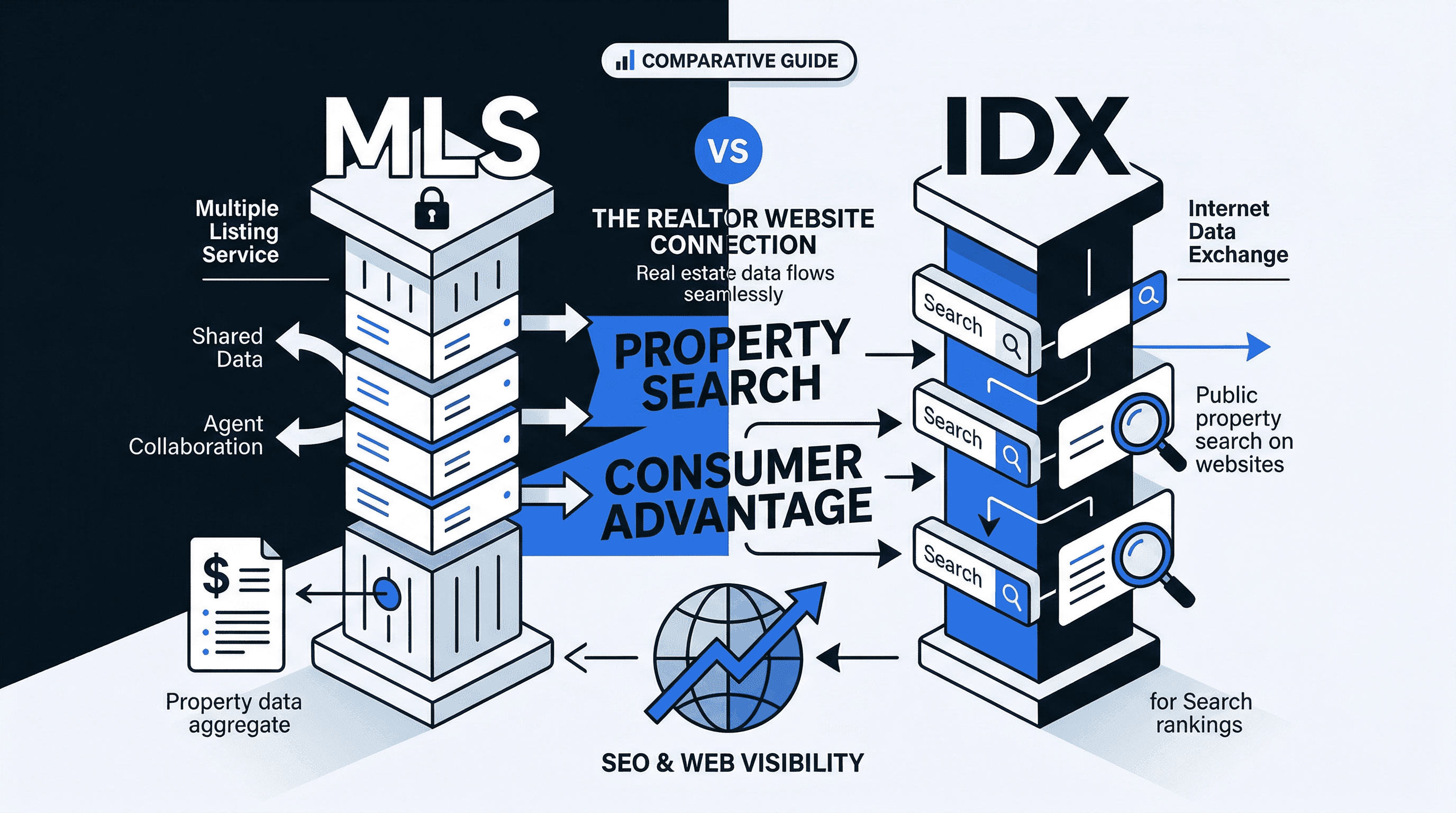
In real estate, we hear “IDX” and “MLS” thrown together so often that they start to sound like the same thing. They’re not. The MLS is where listings actually live; IDX is how those listings get onto a public real estate website in a way buyers can use.
In this guide, we’ll walk through IDX vs MLS differences, how they’re related, and what those differences mean in practice for SEO, lead generation, and your real estate business.
IDX vs MLS in Real Estate: Quick Overview
Before we dive into detail, it helps to get the relationship clear in one sentence:
The MLS is the private, professional database of listings; IDX is the rules and technology that let us show (some of) that MLS data on our own public real estate websites.
- MLS (Multiple Listing Service) – a member-only property database where agents and brokers create, update, and manage listings.
- IDX (Internet Data Exchange) – a policy framework plus software that legally and technically pulls MLS data to our websites for public “MLS search.”
Once we see MLS as the source of truth and IDX as the , the rest of the “IDX vs MLS” confusion starts to disappear.
What Is the MLS? Multiple Listing Service Explained for Agents and Brokers
The Multiple Listing Service (MLS) is a cooperative, professional-only property database run by local or regional Realtor associations and broker organizations. It’s not a single national system; there are hundreds of local MLSs, often with overlapping coverage.
Core features of the MLS
- Private, member-only access – Licensed agents and brokers pay dues to join and access their local MLS.
- Cooperative marketplace – Listing brokers and buyer’s brokers agree on rules for cooperation and compensation.
- Standardized data – Everyone uses the same fields and status definitions, which makes searching and sharing much more efficient.
- Accuracy and timeliness – The MLS is the authoritative record for price changes, status updates, photos, and remarks.
Internally, we rely on the MLS as our back-office system: we enter listings, update them, and run detailed searches for our clients with fields that will never appear on public sites.
What’s actually stored in the MLS?
- Property address and geolocation
- Price and status (active, pending, sold, withdrawn, etc.)
- Beds, baths, square footage, lot size, year built
- Photos, videos, 3D tours, virtual tours
- Public remarks and feature descriptions
- Agent and broker contact details
- Private/internal remarks (for agents only)
- Showing instructions and lockbox info (restricted fields)
MLS data isn’t public domain. Each board controls what can be shown publicly and under what conditions, which is exactly where IDX comes in.
What Is IDX in Real Estate? Internet Data Exchange Explained
IDX (Internet Data Exchange) is both a policy and a technology standard that allows MLS listings to be displayed on public real estate websites in a controlled, compliant way.
In plain language:
- The MLS is the secure database behind the scenes.
- IDX is the plumbing (plus the rulebook) that moves approved MLS data into a public-facing search experience on our site.
How IDX works behind your “MLS search”
- Membership & authorization
We must be active members of the MLS whose listings we want to display. Brokers typically opt into IDX, allowing their listings to appear on other participants’ sites under standard IDX rules. - Data feed from the MLS
An IDX solution (from our board or a vendor) connects to the MLS and receives an authorized data feed. It ingests the data on a schedule—often every 15 minutes to a few hours—and normalizes it for web display. - Display on our website
The IDX provider gives us widgets, plugins, or an API. When visitors search on our site, what they’re really doing is querying that formatted slice of MLS data through the IDX layer. - Compliance enforcement
IDX follows rules set by NAR and our local MLS: - Only approved fields can be shown publicly.
- Listing broker attribution and required disclosures must appear.
- Owners can restrict syndication or auto-valuations where policy allows.
What IDX is not
- Not another MLS – it doesn’t originate listings; it mirrors allowed portions of MLS data.
- Not “just a website” – it’s the engine that powers the MLS search feature on our real estate website.
- Not full MLS access – many internal fields never leave the MLS and are invisible to consumers.
IDX vs MLS: Key Differences at a Glance
| Aspect | MLS (Multiple Listing Service) | IDX (Internet Data Exchange) |
| Core concept | Cooperative listing database for professionals | Policy + technology to display MLS listings publicly |
| Who runs it | Local/regional Realtor associations & brokers | Vendors and brokers, under MLS/NAR IDX rules |
| Who uses it directly | Licensed agents and brokers (behind login) | Consumers on agent/broker sites (no login required to search) |
| Primary purpose | Data accuracy, cooperation, compensation, compliance | Marketing, lead generation, online property search |
| Type of data | Full listing record, including private/internal fields | Subset of public-facing fields allowed by MLS policy |
| Cost structure | Membership dues to each MLS | IDX subscription/integration fees + MLS membership |
| Visibility | Mostly invisible to consumers | Front-end “MLS search” users interact with |
If we had to reduce “IDX vs MLS” to a single line: MLS creates and stores the data; IDX delivers it to the public via our websites.
The MLS–IDX Connection: How Listings Travel from Database to Website
The relationship between IDX and MLS is really a pipeline:
- Listing input into the MLS
A listing agent enters a property into the MLS. At this moment, the MLS becomes the authoritative record for that listing. - MLS enables IDX sharing
Under IDX policy, the MLS exposes a controlled subset of its data to approved participants. Brokers who opt in allow their listings to be shown on other IDX sites. - IDX vendor ingests the feed
Our IDX provider pulls the latest data from the MLS at regular intervals and stores or caches it for fast access. Different providers use different technologies (classic IDX feeds, RETS, RESO Web API, etc.). - Our website presents MLS search
When a buyer hits “MLS search” or “Search homes” on our site, they’re seeing MLS data rendered by the IDX software: search forms, maps, listing grids, and property detail pages. - Updates sync back through the pipe
Any price change, status change, or new photo is updated once in the MLS, then propagated through IDX feeds to our website, often within minutes.
From a buyer’s point of view, it feels like our website “has all the listings.” From a technical standpoint, what’s really happening is MLS → IDX feed → our site.
“MLS Search” vs IDX: What Users See vs What Powers It
On real estate websites, we usually label the main search page as “MLS Search,” “Search the MLS,” or “Home Search.” Technically:
- MLS search is the user-facing feature where buyers filter by price, beds, neighborhood, and see properties.
- IDX is the underlying mechanism that legally and technically makes that MLS search possible on our domain.
So whenever we see a site claiming to offer “real-time MLS search” or “MLS listings on our website,” there is almost always an IDX integration operating under the hood.
Free MLS IDX vs Paid IDX Services: What’s the Real Difference?
Most of us quickly discover that “IDX” isn’t a single product. We have:
- Free IDX tools offered by some boards/MLSs
- Paid IDX platforms like iHomefinder, IDX Broker, Showcase IDX, Diverse Solutions, and others
Both rely on the same MLS data and IDX policy, but the impact on SEO, branding, and lead generation is completely different.
Free MLS search tools: usually framed, basic IDX
Board-provided “free IDX” tools are typically delivered as an iframe you drop into a page on your site.
- The listings are technically not on your site; they’re on the MLS or vendor’s server, shown through a window.
- Search functionality is often basic, with limited branding and minimal customization.
- Lead capture is usually weak or nonexistent.
- From Google’s perspective, the rich listing content inside the iframe does not count as content on your domain, so it carries little SEO value.
We’ve seen free IDX work as a stopgap for agents who simply want “somewhere to send people to search” without paying monthly fees. It’s better than dumping everyone on Zillow, but it doesn’t build a real digital asset, and it rarely moves the needle on rankings or lead volume.
Paid IDX platforms: full-featured IDX-powered websites
Paid IDX vendors build a complete lead-generation and SEO platform on top of the MLS feed. Compared to free tools, we typically get:
- Indexable listing pages rendered under our own domain (not just in iframes).
- Advanced property search experience: maps, polygon search, filters, open houses, price reductions, and more.
- Lead capture tools like forced/soft registration, “save search,” “favorite this home,” and showing request forms.
- Behavior tracking – we can see what properties a lead viewed, which areas they’re searching, and how often they come back.
- CRM and email integrations so leads flow straight into our follow-up system.
- Custom widgets for things like “Newest listings in [Neighborhood]” or “Condos under $400k in [Area].”
Once we plug a quality IDX into our site and actually turn on the lead capture features, traffic that used to just browse and leave suddenly converts into a stream of contactable leads we can nurture over time.
IDX vs RETS and “Organic MLS Integration”
Beyond “IDX feed” vs “MLS,” we also run into terms like RETS and organic MLS integration. These describe how deeply the MLS data is integrated into our website.
What is RETS?
RETS (Real Estate Transaction Standard) is (or was, in many markets) a protocol that lets approved websites pull raw listing data directly from the MLS into their own databases.
With a RETS-based or RESO Web API integration, we’re not just displaying listings that live on someone else’s server; we’re actually importing MLS data into our own database and building our property search on top of it.
Compared to a typical hosted IDX feed:
- Speed – Searches can run faster because our site is querying a local database instead of bouncing out to an external server and back.
- Update control – We can schedule syncs as frequently as our MLS and infrastructure allow, sometimes near real time.
- Complexity and cost – We need developers, database design, and ongoing maintenance. It’s a high-control, high-effort route.
Framed IDX vs organic MLS integration
Vendors often contrast “framed IDX” (iframe-based) with “organic MLS integration.” In simple terms:
- Framed IDX – Listings are hosted elsewhere and embedded via iframe. Minimal SEO benefit, limited control.
- Organic MLS integration – MLS data is pulled into our site so:
- Each listing has its own URL on our domain.
- Listing content is fully indexable by search engines.
- We can build rich neighborhood and property-type pages using live MLS data.
Many modern IDX solutions now occupy a middle ground: we still use a vendor, but they render content server-side on our domain so our listing pages are SEO-friendly and indexable, without us having to build a full RETS integration from scratch.
IDX vs MLS Syndication: Zillow, Realtor.com, and Other Portals
It’s also important to separate IDX from syndication.
What is syndication?
Syndication is when MLS or broker data is sent out to third-party listing portals and advertising platforms such as:
- Zillow
- Trulia
- Realtor.com
- Homes.com
- Other niche or regional property websites
Brokers can often choose which sites to syndicate to, or even whether to syndicate at all. Some MLSs use services like ListHub as a centralized “hub” to manage this distribution.
How syndication differs from IDX
- IDX – Shares MLS listings among participating brokers’ own websites under IDX rules. It powers the MLS search feature on our domain and is aimed at lead generation for us.
- Syndication – Sends listings to third-party consumer portals, where those companies control the user experience and often sell leads back to agents.
In practice, we generally want both:
- IDX to keep buyers searching on our site and to capture leads into our own CRM.
- Syndication to maximize exposure of our seller clients’ listings on high-traffic portals.
Why IDX vs MLS Matters for Real Estate Websites and Lead Generation
Understanding how IDX and MLS are related isn’t just technical trivia; it shapes how our real estate website performs as a marketing and lead-generation platform.
With MLS but no IDX
If we belong to an MLS but don’t use IDX on our site, we’re essentially running a static brochure website:
- About page, contact info, maybe a handful of manually added “featured listings.”
- Buyers leave our site to search on portals, where other agents are one click away.
- We lose the ability to see what people are looking at and to follow up intelligently.
With MLS + IDX integrated
When we connect IDX to our MLS membership and integrate it properly into our website:
- Our site offers a full MLS search experience similar to big portals, but branded to us.
- Visitors can browse nearly the entire local inventory, not just our own listings.
- We can turn anonymous traffic into leads with saved searches, alerts, and registration prompts.
- Our listing pages can become SEO-friendly, indexable URLs that attract long-tail traffic.
This is the difference between having an online business card and having a website that functions as a lead-generating engine.
The SEO Impact of How We Implement IDX
From an SEO perspective, not all IDX vs MLS setups are created equal.
Framed/free IDX: minimal SEO value
When listing content is embedded via iframes from an MLS or vendor:
- Search engines mostly see a thin page with a frame, not thousands of rich listing details.
- We’re left trying to rank a handful of non-listing pages against national giants for broad keywords like “homes for sale in [city],” which is usually a losing battle.
SEO-friendly, indexable IDX: huge long-tail opportunity
With IDX solutions that render content on our own domain, each listing and search results page can become a unique, indexable URL. That opens up strategies like:
- “Homes for sale in [Neighborhood]”
- “Waterfront homes in [Lake Name]”
- “Condos for sale in [Building Name]”
- “New construction homes in [Subdivision]”
Instead of fighting the portals on one or two massive national phrases, we build out hundreds or thousands of hyper-local pages powered by live MLS data. Over time, this gives us a wide footprint of long-tail rankings that drive consistent, targeted traffic to our IDX-powered listing pages.
Buyer vs Agent Perspective on IDX and MLS
From a buyer’s point of view
- Buyers rarely log directly into an MLS system.
- They experience MLS data through:
- Agent and broker websites (IDX)
- Large portals (syndication feeds)
- Franchise and brokerage platforms
- To most buyers, “IDX search,” “MLS search,” and “home search” all blur together as simply “searching online homes.”
From our point of view (agents and brokers)
- The MLS is our core professional tool for data accuracy, cooperation, and transaction management.
- IDX is our public-facing marketing and lead capture layer, turning MLS data into search experiences we control.
- When we understand the difference, we’re better equipped to:
- Explain to clients why our site is current and reliable.
- Invest wisely in the right IDX integration instead of treating every “MLS search” widget as the same.
- Build a digital strategy that leverages MLS data as a long-term asset.
How to Choose the Right IDX Solution for Your MLS and Website
Once we’re clear on the IDX vs MLS differences, the next step is deciding how we want to integrate IDX with our particular MLS and website stack.
Key factors to evaluate
- MLS coverage and compatibility
- Does the IDX provider support our local MLS (or multiple MLSs if we operate across borders)?
- How often do they refresh data from each MLS feed?
- User experience and features
- Is the property search fast and mobile-friendly?
- Do we get map search, advanced filters, and polygon or radius search?
- Are listing detail pages clean, modern, and visually appealing?
- Lead capture tools
- Can we configure when users must register (after X views, before photos, etc.)?
- Are there “save search,” “favorite listing,” and “email alert” options?
- Does it integrate into our CRM so we can automate follow-up?
- SEO architecture
- Are listing and search pages indexable on our domain, or trapped in iframes?
- Can we customize URLs, meta tags, and on-page content around target neighborhoods?
- Does the platform support area pages that combine content + live MLS listings?
- Branding and customization
- Can the IDX seamlessly match our site design, fonts, and colors?
- Can we create custom widgets and curated searches (e.g., “Lofts under $500k downtown”)?
- Compliance & support
- Does the vendor auto-enforce MLS display rules and IDX policy changes?
- Is there responsive support when something breaks or an MLS updates its feed format?
We align these criteria with our goals. If we just want a simple search tool, our requirements are lighter. If we want a true IDX-optimized lead engine that’s tightly connected to our MLS, we look harder at SEO, lead capture, integrations, and long-term scalability.
Common Misconceptions About IDX vs MLS
“IDX and MLS are the same thing.”
No. The MLS is the database where listings live. IDX is the controlled way those listings are shared to public sites. We can’t have IDX without the MLS, but they’re not interchangeable.
“If I have IDX, I can show every piece of MLS data.”
IDX only exposes fields approved for public display. Internal remarks, lockbox info, confidential seller notes, and some status fields stay behind the MLS login.
“Any MLS search on a site is just as good as any other.”
Two sites can say “Search the MLS,” yet:
- One uses basic framed IDX with no SEO benefit and weak lead capture.
- The other uses a modern, organic-style IDX integration with indexable pages, advanced filters, and a powerful CRM connection.
From a business perspective, those two approaches couldn’t be more different—even though both sit on top of the same MLS.
“Zillow just pulls from the MLS, so my IDX website can’t compete.”
Portals use a mix of feeds, syndication agreements, and manual inputs. They’re not a simple one-to-one mirror of our MLS. Locally, a well-implemented IDX integration connected to our MLS can be more accurate and much better aligned with our brand and lead-gen strategy than any portal.
Bottom Line: How IDX and MLS Are Related and Why It Matters
When we cut through the jargon, the IDX vs MLS relationship looks like this:
- MLS is our data backbone – a private, standardized, cooperative database where listings are created and maintained.
- IDX is our window to the public – the rules and technology that allow us to legally turn MLS data into searchable listings on our own website.
Every real estate website “MLS search” feature is really a reflection of how that site has implemented IDX on top of the MLS—free vs paid, framed vs organic, basic vs lead engine.
Understanding the differences and the connection between IDX and MLS is what lets us design a real estate website that’s not just pretty, but actually drives traffic, captures leads, and supports our long-term digital strategy.