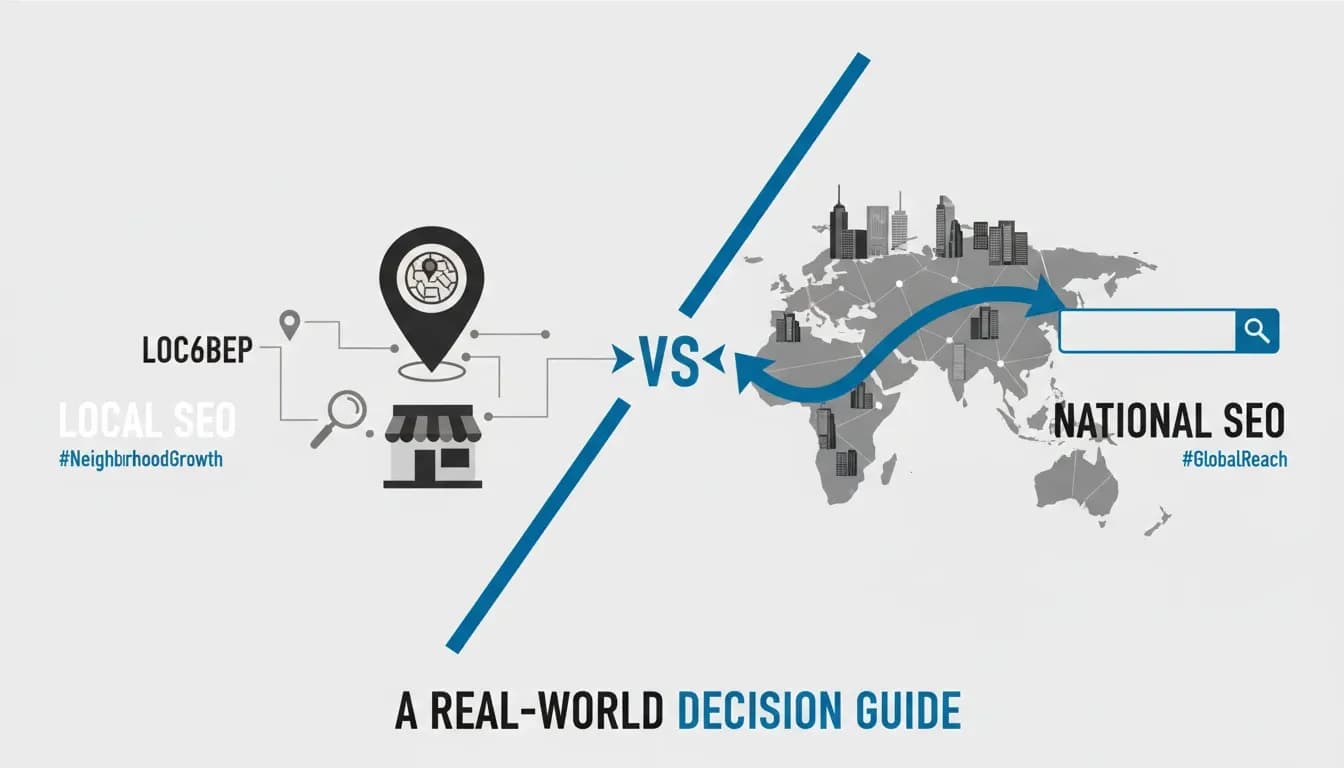
When we talk to business owners about SEO, the first question is almost never about schema or backlinks. It’s some version of: “Should we go after local SEO or national SEO?”
That choice isn’t just “target nearby vs target everywhere.” It decides your budget, timelines, tech stack, content plan, and even parts of your sales process. If you get the scope wrong—or blur local SEO and national SEO into one fuzzy strategy—you almost always end up mediocre at both.
In this guide, we’ll walk through a practical, scope‑first decision framework for local SEO vs national SEO (with some notes on global and hybrid strategies) so you can confidently pick the right path and avoid signal dilution.
Local vs National (and Global) SEO: What Each Actually Is
What Local SEO Really Means
Local SEO (local search engine optimization, hyperlocal SEO) is about winning local intent searches and map visibility in a specific geographic area.
Typical local searches:
- “plumber near me”
- “estate planning lawyer Denver”
- “best brunch in Brooklyn”
- “dentist in Toronto”
- “real estate agent [suburb]”
Where you show up:
- Google Map Pack / Local Pack / 3‑Pack
- Google Maps / Local Finder
- Localized organic results (city + service pages)
Primary local SEO ranking signals:
- Proximity to the searcher
- Google Business Profile (GBP) quality and activity
- Reviews (volume, velocity, sentiment, keywords)
- NAP consistency (Name, Address, Phone) across citations
- Local, city- and neighborhood‑specific content and links
What National SEO Really Means
National SEO (nationwide SEO, broad‑scope SEO) is about ranking for non‑location‑modified keywords across an entire country. Think of it as classic organic SEO at scale.
Typical national searches:
- “electronic signature software”
- “best hydroponic garden system”
- “home gym equipment”
- “marketing agency USA”
Where you show up:
- Standard organic results (no map pack)
- Product and category results, review and comparison sites
- People Also Ask boxes, AI Overviews, and other SERP features
Primary national SEO ranking signals:
- Topical authority (breadth and depth of content clusters)
- High‑quality backlinks and digital PR
- Brand authority and mentions across the web
- Technical SEO (architecture, crawlability, site speed)
- Precise search intent matching for each keyword
Where Global / International SEO Fits
Global SEO (international SEO, multilingual SEO) extends national SEO across borders and languages:
- Targeting queries in multiple countries and languages
- Handling hreflang, ccTLDs vs subfolders, and language switches
- Accounting for regional engines (Google, Baidu, Yandex, etc.)
- Localizing offers, content, and UX for cultural nuances
For most small and mid‑sized businesses, the real fork in the road is still local SEO vs national SEO. Global SEO usually comes later, when you’ve already proven one of those models.
Start With Business Reality, Not Keywords
Before we look at SERPs or keyword difficulty, we always start with three blunt questions:
- Where do you realistically make money right now?
- Are sales actually coming from a radius around a physical location?
- Or can you fulfill profitably anywhere in the country?
- What’s your delivery model?
- Single‑location service (plumber, med spa, dental, law firm, restaurant)?
- Multi‑location chain or franchise?
- Location‑agnostic: SaaS, info product, national e‑commerce, remote consulting?
- What can you afford to invest for 12 months?
- Local SEO: typically hundreds to a few thousand per month.
- Competitive national SEO: very often low‑ to mid‑five figures per month when you factor content, links, and technical work.
Those answers define your SEO universe. Local vs national is just the targeting layer you stack on top.
Why Local and National Behave So Differently in Google
Local SEO and national SEO aren’t just “different keywords.” They’re different games
How Google Weighs Local SEO
- Huge emphasis on proximity
- Heavy use of business entity data:
- Google Business Profile categories, services, posts
- NAP consistency and citations
- Reviews and local engagement signals (calls, directions, website clicks)
- Local links and mentions (chambers, local news, neighborhood guides)
How Google Weighs National SEO
- Strong bias toward topical authority and brand strength
- Backlinks from relevant, authoritative domains
- Engagement at scale (CTR, dwell time, conversions)
- Clean architecture and crawling efficiency for hundreds or thousands of URLs
When we see sites trying to win both games with one blended strategy, the same patterns pop up:
- Long‑form national guides cannibalize thin local service pages.
- Dozens of duplicate “city pages” for an e‑commerce brand dilute category page authority.
- Time that should fund reviews, GBP optimization, and citations gets sunk into generic blogs that don’t rank locally or nationally.
The outcome is predictable: stuck on page two in organic, weak Map Pack visibility, and no clear wins in either local or national search.
Who Should Use Local SEO, National SEO, or a Hybrid Strategy?
When Local SEO Should Be Primary
Local SEO should be your primary scope when any of these are true:
- Revenue depends on a physical location or service area.
- Restaurants, bars, coffee shops
- Dentists, doctors, physios, med spas
- Home services: plumbers, roofers, electricians, cleaners
- Local professional services: law, accounting, real estate
- Gyms, salons, retail storefronts
- Customers naturally search with location intent.
- “near me” queries
- “[service] in [city]”
- Map Packs on all your money terms
- You need wins in 2–6 months on a constrained budget.
- Local SEO usually reaches traction faster and with fewer resources than a national campaign.
When National SEO Should Be Primary
National SEO should lead your strategy when:
- Your offer is location‑agnostic.
- SaaS or digital tools
- Online education / info products
- Brands that ship nationwide
- Remote agencies and consultants
- Core keywords don’t show map packs.
- When we search your service without a city and see national blogs, marketplaces, or software vendors, we’re in national SEO territory.
- You have the budget and patience for a 12–24 month play.
- You can invest in content clusters, digital PR, and serious technical work.
When a Hybrid Local + National SEO Strategy Makes Sense
A hybrid approach works well when you:
- Have one or more physical locations and
- Also serve a broader national (or regional) audience.
Examples:
- Real estate teams with a core metro area focus but content targeting out‑of‑state buyers.
- Multi‑location healthcare practices that publish national guides on treatments.
- E‑commerce brands with a flagship store plus nationwide shipping.
In practice, hybrid doesn’t mean you mash local and national signals together. It means you:
- Choose one primary scope based on where the bulk of your revenue comes from today.
- Build distinct site architecture and content plans for local vs national.
- Measure success with separate KPIs for each scope.
A Scope‑First Decision Framework: Local vs National SEO
Here’s the decision‑making framework we use when we’re mapping local SEO vs national SEO for a new business.
Step 1 – Classify Your Market Type
- Local service / brick & mortar.
- You serve people at or near a physical location, and you don’t want to fulfill nationally.
- Multi‑location local brand.
- Same services, multiple cities/branches—classic multi‑location SEO case.
- Location‑agnostic product/service.
- You can deliver anywhere in the country without friction (SaaS, infoproducts, national ecommerce).
Step 2 – Inspect SERPs for Core Money Terms
Search three variations for each major service or product:
- “[service] near me”
- “[service] [your city]”
- “[service]” (no location)
Then ask:
- Is there a map pack? If yes, Google treats it as local intent.
- Who dominates the top results?
- Local practitioners → Local SEO is essential.
- National brands, marketplaces, comparison sites → National SEO.
- Are AI Overviews appearing?
- Do they list business types or specific brands?
- This tells us how “brand‑sensitive” the SERP is becoming.
Step 3 – Match Scope to Resources and Time Horizon
Be brutally honest about:
- 12‑month SEO budget
- Internal content and dev capacity
- How fast you need SEO to impact cash flow
In our experience:
- Local‑first fits limited budgets, shorter runways, and physical‑location models.
- National‑first fits well‑funded brands and location‑agnostic offers with higher lifetime value.
Step 4 – Decide on Your Primary Scope
Now pick one primary scope and commit to it for at least 6–12 months:
- Local SEO primary, with a light national/informational layer as needed.
- National SEO primary, with minimal but clean local presence (e.g., one HQ location page).
- Hybrid, but still with a declared primary: local or national gets priority in budget and implementation.
Pros and Cons of Local vs National SEO
Local SEO: Advantages and Limitations
Advantages
- Faster wins (2–3 months to see movement in many markets).
- Lower cost vs national SEO for similar impact.
- Highly conversion‑oriented traffic (calls, directions, bookings).
- Clear playbook: GBP optimization, reviews, citations, local content.
Limitations
- Ceiling on reach: you’re capped by the size of your service area.
- Strong proximity bias: ranking across an entire metro can be tricky.
- Reputation‑sensitive: bad reviews directly impact both rankings and conversions.
National SEO: Advantages and Limitations
Advantages
- Massive growth potential—far more search volume and markets.
- Compounding brand authority when you rank for competitive head terms.
- Scalable content economics: one great guide can serve the whole country.
- Easier geographic expansion; less tied to physical locations.
Limitations
- Heavier competition with well‑funded, mature sites.
- Longer time to meaningful rankings (6–12+ months typical).
- Higher cost: content, links, and technical SEO at scale.
- Easy to misalign content with commercial intent and chase vanity traffic.
If You Choose Local: What You Actually Do Differently
1. Google Business Profile Optimization Is Non‑Negotiable
- Complete all fields: categories, subcategories, services, hours, attributes.
- Add high‑quality photos and keep them fresh.
- Publish GBP posts for offers, events, FAQs.
- Use UTM tags on the website link so you can track GBP‑driven traffic and conversions.
We also prepare clients for reverification and suspension: have leases, utility bills, licenses, and other proof ready. When a reverification email lands, the worst outcome is someone randomly clicking through and burning the 60‑minute timer without a plan.
2. Systematize Review Generation and Reputation Management
- Ask for reviews after successful visits or jobs via SMS or email.
- Send people to a simple
/reviews page with:
- Links to Google, Yelp, specialist platforms
- Prompts like “What problem did we solve?” or “What would you tell a friend?” to encourage detail and keywords
- Respond to every review. AI can help draft positive replies, but humans should own negative ones.
3. Build Clean Local Citations and NAP Consistency
- Audit major directories: Google, Apple Maps, Bing Places, Yelp, YellowPages.
- Fix inconsistent business names, addresses, and phone numbers.
- Add niche and local citations (industry associations, local chambers, neighborhood sites).
4. Create Location‑Focused Site Structure
- Give every location a dedicated landing page:
- Unique copy (no city name swapped templates).
- Embedded maps (for UX), directions, parking info.
- Service list for that specific branch or service area.
- For multi‑location SEO, link each GBP directly to its own location page, not the homepage.
- Use local business schema and clear NAP in footer and contact page.
5. Use Local SEO Tools Internally, Not as KPIs
We rely on grid rank tools and local pack trackers heavily—but only as diagnostics. They are not client‑facing KPIs. We care far more about:
- Calls and form fills from organic and Maps
- Direction requests
- Review volume and sentiment over time
If You Choose National: What You Actually Do Differently
1. Design for Topical Authority, Not One‑Off Posts
- Identify core pillars (e.g., “home gym equipment”, “estate planning”, “CRM for agencies”).
- For each pillar, plan a cluster of supporting content:
- How‑to guides
- Use‑case stories
- Comparisons (“X vs Y”)
- Best‑of lists
- FAQs and troubleshooting posts
- Internally link supporting articles → pillar pages → commercial pages.
2. Match Content Format to SERP Intent
For each national keyword, look at the current winners:
- If SERPs are dominated by comparison posts, publish a strong comparison page.
- If SERPs feature checklists, tools, or templates, build those assets.
- If video dominates, invest in YouTube and embed video on relevant pages.
3. Invest in Experience‑Rich, E‑E‑A‑T‑Aligned Content
- Use real examples, screenshots, and case studies.
- Give authors proper bios and credentials.
- Update content regularly and date it clearly.
- Back claims with citations, stats, and external sources.
This not only helps rankings; it also makes you far more cite‑worthy for AI Overviews and LLM‑based tools that summarize the web.
4. Build Authority With Smart Link Acquisition
- Once you have strong content clusters, pitch:
- Guest posts and expert contributions
- Data‑driven PR stories
- Resource swaps and co‑marketing with adjacent brands
- Use linkable assets (tools, calculators, deep guides) instead of shoving people straight to money pages.
5. Treat National SEO as a 12–24 Month Program
We evaluate early success using:
- Impressions and average positions for long‑tail queries
- Indexation depth and crawl health in key clusters
- Brand mentions and branded search volume
- Non‑brand organic revenue trajectory, not just rankings
Designing a Hybrid Local + National SEO Strategy Without Dilution
When you genuinely need both scopes, we structure hybrid SEO around a few non‑negotiables.
1. Declare a Primary Scope
Decide which side is the immediate profit driver and allocate budget accordingly. If 80% of revenue is local services and 20% is national info products, local SEO is primary. The national component is there to support long‑term growth, but it shouldn’t cannibalize local resources.
2. Separate Architectures and Keyword Intents
- Local SEO section
/locations/ or /city/ structure for branches and service areas- Each GBP linking to a unique URL
- Local keyword focus: “service in city”, neighborhood and “near me” variations
- National SEO section
/blog/ or /resources/ for educational content- Strong, non‑geo category and product/service pages
- National keywords: “best [product]”, “[service] software”, “[industry] tools”
3. Avoid Internal Cannibalization
We explicitly map keywords so no two pages fight over the same phrase:
- Local city page: “estate planning lawyer Denver”
- National guide: “how to choose an estate planning lawyer”
Different intent, different URLs, clear internal linking between them.
4. Align KPIs by Scope
- Local KPIs
- Map Pack and local organic visibility
- GBP calls, direction requests, bookings
- Review volume and rating trends
- National KPIs
- Non‑brand organic sessions
- Keyword share of voice across national terms
- Revenue and leads from national landing pages
How AI Overviews and LLMs Change (and Don’t Change) the Decision
AI Overviews and chat‑based research affect how people discover you, but not the fundamentals of local vs national SEO.
- AI agents still depend heavily on:
- Google Maps and GBP data for local tasks (“book a plumber at 7pm”).
- Clear, structured, experience‑rich content for national queries.
- We’re watching how AI tools describe brands:
- If AI summaries don’t match your positioning, that’s a content and brand clarity gap.
What we don’t recommend is buying “LLM optimization” as a black box. The real work is still:
- Making your site fast, clean, and well‑structured.
- Publishing factual, current, high‑experience content.
- Building a brand that people and algorithms can summarise in one clear sentence.
30–60–90 Day Rollout Plans by Scope
Local‑First 90‑Day Plan
Days 1–30
- Audit and fully optimize GBP (categories, services, photos, posts).
- Fix NAP inconsistencies across top citations.
- Launch a simple, automated review request process.
- Identify and refine 1–3 core “service + city” landing pages.
Days 31–60
- Build or enhance city and service‑area pages.
- Acquire local citations and a handful of locally relevant links.
- Add local FAQs, parking info, and neighborhood mentions.
- Track calls, directions, and form fills from GBP and Maps.
Days 61–90
- Expand into hyperlocal (neighborhood) content if warranted.
- Refine on‑page elements based on Search Console and call data.
- Decide whether to scale with more GBPs/locations or deepen authority.
National‑First 90‑Day Plan
Days 1–30
- Run a technical SEO audit and fix blocking issues (crawl, index, performance).
- Conduct national keyword research with clear intent mapping.
- Define 3–5 main topic pillars connected to revenue.
Days 31–60
- Publish or overhaul pillar pages and associated commercial pages.
- Set up internal link structures to point authority at these pages.
- Start small‑scale, targeted link outreach focused on the new pillars.
Days 61–90
- Fill out content clusters around each pillar (10–20 supporting pieces).
- Launch digital PR or partnership campaigns to attract authoritative links.
- Track performance by intent cluster (informational vs commercial vs transactional) and adjust.
How to Measure If Your Scope Decision Is Working
Local SEO Metrics
- GBP views and interaction rates (calls, directions, website clicks).
- Map Pack and local organic rankings for “service + city” and “near me”.
- Review volume, average rating, and review keyword themes.
- Organic‑driven revenue: booked jobs, appointments, in‑store visits.
National SEO Metrics
- Growth in non‑brand organic traffic.
- Keyword rankings and share of voice across national SERPs.
- Referring domains and backlink quality trending upward.
- Leads and revenue from key national landing pages and funnels.
If after 3–4 months you see flat metrics and a confusing mix of local and national tactics, it’s usually a sign the scope decision isn’t clear enough. At that point, we revisit the framework, clarify what actually drives revenue, and deliberately narrow the strategy.
Local vs National SEO: The Real Decision
Choosing between local SEO and national SEO is ultimately choosing:
- How you structure your site
- Which search intents you prioritize
- Where your content and link budget goes
- How long you’re willing to wait for ROI
The safest path is to:
- Start with your business model and current revenue reality.
- Validate intent by looking at SERPs, not guesses.
- Pick a primary scope—local, national, or hybrid with a clear bias.
- Execute deeply on that scope for at least 6–12 months before expanding.
If you want this framework applied to your specific case, share:
- What you sell
- Where your customers are
- Your rough 12‑month SEO budget and timeline
We can then map a concrete local vs national SEO decision framework—and a 90‑day rollout plan—that fits your situation instead of a generic template.