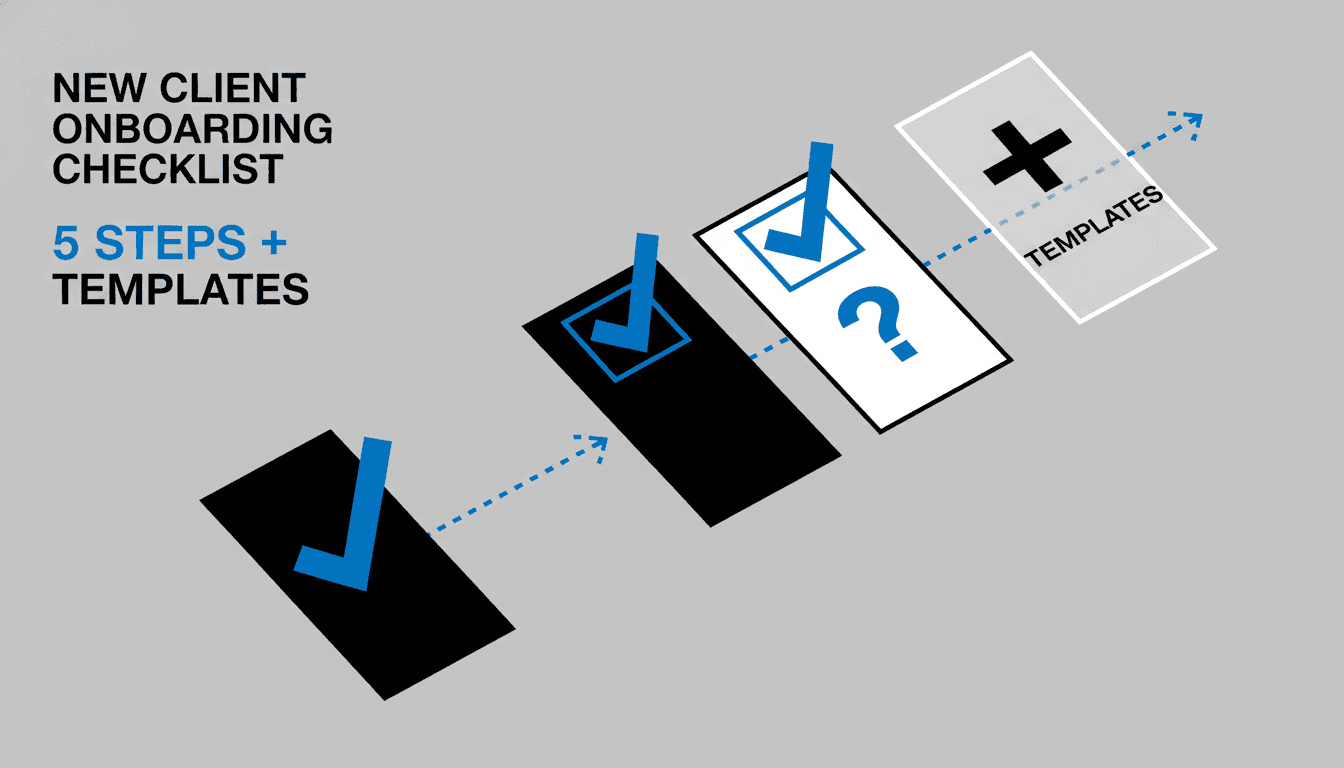
Landing a new client feels great—but what we do in the first week determines whether that win becomes a smooth, profitable relationship or a costly misadventure. In our client onboarding process, we focus on clarity, momentum, and trust. Below are the five moves we make immediately after we get a client, plus templates, checklists, and best practices you can copy for agencies, SaaS, real estate, and professional services.
1) Lock down the business side before you lift a finger (contract, SOW, payment terms)
We always formalize the engagement before starting billable work. This protects both sides, eliminates ambiguity, and accelerates delivery. Yes, many guides start with the kickoff meeting—but in our experience, a signed agreement and a deposit first keeps everyone honest about scope, timelines, and responsibilities.
- Send a clear Statement of Work (SOW) via e‑sign with: scope and deliverables, acceptance criteria, timeline and milestones, roles and responsibilities on both sides, review and approval process (who decides and turnaround times), change control, confidentiality, IP ownership, NDAs, and SLAs.
- Payment terms that reduce friction: collect a 30–50% deposit (or first month’s retainer) before scheduling the kickoff; offer multiple payment methods (ACH, card), click‑to‑pay links, and set up recurring auto‑billing for retainers. Consider delayed capture for scheduled starts. Spell out late fees and a kill fee.
- Invoicing cadence: milestone billing for projects (e.g., 30/40/30) or same‑day each month for retainers. We send invoice reminders automatically so finance isn’t chasing email threads.
- Governance and risk: include data privacy, KYC/compliance where relevant, and how access/permissions will be provisioned and revoked at wrap‑up.
- Real estate specifics: buyers—buyer representation agreement and lender pre‑approval; sellers—listing agreement, disclosures, marketing permissions, and photography/staging timelines. Walk clients through clauses to reduce anxiety.
- Put our house in order: we run client funds through a dedicated business bank account, use a professional email on our domain, and keep invoicing/time‑tracking ready (e.g., QuickBooks, Stripe, Harvest). Even details like a clean video background and a polished calendar link contribute to trust on day one.
Deposit request email (copy/paste)
Subject: Getting started + next steps

Hi [Name],We’re excited to get started. Attached is the agreement and scope confirming deliverables, timelines, and responsibilities.To secure the start date, the initial invoice for [amount] (30% deposit) is attached. Once it’s paid, we’ll schedule our60–90 minute kickoff and send a short onboarding checklist of the accesses we’ll need.If anything in the scope needs adjusting, reply here and we’ll update the agreement.Thanks,[Your Name]
2) Run a high‑impact kickoff to align goals, scope, and ways of working
With the contract signed and the deposit paid, we schedule a 60–90 minute new client kickoff meeting with decision‑makers and day‑to‑day contacts. We send a brief agenda and a welcome pack in advance so we can stay strategic in the meeting.
- Welcome pack: process overview; team roster and escalation path; office hours and response times; communication plan (email, Slack, PM tool) with meeting cadence; client onboarding checklist of assets/access we’ll need; FAQs and a glossary to defuse jargon.
- Goals and KPIs: what success looks like in the next 30/60/90 days, quantified and dated. For SaaS: adoption metrics and time‑to‑value; for real estate: days on market, offer timelines, or tour targets; for agencies: CPA, ROAS, qualified leads, or revenue targets.
- Scope boundaries: what’s in/out, known constraints, assumptions, and risks.
- Decision rights: who approves what and how decisions are documented (we keep a simple decision log).
- Communication cadence: confirm weekly/biweekly check‑ins, status format, and SLAs for response times.
- Three clarity questions we always ask:
- How could we exceed your expectations for this engagement?
- What problems should we solve first?
- What top three outcomes would you love to see in the first 90 days?
- We record and transcribe the kickoff so nothing important gets lost three months later.
Client kickoff agenda (template)
- Introductions and roles
- Objectives and KPIs (what success looks like)- Scope, timeline, and assumptions
- Mutual deliverables and deadlines
- Decision-making and approvals
- Risks and constraints (legal/compliance, seasonality)- Communication cadence, tools, and SLAs
- Immediate next steps and owners
Kickoff follow‑up email (copy/paste)
Subject: Kickoff recap + action items

Hi [Name],Great kickoff today. Here’s a quick recap and commitments:Goals/success metrics:- [e.g., Increase qualified demo requests 25% by Q2; sell by <date> with ≥[price]]Decisions made:- Scope confirmed: [summary]- Review cadence: [e.g., weekly Tue updates; 48‑hour review windows]- Approver(s): [names]Action items (due dates):- You: Provide [access/assets] by [date]; introduce us to [stakeholder].
- Us: Deliver [first milestone] by [date]; share draft reporting template by [date].Access needed:- [List]Next touchpoint:- [Date/time] for status + blockers.Reply with any corrections and we’ll update the doc.Thanks,[Your Name]
3) Wire up access, data, and tools—and build a credible plan
Momentum dies when access lags. We make it easy for clients to help us move fast by sharing a concise client intake checklist, setting up a shared workspace, and drafting a simple plan with milestones.
- Access and permissions:
- Marketing/growth: GA4, Search Console, ad platforms, CRM/ESP (HubSpot, Klaviyo), CMS, tag manager, data warehouse, past campaign benchmarks.
- Finance/bookkeeping: read‑only bank access (or client‑connected integrations), accounting software (QuickBooks), statements, processors, payroll. Some banks restrict integrations on read‑only logins—when that happens, we have the client connect accounts or send statements monthly.
- Product/engineering: repository (Git), staging/prod credentials, error logging, design files, PM/backlog.
- Content/copy: brand/voice guide, tone examples, SME contacts, keyword research, editorial calendar.
- Real estate: MLS access, lender pre‑approval (buyers), title/tax/insurance docs (sellers), disclosures, photography schedule, staging vendors.
- Workspace and documentation: client folder with clear subfolders (admin/contracts, assets/brand, research/competitors, meeting notes, deliverables, reports). We establish naming conventions; keep a rolling question log; track assumptions; maintain a risk register with mitigations and owners.
- Project plan (simple, visible):
- 0–2 weeks: align, sign, access setup, quick wins identified and scheduled.
- 2–6 weeks: core execution with weekly check‑ins and a mid‑point review.
- Phase end: delivery, acceptance, wrap‑up with learnings and next steps.
- Security and privacy: least‑privilege access, password manager, and clarity on where sensitive files should (and shouldn’t) live. Agree how/when access will be revoked at the end of the engagement.
- Onboarding automation tools: we favor a single source of truth (Asana, ClickUp, Notion, Monday), CRM + pipeline (HubSpot), e‑sign (DocuSign), client portals for assets/status, and just‑in‑time guides. For product/SaaS teams, cobrowsing and AI support agents shorten time‑to‑value for new users.
Access request email (copy/paste)
Subject: Access checklist to get us moving

Hi [Name],To start on [first milestone], we’ll need the following accesses. Feel free to forward this to [IT/Ops] if helpful.
- [System] – [permission level] – [who can grant it]- [System] – [permission level] – [who can grant it]- Brand assets: logo files, style guide, fonts, approved image library
- Prior [reports/campaigns/docs]: last 12 months if available

Once these are in place, we can deliver [first quick win] by [date].Thanks,[Your Name]
4) Educate, equip, and ship a quick win
Clients feel confident when they understand the process and see progress quickly. We combine short walkthroughs with a fast, visible win in the first 3–7 days.
- Walkthroughs and just‑in‑time enablement: quick sessions on how we work, how approvals happen, and how to use tools (PM system, dashboards). We record sessions, share summaries with timestamps, and host a lightweight resource hub (one‑pagers, checklists, short videos).
- Personalized demos: we screen‑share or co‑browse in the client’s environment to remove uncertainty and accelerate adoption.
- Quick win examples:
- Marketing: fix GA4 attribution or a leaky form; publish a small but meaningful content piece; ship a conversion lift on a high‑traffic page.
- Product: remove a nagging bug; reduce friction in a top flow; deliver a small UX polish with measurable impact.
- Bookkeeping: reconcile a subset of transactions; set up rules; produce a clean mini‑report.
- Real estate: for buyers, set tailored MLS alerts and schedule a first tour route; for sellers, finalize a pricing strategy, book photography, and share a staging checklist with before/after examples.
- Communicate progress clients can forward internally: a simple weekly update they’ll actually read. Early on, we track time even on fixed‑fee work so estimates improve and budget surprises disappear.
Weekly update template (copy/paste)
Subject: Week of [date] – [Client/Project] updateWins
- [Quick win shipped + result]- [Another]In progress
- [Milestone] – [percent complete] – on track for [date]On deck
- [Next item]Blockers/decisions needed by [date]- [Decision] – impact if delayed: [impact]Budget/time
- This phase: [X/Y hours or % of budget used]; forecast to complete: [estimate]Notes
- [Anything important/risks]
5) Guide execution with cadence, boundaries, and proof (then wrap up for renewals and referrals)
We balance responsiveness with structure, so clients feel supported without chaos. This is where churn drops and lifetime value increases—because expectations are clear and results are visible.
- Operationalize communication: weekly or biweekly check‑ins with a light agenda (status, decisions, risks, next deliverables); response‑time norms (e.g., same business day for requests, 24 hours for non‑urgent items); a single source of truth for tasks/files; and backup coverage when we’re away.
- Manage scope creep politely but firmly: acknowledge good ideas, estimate impact, and present a change order before doing the work. Keep a backlog of “nice to haves.”
- Bill like a pro: invoice the deposit immediately; automate reminders; milestone billing for projects; consistent monthly cadence for retainers. Sometimes we start hourly for 1–2 months while scope stabilizes, then move to a fixed monthly fee.
- Show proof: dashboards tied to onboarding metrics and KPIs; short, regular updates on status, risks, and next steps; mid‑point reviews; end‑of‑phase wrap‑ups with outcomes vs. goals and recommendations.
- Close the loop: capture testimonials while results are fresh, ask for referrals at peak satisfaction, and propose a thoughtful next phase only if it clearly advances client goals. In real estate, we request a review right after closing and share a concise “what we achieved” summary alongside photos/metrics.
- Professionalism compounding: be on time, prepared, and concise; write skimmable emails; keep your video background tidy or blurred. Small signals of reliability add up fast.
Change‑order message (copy/paste)
Subject: Quick estimate for the new [request]Hi [Name],The [new request] is a great idea. It’s outside the original scope, so here’s a quick estimate to include it in this phase:- Scope: [brief description]- Impact: +[hours/cost]; timeline shifts to [date]- Option B: Defer to Phase 2 (no impact to current budget/timeline)Let us know which option you prefer and we’ll update the plan.Thanks,[Your Name]
Client onboarding checklist (client‑facing)
- Stakeholder list with roles and contact info
- Access: analytics, CMS/CRM, ad accounts, code repos, data sources
- Brand/legal assets: logos, fonts, brand guide, disclaimers
- Data exports or historical performance reports (last 12 months)
- Compliance requirements (privacy, KYC, industry guidelines)
- Real estate extras: title/tax/insurance docs (sellers), lender pre‑approval (buyers), MLS preferences
Your internal onboarding checklist
- Create shared project workspace with clear folder structure and naming conventions
- Build PM board with milestones, owners, dependencies, and status labels
- Prepare templates: status report, meeting notes, decision log, change‑order form
- Set invoice schedule and payment links; automate reminders
- Draft risk register with mitigations and owners
- Schedule recurring check‑ins for the next 4–8 weeks
- Establish a living questions list and assumptions register
Client intake form questions
- What problem are we really solving—what’s the “job to be done”?
- Which outcomes matter most in the next 30, 60, and 90 days?
- What has/hasn’t worked before? Any internal constraints we should know?
- Who approves decisions and who can unblock issues quickly?
- What must be true for this to feel like a success six months from now?
- Bonus: How could we exceed your expectations during onboarding?
Onboarding metrics and KPIs
- Time‑to‑first‑value (TTFV) and milestone achievement rate
- Adoption/usage (SaaS), showings/offers (real estate), or early campaign KPIs (services)
- Cycle time (from sign to go‑live) and percent on‑time deliveries
- Feedback signals: CSAT for onboarding, response time SLAs met
- Churn risk indicators and expansion/upsell readiness
FAQs: What to do after you get a client?
What should a new client welcome pack include?
A process overview, team roster, office hours/response times, communication tools and cadence, deliverables and what you’ll need from the client (access/assets/data), FAQs/glossary, and a short kickoff agenda. For real estate, add pricing strategy notes, staging plans, showing rules, and offer deadlines.
How long should the kickoff meeting be?
Plan 60–90 minutes. Keep it strategic and document decisions. We record, transcribe, and send a concise recap with action items and due dates.
Do we finalize payment terms before work?
Yes. We do not begin billable work without a signed agreement and a deposit. Offer multiple payment options and an easy, frictionless checkout (click‑to‑pay) to prevent delays.
How does great onboarding reduce churn and increase CLV?
Clear expectations, quick wins, and steady communication create confidence and momentum. That leads to renewals, referrals, and thoughtful expansions—because clients see value fast and understand the path to results.
Bottom line
After you land a new client, do these five things in order: formalize the engagement and payment, run a thoughtful kickoff, wire up access and build a simple plan, educate while shipping a quick win, and guide execution with steady cadence and clear boundaries. Nail these steps and your “new client” becomes a long‑term partner—complete with results, renewals, and referrals.