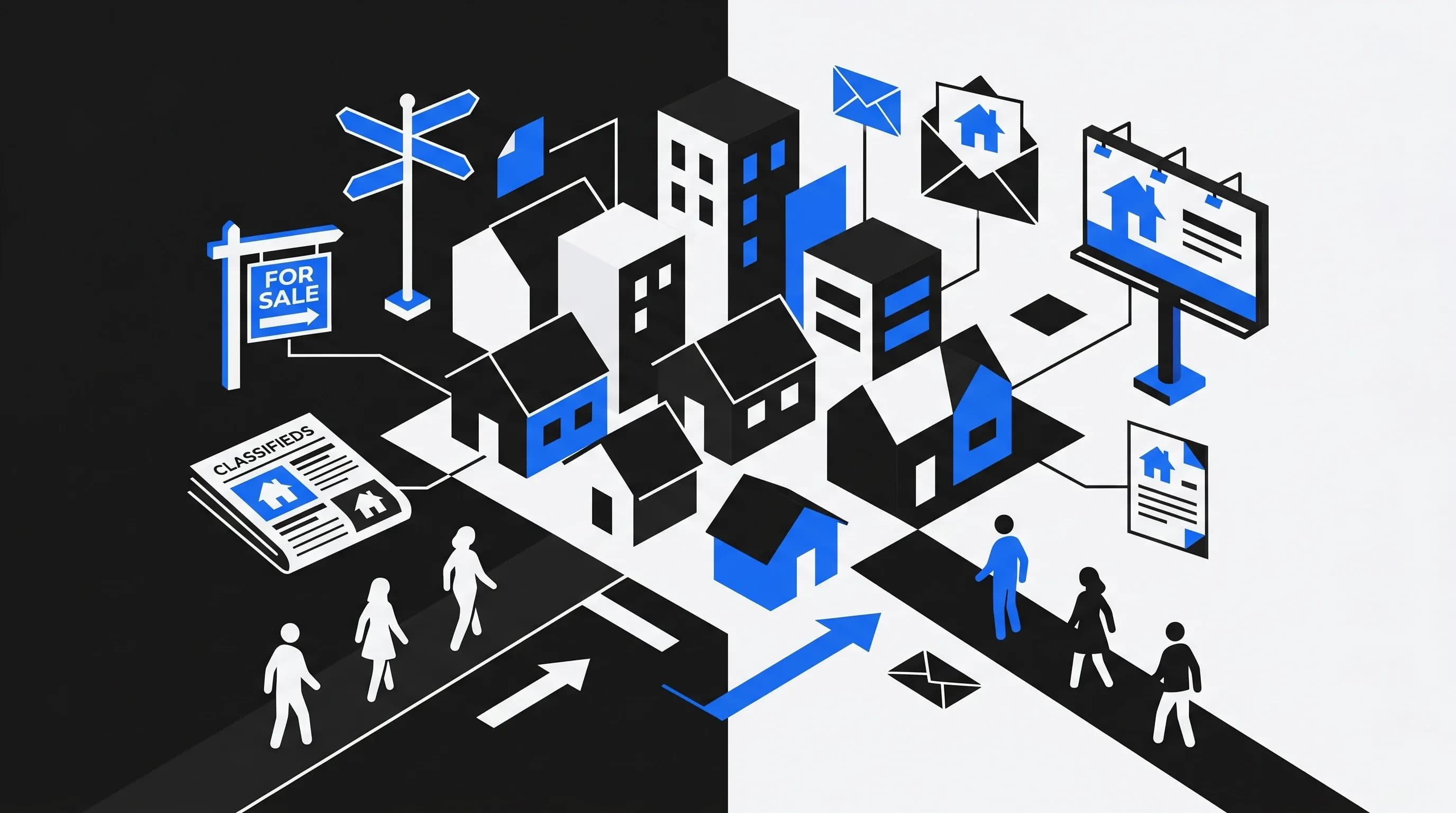
An effective offline real estate marketing strategy helps agents, brokers, developers, property managers, and real estate businesses become visible, trusted, and remembered in the local market. And that matters because real estate is not just a digital transaction. It is local, emotional, personal, and relationship-driven.
We all know digital marketing matters. SEO, Google Business Profile, social media marketing, email marketing, paid ads, listing websites, virtual tours, and landing pages are all useful. But there is a trap many real estate professionals fall into: believing that if we are not constantly posting online, people will forget we exist.
That is not the whole story. Buyers and sellers do not hire us only because we made a nice Instagram reel or ran a Facebook ad. They hire us because they trust us, remember us, see us in the community, hear our name from someone they know, and believe we understand their neighborhood. That is why offline real estate marketing still works, and in many markets, it is becoming more powerful because so many agents are focused only on digital channels.
The best real estate marketing strategies combine both worlds. Digital marketing helps us scale, retarget, educate, and measure. Offline marketing helps us create local visibility, build credibility, generate referrals, and start real conversations before someone is ready to buy, sell, invest, lease, or develop.
In this guide, we will build a complete offline real estate marketing plan: direct mail, real estate flyer distribution, referral marketing, open houses, networking, community engagement, local sponsorships, door knocking, handwritten notes, business cards, print advertising, billboards, cold calling, property events, real estate seminars, CRM tracking, ROI measurement, and more.
Offline real estate marketing is any real estate promotion, lead generation, branding, or client relationship activity that happens outside purely digital channels. It includes traditional real estate marketing tactics like direct mail, postcards, flyers, brochures, business cards, print ads, open house signs, billboards, radio advertising, events, seminars, sponsorships, networking, referral programs, door knocking, and face-to-face conversations.
But we should not think of offline marketing as old-fashioned. A strong offline marketing strategy for real estate is not about randomly handing out flyers or putting our face on a bench and hoping for the best. It is about becoming memorable to the right local audience before they need us.
Most homeowners are not selling today. Most buyers are not buying today. But life changes. Someone gets married, divorced, promoted, transferred, becomes an empty nester, inherits a property, has a baby, starts investing, or decides they are tired of renting. Our job is to make sure that when that moment happens, we are the agent, broker, or real estate professional they think of first.
That is the real purpose of offline marketing: local presence, trust, memory, and follow-up.
Offline marketing still works because real estate is a high-trust business. Buyers, sellers, landlords, tenants, developers, and investors are not only evaluating properties; they are evaluating people. They want confidence, local knowledge, negotiation ability, credibility, and personal care.
A social media post can be scrolled past in half a second. A useful postcard can sit on the kitchen counter for a week. A handwritten note may get pinned to the fridge. A thoughtful pop-by gift can be talked about at dinner. A client appreciation event can create a memory. A real phone call can remind someone that we care about them beyond the transaction.
That is why traditional real estate marketing still has real power. It creates emotional memory in a way that many digital impressions do not.
The strongest offline lead generation comes from repeated, relevant, human touches. One mailer rarely changes a business. A consistent offline marketing system can.
Before we print real estate flyers, buy billboard advertising, sponsor a local event, or send direct mail, we need a real estate marketing plan. Offline marketing works best when it is targeted. Random activity creates random results.
A practical offline real estate marketing strategy starts with the following foundation.
We need to know exactly who we serve and where we serve them. A niche can be based on geography, property type, client type, price point, or life stage.
The more specific the niche, the sharper the message. “We help people buy and sell homes” is forgettable. “We help young families find homes near top schools in Westlake” is much stronger.
Offline marketing depends on relevance. We need to understand the audience’s income, lifestyle, family structure, property goals, commute patterns, investment capacity, pain points, and community involvement.
A family buyer may care about schools, parks, safety, commute time, and hospital access. An investor may care about rental yield, vacancy rates, tenant demand, capital growth, and infrastructure. A luxury seller may care about privacy, presentation, discretion, and negotiation quality.
Every offline campaign needs a short, clear reason to choose us. A postcard, business card, open house sign, flyer, or billboard has very little space, so the message must be simple.
If we were building an offline marketing plan from scratch, we would almost always start with a geographic farm. Real estate farming means choosing a specific neighborhood, subdivision, suburb, condo building, apartment complex, or local area and consistently marketing to that audience until we become known there.
It is called farming for a reason. We plant seeds, nurture the soil, and harvest later. We do not send one postcard and expect five listings. We show up again and again until our name becomes familiar.
For newer agents, we like a farm of around 300 to 500 homes. If the budget is smaller, starting with 150 to 250 homes is completely fine. It is much better to market consistently to 250 homes than inconsistently to 2,000.
A good farm should have:
For example, if a neighborhood has 400 homes and a 5% annual turnover rate, about 20 homes may sell each year. If we become the known agent there and win even a few listings annually, that farm can become extremely profitable.
Real estate direct mail remains one of the best offline marketing strategies for real estate agents because property decisions are tied to location. We can target specific streets, postal routes, neighborhoods, condo buildings, homeowners, landlords, investors, absentee owners, or expired listings.
But there is an important distinction: direct mail still works; bad direct mail does not.
A generic “Just Listed!” postcard with a headshot and no useful information may not create much response. But a local, helpful, personal, and consistent mailer can build authority over time.
We recommend sending at least one useful mailer per month. Consistency matters more than complexity. If we disappear for six months, we lose momentum.
Strong real estate postcard and mailer themes include:
“Another home sold in [Neighborhood]. Here’s what this sale tells us about buyer demand in your area.”
“Several homes in your neighborhood have recently sold above last year’s pricing. If you have been curious what your home may be worth in today’s market, we would be happy to prepare a neighborhood-specific estimate.”
“We have qualified buyers looking in [Neighborhood]. If you have considered selling, now may be a good time to understand your options.”
Real estate flyer distribution is a cost-effective way to build neighborhood visibility, promote listings, increase open house attendance, and reach homeowners who may not be actively searching online. Flyers, leaflets, brochures, door hangers, and printed property guides are tangible. They can stay in homes, cars, offices, and community spaces longer than many digital ads stay on a screen.
A real estate flyer should be understood in seconds. Avoid overcrowding it. One clear message beats five competing messages.
One simple grassroots marketing idea is to place permitted flyers or posters near admired homes, high-demand streets, or neighborhood landmarks with a message like:
“Want a home like this? Call [Name] at [Number].”
This works because it reaches people in an emotional moment, when they are already imagining a lifestyle or neighborhood they want.
Door knocking still works when it has context. Randomly knocking and asking, “Do you want to sell your house?” can feel awkward. Knocking with a useful reason feels different.
The best door knocking campaigns are tied to something specific: a new listing, a recent sale, an open house, a buyer need, a neighborhood market update, a community event, or a property value change.
“Hi, we just wanted to let you know that a home nearby recently sold, and we are sharing a quick update with neighbors because it may affect property values in the area. Have you been curious what homes like yours are selling for right now?”
“Hi, we are hosting an open house this weekend at [Address], and we wanted to personally invite the neighbors. Sometimes neighbors know someone who wants to move into the area. Do you happen to know anyone who has been looking in this neighborhood?”
“Hi, we are working with a buyer who is specifically looking for a home in this neighborhood. They like the area because of [Reason]. We know this is a bit direct, but have you had any thoughts of selling, or do you know anyone nearby who might consider it?”
This approach works because we are not begging for a listing. We are bringing relevant market activity to the homeowner.
One of the smartest offline lead generation strategies for realtors is to create buyer demand first, then use that demand to start seller conversations.
Instead of asking homeowners, “Do you want to list?” we approach them with a specific buyer need. That is much more compelling.
“Hi [Homeowner Name], we are local real estate professionals currently working with a buyer who is looking for a home in [Neighborhood]. They are hoping to find a [Bed/Bath/Style] home and are particularly interested in this area because of [Reason]. We know your home is not currently on the market, but we wanted to ask if you have had any thoughts of selling or if you know anyone nearby who may consider it. If there is any interest, we would be happy to have a confidential conversation. No pressure and no obligation.”
Even when the home is not right for that specific buyer, we may uncover a future seller. And because the outreach feels useful, it usually creates a better conversation than a generic listing pitch.
Real estate referral marketing is one of the highest-converting offline marketing channels because trust transfers. When a friend, family member, neighbor, colleague, mortgage broker, attorney, accountant, or past client recommends us, the prospect arrives warmer than a cold digital lead.
Word-of-mouth marketing in real estate is not accidental. We can build a simple system that encourages referrals, rewards relationships, and keeps us top of mind.
“We are always grateful when people think of us for real estate questions. If you ever hear of someone who needs advice, even if they are not ready to buy or sell yet, we are happy to be a resource.”
The best referral programs are not only about gift cards, cash incentives, or vouchers. They are built on excellent service, consistent follow-up, and making people feel valued long after closing.
Handwritten notes are simple, inexpensive, and deeply effective. Very few real estate agents send them consistently, which is exactly why they stand out.
We like to think of handwritten notes as emotional retargeting. Instead of reappearing in someone’s feed, we reappear in their real life in a way that feels human.
“Hi Sarah, we drove past your neighborhood this week and thought of you. We hope you and the family are doing well and still loving the house. Just wanted to say hello.”
“Hi Mike, thank you again for introducing us to your coworker. It means a lot that you trusted us enough to send someone our way. We never take that lightly.”
“Happy home anniversary! We cannot believe it has already been a year since you moved in. We hope the house has become everything you hoped it would be.”
Keep note cards, envelopes, and stamps nearby. A realistic goal is two or three notes per week. Over a year, that creates more than 100 personal touches with past clients, referral partners, neighbors, and prospects.
A pop-by is a small gift or gesture that reminds someone we are thinking of them. Done well, pop-bys can strengthen client relationships and generate referrals. Done badly, they feel like branded junk.
The best pop-bys are personal, seasonal, local, home-related, or genuinely useful.
We do not need to deliver pop-bys to everyone. Segment the CRM and start with the highest-value relationship groups:
For most agents, one to four pop-bys per year is enough if they are thoughtful. The goal is not the gift itself. The goal is the feeling: “They thought of me.”
Community engagement for real estate agents is one of the best ways to build local trust. People prefer to work with businesses they recognize, and local sponsorships help us become part of the community rather than just another salesperson trying to win a listing.
Sponsorships create repeat exposure. A local 5K, school event, charity run, or sports team sponsorship may put our name on banners, shirts, programs, signs, emails, and social posts. People may not need us immediately, but our name becomes familiar.
The goal is not to slap a logo everywhere. The goal is to be seen as someone who contributes. People remember the real estate professional who shows up for the community.
Real estate networking is essential because many opportunities come from relationships before they show up publicly. Offline networking lets us meet buyers, sellers, investors, vendors, developers, business owners, and referral partners face-to-face.
Partnerships are powerful because they allow us to tap into trusted community networks. We can collaborate with:
Open houses are not just for selling that one property. A well-run open house is an offline marketing machine. It can generate buyer leads, seller leads, neighbor relationships, referrals, listing opportunities, and brand visibility.
We should not just put the open house in the MLS and hope people show up. We need an offline promotion plan.
Different visitors need different conversations.
For active buyers:
For neighbors:
For future sellers:
That final question is excellent because it gives us a natural reason to follow up.
Follow-up is where many agents lose money. For neighbors, send a simple message:
“Thanks for stopping by the open house. We will keep you posted on what happens with the sale since it may be useful for neighborhood values.”
For buyers, send matching properties. For potential sellers, offer a valuation. Every open house contact should be tagged in the CRM by source.
In-person events build authority because prospects get to experience our expertise directly. Educational events work especially well because they position us as advisors, not just salespeople.
Client appreciation events do not have to be huge. In fact, smaller events often create better relationships because we can have real conversations. A 10-to-25-person gathering may create more trust than a 200-person event where we barely speak to anyone.
Even when someone cannot attend, the invitation still counts as a relationship touch. Use mailed invitations, email, text reminders, and phone calls for VIPs.
Outdoor advertising is powerful for brand awareness. It is not always the most targeted offline lead generation channel, but repeated exposure matters in real estate. Seeing the same agent’s name across yard signs, billboards, bus shelters, shopping centers, and open house signage builds familiarity.
Billboard copy needs to be short. People should understand it instantly.
Include the name, face, brand, short CTA, and phone number or short URL. Use QR codes only where people can safely scan them, such as pedestrian areas, not driver-facing billboards.
Print advertising is no longer the center of most real estate marketing plans, but local papers, neighborhood magazines, and specialty publications can still work in certain markets, especially suburban, luxury, retirement, investor, and community-focused audiences.
Instead of only listing properties, use print ads to build authority. A strong concept could be:
“[Neighborhood] Market Update: What Sellers Should Know This Month.”
Include a few key market stats, one recent sale, a short expert comment, and a CTA to request a free home value update.
Radio can reach local audiences through station choice, program type, and time slot. Morning commute slots may reach working professionals. Local talk radio may reach homeowners, investors, and older demographics.
“Thinking of selling in [Suburb]? Before you list, know what your home could be worth in today’s market. Call [Agency] for a free local property appraisal.”
Business cards for realtors still matter because real estate involves face-to-face conversations. At inspections, seminars, networking events, client gatherings, and casual conversations, a card gives people a simple way to remember us.
The QR code can link to current listings, an appraisal booking page, a digital business card, a Google Business Profile, a neighborhood market report, or a virtual tour library.
Consistency matters. Printed material should match our website, signage, social media, email templates, listing presentations, and brand voice.
Cold calling real estate prospects still has a place when it is professional, relevant, and compliant. It is especially useful for old leads, expired listings, investors, landlords, previous buyers, absentee owners, and homeowners in high-demand neighborhoods.
A lot of agents avoid calling past clients because they think they need a real estate reason. We do not. In fact, calling only when we want business is what makes it awkward.
“Hey [Name], you popped into our mind today, and we just wanted to call and see how you are doing.”
“Hey, we were driving near your neighborhood earlier and thought of you. How are things going with the house?”
One or two warm calls per week can create 50 to 100 meaningful relationship touches per year without spending money.
Always follow do-not-call laws, consent rules, privacy regulations, fair housing rules, advertising requirements, and local real estate board guidelines. Offline marketing must be both effective and compliant.
Offline marketing can be especially effective for specific seller categories, but these campaigns require skill, sensitivity, and the right message.
Expired listing owners already raised their hand and said they wanted to sell. But the tone matters. Avoid arrogant messaging like “Your agent failed.” Instead, lead with empathy.
“We noticed your home was previously on the market and did not sell. We are sure that was frustrating. If selling is still part of your plan, we would be happy to give you a second opinion on what may have happened and what options you have now.”
For sale by owner sellers want a buyer. Do not start by arguing that they need an agent. Start with value and questions.
“We saw your home is for sale by owner. We are curious, are you cooperating with buyers’ agents if they bring a qualified buyer?”
Absentee owners may own rentals, inherited properties, or vacant homes. Offline letters can work well when focused on tired landlord problems, investor buyer demand, property value updates, maintenance burden, or cash-out opportunities.
This audience requires compassion. We should be a resource, not a vulture.
“We understand this may be a difficult time, and we apologize if this note reaches you at an inconvenient moment. We help families understand their options when a property is inherited, whether that means keeping it, renting it, preparing it for sale, or selling as-is. If you ever need a resource, we would be happy to help.”
Offline real estate marketing is not only for residential agents. Developers, property investors, commercial brokers, and property teams can use offline channels to create buyer interest, investor inquiries, tenant leads, and local awareness.
For developers, launch events and printed materials are especially powerful. Buyers and investors want to understand the project, location, floor plans, amenities, pricing, completion timeline, financing options, and investment potential.
People relocating to a city or commuting regularly can be strong real estate prospects. Airports, railway stations, bus terminals, taxi areas, rideshare zones, and corporate office districts can create useful exposure.
Offline marketing becomes much more powerful when every physical touchpoint connects to a measurable next step. We do not want a postcard, flyer, business card, sign, or event to create only vague awareness. We want it to create trackable action.
This is how offline visibility becomes measurable pipeline.
Offline marketing can generate leads from calls, walk-ins, open houses, postcards, flyers, referrals, events, sponsorships, door knocking, and business cards. Without a CRM, many of those leads get lost.
A real estate CRM helps us capture leads, track campaign performance, segment buyers and sellers, set reminders, manage referral programs, automate follow-ups, and measure conversion rates.
The better our notes, the more personal our offline marketing becomes.
Offline marketing is sometimes criticized as hard to measure, but we can track it with the right system. We should measure both activity and outcomes.
Cost per lead = Total campaign cost ÷ Number of leads generated
For example, if a postcard campaign costs $2,000 and generates 40 leads, the cost per lead is $50.
But we should also evaluate lead quality. A campaign that generates fewer high-intent seller leads may outperform a cheaper campaign filled with weak inquiries.
Every time someone reaches out, ask:
“By the way, what made you think to contact us?”
Then log the answer. Over time, patterns appear. We may discover that handwritten notes generate referrals, farm postcards create listing appointments after six months, open house neighbor invites produce future sellers, or pop-bys strengthen our best referral relationships.
Offline and digital real estate marketing should not compete. They should support each other.
| Marketing Channel | Best For | Limitations |
|---|---|---|
| Offline marketing | Trust, local visibility, referrals, personal relationships, neighborhood farming, community engagement | Requires consistency, physical effort, and strong follow-up systems |
| Digital marketing | Scale, retargeting, SEO, lead capture, virtual tours, paid ads, content distribution, automation | Can feel impersonal and competitive without relationship-building |
| Combined strategy | Measurable local dominance, offline-to-online lead generation, CRM nurturing, stronger conversion rates | Requires planning, tracking, and consistent execution |
For example, a postcard can send homeowners to a dedicated landing page. An open house can use QR sign-in. A billboard can promote a short URL. A seminar can lead to an email nurture sequence. A handwritten note can reconnect a past client who later checks our Google reviews. The best real estate marketing strategies blend physical trust with digital measurement.
The biggest reason offline marketing fails is inconsistency. Agents send a few notes, mail one postcard, do one pop-by, and then disappear. We need a repeatable calendar.
We can build an offline marketing strategy at almost any budget level. The right budget depends on our market, goals, stage of business, and available time.
Consistency beats intensity. A small campaign done every month is usually better than a big campaign done once.
Here is a practical campaign for an agent targeting homeowners in one neighborhood.
| Goal | Generate seller appraisal appointments |
|---|---|
| Audience | Homeowners in a high-demand neighborhood |
| Duration | 90 days |
| Channels | Monthly direct mail, door-drop flyers, café partnership, school sponsorship, open house signage, cold call follow-up, QR landing page, CRM nurture sequence |
| Message | “Buyer demand is strong in [Neighborhood]. Find out what your home could sell for in today’s market.” |
| Offer | Free property value update and local market report |
| Tracking | QR code, unique phone number, dedicated landing page, CRM source tag, call notes |
| Follow-up | Call within 24 hours, send market report, offer appraisal appointment, add to monthly seller nurture |
Offline marketing works best when it is repeated, targeted, personal, useful, and measurable.
Yes. Offline marketing is still effective because real estate is local and relationship-based. Direct mail, referrals, open houses, handwritten notes, community events, sponsorships, business cards, and local networking help agents build trust and stay memorable before buyers and sellers are ready to act.
The best offline marketing strategy depends on the market, but for most agents, the highest-ROI combination is geographic farming, direct mail, referral marketing, past client follow-up, open house neighbor outreach, handwritten notes, and local partnerships.
Real estate agents can generate leads offline through direct mail campaigns, flyers, door knocking, buyer need letters, referrals, client events, open houses, cold calling, networking events, seminars, local sponsorships, print advertising, business cards, and community engagement.
Direct mail can work very well when it is targeted, consistent, local, and useful. The strongest real estate direct mail campaigns include market updates, just sold postcards, home valuation offers, buyer demand letters, and neighborhood-specific insights with QR codes or unique phone numbers for tracking.
Flyers can be effective when they have one clear message, strong local relevance, professional design, and a clear call to action. Real estate flyers work especially well for open houses, new listings, buyer demand campaigns, home valuation offers, local seminars, and neighborhood farming.
Realtors get referrals by delivering excellent service, staying in touch after closing, sending handwritten notes, hosting client appreciation events, giving thoughtful pop-bys, building referral partner relationships, asking for introductions, and making it easy for past clients to recommend them.
Track offline campaigns with QR codes, unique phone numbers, personalized URLs, dedicated landing pages, CRM source tags, sign-in forms, call tracking, campaign codes, and the simple question, “What made you think to contact us?”
Low-cost offline marketing ideas include handwritten notes, warm calls, door knocking with a reason, open house neighbor invitations, buyer wishlist letters, local volunteering, chamber of commerce networking, business cards, FSBO outreach, expired listing letters, and small pop-bys for top contacts.
Yes. The strongest real estate marketing plans combine offline and online marketing. Offline marketing builds trust, recognition, and relationships. Digital marketing helps capture, nurture, retarget, and measure leads. Together, they create a stronger lead generation system.
For local real estate agents, the best offline tactics are neighborhood farming, monthly direct mail, open house marketing, local sponsorships, community events, referral marketing, local business partnerships, handwritten notes, and consistent past client follow-up.
The agents and real estate professionals who win long term are not always the loudest online. They are the ones people remember. They show up consistently. They call when they do not need anything. They send the note. They host the gathering. They know the neighborhood. They make clients feel valued after closing, not just before the commission check.
That is the power of a strong offline real estate marketing strategy. It helps us become visible locally, useful consistently, trusted personally, and measurable operationally.
If we want a simple place to start, we can do this: write three notes, call two past clients, pick a farm, send one useful mailer, invite neighbors to the next open house, drop off something thoughtful, host a small event, track everything, and repeat.
Offline marketing compounds. Not overnight. Not magically. But steadily, personally, and profitably.
Hey, in Propphy we're determined to make a business grow. My only question is, will it be yours?
It's totally free, with no commitments
Hey, in Propphy we're determined to make a business grow. My only question is, will it be yours?
It's totally free, with no commitments