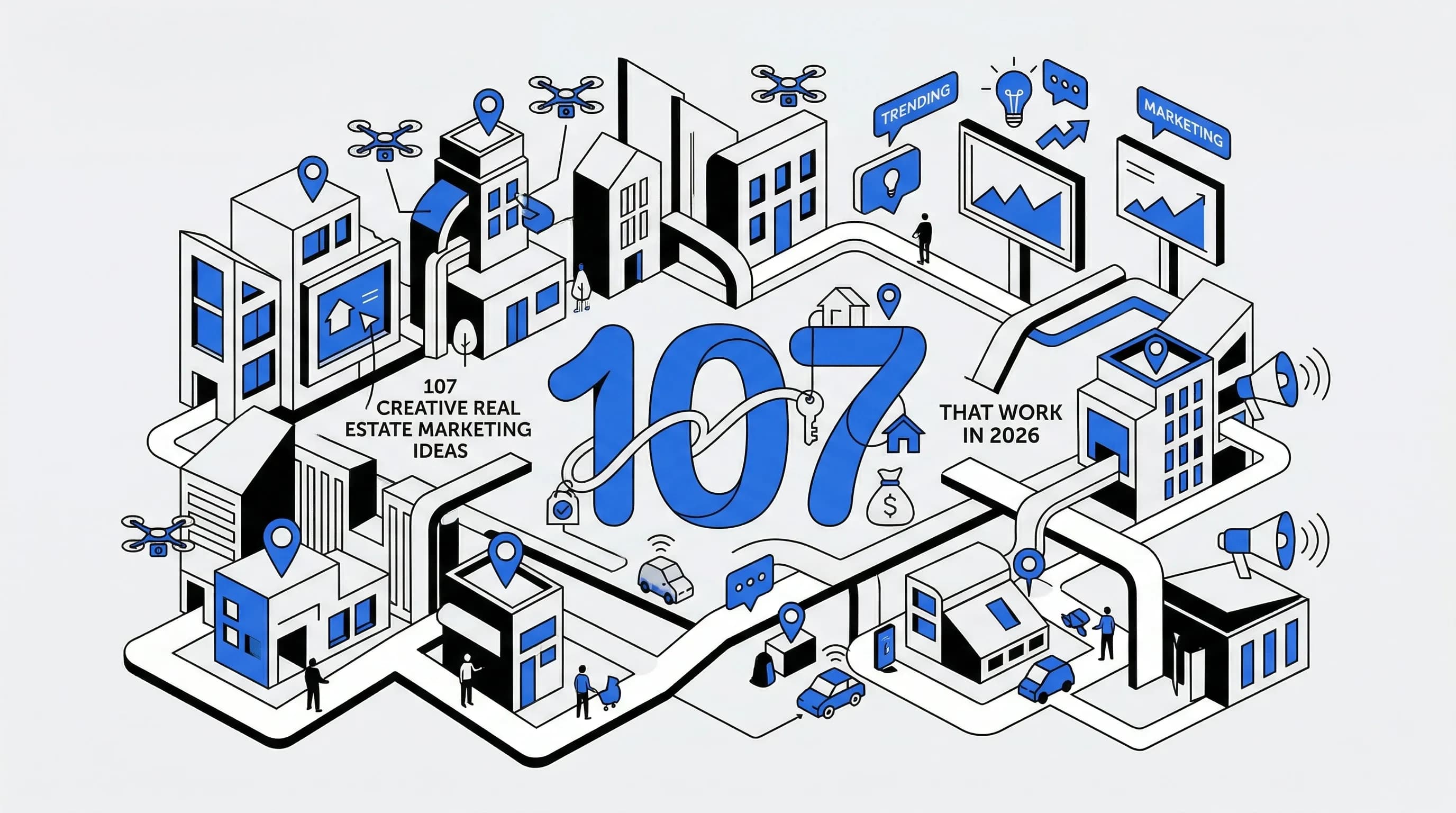
Outside-the-box real estate marketing isn’t about gimmicks or throwing 107 random tactics at the wall. It’s about stacking a lot of smart, modern, mostly inexpensive moves into a system that makes us:
- Unmissable in our local market
- The obvious go-to expert in our niche
- Less dependent on cold prospecting and more on inbound demand
We’ll walk through creative, proven real estate marketing ideas that combine digital, social, SEO, email, print, and community plays—plus plenty of real examples and twists you can swipe today.
1. Shift the Mindset: Systems, Not Random Tricks
Before we jump into the marketing ideas, we need the right mental model or we’ll just bolt random tactics onto a leaky business.
There are two kinds of marketing we always keep in mind:
- Lead generation: Something happens and we end up with a name, email, phone number, or appointment.
- Brand awareness: People don’t convert immediately, but they remember us when they’re ready.
And three main channels we blend together:
- Physical – mailers, signs, events, swag, sponsorships
- Digital – website, SEO, local search, Google Business Profile, email, AI tools
- Social – YouTube, Instagram, TikTok, Facebook, LinkedIn, Nextdoor
Our job is to combine these so that people:
- See us offline (events, community, signs)
- Validate us online (Google, reviews, website, YouTube)
- Keep bumping into us on social until they feel like they already know us
Every “outside-the-box” real estate marketing idea below either builds brand, generates leads, or does both. The big win comes from how we connect them into a repeatable real estate marketing system.
2. Build a Real Estate Marketing Strategy That Actually Fits You
Creative real estate marketing only works if it’s sitting on top of a solid strategy: niche, audience, and value proposition.
2.1 Choose a Profitable Real Estate Niche
Niche marketing is one of the most powerful ways to stand out as a real estate agent. Instead of being “a REALTOR® who works everywhere with everyone,” we become the go-to specialist for a specific group.
Examples of real estate niches:
- First-time buyers in a particular city
- Downsizers / 55+ homeowners
- Luxury homes or waterfront properties
- Investors and small multifamily properties
- Eco-friendly / energy-efficient homes
- New construction / builder partnerships
- Relocation clients moving into your metro
- Specific neighborhoods, school districts, or micro-markets
We look at:
- Where our past deals and referrals came from
- Which client types are underserved in our market
- Where our background, language skills, hobbies, or previous career give us an edge
Outside-the-box twist: instead of stopping at “luxury” or “first-time buyers,” we go ultra-specific:
- “Walkable downtown condos for dog owners in [City]”
- “Homes within 20 minutes of [Major Employer]”
- “Suburban homes with in-law suites for multigenerational families”
Once chosen, we reflect that niche everywhere in our real estate marketing plan: website copy, blog content, social media posts, email segments, and listing presentations.
2.2 Clarify a Unique Value Proposition (UVP) Sellers Actually Care About
Our unique value proposition answers: “Why should a seller or buyer choose us, in this market, right now?”
We shape it by asking past clients questions like:
- “What did you appreciate most about working with us?”
- “What made you choose us over other real estate agents?”
We then layer in what we do that’s demonstrably different, for example:
- Tech-forward marketing: immersive 3D tours, floor plans, video, AI-enhanced listing descriptions
- Hyperlocal expertise: “We’ve sold 27 homes within 1 mile of this address in the last 5 years.”
- Concierge-style support: staging consults, contractor network, moving concierge, relocation playbooks
We compress that into one or two lines we repeat everywhere—our site hero, social bios, emails, and listing presentations. For example:
“We help busy homeowners sell for top dollar with tech-driven marketing—3D tours, data-backed pricing, and a stress-free process from prep to close.”
3. Real Estate Marketing Foundation: Website, Local SEO & Google
Before we launch clever marketing campaigns, we make sure people who hear about us can actually find and trust us online.
3.1 Turn Your Website Into a Local Lead Engine
Our real estate website is more than an online business card; it’s a core lead generation asset and part of our local SEO strategy.
Key upgrades we focus on:
- Mobile-first design: fast-loading, easy to use on a phone, with obvious calls to action (“Book a consult,” “View 3D tour,” “Get your home’s value”).
- Local SEO pages for each neighborhood, suburb, or micro-market we serve, optimized for phrases like:
- “Homes for sale in [Neighborhood]”
- “[City] real estate agent near me”
- “[School district] homes for sale”
- Service pages for buyers, sellers, investors, and relocation clients, clearly explaining our process and value.
- Lead magnets (downloadable guides, checklists, market reports) embedded with email opt-ins.
Outside-the-box idea: embed interactive neighborhood tours—walk-through videos or 3D tours of local streets, parks, and amenities—directly on our neighborhood pages with commentary about prices, schools, and commute times. This keeps people on-site longer and sends strong signals for SEO.
3.2 Dominate “Near Me” Searches with Google Business Profile
Local search is where many clients first discover real estate professionals. We treat our Google Business Profile like a mini-website:
- Correct NAP (name, address, phone), service areas, and hours
- Fresh photos of us, listings, neighborhoods, and events
- Short videos and links to featured 3D tours
- Weekly posts: new listings, open houses, sold announcements, upcoming events
- Systematic reviews and responses to every review
We include phrases like “trusted local real estate expert in [City]” in our profile description and posts to reinforce our positioning.
4. Modern Social Media Marketing for Real Estate (2026-Style)
Social media isn’t just for “Just Listed” posts anymore. Platforms now push content based on interest, not just follower count, which means every real estate agent has a shot at huge reach if each individual piece of content is compelling.
4.1 Build Content Pillars That Reflect the Real You
We organize social content into a few simple pillars:
- Real estate education: buyer/seller tips, market updates, pricing strategies, investment basics.
- Local lifestyle: restaurants, cafés, parks, local businesses, events.
- Personal interests: fitness, food, pets, hobbies—whatever is authentic.
- Values and story: why we got into real estate, what we care about, how we work.
Because algorithms are interest-based, different pieces naturally find their right audience—and together they build a strong personal brand that goes far beyond a headshot and a logo.
4.2 Lean Into Raw, Relatable Vertical Video
Highly polished videos can look like ads; in many cases, simple vertical videos shot on a phone outperform them. Our baseline for scroll-stopping content:
- Vertical video (Reels, TikTok, Shorts) with clear audio (basic lav mic is enough).
- We talk directly to camera or walk viewers through a home or neighborhood.
- We add captions for silent viewers and tight editing (no long pauses).
Ideas that consistently work for real estate agents:
- 30–60 second mini-lessons
- “3 mistakes first-time buyers make in [City]”
- “What not to do before listing your house in [Neighborhood]”
- Local lifestyle reviews
- “3 best coffee shops in [Neighborhood] according to a local agent”
- “New [Restaurant] review: is it worth the hype?”
- Guess-the-price games
- Show a home and ask followers to guess list or sold price; reveal in a follow-up post and reward the closest guess with a small prize.
- Behind-the-scenes
- Staging day, photography day, sign install, open house prep.
These are creative, non-traditional real estate marketing tactics that both educate and entertain while building trust.
4.3 Engineer Engagement (Don’t Just Hope For It)
Algorithms care about comments, shares, saves, and watch time. We build those in with simple prompts:
- “Comment ‘guide’ and we’ll DM you our free [Buyer/Seller/Relocation] guide.”
- Polls in Stories: “Planning to move in the next 12 months? Yes/No.”
- “Save this post” on checklist or market stat graphics.
We then follow up with DMs and conversations, turning passive viewers into real estate leads.
5. YouTube & Long-Form Video: Your Secret Real Estate Marketing Weapon
YouTube is both a social network and a search engine—and increasingly, a data source for AI search tools. If AI is going to recommend “the best real estate agent in [City],” we want to give it no choice but to pick us.
5.1 Create Evergreen Local Content Buyers Actually Search
We focus our real estate YouTube marketing on long-term, high-intent topics like:
- “10 Things You Must Know Before Moving to [City] in 2026”
- “Cost of Living in [City]: 2026 Breakdown”
- “Best Neighborhoods in [City] for Families/Young Professionals/Retirees”
- “Pros and Cons of Living in [City]”
- “Property Taxes in [State/City] Explained (2026 Update)”
These videos act as a permanent lead-generation engine; one strong video can bring in views, calls, and relocation clients for years.
5.2 Optimize Videos for Search, AI & Conversions
We structure each video so search engines and viewers instantly understand its value:
- Title with clear keywords: “Moving to [City] in 2026? Watch This First (Real Estate & Cost of Living).”
- Description that leads with links to our free guides, home search portal, and consult booking, followed by a detailed summary.
- Timestamps framed as questions:
- 00:00 – Is [City] a good place to live in 2026?
- 02:10 – Average home prices in [City] right now
- 05:45 – Safest neighborhoods in [City]
- 09:30 – Should you rent or buy in [City]?
- Playlists like “Moving to [City],” “Neighborhood Tours,” “Market Updates,” and “Property Tours.”
6. 3D Tours, Virtual Experiences & Scroll-Stopping Visuals
Immersive media—3D tours, virtual walkthroughs, floor plans, and high-resolution photos—is now a central pillar of innovative real estate marketing strategies.
6.1 Turn Every Listing into a 24/7 Virtual Open House
Instead of relying on a two-hour Sunday open house, we set up an always-on virtual experience:
- Embed the 3D tour on a dedicated property landing page on our own website.
- Link it from the MLS (where allowed), syndication portals, Google Business posts, and email campaigns.
- Share short teaser clips from the tour on Instagram, TikTok, and Facebook.
This “virtual-first” approach helps:
- Filter out casual “looky-loos” and attract more serious, qualified buyers.
- Support out-of-town or relocating buyers who can’t attend in-person showings.
- Give sellers confidence that their home is marketed with best-in-class tools.
6.2 Use Floor Plans & Spatial Data to Build Buyer Confidence
Features like accurate measurements, floor plans, and labeled rooms help buyers picture how they’ll live in the home. We incorporate:
- Detailed floor plans in our listing presentations, brochures, and listing pages.
- Measurement tools and auto room labels where our 3D platform supports it.
- “Defurnish” or “redecorate” views to help buyers visualize possibilities.
Outside-the-box add-on: post-closing, we can turn that same 3D tour into a digital “owner’s manual” with tags showing shutoff valves, filter locations, and smart home controls—a memorable value-add that boosts referrals and repeat business.
6.3 Capture Once, Repurpose Everywhere
From a single professional shoot (photo + 3D), we can generate:
- 3D tour
- High-resolution hero photos
- Short-form vertical videos (Reels/TikTok/Shorts)
- Longer walkthroughs for YouTube
- Floor plans and highlight reels
- AI-assisted listing descriptions and social captions
We then use those assets across our entire real estate marketing campaign: on the MLS, on our site, via email blasts, in print flyers, in Facebook ads, and in future listing presentations.
7. The Ultimate Listing Marketing System (That Wins You More Listings)
Instead of treating each listing as a one-off upload to the MLS, we run a multi-phase, multi-channel real estate marketing campaign around it. This not only sells the property—it also showcases our capabilities to future sellers.
7.1 Pre-Launch: Build Anticipation
- Pro photography with at least one true twilight or “hero” exterior shot.
- Short-form vertical tour (30–60 seconds) for Reels, TikTok, Shorts.
- Long-form YouTube tour (3–10+ minutes) optimized with title, description, and timestamps.
- Behind-the-scenes content:
- Stories of staging, photography, and prep.
- “Coming soon” teasers highlighting one standout feature or lifestyle benefit.
7.2 Launch: Go Live Everywhere Strategically
- MLS & portals with great photos, concise but compelling listing copy, and clear links to the 3D tour when allowed.
- Facebook/Instagram Ad #1 – Just Listed
- Campaign objective: lead generation or traffic to our own IDX site.
- Budget: e.g., $20/day for 7 days.
- Image: usually the front exterior or strongest lifestyle image.
- Important: we avoid showing all the “decision-making” photos (kitchen, primary bed, primary bath) in the ad to encourage clicks to our site.
- We keep traffic on our own website, not Zillow or generic brokerage pages.
- Business page posts:
- “Just listed” post linking to our site.
- Native upload of the listing video (Facebook deprioritizes YouTube links).
- Marketplace listing with limited photos and a call to message us for full details and 3D tour.
- Short-form blast: post the 60-second tour to Reels, TikTok, and Shorts simultaneously.
7.3 Open House & Virtual Open House Marketing
- Facebook/Instagram Ad #2 – Open House:
- Run 2–3 days ahead of time with a smaller budget (e.g., $10–$20/day).
- Target our city/ZIP plus our retargeting audiences.
- Stories & posts:
- Announce date/time, tease features, and answer common questions.
- Go live during part of the open house to capture people who can’t attend.
- Interactive on-site experience:
- Tablet kiosks running the 3D tour and neighborhood info.
- Sign-in flows tied into our CRM for follow-up.
7.4 Under Contract & Sold: Turn One Listing into Many Leads
- Under Contract post with a different photo and brief story of how the deal came together.
- Sold post featuring the clients (if they agree) with a narrative about their journey, not just “Congrats!”
- Client-generated content:
- We offer them a fun “SOLD” sign and encourage them to post a photo on their own social, tagging us.
- Facebook/Instagram Ad #3 – Just Sold:
- Budget example: $15/day for 7 days.
- Split between a new local audience and retargeting people who engaged with our Just Listed/Open House ads.
Over time, this listing marketing system becomes a signature part of our unique real estate marketing strategy and a compelling section in our listing presentations.
8. Smart, Segmented Email Marketing for Real Estate Agents
Email remains one of the highest-ROI real estate marketing channels, especially when we segment instead of blasting the same message to everyone.
8.1 Segment by Interest, Not Just “Buyer or Seller”
We tag our database by what people care about:
- Landlords vs. owner-occupiers
- First-time buyers vs. move-up buyers vs. downsizers
- Investors vs. primary residence buyers
- Specific neighborhoods or condo buildings
Then we create niche-specific campaigns, for example:
- “5 Ways to Find the Perfect Tenant in [City]” for landlords
- “2026 Price & Rent Forecast for [Neighborhood]” for local homeowners
- “Your 7-Step Downsizing Checklist for [City] Homeowners 55+” for older owners
We send an initial invitation to the full list:
“If you’re a landlord in [City], reply ‘landlord’ and we’ll send you our new landlord guide.”
Those who respond self-segment, and we follow up with targeted sequences and personal outreach.
8.2 High-Impact Real Estate Email Sequences
Ideas we use repeatedly:
- Relocation welcome series:
- Intro to the city and our team
- Neighborhood profiles with sample 3D tours
- Schools, commuting, and lifestyle guides
- How our relocation process works and how to book a consult
- “Selling in 90 Days” series for potential sellers:
- Home prep checklist PDF
- Staging before/after case studies
- Video of our marketing process
- Call to schedule a pricing strategy session
- Post-close nurture:
- Quarterly market updates
- Home maintenance checklists
- Invites to client appreciation events
- Vendor spotlights and referral reminders
We also enrich our emails with visuals: short property videos, GIFs from 3D tours, staging “before and after” photos, and simple infographics of market data.
9. Stop Ignoring the Gold Mine: Your Existing Database
Our sphere of influence and past clients are usually our most valuable real estate marketing asset. Outside-the-box means mining that list intelligently.
9.1 Turn Your Email List into a Social Media Powerhouse
We export our contacts and upload them to Facebook/Instagram as a Custom Audience. That lets us run:
- Client appreciation event ads to only people who already know us
- Market update videos to warm past clients and leads
- Sellers campaigns like “Thinking of selling in [Neighborhood]? Here’s what we just did for your neighbor.”
Because this audience knows us, cost-per-lead drops and engagement typically goes up.
9.2 Systematic Referrals, Reviews & Reputation
We build a simple referral and review system:
- Immediately after closing, we send a thank-you email with direct links to Google, Zillow, and Facebook reviews plus a few prompts.
- We ask for a short video testimonial when clients are especially happy.
- We repurpose testimonials on our website, social media, print materials, and listing presentations.
Outside-the-box extensions:
- Quarterly “Homeownership Clinics” co-hosted with lenders, contractors, or tax advisors and promoted primarily to our own database.
- Referral ecosystem with CPAs, attorneys, HR departments, and relocation companies, built over time through value-first introductions.
10. Hyperlocal & Offline Real Estate Marketing—With a Fresh Twist
Offline tactics still work beautifully when we update them and connect them to our digital presence.
10.1 High-Impact Print & Direct Mail That Feels Premium
Instead of generic “I’ve just sold” postcards, we invest in:
- Premium postcards or mini-magazines with:
- Compelling before/after and staging stories
- QR codes linking to 3D tours and video walkthroughs (“Scan to walk through this home right now”)
- Local micro-market stats for that specific subdivision
- Niche mailers:
- “Thinking of downsizing from your 4+ bedroom home in [Neighborhood]? Here’s what your neighbors achieved last year.”
10.2 Guerrilla Local Real Estate Marketing Ideas
We use a handful of “unusual but local” plays that get people talking.
- Dry-cleaner partnership:
- We provide simple, value-driven flyers that get stapled to garment bags—everyone picking up clothes takes our brand home.
- Branded water at hot events:
- On hot days at kids’ games or outdoor fairs, we hand out cold water bottles with custom labels and a QR code to our home valuation page.
- Co-marketing with small businesses:
- We create flyers that promote a local café or sandwich shop (“Bring this in for a free drink with your order”) and our real estate brand; we distribute to area buildings and neighborhoods.
- Movie theater ads:
- A simple 15–30 second spot before local films can quickly position us as “the” agent in town.
- Youth sports and school sponsorships:
- Jersey logos, field banners, or radio broadcast mentions tie us deeply into the community and build long-term brand awareness.
Events are still one of the most powerful real estate marketing ideas when done right.
- Hyper-specific education nights:
- “Downsizing in [City]: How to Sell Your Family Home and Love Your Next Chapter”
- “Investing in Small Multifamily in [City]: From Your First Duplex to Your Third”
- Clinics and office hours:
- “Saturday Morning Seller Clinic” where homeowners can book 15-minute consults.
- “Landlord Drop-In” where landlords bring leases for a quick review.
- Experiential client events:
- Art gallery nights, rooftop mixers, food truck events, or wine & cheese at a model home, co-hosted with local vendors.
These give us face time, create tons of photo/video content, generate word of mouth, and deepen loyalty with past clients.
11. Paid Social & Retargeting: Real Estate Ads That Actually Convert
With housing-specific ad rules, we can’t microtarget by age or income, but Meta’s AI does a surprisingly good job if our creative is strong.
11.1 Core Facebook/Instagram Ad Types for Real Estate
- Brand awareness ads:
- Short videos explaining who we help and how.
- Market update clips for our city.
- Listing ads:
- Just listed, open house, and just sold campaigns as outlined in the listing system.
- Lead magnet ads:
- “Free 2026 Relocation Guide for [City]”
- “[Neighborhood] 2026 Price & Rent Outlook”
We always track:
- Cost per lead
- Leads → appointments
- Appointments → signed clients
That data tells us which real estate marketing tactics to double down on and which to pivot away from.
11.2 Retargeting Warm Audiences
We set up retargeting campaigns to show ads to:
- Website visitors
- People who watched a certain percentage of our videos
- Our email list custom audience
These audiences have much higher conversion rates and lower ad costs because they already know who we are.
12. Personal Branding: The Glue That Makes All This Work
In a world where AI can generate generic content and big portals spend billions on advertising, a strong personal brand is our moat. It turns marketing from “shouting in the void” into a magnet.
12.1 Components of a Magnetic Real Estate Brand
- Clear positioning: who we serve, where we work, and what makes us different.
- Consistent visuals: professional (but not overly stiff) photos, consistent colors and fonts across our website, thumbnails, mailers, and signs.
- Signature content series:
- “Monday Market Minute” weekly updates
- “Tour Tuesday” listing or neighborhood walks
- “Ask a REALTOR®” Q&A segments
- Story: why we’re in real estate and what we stand for, communicated repeatedly across platforms.
12.2 Own Your Audience (Don’t Let Platforms Own You)
Algorithms change, accounts get hacked. Our email list is the one channel we truly control.
- We offer strong lead magnets:
- Relocation guides
- Buyer and seller roadmaps
- Neighborhood-specific reports
- We promote them on:
- Our website and blog
- YouTube descriptions
- Social posts with “comment [keyword] for the guide” automations
- We send a short but consistent weekly newsletter with:
- New videos
- Market insights
- Stories and case studies
- Occasional event invites and calls to action
13. Measuring What Matters: From Ideas to a Repeatable Real Estate Marketing Plan
The difference between random creative ideas and a true real estate marketing strategy is measurement. We track:
- Traffic & engagement:
- Website visits, time on page, 3D tour views
- Social reach, watch time, saves, and shares
- Email open and click-through rates
- Lead & conversion metrics:
- Number of leads per channel
- Appointments booked
- Signed clients and closed deals
- Days on market and list-to-sale price ratio for listings
- Cost & ROI:
- Cost per lead by campaign
- Return on ad spend
- Lifetime value of a client (repeat and referral deals)
After each listing or major campaign, we run a quick “post-mortem”:
- Which channels generated actual showings and offers?
- Which content pieces got the most engagement?
- What did the seller notice and appreciate most about our marketing?
We fold those lessons into checklists and templates so every future marketing campaign is sharper, easier to run, and more profitable.
14. 107+ Creative Real Estate Marketing Ideas at a Glance
To wrap this up, here’s a condensed checklist you can use to build or refine your own outside-the-box real estate marketing strategy.
- Clarify a niche and UVP.
- Launch or upgrade a mobile-first, SEO-optimized website.
- Build hyperlocal neighborhood and niche pages.
- Optimize your Google Business Profile and post weekly.
- Create evergreen YouTube videos for “Moving to [City]” topics.
- Film vertical videos for Reels/TikTok/Shorts 3–5x per week.
- Run “guess the price” and myth-busting series on social.
- Turn every listing into a full marketing campaign (3D, video, ads).
- Use 3D tours and floor plans for a 24/7 virtual open house.
- Host hyper-specific seminars and “office hours” for sellers, buyers, landlords, and investors.
- Throw memorable community and client events with local partners.
- Use premium print with QR codes to immersive digital experiences.
- Deploy guerrilla plays like dry-cleaner flyers and branded water.
- Run Facebook/Instagram ads for brand, listings, and lead magnets.
- Retarget your database and website visitors with tailored ads.
- Segment your email list by interest and run targeted sequences.
- Systematize reviews, testimonials, and referral touchpoints.
- Build a recognizable personal brand with signature content series.
- Own your audience through consistent email list building and nurturing.
- Measure cost per lead and conversion for every major channel and improve one small thing each month.
We don’t have to implement all 107 ideas at once. We start with a handful that fit our market and personality, treat them as part of a connected system, and layer in new tactics as the foundation gets stronger. That’s how we move from random marketing noise to an outside-the-box real estate marketing engine that consistently brings in more listings, better clients, and stronger results.