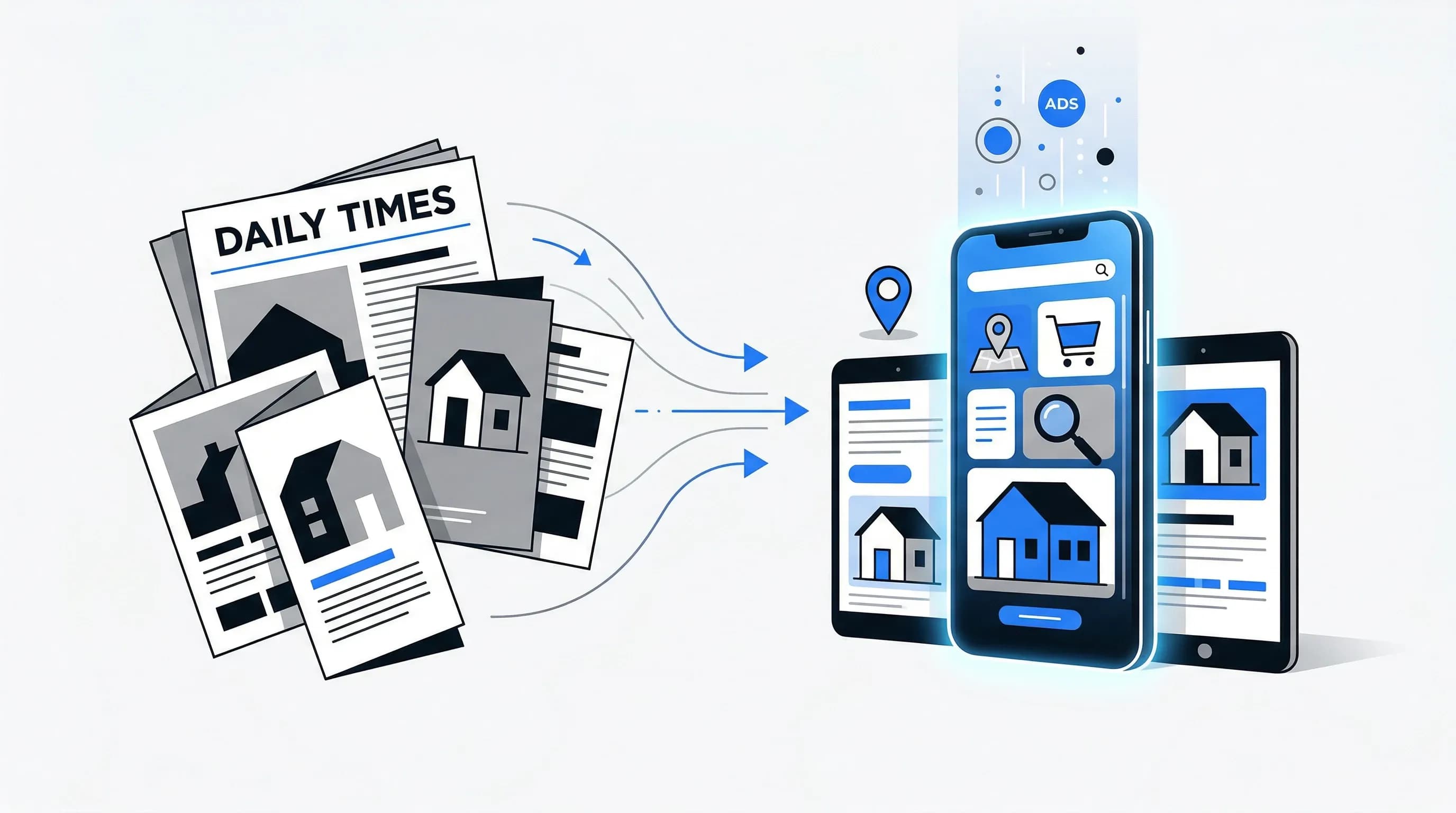
Advertising Options for Real Estate Agents: From Print Ads to Online Marketing

If we strip away the buzzwords, almost everything we spend on “advertising” as real estate agents falls into two buckets: we’re either buying brand awareness (being known, remembered, and trusted) or lead generation (people who actually raise their hand right now). Once we see that clearly, choosing between print, offline, and digital advertising options gets a lot easier.

In this guide, we’ll walk through the main real estate advertising options available today—from classic brochures and postcards to Google Ads, 3D virtual tours, and AI‑assisted content—and show how to stitch them into one multichannel system that actually produces listings and closings in today’s market.

Why Real Estate Advertising Has to Be Multichannel Now

Real estate advertising used to be linear: a yard sign, a newspaper ad, maybe a glossy magazine, and phone calls from interested buyers. Now the path looks more like a pinball machine. Buyers and sellers bounce between:

  • Google searches (“homes for sale in [City]”, “best realtor near me”)
  • Listing portals (Zillow, Realtor.com, Rightmove, local MLS portals)
  • Social platforms (Instagram, Facebook, TikTok, YouTube)
  • Email newsletters and listing alerts
  • Yard signs, postcards, and local magazines
  • Open houses, community events, and word‑of‑mouth

At the same time, the numbers are brutal for many traditional print discovery channels:

  • Only about 19% of buyers touch a real estate magazine at any point in their search.
  • Roughly 29% use newspapers.
  • About 52% still use yard signs.
  • 89% rely on an individual agent, and 100% use the internet somewhere along the journey.

On the spend side, the shift is equally dramatic: in 2005, only around 11% of real estate ad budgets were online; by 2010 that jumped to 64%, and today most serious agents put the majority of their lead‑gen budget into digital with a smaller slice reserved for print and offline branding.

That means the real question isn’t, “Should we do online marketing?” but, “How do we architect our online and offline marketing so they feed each other and actually produce business?” A strong real estate advertising strategy now needs to:

  • Maximize reach: show up where your ideal buyers and sellers already spend time, on and offline.
  • Improve velocity: use compelling visuals and smart distribution to shorten days on market and reduce price cuts.
  • Build brand and trust: use consistent, professional promotion to become the obvious choice when someone is ready to move.

Print and offline channels excel at trust, tangibility, and local presence. Online and digital channels excel at reach, precise targeting, tracking, and fast testing. The best real estate agents deliberately use both.

Let’s be honest about what print advertising really does for real estate in 2025. Before portals and IDX sites, print was where people discovered listings: Sunday newspaper “Homes” sections, full‑page color spreads, classified ads. It handled both discovery and proof.

Today, print is almost entirely about brand awareness, farming, and credibility. It rarely sells the house directly; it often sells you.

High‑Quality Real Estate Brochures and Flyers

Property brochures and flyers are still some of the most effective print marketing materials for real estate agents, especially when they’re tightly integrated into your online marketing.

We treat them as “portable showrooms” that buyers can hold onto after they’ve left the property. To make them work:

  • Invest in professional photography—these images will pull double duty on the MLS, your website, social media, and your brochures.
  • Use clean, modern layouts on thicker, high‑quality stock to signal professionalism and attention to detail.
  • Include key facts (beds, baths, square footage, price), a floor plan or layout overview, and a short, benefit‑driven description that tells a story about the lifestyle, not just the features.
  • Add neighborhood highlights: schools, commute times, parks, and local amenities.
  • Always add a QR code or custom URL that points to an online listing page, 3D virtual tour, or video walkthrough so buyers can dive deeper instantly.

We use these brochures at the property, in flyer boxes, at open houses, in relocation packets, and even at select local businesses (coffee shops, gyms, coworking spaces) where it’s allowed. The print creates a tactile, memorable first impression; the QR code hands the conversation off to your digital marketing.

Business Cards That Actually Get Used

Business cards are old‑school, but they’re far from dead. They’re still a core part of offline marketing for real estate agents, especially when you think of them as little bridges to your online presence instead of static contact info.

We recommend:

  • Including your name, title, brokerage, license details (where required), phone, email, and website.
  • Adding a professional headshot for face–name recognition.
  • Leaning into branding elements—logo, colors, tagline—to reinforce your identity across print and digital.
  • Embedding a QR code that sends people to a lead‑optimized “About” page, your main site, or even a “book a call” calendar.

We hand them out at open houses, community events, networking meetups, client parties, and when we partner with local businesses. The key is what happens after: same‑day follow‑up via text, email, or a quick social connection so your card isn’t the only reminder that you exist.

Direct Mail: Postcards, Letters, and Real Estate Newsletters

Direct mail remains one of the most underrated advertising options for realtors—particularly for geographic farming and seller lead generation. When we compare results, a well‑run farm with targeted postcards often outperforms random online brand campaigns for actually generating listings in a tight area.

Why direct mail still works:

  • It’s tactile and personal—people still sort their physical mail and often remember high‑quality pieces.
  • Response rates can beat some digital channels, especially when you combine mail with email and social retargeting to the same list.
  • It’s highly geographically targeted—you can own a neighborhood, condo building, or subdivision in a way broad online ads struggle with.

We primarily use three types of mailers:

  1. Just Listed / Just Sold postcards

    • Show proof that you’re active and effective in the neighborhood.
    • Include strong visuals, list vs. sold price where allowed, days on market, and a short testimonial or success stat (“3 offers in 48 hours”).
    • Add a crystal‑clear CTA like “Curious what your home could sell for? Scan for a free neighborhood report.”
  2. Market update and educational pieces

    • Short snapshots of appreciation, inventory, and local stats.
    • Bite‑sized advice: “3 small upgrades that boost resale value in [Neighborhood].”
    • Drive homeowners to a valuation tool or a full online report via QR code or custom URL.
  3. Printed real estate newsletters

    • These are mini magazines: 4–8 pages with local stories, business spotlights, homeowner tips, and your featured listings.
    • We’ve found that when we include genuinely useful local content, people actually keep and share these, which massively boosts brand recall.

Because print can be hard to track, we treat everything like a small experiment. Each campaign gets its own custom URL, unique phone number or email alias, and QR code, so we can tie response back to a specific postcard or newsletter.

We also coordinate our direct mail drops with digital ads: we’ll upload the same address list to Facebook as a custom audience, then run local awareness or lead‑gen ads around the time mail hits. The repetition—mailbox, news feed, yard signs—does the heavy lifting.

Real Estate Signage and Outdoor Advertising

Real estate signage might not feel glamorous, but it’s still one of the highest‑ROI offline marketing tools in the business. Yard signs, riders, and open house directionals repeatedly show up in buyer journey surveys as major sources of awareness.

At a minimum, we recommend:

  • For Sale / For Rent signs with bold, simple branding and large, legible contact info.
  • Rider panels highlighting key hooks: “Pool,” “Views,” “Under Contract,” “Open Sunday 1–4.”
  • QR codes on signs that take drive‑by traffic directly to a mobile‑friendly listing page or 3D tour.
  • Directional signs for open houses that are clean, consistent, and plentiful enough to actually guide people in.

Beyond core signage, we look at outdoor advertising more as branding than direct response:

  • Billboards on commuter routes or near high‑value neighborhoods.
  • Bus benches and shelter ads.
  • Grocery cart ads and community sports field banners.

We only invest here when we’re prepared to run placements for multiple months and when they clearly support a geographic farming strategy or a specific demographic (e.g., luxury condos along a particular corridor). One‑off billboards to “see your face big” are usually a red flag from an ROI standpoint.

Event Marketing and Community Presence

Offline real estate marketing ideas that involve actual human interaction are often more powerful than another ad impression. We think of events as live advertising that feeds your database and your content machine at the same time.

Some of the offline events we’ve seen agents get tremendous mileage from:

  • Open houses with neighbors‑only preview hours and a clear sign‑in flow (ideally via QR code to a simple landing page).
  • Buyer and seller seminars, both in person and via Zoom, on topics like “Buying your first home in [City]” or “How to sell and buy at the same time in this market.”
  • Neighborhood events: block parties, BBQs, seasonal festivals, or free community garage sale days you help coordinate.
  • Charity events and volunteer days: park cleanups, food drives, Habitat for Humanity builds.
  • Client appreciation events: movie nights, wine tastings, pumpkin patch days, or photos with Santa.

Every event gets treated like a mini campaign. We’ll tease it on social, send email invites, sometimes drop a small run of postcards, and always capture attendance with a quick digital sign‑in. Those contacts flow into our CRM with tags like “open house – [address]” or “buyer seminar – [topic],” so we can follow up in a relevant way instead of dumping everyone into a generic drip.

Networking and Local Business Partnerships

Some of the best real estate “advertising” never looks like advertising at all—it looks like relationships. We deliberately build a local referral ecosystem and then support it with both offline and online content.

The core players in that ecosystem usually include:

  • Mortgage lenders and insurance brokers
  • Home inspectors and appraisers
  • Contractors, electricians, plumbers, handymen
  • Stagers, interior designers, and cleaners
  • Landscapers and lawn‑care services
  • Local cafés, gyms, and coworking spaces

We feature these partners in printed newsletters, blog posts, YouTube interviews, and Instagram spotlights. In return, they mention us in their own marketing and send warm referrals. Over time, this is what actually makes you “the face of your community” far more than any single ad placement.

Digital Advertising & Online Marketing for Real Estate Agents

Because 100% of buyers and sellers hit the internet somewhere along their journey, a strong digital foundation isn’t optional anymore; it’s table stakes. Before we pour money into PPC or social ads, we make sure our home base is solid.

Your Website, CRM, and Google Business Profile: The Digital Foundation

We think of three core digital assets as non‑negotiable before scaling ad spend:

  • A high‑converting real estate website with mobile‑optimized design and live IDX search.
  • A unified CRM (database) to centralize all leads—portal leads, ad leads, open house contacts, referrals, sphere—and automate follow‑up.
  • A fully optimized Google Business Profile (your “digital Yellow Pages” listing) with consistent NAP data, photos, posts, and reviews.

Without these pieces, paid traffic is like water poured into a leaky bucket. With them, every advertising channel—print, online, and offline—has a clear destination and a clear way to be tracked.

Listing Portals and Online Marketplaces

Listing portals are a core real estate advertising channel because they’re where buyers expect to browse homes. Even if you don’t pay for premium placements, your listings live here, and you can either treat those pages as generic placeholders or as fully optimized advertising assets.

We aim for:

  • Top‑tier visuals: professional photos, 3D virtual tours, video walkthroughs, and floor plans where supported.
  • Compelling copy: unique, story‑driven descriptions instead of recycled MLS remarks.
  • Complete details: HOA fees, taxes, utilities, parking, school info—anything buyers would otherwise need to Google.

Where it makes sense, we experiment with paid “featured listing” or “enhanced visibility” placements for higher‑value or harder‑to‑sell properties. But we never rely on portals as our only ad strategy; we see them as one piece in a multichannel listing promotion plan.

SEO, Local Search, and Real Estate Landing Pages

Search engine optimization is one of the more durable real estate marketing strategies because it compounds over time. But instead of obsessing over ranking for “homes for sale in [big city]” (where you’ll be competing with portals and national brands), we focus on three practical SEO levers:

  • Address‑ and neighborhood‑specific landing pages for each listing, with the property address in the URL, page title, and meta description.
  • Hyperlocal content—neighborhood guides, “living in [community]” posts, cost‑of‑living breakdowns, and school guides that keep working long after you hit publish.
  • Local SEO via Google Business Profile: photos, posts, FAQs, and review requests built into our closing process.

For each new listing, we create a landing page that includes photos, embedded 3D tour, floor plans, neighborhood map, key amenities, and strong calls to action (“Schedule a showing,” “Request more info,” “Download full brochure”). We then point our mailers, QR codes, Google Ads, and social traffic to that page so it becomes the hub of the entire campaign.

When someone types “condos in [City] under 400k” or “realtor near me,” they’re sending us an unambiguous signal: they’re in the consideration or action stage of the funnel. This is why we prioritize Google Search Ads as one of our top real estate lead‑gen channels when we want volume and intent.

Our basic Google Ads structure for buyers looks like this:

  • Campaign focused on “Leads” using Search Ads, with geographic targeting set to presence in your target area, not merely “interest in.”
  • Ad groups organized by niche (city, specific suburb, condo market, new construction).
  • Broad match keywords around those niches, protected by a strong negative keyword list (to filter out renters, low‑intent terms, or irrelevant searches).
  • Ad copy that mirrors the search terms and sends people to a pre‑filtered IDX search or landing page with “newest listings” and clear calls to action.

We’ve seen that when those ads drive to a fast, mobile‑friendly MLS search or property list instead of a generic homepage, cost per lead drops and lead quality goes up. We treat spend levels as tests: $500–$1,000/month in one area is enough to see patterns, but we’re only comfortable scaling once we’ve dialed in negative keywords, landing pages, and follow‑up.

Social Media Marketing: Organic and Paid

Social media is where we do a lot of our real estate branding and authority‑building. We think of it less as a magic lead tap and more as our omnipresence engine—something that keeps us in front of people and supports all of our other advertising options.

Different platforms serve different roles:

  • Instagram: Reels, Stories, and carousels for listing highlights, before‑and‑after staging, neighborhood spotlights, and day‑in‑the‑life content.
  • Facebook: Local groups, events, longer‑form posts, and highly targeted housing‑category ads.
  • TikTok: Short, educational real estate content; fast home tours; “things to know before buying in [City].”
  • YouTube: Long‑form neighborhood guides, cost‑of‑living breakdowns, market updates, and full listing walkthroughs—one of the best long‑term channels for relocations.
  • LinkedIn: Brand building and networking, especially for commercial or higher‑end residential niches.

On the paid side, we use Facebook and Instagram (Meta) ads primarily for top‑ and mid‑funnel real estate lead generation: new construction lists, “homes under X with Y feature,” or home valuation offers for sellers. For these campaigns, we keep the structure simple: a clear promise, one strong image or short video, a built‑in Meta lead form, and a thank‑you screen that hands off to a tailored search or valuation page on our site.

3D Tours, Virtual Walkthroughs, and Video Marketing

In today’s market, professional photos are the bare minimum; buyers now expect some kind of rich media experience. We treat 3D tours and video as central advertising assets rather than “nice extras.”

From a single 3D scan or video shoot, we can create:

  • Still photos for MLS, portals, brochures, flyers, and postcards.
  • Vertical clips for Instagram Reels, TikTok, and Stories.
  • Horizontal walkthroughs for YouTube and listing videos.
  • Interactive floor plans and dollhouse views that clarify layout better than any static image.

We embed these tours everywhere: on the MLS (where supported), on our property landing pages, in email blasts, on our Google Business Profile, and behind QR codes on signs and mailers. Every tour is paired with a clear next step: “Schedule a private tour,” “Request the full property brochure,” or “Get neighborhood sales data.” The goal is always to turn viewer engagement into a conversation.

Email Marketing and Real Estate Newsletters

Email remains one of the highest‑ROI digital marketing channels for real estate agents, especially once your database grows beyond a few dozen contacts. We think of it as the connective tissue between all our advertising options.

We use email to:

  • Announce new listings with photos, feature highlights, and links to 3D tours and landing pages.
  • Send segmented alerts by price point, neighborhood, or property type.
  • Run automated nurture sequences for new buyer and seller leads with educational content, case studies, and gentle calls to action.
  • Publish monthly or quarterly market update newsletters for our farm areas, often mirroring content we’ve also used in print.

Whenever we run a print campaign, we try to reinforce it with at least one email touch referencing the same theme or property, so people encounter the message in multiple contexts.

Retargeting and Remarketing for Warm Real Estate Leads

Most prospects don’t convert on their first exposure to you or your listing. Retargeting is how we stay in front of people who have already shown intent—visited a property page, watched a video, clicked a tour, or filled out a partial form.

In practice, our retargeting looks like this:

  • Install tracking pixels on our website and landing pages to build remarketing audiences.
  • Run tailored Facebook, Instagram, and Google Display ads that reference the specific listing or offer they viewed.
  • Rotate creative and calls to action: price reductions, open house invites, “last chance” messages, or additional features not shown in the first ad.

We treat email follow‑up similarly: if someone clicked a link to a particular property but didn’t inquire, we’ll send a short personal‑style email asking if they had questions about that home and offering alternative options if it’s not the right fit.

Analytics and Data‑Driven Real Estate Advertising

With so many advertising channels—from postcards and yard signs to YouTube and PPC—we can’t afford to rely on gut feelings. We track enough data to know which real estate marketing strategies are actually generating closings, not just clicks and likes.

At a minimum, we look at:

  • Engagement metrics: website traffic, time on page, 3D tour engagement, video view‑through rates, email opens and clicks.
  • Lead source attribution: custom URLs and phone numbers for print, form questions like “How did you hear about us?”, and consistent use of tags in our CRM.
  • Ad performance: cost per click (CPC), cost per lead (CPL), and, when deals close, effective cost per closing by channel.

We then A/B test variations—headlines, images, offers, even postcard designs—and shift budget based on what actually puts appointments and contracts on the board.

Using AI to Scale Your Real Estate Marketing & Advertising

The volume of content a modern real estate advertising plan requires used to be overwhelming: blog posts, listing descriptions, video scripts, ad copy, email sequences. Now, AI has become an unfair advantage for agents willing to learn how to use it well.

We routinely use AI tools to:

  • Draft listing descriptions that we then fact‑check and personalize.
  • Generate YouTube scripts, Reels/TikTok hooks, and carousel ideas based on local keyword trends.
  • Turn research about relocation trends or market stats into guides and PDFs we can use as lead magnets.
  • Build email nurture sequences and text follow‑up templates for different segments (first‑time buyers, downsizers, investors, relocators).

The point isn’t to replace your voice; it’s to offload 80% of the blank‑page work so you can spend your time recording videos, meeting clients, and negotiating deals. In practice, this is what makes it realistic for us to maintain a multichannel presence without hiring a full marketing team.

Integrating Print, Online, and Offline into One Real Estate Advertising System

Instead of thinking in terms of isolated tactics (“I’m running a postcard” or “I’m posting on Instagram”), we treat every listing and campaign as a system where print, digital, and offline touchpoints all support the same goal.

Sample Multichannel Campaign for a New Listing

  1. Asset creation

    • Professional photo shoot + drone where appropriate.
    • 3D virtual tour and detailed floor plan.
    • Short vertical videos and a full horizontal walkthrough.
    • High‑quality brochures, flyers, and yard signage with QR codes to the tour or landing page.
  2. Digital launch

    • MLS + portals with complete media and narrative descriptions.
    • Dedicated, SEO‑friendly landing page on your website.
    • Email blast to your database announcing the new listing and linking to the 3D tour.
    • Social media push: Reels, Stories, TikToks, and YouTube walkthroughs.
    • Optional Google Search and Facebook Ads targeting local buyers and your warm audiences.
  3. Print and offline amplification

    • Yard sign with QR code to the 3D tour.
    • Brochures and property flyers at the house, nearby businesses, and in relocation packets.
    • Just Listed postcards to 200–500 nearby homes with a tracking URL and campaign‑specific phone number.
    • Neighbors‑only open house preview, promoted via postcards, email, and social.
  4. Follow‑up, retargeting, and optimization

    • Retarget website visitors and tour viewers with fresh creatives and open house invites.
    • Monitor tour engagement, site analytics, ad metrics, and showing feedback.
    • Adjust copy, photos, and budgets based on what’s actually driving showings and offers.
  5. Post‑sale leverage

    • Just Sold mailers and social posts with a concise case study (“3 offers in 6 days after 1,200+ 3D tour views”).
    • Short email to your database explaining how you marketed the property and inviting homeowners to ask about their own home’s value.
    • Review request to the seller and permission to use their testimonial in future listing presentations.

This structure turns each listing into both a transaction and a marketing asset—a demonstration of your real estate advertising strategy that helps you win the next listing.

Choosing the Right Real Estate Advertising Mix for Your Budget and Market

Not every real estate agent will use every channel on day one. The key is to prioritize in a way that matches your budget, market, and personal strengths.

By Budget Level

  • Lean budget
    • Core assets: solid website, CRM, Google Business Profile, business cards.
    • Channels: organic social media, email list, yard signs, a narrow geographic farm with occasional postcards, consistent community event presence.
  • Moderate budget
    • Add regular professional photo + video on listings, 3D tours on select homes.
    • Scale geographic farming with predictable direct mail.
    • Layer in Google Search Ads and one or two focused Facebook/Instagram ad campaigns.
  • Aggressive budget
    • 3D tours and video for nearly every listing.
    • Magazine or high‑end print placements where appropriate (luxury, resort, niche communities).
    • Robust PPC, retargeting, and content marketing with AI‑assisted output.
    • Large‑scale farm newsletters plus community sponsorships and outdoor ads.

By Market Type

  • Luxury / high‑end
    • Premium print (thick brochures, high‑end magazines) combined with cinematic video and 3D tours.
    • Brand‑driven campaigns on social and search, emphasizing discretion, lifestyle, and global reach.
  • Suburban / family‑oriented
    • Strong geographic farming via direct mail, real estate newsletters, and community sponsorships.
    • Facebook and Instagram as core channels, plus SEO around schools, neighborhoods, and family amenities.
  • Urban / younger buyers
    • Mobile‑first digital: TikTok, Instagram Reels, YouTube, and Google Ads.
    • Less focus on traditional print; more on lifestyle storytelling and micro‑neighborhood content.

By Personal Strengths

  • If you’re strong on camera, lean into video marketing, virtual tours, YouTube, and short‑form video ads.
  • If you write well, build out blog content, email newsletters, and in‑depth neighborhood guides that can be repurposed into social posts and scripts.
  • If you’re a born networker, double down on events, partnerships, and community marketing, then amplify all of that activity online.

When we evaluate real estate advertising options now, we use a simple filter:

  • Is this primarily brand awareness or lead generation?
  • Does it point to a trackable, digital next step?
  • Is it supporting my core system (website + CRM + database), or is it a vanity play?

Print isn’t dead—but it’s firmly in the “supporting cast” category. We use it strategically for farming, luxury niches, and seller expectations, always with a QR code or URL that hands off to an online experience where we can actually capture and nurture the lead.

Digital—your site, CRM, Google Business Profile, search ads, social ads, 3D tours, and content—is where the bulk of discovery and decision‑making happens. That’s why the agents winning the most market share today architect their advertising around a digital core and then layer print and offline tactics on top, not the other way around.

Key Takeaways for Real Estate Advertising Options

  • Classify every advertising option as brand awareness or lead generation before you spend a dollar.
  • Don’t choose between print and digital; use print strategically to support a digital‑first marketing system.
  • Invest in professional visuals—photos, 3D tours, video—since they enhance every channel from postcards to PPC.
  • Treat each listing as a coordinated campaign across portals, your site, email, social, direct mail, and signage.
  • Always connect offline to online with QR codes, custom URLs, and unique contact details so you can measure results.
  • Use AI to scale your content and follow‑up, but rely on your own expertise and consistency to convert leads into clients.

If you’d like a concrete 90‑day advertising mix tailored to your price point, market type, and budget—what to do in print, what to do online, and what to skip—you can share those details and we can map out a specific plan.
Written by

Juan Adrogué

Founder & Lead Strategist at Propphy

Contact Propphy on mobile

Do you want more leads?

Hey, in Propphy we're determined to make a business grow. My only question is, will it be yours?

It's totally free, with no commitments
Phone mockup preview
5.0
Trusted by the Best

Grow your REAL ESTATE business with Propphy