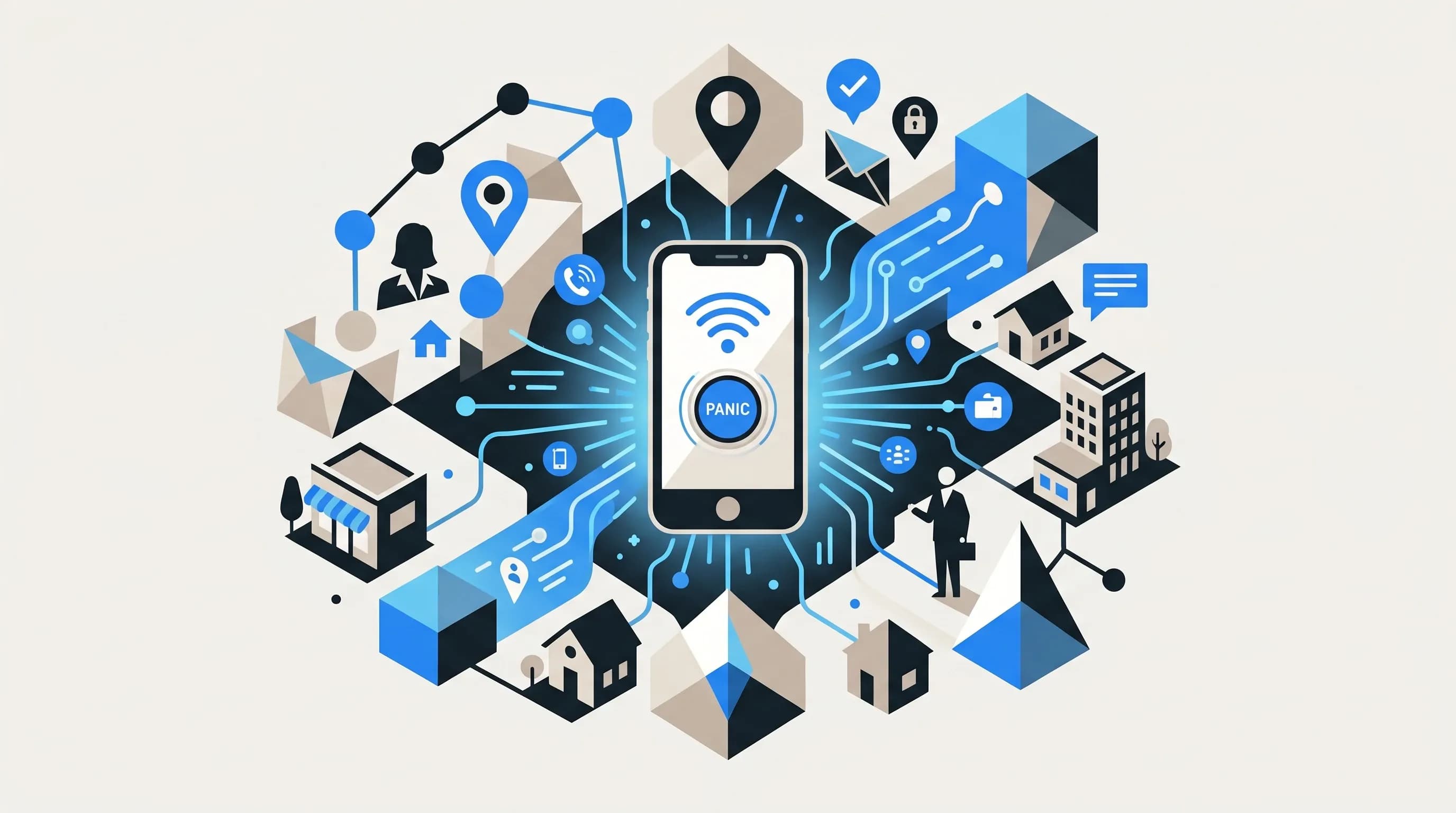
Real estate looks flexible, social, and polished from the outside. We host open houses, tour beautiful properties, meet new clients, negotiate deals, and help people make life-changing decisions. But every experienced real estate professional knows the less glamorous side of the job: we routinely meet strangers alone, enter vacant homes, walk through model houses, visit rural listings, work evenings and weekends, and share public contact information online.
That combination creates real risk. Most appointments are normal and uneventful, but the job gives a bad actor an easy opening. That is why the security technology keeping real estate agents safe has become such an important topic for agents, brokers, teams, builders, and property managers.
Today, real estate agent safety is no longer just about “trust your gut” or “meet at the office first.” Those habits still matter, but modern realtor safety technology adds powerful layers: mobile safety apps, wearable panic buttons, GPS location sharing, automated check-in timers, smartwatch SOS tools, live-streamed tours, visitor screening, background checks, biometric identity verification, portable cameras, property security systems, video surveillance, and cloud-based access control.
The key is using technology the right way. Safety apps and panic buttons are not force fields. They are emergency communication tools. The safest approach is layered: smart technology, better habits, stronger boundaries, brokerage support, and a mindset that says, “We are going home at the end of the day.”
Real estate is one of the few professions where meeting unknown people in private spaces is a routine business activity. We may be alone in a vacant property with a person we have only spoken to by phone. We may sit in a model home for hours waiting for walk-in traffic. We may unlock a fixer-upper, basement, garage, vacant rental unit, luxury listing, or rural property with no one else nearby.
Safety data makes the issue hard to ignore. According to safety information referenced by the National Association of Realtors, roughly 2% of residential real estate agents reported being victims of crimes while working in 2022. With about 1.5 million agents in the United States, that translates to tens of thousands of professionals. NAR’s 2023 Safety Report also found that 46% of real estate professionals had experienced a situation that made them fear for their personal safety.
These are not abstract concerns. Tragic cases involving agents such as Beverly Carter, Michelle Anglin, and Cindy Cranston Jr. changed how many people in the industry think about realtor safety. The details vary, but the pattern is familiar: an agent doing normal work, alone or isolated, in an environment where help was not immediately present.
That is why safety technology for real estate agents is becoming part of the professional toolkit, right alongside CRMs, digital lockboxes, showing platforms, transaction software, e-signature tools, and marketing automation. We use technology to sell homes more efficiently; we should also use it to protect the people doing the work.
Security technology is most useful when we match it to the real-world moments that create vulnerability. For agents, the highest-risk situations are often ordinary tasks that happen every week.
Online leads, social media inquiries, phone calls, cold emails, and sign calls can all turn into appointments. Most prospects are legitimate, but we still may know very little about them before agreeing to meet. A first meeting at a vacant home, especially after dark or in an unfamiliar neighborhood, creates unnecessary risk if we have not verified the client or shared the appointment details.
Vacant property security is a major concern because empty homes can attract trespassers, vandals, thieves, and squatters. For agents, they also create isolation. Rural properties add another layer: weaker cell service, fewer witnesses, longer emergency response times, and more distance between neighbors.
Open house safety is complicated because we intentionally invite strangers into the property. We may be alone while multiple people move through different rooms. The beginning and end of an open house can be especially risky because traffic is lighter and we may be setting up signs, unlocking doors, or closing the property alone.
Model home safety deserves special attention. Agents and sales representatives may be stationed in staged homes for long periods, sometimes separated from other staff. Walk-in visitors may arrive without appointments. That is one reason live-streamed tours and remote monitoring have become more relevant for builders and new-home communities.
We may arrive before photographers, after contractors, or between showings. We may check lights, open blinds, place signs, remove flyers, or prepare a listing for an open house. These quiet “in-between” moments can create risk because no client, colleague, or homeowner is present.
Another overlooked risk is being perceived as the threat. If a homeowner, tenant, neighbor, family member, or contractor forgets about a scheduled showing or appointment, an agent entering the property may be mistaken for someone trespassing. Calendar reminders, showing confirmations, access logs, and visitor management systems can reduce this risk.
Before we talk about apps, panic buttons, and cloud-based access control, we need to say this clearly: technology works best when paired with judgment. No device replaces awareness, preparation, and boundaries.
Some of the most valuable realtor safety tips are still simple, physical habits:
Technology should support these instincts, not silence them. A dangerous thought is, “This feels wrong, but we have a safety app, so we will go anyway.” A better thought is, “This feels wrong, so we will reschedule, bring someone, meet publicly, notify the broker, or leave.”
Mobile safety apps are some of the most practical safety tools for real estate agents because they use the device we already carry: our phone. A good real estate agent safety app can turn a smartphone into a GPS tracker, panic button, check-in system, incident reporting tool, and emergency communication platform.
Common features include:
The biggest benefit is speed. If an agent is in a vacant house, parking lot, rural property, or unfamiliar neighborhood, responders need an exact location. A vague “I need help” may not be enough. GPS safety apps help close the gap between “something is wrong” and “help is on the way.”
We also need to think about real estate schedules. An agent may have six showings, a listing appointment, an inspection, and an open house in one day. If no one knows where we are supposed to be, no one knows when we are missing. That is why shared schedules, mobile safety apps, and GPS location sharing work so well together.
Some safety technology goes beyond basic emergency contact alerts. Platforms such as my-eforce are designed to connect agents and other high-risk workers with professional monitoring support rather than relying only on friends, family, or coworkers.
That matters because personal contacts may be busy, asleep, unavailable, or too far away. In a real emergency, we may need someone trained to receive the alert, evaluate the context, and escalate quickly.
According to presentations around my-eforce, the platform can work through mobile phones and smartwatches and monitor location, health events, critical incidents, hard falls, car accidents, and extreme heart rates. A discreet SOS alert may include the agent’s location, video, audio, and emergency context for the monitoring team.
The goal of professional safety technology is to tell our story when we cannot. If we cannot speak, unlock a phone, explain the situation, or safely call 911, the system should still communicate where we are and what may be happening.
This is a major evolution from a basic panic button. A simple beacon may tell someone, “This person needs help.” A richer emergency response platform can begin to explain the situation with location data, sound, video, and incident context.
A panic button for real estate agents is valuable because emergencies do not always give us time to unlock a phone, open an app, and tap the right screen. Wearable panic buttons and smartwatch SOS tools can be activated quickly and discreetly.
Wearable panic buttons may come as pendants, bracelets, clips, keychain devices, or small accessories. Some pair with a smartphone and send emergency contacts a customized alert with location data. Others connect to monitoring centers or emergency services.
Smartwatches are especially practical because they stay on the body. A phone can be left in the car, dropped, taken, buried in a purse, or placed on a kitchen counter during a showing. A smartwatch stays accessible.
Smartwatch-based safety features may include:
The discreet nature of a smartwatch matters. If a situation feels off, reaching into a bag for a phone may draw attention. Tapping a watch can be less obvious. As part of a layered safety plan, smartwatch monitoring can be one of the easiest tools to use consistently.
One of the most important features in modern real estate safety tools is silent emergency activation. A visible phone call can escalate a threat if the other person notices we are calling for help. Silent alerts reduce that risk.
A silent alert may notify:
The best systems let us customize alert recipients and messages before we need them. For example, an agent might create a message that says: “I need help. This is my current location. Please call 911.” In the moment, the agent may only need one discreet tap or button press.
Still, we should understand the limitation: if danger is seconds away, help may still be minutes away. A panic button is excellent for summoning help, sharing location, and documenting distress. It is not a physical shield. We should never use an SOS tool as an excuse to ignore obvious danger.
GPS location sharing is one of the simplest and most effective safety measures for real estate professionals. We move constantly between appointments, and emergencies do not always happen where the calendar said we would be an hour earlier.
Modern mobile safety apps and wearable devices can share:
Shared calendars add another layer. A Google Calendar, brokerage calendar, CRM task list, or showing platform can include the client’s name, phone number, property address, expected start time, expected end time, and check-in deadline. If a showing was supposed to end at 2:00 p.m. and we have not checked in by 2:15, someone should know to follow up.
Brokerages should create clear privacy rules around GPS tracking. Agents need to know when tracking is active, who can view location data, how long it is stored, and what happens after an alert. Safety technology works best when agents trust the system.
Check-in timers are a practical answer to a common problem: we forget to check in manually. A timer-based safety app lets an agent start a countdown before entering a property or beginning an appointment. If the agent does not confirm they are safe before the timer expires, the system automatically notifies designated contacts.
These tools are ideal for:
Some apps provide a warning before escalating. For example, the app may remind us to confirm safety five minutes before the alert goes out. If we do not respond, our location and appointment information can be sent to emergency contacts, brokerage staff, or a monitoring center.
Open house safety apps and visitor screening systems help create accountability. Open houses are unpredictable because people can walk in without an appointment. Visitor registration tools give us a documented record of who entered the property.
Some platforms allow agents to collect names, phone numbers, emails, and even secure visitor images. SafeShowings is one example of a tool that can record visitor information and use timer-based alerts if the agent does not end the showing as expected. Alerts may include the location, time, and visitor image.
The goal is not to make visitors feel accused. The goal is to establish a professional safety standard. We can explain it simply:
For higher-risk properties, we should also consider working open houses in pairs, notifying neighbors, using portable cameras where appropriate, and avoiding being alone during setup and closing.
Live-streaming is not just a marketing tool. It can also be a real estate safety tool. In model homes, for example, a live-streamed tour can allow a supervisor, colleague, or staff member to watch remotely while an agent guides a visitor through the property.
This creates several safety benefits. First, the agent is no longer completely alone from a visibility standpoint. Second, the presence of live oversight may deter someone with bad intentions. Third, if something happens, the company may have immediate visual information about the incident, the visitor, and the agent’s location.
This is especially relevant for model homes, new construction communities, luxury listings, and vacant properties where agents may spend long periods alone. Live-streaming does not eliminate risk, but it changes the environment. It makes the private more visible, and that alone can improve safety.
Client verification is one of the most important safety steps before a private showing. We should not feel obligated to meet an unknown person alone at a vacant property without basic information.
At minimum, safer client intake can include:
Background check platforms and identity verification tools can help confirm that a prospect is who they claim to be. Some systems, including biometric identity platforms, use camera-enabled devices to verify identity, detect duplicates, reduce fraud, and confirm proof-of-life with anti-spoofing technology.
We do need to be careful. Background checks for clients, digital screening, and identity verification must be handled consistently and in compliance with fair housing laws, privacy rules, brokerage policy, and local regulations. The key is consistency. Safety procedures should apply to everyone, not only to people who “seem off.”
Meeting a new prospect at the office before a showing can be a useful safety layer. It creates a record, gives staff a chance to see the client, and may deter some bad actors. But we should not treat it as a complete safety plan.
There are practical limitations:
Meeting at the office can help, but prevention matters more than post-incident identification. We still need GPS location sharing, check-in timers, client verification, panic buttons, open house safety procedures, and the willingness to reschedule or leave when something feels wrong.
Not every useful safety device is high-tech. A small personal alarm on a keychain can be a smart addition to our showing kit. These devices often look like car remotes and emit a loud sound when activated. They do not require cell service, a charged phone, or an app login. Their purpose is simple: draw attention, startle an attacker, and create a moment to escape.
Door-prop and exit-control devices can also be valuable. A tool such as a high-visibility doorstop-style device can keep a door from closing behind us in a vacant home, basement, garage, or confined area. This matters because preserving an escape route is one of the most basic safety principles.
Some agents also carry pepper spray or mace where legal. If we choose to carry any defensive tool, we need training and practice. We should know how it works, how far it sprays, how wind affects it, how to access it quickly, and whether we are legally allowed to carry it. A safety device buried at the bottom of a purse is not a plan.
Portable cameras and smart home security devices can help protect both agents and properties. A portable motion-activated camera may be useful during staging, pre-listing preparation, vacant property visits, or open houses where additional visibility is needed.
Portable cameras may provide:
We should always consider privacy and consent rules before recording inside a property. Audio and video recording laws vary by jurisdiction, especially in private homes. Brokerages should get legal guidance before making recording-based tools part of an official policy.
Real estate property security matters for sellers, landlords, property managers, and agents. Vacant homes, rental units between tenants, and fixer-upper properties are especially vulnerable because they may lack regular occupants and may already have weak doors, old windows, missing hardware, or signs of vacancy.
A property security system may include:
Wireless security systems are especially useful for real estate because they can be installed temporarily, moved between properties, or left in place as a selling point. A secure property protects value. Theft, vandalism, water damage, fire, or unauthorized entry can delay a sale, reduce buyer confidence, and create liability concerns.
For apartment buildings, commercial properties, mixed-use developments, leasing offices, and managed communities, individual safety tools are not enough. We need building-wide security systems and access control for real estate.
Cloud-based access control allows property managers to control who can enter a building, when they can enter, and which areas they can access. These systems may use:
This matters in busy buildings where residents, delivery drivers, cleaners, contractors, leasing agents, maintenance teams, visitors, and vendors all move through the property. Without access control, unauthorized individuals can enter without attracting attention.
For agents showing units in multifamily or commercial buildings, cloud-based access control and visitor management can make the showing environment safer. For owners and property managers, building security systems can also protect tenants, reduce security breaches, support compliance, and improve perceived property value.
Video surveillance is strongest when it is integrated with access control, visitor management, alarms, and emergency alerts. Cameras at entrances, parking areas, elevators, stairwells, package rooms, leasing offices, fitness centers, shared laundry rooms, and building perimeters can deter crime and document incidents.
Integrated video surveillance helps property managers and brokers:
For real estate professionals, safer buildings mean safer appointments. A property with modern access control, cameras, visitor logs, and remote monitoring reduces uncertainty and makes it harder for unauthorized people to move unnoticed.
| Safety Technology | Best Use | Main Benefit | Important Limitation |
|---|---|---|---|
| Mobile safety apps | Showings, open houses, field appointments | GPS sharing, SOS alerts, check-in timers | Requires phone access, battery, and signal |
| Wearable panic buttons | Private showings, parking lots, vacant homes | Fast, discreet emergency activation | May depend on phone pairing or subscription |
| Smartwatch SOS tools | Daily field work and discreet alerts | Always on the body and easy to activate | Must be charged and configured correctly |
| Professional monitoring | Higher-risk work, solo agents, teams | Trained response when personal contacts are unavailable | May involve monthly cost and policy setup |
| Visitor screening apps | Open houses and walk-in events | Creates accountability and visitor records | Requires a consistent, professional explanation |
| Background checks and identity verification | New leads and private showings | Confirms identity and discourages bad actors | Must comply with privacy and fair housing rules |
| Portable cameras | Vacant homes, staging, model homes | Documents activity and deters misconduct | Recording laws and consent rules vary |
| Cloud-based access control | Multifamily, commercial, managed properties | Controls building entry and visitor access | Requires property-level implementation |
A strong real estate showing safety checklist combines technology and common sense. Before we enter the property, we should already have a plan.
Agent safety should not be left entirely to individual agents. Brokerages, teams, builders, and property management companies should build safety into operations. A brokerage that treats safety seriously sends a clear message: production matters, but people matter more.
Brokerages can support safety by providing:
Brokerages also need an emergency workflow. If an alert goes out, who calls the agent? Who calls 911? Who contacts the broker? Who documents the incident? Who follows up after a false alarm? Without a response plan, alerts can create confusion instead of protection.
The best realtor safety app or device is not always the most advanced one. It is the one we will actually use. If a tool is awkward, confusing, or too slow under stress, it will get skipped.
When evaluating safety tools for real estate agents, we should look at:
The future of real estate agent safety is integration. Instead of separate tools for alerts, check-ins, access control, calendars, lockboxes, and visitor registration, we are moving toward connected safety ecosystems.
Future systems may include:
The goal is not to make agents feel watched. The goal is to create a professional safety infrastructure that protects people, clients, sellers, tenants, and properties.
Real estate agents should not have to live in fear, but we also should not pretend the risks do not exist. Safety is not paranoia. Safety is professionalism.
Using a mobile safety app is professional. Sharing our schedule is professional. Refusing to meet a stranger alone at night in a vacant house is professional. Running a consistent client verification process is professional. Wearing a panic button, activating GPS location sharing, using visitor registration, and asking the brokerage for better safety systems are all professional.
The security technology keeping real estate agents safe is getting better every year: mobile SOS tools, smartwatch monitoring, GPS tracking, live-streamed tours, personal alarms, professionally monitored platforms, background checks, biometric identity verification, portable cameras, real estate security systems, video surveillance, and cloud-based access control all help us work with more protection.
But the core principle remains simple: technology should support our awareness, not replace it. The safest agents are not the ones who rely on one app, one device, one weapon, or one office policy. They are the ones who build layers around themselves: technology, habits, boundaries, training, brokerage support, and mindset.
Show the property. Serve the client. Build the business. And go home safe.

Hey, in Propphy we're determined to make a business grow. My only question is, will it be yours?
It's totally free, with no commitments
Hey, in Propphy we're determined to make a business grow. My only question is, will it be yours?
It's totally free, with no commitments