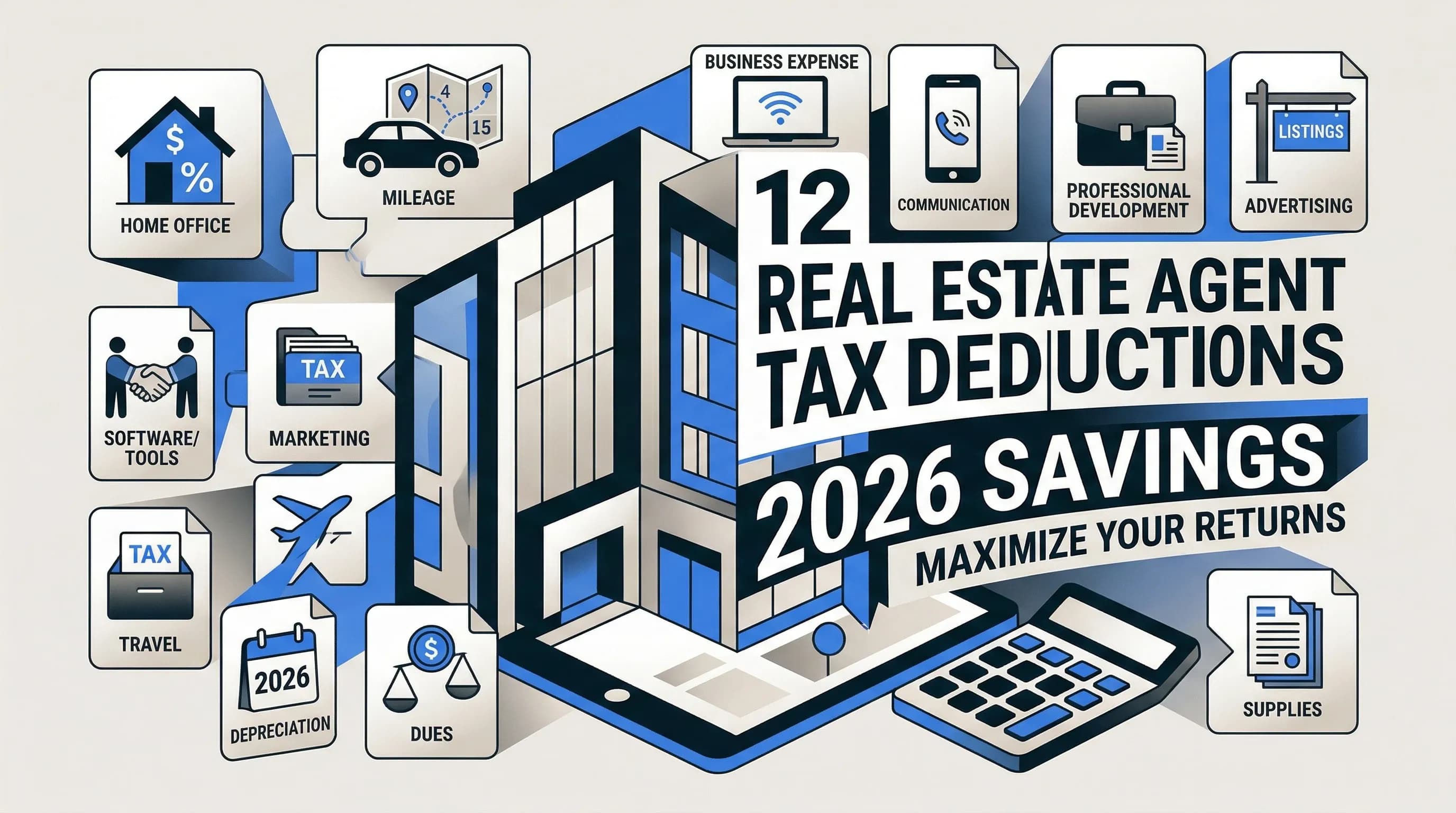
As real estate agents in 2026, we have more legitimate tax write-offs than almost any other small business group—if we treat ourselves like business owners instead of W‑2 employees. The IRS already sees us as self-employed; our job is to understand what we can deduct, how to track it, and how 2026 rules (like a higher SALT cap and 100% bonus depreciation) can dramatically lower our tax bill.
This guide walks through 12 core real estate agent tax deductions you shouldn’t miss in 2026, plus a few structure and planning moves that can easily mean thousands of dollars in extra tax savings. It’s educational, not personal tax advice, so always confirm specifics with a CPA who understands real estate agents.
Most working agents, Realtors, and broker associates are treated as independent contractors, not employees. In IRS language, we’re usually “statutory non‑employees” under IRC §3508.
That means:
In plain English: what matters for taxes is not our gross commissions, it’s our net self‑employment income after write-offs. Every legitimate business deduction we take shrinks that number—and our income and self‑employment taxes along with it.
These are the standard real estate agent tax write-offs most of us pay on autopilot, and they’re 100% deductible when tied to our practice.
On Schedule C, these usually land in categories like “Dues & Subscriptions,” “Insurance,” “Legal & Professional Fees,” or “Rent/Commissions”. In our own books, we’ve learned that going line‑by‑line through 12 months of bank and card statements and tagging every recurring NAR/MLS/broker fee is the only way to make sure nothing slips through the cracks.
Some taxes function as business deductions, others as itemized personal deductions. For real estate agents, the key buckets are:
As of late 2025, the SALT cap was significantly increased to around $40,000 for most taxpayers (about $20,000 if married filing separately), with the benefit phasing out as MAGI exceeds $500,000. In practice, this makes itemizing worth a fresh look for agents in high‑tax states, especially those earning strong commissions, owning homes, and paying substantial state income or property taxes.
We work with our tax pros to decide each year whether itemizing plus the larger SALT cap beats the standard deduction—but note that our Schedule C business deductions sit on top of that decision. We still want every deductible business tax properly captured, regardless of how we handle personal itemized deductions.
Real estate is team‑driven, and many of the payments we make to others are fully deductible business expenses.
These typically go under “Commissions & Fees” or “Contract Labor” on Schedule C. As our own business scaled and we started using more transaction coordinators and VAs, we found that tracking these in a dedicated “Commissions Paid / Contract Services” category made year‑end review a lot easier.
If we pay any non‑employee $600 or more in a calendar year for services or commissions, we generally must:
Good compliance here not only avoids penalties but also guarantees those commission write‑offs are properly documented if the IRS ever asks.
The home office deduction is one of the most powerful—and most misunderstood—real estate tax breaks. Many agents skip it out of audit fear and leave thousands on the table every year.
A home office must be:
A spare bedroom we use strictly for calls, contract work, marketing and admin usually qualifies. The end of the dining table where the kids do homework at night does not.
The IRS generally expects us to have one principal office. If we’re claiming our home office as that principal place of business, we still can usually deduct reasonable desk fees at the brokerage as additional rent. But we want our narrative and documentation to be consistent: where do we primarily do our admin work, scheduling, marketing, and file management?
In our own books, we measure and document our home workspace (photos, square footage) and make sure our usage pattern clearly supports the home office claim before layering on big brokerage desk fees.
Simplified method
Regular (actual expense) method
We often run both methods with our CPA. For many agents, especially in higher‑cost housing markets, the actual expense method delivers a significantly larger deduction.
Even if we don’t formally claim the home office, we can generally deduct the business portion of:
We use a reasonable percentage based on usage (for example, 70% business) and keep notes backing up that estimate. Running these bills through a dedicated business account helps tremendously at tax time.
Everything that runs our real estate office—whether at home, in a brokerage, or hybrid—can create tax savings if it’s ordinary and necessary.
For 2026, we’re in a particularly favorable environment for equipment write-offs thanks to 100% bonus depreciation and generous Section 179 rules on many types of business property:
Traditionally, these would be depreciated over 5–7 years, but in 2026 we can often write off 100% of the cost in the year we place the asset in service, provided business use and income levels support it. For example, dropping $4,000 on a new video kit and editing computer to level up our marketing can translate to a $4,000 deduction in 2026 instead of being spread across several years.
Most real estate tech tools are treated as simple, fully deductible expenses:
We like to group these in a “Technology & Software” category in our bookkeeping so we can instantly see the total and avoid under‑reporting this fast‑growing cost center.
Many independent contractor agents pay for a dedicated workspace outside of home, which creates a clear, straightforward Schedule C write-off.
We record these as “Rent – Office” or equivalent. The key is consistent tracking—brokerages love to bundle tech, mentoring, and office access into one monthly fee, so we look at those statements carefully and book them as office rent when that’s primarily what they provide.
If our brokerage office is our clear, primary office for admin and management, we coordinate with our tax advisor before also taking a significant home office deduction; the story needs to make sense if the IRS ever reads it.
For many full‑time Realtors, vehicle expenses are the single largest tax deduction. Our car is basically our mobile office—showings, listing appointments, inspections, appraisals, closings, and networking events all generate legitimate business miles.
For 2026, the IRS standard mileage rate is set at 72.5 cents per business mile (IRS Notice 2026‑10). That rate already bakes in gas, wear and tear, and most operating costs.
What doesn’t count:
Standard mileage method
Actual expense method
Under current 2026 rules, certain vehicles with a GVWR above 6,000 lbs used more than 50% for business (large SUVs, trucks) can qualify for 100% bonus depreciation or large Section 179 deductions. It’s not unusual to see first‑year write-offs of tens of thousands of dollars if the numbers pencil out and business use is well documented.
We treat this strategy carefully. The IRS scrutinizes it, and dropping below 50% business use later can trigger depreciation recapture. When we consider a heavy vehicle, we make sure our mileage logs and usage pattern would stand up in an audit before counting on the deduction.
The IRS expects contemporaneous mileage logs. That can be as simple as a mileage app that tracks trips automatically, or a written log noting:
Trying to recreate a mileage log from memory in March for the prior year is a recipe for losing the deduction if we’re audited. We treat mileage logging as non‑negotiable, because the payoff is so big.
As independent contractors, we pay both the “employee” and “employer” halves of Social Security and Medicare via self‑employment tax. The combined rate is generally 15.3% on net self‑employment income up to the Social Security wage base, then 2.9% Medicare plus any additional Medicare surtax on high incomes.
We can deduct 50% of our self‑employment tax as an “adjustment to income” on Schedule 1 (Form 1040). This:
Example: if our SE tax is $14,000, we’ll usually see a $7,000 deduction appear automatically when we complete Schedule SE and transfer the result to Form 1040. It’s easy to miss conceptually because software handles it in the background, but it’s a legitimate tax benefit that softens the blow of being self‑employed.
Marketing is the lifeblood of our pipeline, and almost all of it is a fully deductible real estate agent write-off in 2026.
We categorize these as “Advertising & Promotion”. In our own practice, we’ve noticed that when we deliberately track every sign, mailer, and boosted post, the tax savings effectively discount our marketing spend by our marginal tax rate—often 20–30% or more.
Two massive categories many agents under‑deduct are professional services and education/training. Both are central to staying sharp and scaling a modern real estate business.
Deductible professional fees typically include:
We ask our tax pro to break out business vs. personal fees on invoices so we can defend the business portion in our records.
Once we’re licensed, virtually everything we spend to maintain or improve our skills in real estate is deductible:
If we travel primarily for business education, we usually can also deduct:
A common pattern we use: align a major conference late in the year, then combine the trip with other planned deductions (equipment purchases, coaching payments, etc.) to create a focused year‑end tax strategy.
Relationship‑building is the engine behind referrals and repeat business. The IRS allows deductions here, but the rules are narrow, especially for gifts.
Under current federal rules, the deduction for business gifts is capped at $25 per recipient per year.
That said, some items can be more clearly treated as promotional/advertising instead of gifts, especially if they’re broadly branded, low‑value, and widely distributed (think branded cutting boards, door mats, or toolkits). We work with our CPA on the right treatment here and keep documentation of intent and branding.
For 2026, most business meals are back to being 50% deductible. That includes:
To support these realtor tax deductions, we record on each receipt or in our bookkeeping app:
Pure entertainment (sporting events, concerts) is generally not deductible under current rules, even if we invite clients, unless it’s part of a specific, well‑documented promotional event.
Two of the most powerful tax benefits for self‑employed real estate professionals aren’t on Schedule C at all—yet they can easily dwarf many of our day‑to‑day real estate agent write-offs.
If we’re not eligible for an employer‑sponsored health plan (through us or a spouse), we may be able to deduct up to 100% of our health insurance premiums as an “above‑the‑line” deduction on Form 1040, limited by our net self‑employment income.
Potentially deductible premiums include:
This is separate from itemized deductions and can significantly lower our taxable income, especially as premiums continue to rise.
Agent income is perfect for self‑employed retirement plans, which may allow large, tax‑deductible contributions:
In practice, pairing a Solo 401(k) with our Schedule C deductions can let us move a very large percentage of our real estate profit into tax‑deferred retirement in 2026, especially if we start planning early in the year instead of scrambling in March.
The “big 12” real estate agent tax deductions cover most day‑to‑day expenses. But 2026 also offers some high‑impact strategies that can radically reduce our taxable income when we’re ready for them.
As agents, we’re uniquely positioned to benefit from rental property depreciation, especially if we qualify as a Real Estate Professional (REP) under the tax code.
On a typical rental, we deduct:
Those deductions often produce a paper loss even when the property is cash‑flow positive. For most investors, those are passive losses that can’t offset their W‑2 income or active business income.
But if we:
we may qualify as a Real Estate Professional. With proper grouping and documentation, that can allow rental losses (boosted by 100% bonus depreciation and cost segregation on certain components) to offset our active commission income in 2026. This is advanced planning territory, but for agents building rental portfolios, it’s one of the most powerful tax strategies available.
Smaller, easily forgotten deductions include:
Separating business and personal banking is crucial here. In our own systems, once we moved to truly dedicated business accounts and cards, it became much easier to capture every bank fee and interest expense as a deductible cost of doing business.
On top of deductions, some agents also qualify for general business tax credits (Form 3800) when they hire staff, provide health coverage, or invest in energy‑efficient improvements or EVs used in business. These credits reduce tax dollar for dollar, but they’re complex enough that we always coordinate them with a tax professional.
At some income level, the question stops being “What can I deduct?” and becomes “How should my business be structured?” For many agents netting $70,000+ per year consistently, an LLC taxed as an S‑corporation can be a major lever for reducing self‑employment tax.
As a sole proprietor, all of our net income is subject to SE tax. With an S‑Corp, we:
We still get to claim all the same real estate agent tax deductions we’ve covered—vehicle, home office, marketing, tech, retirement contributions, etc.—but the way net income flows through can significantly lower our overall SE tax bill when done correctly.
Across the board, we see agents making the same avoidable errors that lead to overpaying or getting burned in an audit:
In our own practice, the switch that changed everything was treating tax planning as a year‑round process: tracking expenses as they happen, logging miles daily, and checking in with a real‑estate‑savvy CPA before making big moves like vehicle purchases, rental acquisitions, or S‑Corp elections.
All the tax savings in the world don’t matter if we can’t prove our deductions. Here’s a practical record‑keeping system that works in the real world of open houses and contract deadlines:
Our goal isn’t perfection; it’s consistency. If we can answer, “What did I spend on vehicle, marketing, tech, and education this year?” with a few clicks, we’re already ahead of most agents—and our tax bills will show it.
In 2026, a well‑organized, forward‑thinking real estate agent can typically deduct at least these 12 categories:
Layer onto that the right entity structure, smart use of 100% bonus depreciation, the bigger 2026 SALT cap, and (for some) Real Estate Professional status on rentals, and it’s entirely possible to keep tens of thousands of dollars more of our commission income each year—without ever bending the rules.
If you have a sense of your 2026 income, how much you drive, and whether you use a home office or own rentals, you can take these categories to a CPA who specializes in real estate and have them build a custom checklist and tax plan. That way, every mile you drive, every coaching dollar you spend, and every camera or laptop you buy is working double duty: growing your business today and shrinking your tax bill tomorrow.

Hey, in Propphy we're determined to make a business grow. My only question is, will it be yours?
It's totally free, with no commitments
Hey, in Propphy we're determined to make a business grow. My only question is, will it be yours?
It's totally free, with no commitments