Real estate agent. Realtor. Broker. People toss these words around like they all mean the same thing, but they don’t—and when we’re talking about the largest purchase or sale most people ever make, those differences matter.
All Realtors are licensed real estate professionals, but not all real estate agents are Realtors. On top of that, brokers sit one rung higher on the licensing ladder and control the brokerage itself.
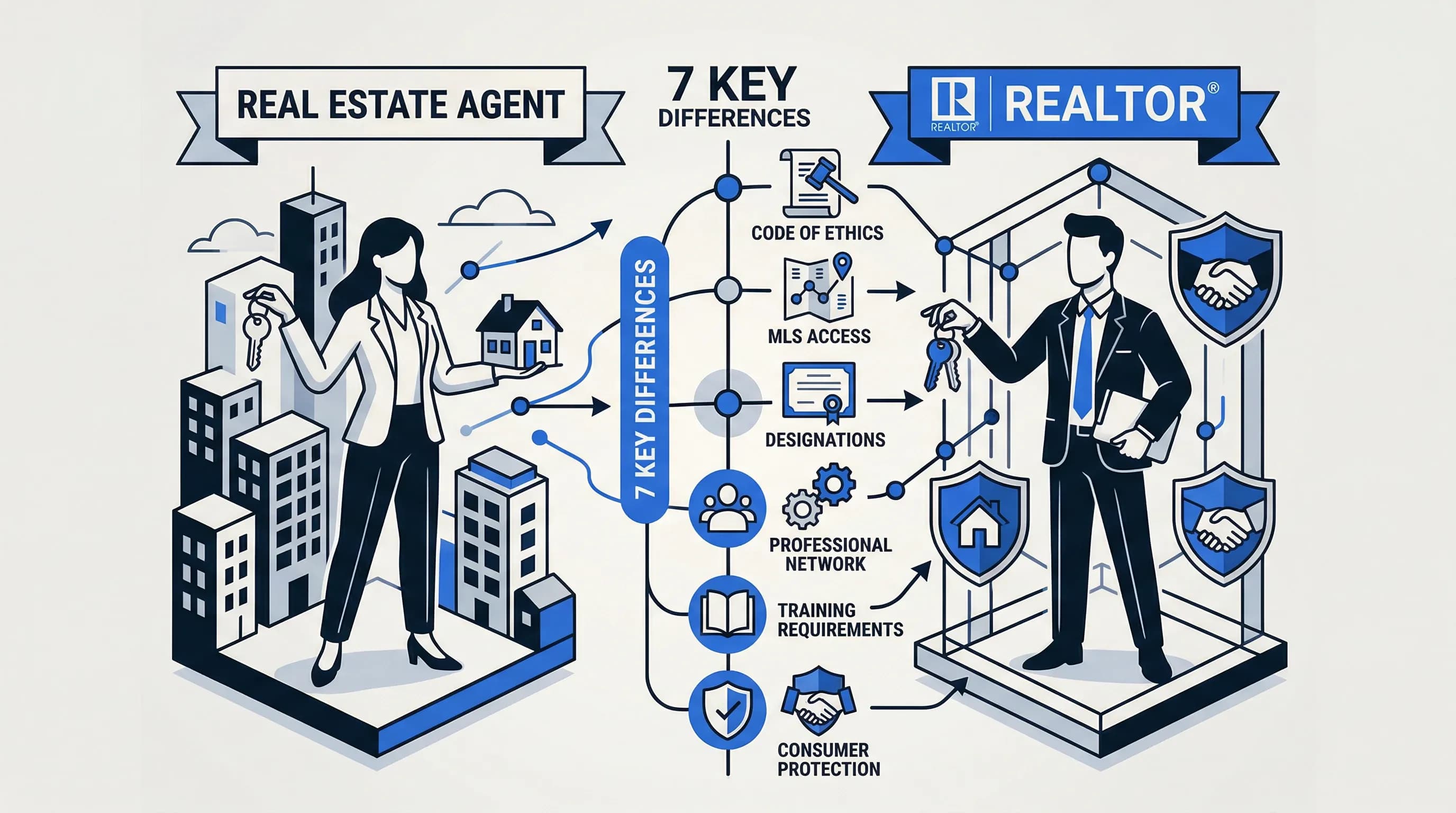
In this guide, we walk through what each role really is, where they overlap, and the 7 key differences between a real estate agent and a Realtor that matter for both consumers and anyone considering a real estate career.
Realtor vs. Real Estate Agent: Fast Overview
- Real estate agent (salesperson, sales associate): state-licensed professional who must work under a broker and can represent buyers and sellers.
- Realtor: a licensed agent or broker who is also a dues-paying member of the National Association of REALTORS® (NAR) and bound to its Code of Ethics.
- Broker: more advanced license; can run a brokerage, supervise agents, and work independently.
So when we compare “real estate agent vs Realtor,” we’re really comparing an ordinary licensee with a licensee who has added a layer of membership, ethics, tools, and accountability on top of that license.
What Is a Real Estate Agent?
A real estate agent—also called a real estate sales agent, salesperson, or sales associate depending on the state—is a person who:
- Has completed state-required pre-licensing education
- Passed a state real estate licensing exam
- Holds an active state-issued real estate license
- Is legally allowed to represent buyers or sellers in real estate transactions
- Must work under a licensed broker’s supervision and cannot operate independently
When most people say “my real estate agent,” they mean this entry-level, state-licensed professional working under a brokerage.
What does a real estate agent do day to day?
Licensed real estate agents typically:
- List homes for sale as a listing agent (seller’s agent)
- Represent buyers as a buyer’s agent
- Show and compare properties, host open houses
- Draft and explain offers, purchase agreements, and addenda (within state law)
- Coordinate inspections, appraisals, title work, and closing
- Negotiate price and contract terms on behalf of their clients
- Stay on top of local market trends, inventory, and pricing data
They’re usually the first point of contact for consumers in a real estate transaction, but they operate under the legal umbrella of their employing broker.
What Is a Realtor®?
A Realtor® is not a different license type. It’s a membership designation.
More precisely, a Realtor is:
- A licensed real estate agent or broker who
- Has joined the National Association of REALTORS® (NAR) via a local Realtor association
- Pays annual NAR, state, and local dues
- Agrees to and is bound by the Realtor Code of Ethics
- Is legally allowed to use the trademarked title “Realtor®”
Every Realtor is a real estate licensee. Not every real estate licensee is a Realtor. It’s a bit like the Kleenex vs. tissue situation: the public often uses “Realtor” generically, but technically it means a NAR member who has taken on extra ethical and financial commitments.
What Is a Real Estate Broker? (Quick Context)
Because “Realtor vs real estate agent vs broker” all blur together for most people, it helps to understand where a broker fits in.
A real estate broker is also a licensed real estate professional, but with:
- More education and coursework than agents
- A stricter or more advanced broker licensing exam
- Often 2–4+ years of experience as an agent first (varies by state)
Depending on the state, brokers may be:
- Independent brokers: can open a brokerage, work under their own name, and sponsor agents
- Managing / principal brokers: legally responsible for everything that happens under the brokerage
- Associate brokers: hold a broker license but still choose to work under another broker
A broker can do everything a real estate agent can do—and more. An agent cannot do everything a broker can do, such as run an independent brokerage or supervise other agents.
Real Estate Agent vs. Realtor: 7 Key Differences Compared
Now that we’ve separated license from membership, we can line up the 7 key differences between a standard licensed real estate agent and a Realtor.
1. Professional Status: License vs. Membership
The first big distinction is what actually defines the role.
Real estate agent (non‑Realtor):
- Legal status: State-licensed salesperson or real estate representative
- Defined by: Passing a state licensing exam and holding an active license
- Must work under: A licensed broker
Realtor®:
- Status: Membership designation and trademarked title on top of a license
- Defined by: Being a NAR member with a valid real estate license
- Can be: A real estate agent, real estate broker, property manager, appraiser, or other licensed real estate professional
When someone calls themselves a Realtor, it means they’re both licensed by their state and a member of the National Association of REALTORS®. A real estate agent who is not a Realtor is still fully licensed—but operates without that association membership and trademarked branding.
2. Accountability, Oversight & Supervision
This is where “agent vs broker vs Realtor” can confuse people, because oversight comes from two different places: licensing and membership.
Real estate agent (non‑Realtor):
- Must work under a broker’s supervision in every U.S. state
- Broker is responsible for:
- Reviewing contracts and disclosures
- Ensuring compliance with state real estate law
- Setting brokerage policies, risk management, and training
- Accountable to:
- Their state real estate commission or licensing board
- Their employing broker
- State and federal
Realtor®:
- Still follows the same license-based hierarchy:
- A Realtor-agent must still work under a broker.
- A Realtor-broker can work independently, own a brokerage, and supervise agents.
- Additional accountability to:
- The National Association of REALTORS®
- Their state and local Realtor associations
- The Realtor Code of Ethics
If a Realtor violates that code, they can face internal discipline—fines, mandated training, suspension, or even expulsion from NAR, which means losing the right to use the Realtor name and, in many markets, losing direct access to key tools.
Why it matters: Being a Realtor does not magically turn an agent into a broker or change who they work under. It adds another layer of oversight on top of the state regulatory structure.
3. Education & Licensing vs. Membership Requirements
Consumers and aspiring agents often ask whether a Realtor has “more schooling” than a real estate agent. The answer is nuanced.
How to become a real estate agent
While exact details vary by state, the steps to becoming a licensed real estate sales agent usually look like this:
- Meet basic eligibility requirements
- Be at least 18 or 19 years old (depending on state)
- Hold a high school diploma or equivalent
- Pass a background check
- Complete pre-licensing education
- Typically 60–150 hours of approved coursework
- Common topics include:
- Real estate law and agency relationships
- Contracts, disclosures, and contingencies
- Financing, mortgages, and loan types
- Real estate appraisal and valuation basics
- Property ownership, taxes, transfers, and deeds
- Fair housing and anti-discrimination laws
- Pass the state licensing exam
- Usually a mix of:
- National content (general real estate principles)
- State-specific law (local practice rules and regulations)
- Apply for your license & affiliate with a broker
- Submit fingerprints, applications, and fees to your state regulator
- Choose a sponsoring broker to activate your license
- Complete post-licensing or continuing education (CE)
- States require CE to keep your license active
- Topics often include:
- Legal updates
- Ethics
- Contracts and risk management
How to become a Realtor
Becoming a Realtor is a separate step from becoming licensed:
- First become a licensed real estate professional (agent or broker).
- Join a local Realtor association, which also connects you to your state association and NAR.
- Pay annual dues (local, state, and national).
- Complete required ethics training on a recurring schedule.
- Agree in writing to abide by the NAR Code of Ethics.
There is no separate “Realtor exam” beyond what’s required to hold your existing real estate license. The Realtor track is primarily about ethics, membership, and access to tools, not extra licensing content.
4. Ethics, Professional Standards & Complaint Processes
This is one of the most substantive differences between a real estate agent and a Realtor.
Real estate agent (non‑Realtor) must comply with:
- State real estate laws and regulations
- General contract and consumer protection laws
- Brokerage policies and supervision
If something goes wrong, enforcement usually comes from:
- The state real estate commission (investigations, fines, license suspension or revocation)
- Civil courts (lawsuits for damages)
Realtor® must comply with all of the above plus the NAR Code of Ethics, which emphasizes:
- Fiduciary duty—putting clients’ interests above their own
- Honesty and truthfulness in advertising and communications
- Full disclosure and transparency in conflicts of interest
- Fair treatment of all parties in a transaction
- Cooperation with other brokers when it benefits clients
On top of state-level enforcement, a Realtor is subject to:
- Ethics complaints filed with their local Realtor association
- Association hearings and discipline if violations are found
- Potential suspension or termination of NAR membership
Why it matters for consumers: If you work with a Realtor and feel they’ve been dishonest, self-dealing, or in violation of professional standards, you have an additional complaint channel, with a written Code of Ethics to point to—not just general law.
Why it matters for professionals: Becoming a Realtor is a public way of saying, “We’re holding ourselves to more than just the bare minimum required by law,” which can be a powerful trust and branding tool.
In practical, day-to-day real estate work, the difference between a real estate agent and a Realtor often shows up in access to tools, data, and networks.
Access to the Multiple Listing Service (MLS)
The Multiple Listing Service (MLS) is the core database where agents and brokers list properties and see everything for sale or recently sold in a given region. It’s the backbone of professional real estate practice.
Real estate agent (non‑Realtor):
- In many areas, the local Realtor association owns or operates the MLS.
- Non‑Realtor licensees may:
- Get indirect MLS access through a Realtor-broker or office agreement
- Have more limited access depending on local board rules
Realtor®:
- As a dues-paying member of the local Realtor association, typically has:
- Full, direct MLS access
- Ability to list homes, run detailed searches, and track status changes in real time
- Standardized forms, contracts, and disclosures
- Often receives:
- Market statistics and trend reports
- Legal hotlines or risk reduction resources
- Discounts on real estate technology tools
Additional resources and networks
Regardless of title, an agent typically gets access to their brokerage’s systems: CRM, marketing templates, training, and compliance support.
Realtors layer on top of that:
- NAR publications and research on housing and market trends
- Continuing education opportunities and designations/certifications
- A broad network of local and national colleagues for referrals and collaboration
- Advocacy from NAR on property rights and industry regulations
Over the last few years, as online platforms have surfaced more MLS-derived data to the public, consumers can see more listings on their own. That’s pushed the real value of both agents and Realtors toward negotiation, analysis, and transaction management rather than pure “gatekeeping” of listings.
6. Cost to Practice, Commissions & Earning Potential
From the practitioner’s side, there are cost and income differences. From the consumer’s side, there are common myths about whether a Realtor costs more than an ordinary agent.
Costs for real estate agents vs Realtors
Real estate agent (non‑Realtor) typically pays for:
- Pre-licensing courses: around $100–$500
- State exam fee: about $50–$100
- License application and fingerprinting: roughly $200–$400
- Brokerage costs:
- Desk/office fees (could be $0–$200+/month or more)
- Commission splits (commonly 50/50, 70/30, 80/20, etc.)
- Optional marketing and tech:
- Signs, photography, websites, lockboxes
- Paid leads (Zillow, PPC, etc.)
Realtor® pays all of the above plus:
- NAR national dues
- State Realtor association dues
- Local Realtor board dues
- MLS fees (often billed through the local board)
In many markets, combined Realtor and MLS dues run in the range of $700–$1,200 per year, paid whether you close a deal or not. For new or part-time agents, that overhead can be the difference between staying in the business or not.
How both real estate agents and Realtors get paid
For consumers, the bigger question is: Who pays the commission, and does using a Realtor cost more than using an agent?
- Both real estate agents and Realtors are usually paid by commission, as a percentage of the sale price.
- Commissions are typically split between the listing brokerage and the buyer’s brokerage, then split again between the brokerage and the individual professionals according to their agreements.
- Compensation structures are changing in many markets after recent NAR lawsuits and commission settlements:
- There’s more focus on transparency around what each agent/Realtor charges.
- In some areas, buyers may now be asked to agree in writing to pay their agent’s fee directly, instead of it being automatically covered on the seller’s side.
Important: A Realtor does not automatically cost more than a non‑Realtor agent. Commission rates and service models are negotiated between the client and the professional/brokerage, and both titles live inside the same evolving fee environment.
Income potential: real estate agent vs Realtor
Income for all licensed real estate professionals is highly variable and performance-based.
- Recent government and market data put the median annual wage for real estate sales agents around $54,000+.
- The top 10% of agents and brokers can earn well over $119,000 per year, with many in high-priced markets easily surpassing that.
- Glassdoor and similar sites often show Realtors in the U.S. reporting median total pay in the low-to-mid six figures—but that reflects:
- Higher producers
- Industry mix (agents plus brokers)
- Markets with higher home prices
Realtors don’t earn more because they’re Realtors. They may earn more on average because the people most serious about a long-term real estate career path are more likely to join NAR and plug into its tools, training, and networks.
Job outlook
The U.S. Bureau of Labor Statistics projects jobs for real estate agents and brokers to grow by about 3% through 2032—modest but positive. Local market conditions matter enormously: an agent in a high-price market like New York or San Francisco can earn more per transaction than one in a lower-price market, even with the same commission rate and effort.
7. Practical Impact on Buyers & Sellers: Trust, Branding & Service
In practice, how does “real estate agent vs Realtor” affect you as a consumer trying to decide who to hire? That comes down to branding, trust, and individual quality.
Branding & public perception
Real estate agent:
- Title is typically “real estate agent,” “salesperson,” “licensee,” or “sales associate.”
- Branding rests largely on:
- Their brokerage’s reputation
- Their own reviews, referrals, and track record
Realtor®:
- Can legally market themselves as a “Realtor®” and use the NAR logo.
- Benefit from consumer perception that “Realtor” equals “real professional.”
- Signal that they:
- Are licensed
- Have committed to a formal Code of Ethics
- Likely have access to a full suite of MLS and association tools
Public awareness of the NAR Code of Ethics and recent commission lawsuits has also made more buyers and sellers pay attention to ethical standards and transparency in real estate representation.
What actually matters more than the title
Whether you’re interviewing a Realtor or a non‑Realtor agent, we recommend focusing on these questions:
- Are they licensed in your state?
- Verify on your state real estate commission website.
- Do they have full, current MLS access?
- Ask how they search for properties and track new listings and price changes.
- Who is their broker and what support exists behind them?
- How long has that brokerage been in business?
- Is there strong oversight, training, and risk management?
- How do they communicate?
- Do they explain contracts and market data clearly?
- Do they return calls and messages promptly?
- Do they listen to your priorities instead of just pushing you to act?
- How transparent are they about fees and conflicts of interest?
- Can they walk you through exactly how they’re compensated under the new commission structures?
- Will they disclose when a deal benefits them more than you?
- What do past clients say?
- Ask for reviews, testimonials, or references for similar transactions.
If you like the added comfort of a formal ethics framework and an extra complaint mechanism, choosing a Realtor offers that. But the individual’s competence, integrity, and fit with your needs matter more than the label alone.
Agent vs Broker vs Realtor: Side-by-Side Comparison
| Feature |
Real Estate Agent |
Real Estate Broker |
Realtor® |
| Legal status |
State-licensed sales agent |
State-licensed broker (advanced license) |
Licensed agent or broker plus NAR member |
| NAR membership |
Optional; many are not members |
Optional; many brokers choose to join |
Required – that’s what defines a Realtor |
| Independence |
Must work under a broker’s supervision |
Can work independently and own/manage a brokerage |
Depends on underlying license (agent vs broker) |
| Can supervise agents? |
No |
Yes – responsible for agents they sponsor |
Only if they are a Realtor-broker |
| Ethical requirements |
State law + broker policies |
State law + broker policies |
State law + broker policies + NAR Code of Ethics |
| Title usage |
“Real estate agent” / “salesperson” / “licensee” |
“Broker,” “managing broker,” “associate broker,” etc. |
Can legally use the Realtor® trademark |
| Typical role |
Day-to-day client work: showings, offers, contracts, negotiations |
Complex deals, risk management, training, plus client work |
Same as underlying license, with heightened ethical and membership obligations |
| Access to MLS & tools |
Via brokerage; sometimes limited if non‑member in certain areas |
Usually full brokerage-level access |
Typically full MLS plus association resources and training |
Skills Both Real Estate Agents and Realtors Need
No matter which title appears on the business card, successful real estate professionals share a similar core skill set:
- Communication skills – explaining contracts, deadlines, contingencies, and market trends in plain language
- Negotiation – crafting offers and counteroffers, handling inspection issues, and pushing for favorable terms
- Market analysis – interpreting local pricing data, days on market, absorption rates, and comparable sales
- Problem-solving – keeping deals together through appraisal gaps, title issues, financing challenges, and repair negotiations
- Business and marketing skills – generating clients, marketing listings effectively, managing a pipeline
- Technology skills – using the MLS, CRMs, e-signature tools, online advertising, and even AI-driven tools for analysis and communication
- People skills and emotional intelligence – guiding buyers and sellers through an emotionally and financially high-stakes process
Realtor membership can structure and reinforce these skills through ongoing education and ethics training, but in practice, the biggest differentiator is how seriously each individual professional takes their development.
Realtor vs Real Estate Agent: Which Should You Choose as a Consumer?
When you’re buying or selling a home, you don’t just want a generic “real estate professional”—you want someone who will defend your interests, communicate clearly, and deliver results.
When it may make sense to choose a Realtor
We’d generally lean toward working with a Realtor when:
- You value a formal, enforceable Code of Ethics.
- You want access to a professional complaint process beyond the state commission if something goes wrong.
- You like the idea that your agent is plugged into a wider network of professionals and ongoing training.
- You want added assurance about:
- Fiduciary duty (putting your interests first)
- Honesty in advertising and property information
- Transparency around conflicts of interest and compensation
When a non‑Realtor real estate agent can still be a great choice
At the same time, plenty of excellent practitioners choose not to join NAR. You may be perfectly well-served by a non‑Realtor agent when:
- They have strong local experience with your specific property type and price point.
- They come highly recommended by people you trust (friends, family, other professionals).
- They clearly explain:
- Who they represent (you vs the other party vs both as a dual agent, where allowed)
- How they are compensated under current commission practices
- What services they will and won’t provide
- You’re comfortable relying on:
- State licensing protections
- Broker oversight and the brokerage’s reputation
How to interview a real estate professional (Realtor or agent)
To make a smart choice, we recommend asking:
- How long have you been licensed, and how many transactions did you close last year?
- Do you primarily represent buyers, sellers, or both in my price range and area?
- Can you walk me through the buying/selling process step by step?
- How do you communicate and how often will I hear from you?
- What’s your strategy for pricing, marketing, negotiations, or winning in multiple-offer situations?
- What are your fees, and who pays them under the current rules in our market?
- Are you a Realtor, and if so, how do you apply the Code of Ethics in your day-to-day work?
Whether you end up choosing a Realtor or a non‑Realtor licensed agent, the answers to those questions will tell you far more about their ability to protect your interests than the job title alone.
Thinking About a Career: Should You Become a Realtor or Just a Real Estate Agent?
If you’re on the other side of this question—trying to decide between a real estate career path as an agent vs Realtor vs broker—here’s how we’d break it down.
Step 1: Start as a licensed real estate agent
Regardless of whether you eventually join NAR or become a broker, your path almost always begins with an entry-level real estate sales agent license:
- Complete pre-licensing education.
- Pass the state real estate licensing exam.
- Affiliate with a sponsoring broker.
- Begin building experience with buyers and sellers.
Step 2: Decide whether to join NAR and become a Realtor
For most full-time residential agents, especially those relying on MLS listings, we see becoming a Realtor as the default, practical choice because it unlocks:
- Smoother, more complete MLS access in many markets
- Standardized contracts and forms
- Legal hotlines and risk management resources
- Reputation benefits and a trust signal to the public
- Ongoing education, designations, and networking
Some agents intentionally stay non‑Realtors because:
- They work mainly in off-MLS niches (e.g., certain investments, apartment locating, or new-construction-only models).
- They’re part-time and want to keep fixed overhead lower while they test the waters.
- Their business model doesn’t rely on association tools and branding.
Step 3: Consider advancing to broker over time
After a few years and enough closed transactions, many agents look at becoming a real estate broker:
- You complete broker-level coursework and pass a broker exam.
- You can open your own brokerage, sponsor agents, and keep a larger share of commission revenue.
- You take on more legal responsibility for compliance and risk management.
At that point, you can be a Realtor-broker, combining advanced licensing with NAR membership and its Code of Ethics, which is where a significant part of the industry’s leadership and training infrastructure sits.
FAQs: Realtor vs Real Estate Agent
Is a Realtor more expensive than a real estate agent?
Not inherently. Both real estate agents and Realtors typically work on commission, and those commissions are negotiable. A Realtor doesn’t automatically charge more; their fee is based on their brokerage’s policies, your agreement, and local market norms—not just the Realtor designation.
Do I really need a Realtor to buy a house?
You’re not legally required to use a Realtor or any real estate professional to buy a home, but it’s usually risky to navigate contracts, inspections, disclosures, and negotiations on your own. Whether you hire a Realtor or a licensed non‑Realtor agent, having a skilled representative usually saves money, time, and stress.
Do I need a real estate agent to sell my home?
You can sell “for sale by owner” (FSBO), but most sellers benefit from working with a licensed real estate professional who can price accurately, market widely (often via the MLS), negotiate strongly, and manage the transaction details. Here, again, the more important question than Realtor vs agent is: How experienced and effective is this particular person?
What’s the difference between a real estate broker and a Realtor?
A broker is a license level—someone who can run a brokerage and supervise agents. A Realtor is a NAR member with a Code of Ethics, and can be either an agent or a broker. So you can have:
- Non‑Realtor brokers
- Realtor-brokers
- Non‑Realtor agents
- Realtor-agents
Bottom Line: Real Estate Agent vs. Realtor
To wrap it all up:
- Real estate agent = entry-level, state-licensed professional who must work under a broker and can represent buyers and sellers.
- Realtor® = licensed agent or broker who has joined NAR, pays dues, and follows the Realtor Code of Ethics. It’s a membership and ethical designation, not a separate license.
- Broker = higher license level that allows more independence, responsibility, and the ability to manage a brokerage and supervise agents.
The 7 key differences between a real estate agent and a Realtor come down to:
- License vs membership (legal status)
- Accountability and oversight (state regulators and brokers vs NAR plus local boards)
- Education and entry requirements (licensing vs ethics/membership)
- Ethical and professional standards (law alone vs law plus a formal Code of Ethics)
- Access to tools, MLS, and networks
- Cost to practice and earnings context
- Branding, trust, and real-world consumer impact
For consumers, understanding these distinctions helps you choose the right professional to represent you and ask sharper questions about experience, ethics, and fees. For aspiring professionals, it clarifies how to start as an agent, decide on Realtor membership, and eventually move up to broker if that fits your long-term goals.