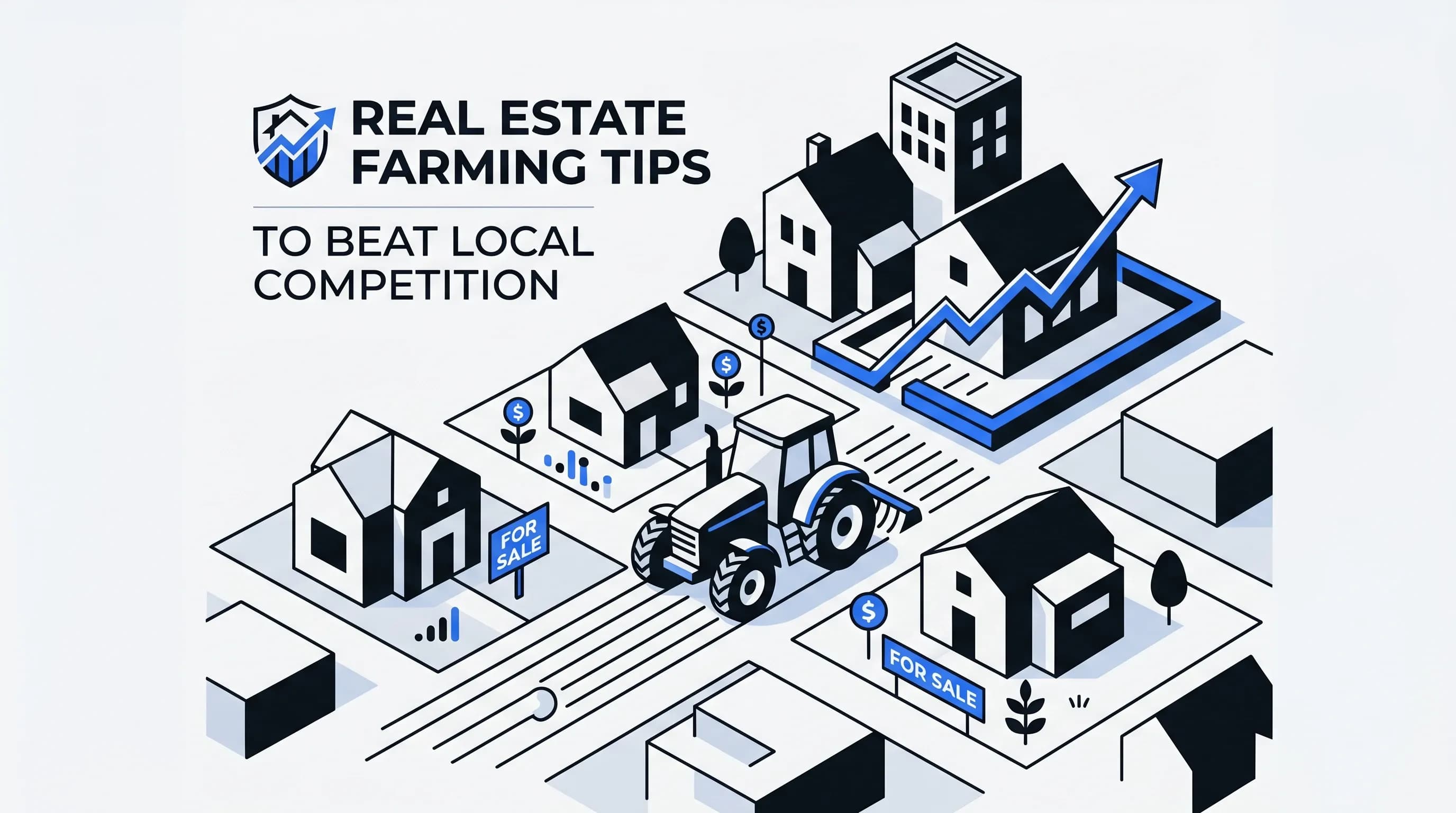
If we want to stop chasing scattered leads and start building a dependable pipeline of listings, referrals, and repeat business, real estate farming is still one of the smartest ways to do it. In a competitive market, the agents who win are rarely the ones who shout the loudest. They are the ones who become the most visible, most useful, and most trusted in a specific neighborhood, subdivision, condo building, or local niche.
That is why real estate farming still works so well for agents and Realtors who want to grow market share. But there is a catch: most farming fails because it is treated like random marketing instead of a long-term system. If we rely on a few generic postcards, talk too much about ourselves, and quit before momentum compounds, we will not become the go-to agent in our farm area.
To outshine the competition, we need a layered real estate farming strategy built on targeted marketing, local relevance, community engagement, smart follow-up, and consistent visibility online and offline. That is how we build brand recognition, trusted relationships, and better conversion rates over time.
Real estate farming is a targeted marketing and prospecting strategy where we focus on a defined group instead of trying to market to everyone. That group can be a geographic area, such as a neighborhood or school district, or a demographic segment, such as downsizers, luxury sellers, or first-time buyers.
In simple terms, we choose a “plot,” plant marketing seeds, nurture relationships, and eventually harvest listings, referrals, and repeat business. The real goal is not just lead generation. The real goal is to become the local expert, neighborhood authority, and top-of-mind real estate professional when someone in that area is ready to buy or sell.
Good real estate farming is not just sending postcards. It combines direct mail, local SEO, a neighborhood web presence, email marketing, community involvement, open houses, social media, market reports, and CRM-driven follow-up. When all of those pieces support each other, we stop looking like just another agent and start looking like the recognized neighborhood expert.
Large teams and national brands may have bigger budgets, but smaller agencies and solo agents can still dominate a local market through hyperlocal marketing. A homeowner may ignore a broad digital ad, but they pay attention when they repeatedly see useful market updates, open house signs, neighborhood event invitations, and local content from the same trusted agent.
Real estate farming works because it lets us be more:
It also helps us answer the biggest question modern homeowners ask: why should they use an agent at all? With DIY platforms, online estimates, and FSBO options, our value has to be obvious. Farming gives us the structure to show that value repeatedly through local pricing expertise, stronger marketing, better service, neighborhood knowledge, and visible proof of activity.
Geographic farming means we focus on a clearly defined physical area, such as:
Demographic farming means we focus on a type of client across a broader market, such as:
For many real estate agents, geographic farming is the best place to start because the boundaries are easier to define, direct mail is more efficient, neighborhood branding is stronger, and local authority develops faster. That said, the best farm area is the one that fits our ideal client, price point, and service strengths. We do not want to pick an impressive-looking market that does not match the conversations we naturally handle well.
Choosing a farm area is not just a branding decision. It is a business decision. A weak farm can drain budget and time for months. A smart farm area creates a realistic path to listings and long-term dominance.
Before we farm a neighborhood, we need to know if people are actually moving there. Turnover rate helps us measure that.
Formula: annual home sales ÷ total homes x 100 = turnover rate
Example:
As a general benchmark, many agents look for at least 5% turnover, with 6% to 10% often being a very practical range. Some higher-priced neighborhoods can still be workable with lower turnover, even around 2.5% to 3%, because commissions are larger. The key is to make sure the math supports the effort.
Turnover alone is not enough. We also want to understand inventory movement, buyer demand, and whether the area has enough transaction activity to support a long-term farming campaign. A neighborhood where owners stay forever may sound attractive, but it can starve our pipeline.
Look at the last 12 months of sold listings and see who is taking the listings. If one agent already controls 20%, 30%, or 40% of the market share, we need to be realistic. Breaking into that farm is possible, but it will require more budget, more touches, stronger differentiation, and more patience.
Often, the better opportunity is the adjacent area where no single dominant local agent has fully claimed the neighborhood presence.
One of the most common real estate farming mistakes is starting too big. A farm of 2,000 or 5,000 homes sounds exciting, but if we cannot sustain direct mail, newsletters, follow-up, digital ads, community touches, and local content for 12 to 24 months, it is too large.
For many agents, a practical starting farm size is:
That size makes it easier to maintain a monthly mailer, targeted digital ads, neighborhood market reports, and personal follow-up. We have also seen that depth often beats width. A smaller farm worked intensely can outperform a much larger area touched lightly.
The strongest farm areas usually have built-in identity. Think major roads, school zones, lakes, parks, neighborhood entrances, or condo towers with recognized names. When residents already identify with a distinct community, it is easier for us to position ourselves as the neighborhood expert.
We should choose a farm that aligns with the kind of clients we want to serve. Many agents do best near the market average or slightly above-average price point, then expand later. We should not force ourselves into a luxury market just because it sounds appealing if our strengths, network, and service model fit another segment better.
The biggest difference between average farming and dominant farming is mindset. We cannot think like lead chasers. We have to think like local market owners.
That means prioritizing:
Most agents do not lose because farming does not work. They lose because they are generic, inconsistent, and impatient. The agents who stand out are the ones who create more trust, visibility, and repeated value than everyone else in the same target neighborhood.
Even if our strategy is mail-heavy, homeowners will still verify us online before they call. If they receive our real estate postcard and then search our name, what they find has to support our positioning as the local authority.
At minimum, we should have:
Bonus assets include neighborhood guides, local video content, blog posts about the area, school and park highlights, and monthly market recap pages. People do not call blind anymore. They check first. If our digital presence is weak, our offline marketing loses power at the exact moment it needs validation.
A generic agent website is not enough if we want serious geographic farming results. We should build a neighborhood page, landing page, or even a mini local brand around the farm area.
That page can include:
We can also use community-centered branding like Living in Oak Ridge, The Oak Ridge Home Report, or Downtown Condo Guide. That kind of micro-branding feels more local and less generic, which helps us stand out in a crowded market.
A Google Business Profile is one of the best digital farming tools available. It helps us appear when homeowners search for agents nearby and reinforces our neighborhood relevance.
To optimize it, we should:
This supports local SEO and improves visibility when residents search for terms like “best real estate agent in [neighborhood]” or “home values in [area].”
Direct mail is still one of the core real estate farming strategies, but only when it is part of a larger system. Generic postcards that scream “Thinking of selling?” do little to build trust. Homeowners see those constantly.
The better approach is to send farm mail that feels relevant and timely. Useful direct mail ideas include:
A strong real estate farming campaign often starts gently. We introduce ourselves, explain that we share local updates, and deliver real value before making a stronger seller prompt. That sequence builds familiarity first, which usually performs better than pushing hard too early.
Personalization matters. We should use the neighborhood name, recognizable entrances, familiar landmarks, and relevant references residents instantly recognize. QR codes can also work well, but only if they lead somewhere useful, such as a neighborhood video, local market report, or community Facebook group instead of a generic homepage.
If we want one of the most versatile real estate farming ideas, a neighborhood newsletter is hard to beat. It can exist in print, email, or both, and it ties together many of our other farming tactics.
A strong community newsletter can include:
The key is to make it a community newsletter, not a dull self-promotional real estate newsletter. When the content says, “We watch this neighborhood, care about it, and keep you informed,” our brand recognition grows naturally.
One of the fastest ways to establish local authority is to become the pricing expert in the farm. Homeowners care about one thing constantly: what their home is worth and what nearby homes are actually selling for.
That means we should regularly share:
We should also use CMAs and home valuation tools proactively. Instead of saving pricing knowledge only for listing appointments, we can turn it into marketing:
Specificity beats generality every time. “The market is changing” is weak. “Three homes sold in our subdivision this month at 99.1% of asking price with an average of 12 days on market” is memorable and credible.
The best farmers do not just market to an area. They become part of the area’s information flow. That is a huge difference.
Great content ideas for a farm area include:
When our content feels like “we live here, watch this area, and care about what happens here,” we build a much stronger standout presence than if every post just says “list with me.”
A neighborhood Facebook group or local brand page can be a smart differentiator in digital real estate farming. It gives us a place to be useful consistently, not just promotional occasionally.
Good content for a neighborhood group or page includes:
The goal is to become the connector. Connectors get trust, and trusted local agents get business. If we create a group, it should not be a nonstop stream of just listed and just sold posts. It should feel like a useful community hub.
One of the smartest shifts in modern farming is moving from anonymous exposure to permission-based follow-up. Instead of just blasting our name out, we want people to raise their hand.
Good opt-in offers include:
Once a homeowner opts in, we have a warmer relationship, contact details, and a better reason to continue the conversation. That is a major advantage over old-school farming that relies only on repeated impressions.
The most effective real estate farming plans are layered. We should never depend on one tactic alone.
A strong strategy stack can include:
When someone receives our postcard, sees our sign, watches our neighborhood video, joins our email list, and meets us at a school event, we become much more memorable. That layered visibility is what helps us outshine the competition.
Door knocking is still effective in many markets, especially when it feels helpful instead of scripted. The key is to show up with context and value, not a pushy sales pitch.
Good reasons to knock include:
We should focus our efforts around activity zones, such as active listings, pendings, and recent sales, because that makes the conversation more relevant. The goal is not to force an appointment at the doorstep. It is to become recognizable, informed, and easy to remember.
Not every agent wants to build a farm through aggressive prospecting, and that is fine. Relationship-based and content-based agents can still build a dominant neighborhood presence through:
We do not need to copy someone else’s personality. We do need to be consistent. Farming rewards repeated value far more than forced style.
Open houses are not just for finding buyers. They are also one of the best ways to strengthen neighborhood prospecting and build local visibility.
Before the open house, we can:
During the open house, we can collect contact information, talk to neighbors about pricing and demand, and identify who may be considering a future move. Afterward, we can send a recap to the area and use the event as another trust-building touchpoint.
If we do not have our own listings yet, holding open houses for other agents is still a smart way to increase visibility in the farm area.
One clever shortcut for newer agents is to market listings in the farm even if they are not our own. With permission from another agent, we can help promote the property, attract buyers, and create visibility for ourselves in the area.
This works especially well when we position it around local exposure and support. Over time, repeated connection to neighborhood inventory helps residents see us as active in the area, even before we have our own local listings.
A good farm makes it easier to identify opportunities before they become obvious to everyone else. We should watch for:
Because we already know the local market, our outreach can be more relevant and informed than a random cold call from outside the area. We can speak specifically about buyer demand, neighborhood pricing, and what local sellers need to do to gain an edge.
The strongest real estate farming ideas go beyond promotion. They position us as community ambassadors.
That can mean:
When people feel that we genuinely contribute to the neighborhood, they stop seeing us as just another real estate marketer. They start seeing us as part of the local identity.
Interviewing local business owners and community leaders is one of the best low-pressure farming strategies available. We can feature:
This gives us original content, builds trusted relationships, increases our visibility through shared audiences, and shows that we are plugged into the local market beyond just transactions.
Hosting or sponsoring neighborhood events is one of the best ways to build goodwill and brand recognition. We do not need to overcomplicate it. Even simple events can make a strong impact.
Ideas include:
The best event strategy is to choose something that fits both our personality and the culture of the neighborhood. Authenticity matters. Forced events rarely build the same trust as genuine involvement.
Our own neighborhood is often the most natural farm area available. If we live there, we already have familiarity, story, context, and repeated opportunities for visibility. But simply living there is not enough.
We still need to be:
Even details like pride of ownership can matter. Fair or not, people often connect how we care for our own home with how we may care for their listing and their transaction.
Email remains one of the highest-ROI tools in real estate marketing. Once we collect emails through open houses, events, valuation offers, or website forms, we should use them consistently.
Useful emails include:
These emails do not need to be long. Short, useful, and regular usually performs best.
Modern farming should be powered by systems. A CRM helps us keep every touchpoint organized and prevent lead leakage. Without one, even strong visibility can turn into weak follow-up.
A CRM can help us:
We can also use predictive analytics, local market tools, and targeted digital ads to identify likely sellers, retarget neighborhood page visitors, and support our offline touches with online visibility.
We should treat our farm like a lab. Test, measure, refine, repeat.
Agents who improve their farming results are usually the ones willing to test messaging, adjust offers, and keep refining instead of simply “sending something and hoping.”
Real estate farming usually takes longer than agents want, but it often works better than they expect once momentum builds. A realistic expectation is a 12-month minimum commitment, with a 24-month mindset if we want real neighborhood dominance.
The timeline can improve when we add more layers, such as face-to-face conversations, email follow-up, local video, and opt-in offers. But even then, farming is not passive and it is not instant. It rewards the agents willing to do the unglamorous work consistently after others disappear.
There is no single magic tactic. The real advantage comes from disciplined consistency.
The agents who dominate a real estate farm area usually do a few things very well:
Most competitors are not impossible to beat. Most are simply inconsistent, generic, or impatient. If we become the agent who is informed, visible, community-minded, digitally credible, and relentlessly useful, we gain a real competitive edge.
Real estate farming is still one of the clearest ways to become the go-to agent in a target neighborhood. It helps us move from random prospecting to a repeatable, defensible business model built on trust, visibility, and local authority.
If we want to outshine the competition, we should focus on becoming the most relevant professional in a specific market. That means choosing the right farm area, using layered marketing, staying active in the community, publishing local data, building a strong digital presence, and committing long enough for the results to compound.
In the end, the agents who win at geographic farming are not usually the flashiest. They are the ones who stay present the longest, understand the neighborhood the best, and serve it most consistently.

Hey, in Propphy we're determined to make a business grow. My only question is, will it be yours?
It's totally free, with no commitments
Hey, in Propphy we're determined to make a business grow. My only question is, will it be yours?
It's totally free, with no commitments