The secret behind a high-converting real estate marketing funnel is not a magic ad, a prettier website, a clever CRM, or a 17-email automation sequence. Those tools help, but they are not the real engine.
The real secret is this: we stop trying to sell property to everyone immediately, and we start guiding the right people through the right journey with the right message at the right time.
That is where most real estate agents, brokers, developers, and teams get stuck. Many campaigns say some version of “Buy now,” “Call for inspection,” “Limited units available,” “Land for sale,” or “DM me if interested.” Those messages are not wrong. They are just often shown to the wrong person at the wrong stage.
A first-time buyer who is still afraid of documentation problems does not need the same message as an investor comparing rental yield. A homeowner casually checking values does not need the same message as a seller who wants a listing appointment this week. A relocation buyer does not need the same nurturing sequence as a luxury buyer waiting for an exclusive opportunity.
That is why a real estate marketing funnel converts: it does not treat every lead the same. It understands where the person is in the buyer journey or seller journey, then moves them forward one step at a time.
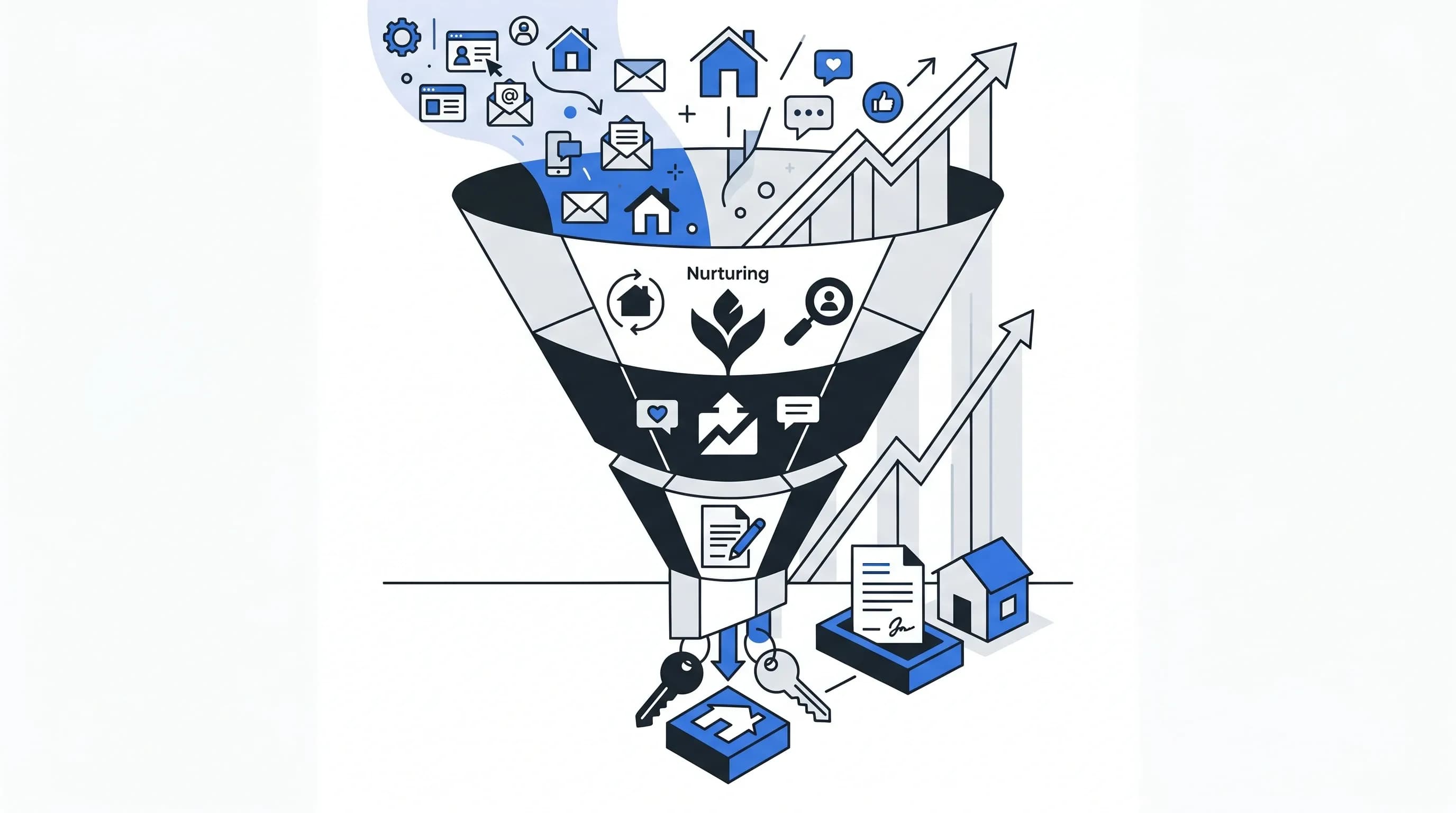
A real estate marketing funnel is a structured system for attracting, capturing, nurturing, qualifying, and converting real estate leads into clients. It is also called a real estate sales funnel, real estate lead funnel, real estate lead generation funnel, realtor marketing funnel, or real estate conversion funnel.
The funnel works because many people enter at the top, but only the most qualified, motivated, and ready prospects move toward the bottom. At the top, someone may discover us through a Google search, Instagram reel, Facebook ad, YouTube video, neighborhood guide, Just Listed campaign, or referral. In the middle, they begin engaging with our content, opening emails, asking questions, comparing properties, browsing listings, or watching property videos. At the bottom, they request a showing, book an appraisal, schedule a consultation, reserve a property, submit buyer information, or sign a listing agreement.
A strong real estate funnel usually includes these stages:
In simpler terms, a high-converting real estate funnel turns strangers into leads, leads into conversations, conversations into clients, and clients into referrals.
Without a funnel, real estate marketing becomes random. We post when we remember. We run paid ads without knowing which campaigns generate qualified leads. We collect inquiries in WhatsApp, Instagram DMs, email inboxes, spreadsheets, and CRMs, then lose track of who asked about what. We call a lead once, hear “I’ll get back to you,” and then assume they were not serious.
But in real estate, “not ready today” does not mean “not valuable.” A buyer may browse for six months before acting. A homeowner may think about selling long before requesting a home valuation. A diaspora buyer may need repeated reassurance about documentation, allocation, inspection, and buyer protection. An investor may need market reports, rental yield comparisons, and infrastructure updates before committing.
A real estate marketing funnel matters because it helps us:
Real estate is a relationship business, but relationships are built through repeated relevant touchpoints. A funnel gives us a system for creating those touchpoints consistently.
The biggest mistake in real estate lead generation is treating every prospect like they are ready to buy, sell, inspect, or sign today.
A cold lead who downloads a first-time buyer guide does not need aggressive closing language. A warm lead who compares two neighborhoods needs proof, pricing context, location education, and social proof. A hot lead who asks for the current price list needs speed, clarity, a direct call, and a frictionless next step.
When we meet a cold prospect and immediately push for paperwork, inspection, or payment, it can feel like walking up to a stranger and saying, “Hi, let’s get married tomorrow.” Too much, too soon.
A high-converting real estate funnel respects the stage of the prospect. It matches:
That is why messaging is more important than the funnel tool. We can have the best real estate CRM, landing page builder, automation platform, AI assistant, email software, and retargeting setup, but if the message is weak or irrelevant, the funnel will not convert.
Before we build a real estate funnel strategy, we need to understand the three major categories of leads: cold, warm, and hot. This is the foundation of a successful real estate lead generation funnel.
Cold leads are early-stage prospects. They may be thinking, “One day we want to buy land,” “Maybe we should stop renting,” “Should we invest before prices rise?” or “Maybe we should sell and move somewhere better.” They are interested, but they may not know their budget, location, financing options, documentation requirements, or timeline yet.
These prospects often ask broad questions:
Cold leads need education, reassurance, and trust. They respond well to awareness content such as beginner guides, scam-prevention checklists, neighborhood education, documentation walkthroughs, market updates, and “mistakes to avoid” posts.
Warm leads are actively comparing options. They may have clarity around budget, location, property type, timeline, financing, family needs, or investment goals. They are no longer just dreaming; they are evaluating.
Their questions are more specific:
Warm leads need comparison content, testimonials, case studies, property videos, development updates, buyer stories, listing alerts, market reports, ROI explanations, and clear answers to objections.
Hot leads are ready to act. They may already know the property, price range, location, and timeline. They are asking about the deal itself.
Hot lead questions often sound like:
Hot leads need direct response, proof, urgency, pricing clarity, availability, booking links, documentation details, and human follow-up. This is where speed matters. If someone requests a showing, consultation, appraisal, or price list, we should not wait days to respond.
A complete real estate digital marketing funnel moves prospects from awareness to action without making them feel pressured. The best funnels feel useful, timely, and personal.
Awareness is the top of the funnel. This is where people first discover us through search, ads, social media, referrals, direct mail, open houses, local events, videos, signs, or neighborhood content.
Common awareness channels include:
At this stage, we should not only post property flyers. Flyers can work for warm and hot leads, but cold prospects need educational and curiosity-driven content. Examples include:
Attention is not enough. A person can watch our video, click our ad, visit our website, and disappear forever. Lead capture turns anonymous traffic into known prospects.
Lead capture happens through:
The goal is to collect enough contact details to continue the conversation without creating too much friction. Depending on the offer, we may ask for name, email, phone number, preferred location, budget range, property address, timeline, or buyer/seller status.
Lead nurturing is where most real estate money is won or lost. Many prospects will not convert immediately. They need time to compare, think, discuss with family, arrange financing, overcome fear, or wait for the right opportunity.
A nurturing system may include:
The key is relevance. If someone downloaded a diaspora buyer guide, we should send content about safe remote purchase, documentation, video inspections, power of attorney, buyer protection, and allocation updates. If someone requested a home valuation, we should send seller preparation tips, local comparable sales, pricing strategy, and a clear invitation to book a property review.
At the conversion stage, we turn trust into action. The prospect has shown intent, so the next step must be obvious and easy.
Bottom-of-funnel offers include:
At this point, confusion kills conversion. We need clear pricing, clear availability, clear documentation, clear process, clear proof, and a clear CTA.
Many prospects leave without converting. Real estate retargeting ads help bring them back. We can retarget website visitors, listing viewers, landing page visitors, video watchers, email subscribers, CRM audiences, and people who clicked ads but did not inquire.
The funnel should also continue after the transaction. A closed client can become a repeat buyer, referral source, testimonial, case study, and long-term advocate. Post-closing nurturing may include thank-you messages, review requests, home anniversary emails, equity updates, market reports, development updates, buyer appreciation events, and referral reminders.
Top-of-funnel lead generation is not about chasing people who are ready to sign today. It is about becoming visible before the prospect chooses an agent, brokerage, developer, or property.
Some of the best real estate lead generation strategies include:
The mistake is running traffic to a weak offer. Instead of sending everyone to a flyer or generic homepage, we can send traffic to a buyer guide, seller checklist, property review page, home valuation page, investment report, or inspection booking page.
A real estate lead magnet is a valuable resource we offer in exchange for contact information. It is one of the most effective ways to capture real estate leads because it gives prospects a reason to raise their hand.
| Audience | Lead Magnet Ideas | Best Next Step |
|---|---|---|
| First-time buyers | Buyer roadmap, mortgage preparation checklist, closing cost guide, inspection checklist | Buyer consultation or listing alerts |
| Sellers | Home valuation report, seller checklist, staging guide, pricing strategy guide | Home value review or listing appointment |
| Investors | Rental yield report, appreciation forecast, investment location guide, ROI calculator | Investment strategy call |
| Relocation buyers | Relocation guide, neighborhood comparison, school-zone guide, moving checklist | Relocation consultation |
| Diaspora or remote buyers | Safe purchase guide, documentation checklist, video inspection guide, buyer protection checklist | Remote buyer consultation |
| Homeowners | Quarterly market report, equity update, renovation vs. sell guide | Property review or seller nurture sequence |
For example, “Download our free checklist: 10 things to verify before buying land in [Location]” is usually stronger than “Call us if interested.” The first offer gives value and attracts people with a real concern. The second assumes they are already ready.
A real estate landing page is a focused page built around one conversion goal. It may be designed to generate seller leads, capture buyer inquiries, promote a specific listing, offer a market report, book inspections, or drive consultation requests.
A high-converting real estate landing page should include:
For a property-specific landing page, we can include title, location, price, payment options, infrastructure, nearby amenities, investment potential, inspection details, and a CTA such as “Request Price List,” “Book Inspection,” or “Speak With an Advisor.” This educates and qualifies the lead before we ever speak with them.
Real estate email marketing, SMS, and WhatsApp follow-up work best when they feel personal, not robotic. Automation can send the message, but the message should still sound like we understand the person’s situation.
A basic real estate drip campaign can look like this:
A strong follow-up question can be simple:
“Are you actively planning to buy or sell soon, or are you mainly researching for the future?”
That one question helps us qualify the lead without pressure. It also tells us whether they belong in a cold, warm, or hot sequence.
A marketing funnel for real estate agents should separate buyer leads and seller leads because they care about different things.
A buyer lead funnel should help prospects understand location, affordability, financing, property options, inspection process, offer strategy, documentation, and next steps.
Buyer nurture content may include:
A seller lead funnel should help homeowners understand pricing, preparation, market timing, valuation, staging, buyer demand, marketing strategy, negotiation, and net proceeds.
Seller nurture content may include:
If we send the same generic newsletter to every lead, we lose relevance. If we segment by buyer, seller, investor, location, budget, property type, and timeline, our follow-up feels like service instead of spam.
A real estate CRM is the backbone of the funnel. It stores lead data, tracks engagement, triggers follow-ups, assigns tasks, and helps us see where each prospect stands in the pipeline.
A well-organized CRM should track:
One of the most important rules is simple: every inquiry must be captured. If someone contacts us on WhatsApp, Instagram, Facebook, a website form, landing page, open house sheet, or paid ad, their information should not disappear inside a chat list.
If we cannot tell how many leads came in, where they came from, what they asked about, how many booked appointments, how many converted, and how many need follow-up, then we do not really have a funnel. We have random activity.
Lead scoring helps us identify which prospects deserve immediate personal outreach. Not every lead should receive the same level of attention at the same time.
A lead may become warmer when they:
Once a lead shows high intent, automation should alert us to follow up personally. The highest-converting real estate funnels combine automation with human connection.
Real estate retargeting ads, also called remarketing ads, help us bring prospects back after they leave our website, landing page, listing page, video, or social profile.
Retargeting works because the audience already knows us. They are not completely cold. They may have visited a property page, downloaded a guide, clicked an ad, watched a neighborhood video, or started a form without completing it.
Retargeting audiences can include:
Effective retargeting ad ideas include:
Urgency can work, but it must be real. Fake scarcity destroys trust. Specific urgency, such as a documented price increase, allocation deadline, limited inspection window, or promo expiration, is much stronger than shouting “last chance” every week.
Templates make a real estate funnel easier to build. We can customize these based on our market, property type, team structure, and audience.
Here is a simple sequence for a lead who downloaded a buyer checklist:
| Timing | Message Type | Goal |
|---|---|---|
| Immediately | Email: Deliver checklist | Fulfill the promise and create trust |
| 5 minutes later | SMS or WhatsApp: Confirm delivery | Start a conversation |
| Day 2 | Email: Common buyer mistakes | Educate and reduce fear |
| Day 4 | Email: Testimonial or buyer story | Build proof |
| Day 7 | Email: Neighborhood or property comparison | Help the lead evaluate options |
| Day 10 | SMS: Ask about timeline | Qualify readiness |
| Day 14 | Email: Consultation or inspection invitation | Move to conversion |
A strong SMS can be short and personal:
“Hi [Name], we saw you downloaded the buyer checklist for [Location]. Are you actively looking now, or are you researching for later?”
That message does not pressure the lead. It opens the door.
If we cannot track it, we cannot scale it. A real estate funnel should be measured continuously, not guessed.
Important awareness metrics include:
Important lead capture metrics include:
Important nurturing metrics include:
Important conversion metrics include:
Our best benchmark is our own previous performance. Instead of only comparing ourselves to large brokerages or celebrity agents, we should ask, “What did we generate last month, and how can we improve this month?”
The best real estate funnel platform depends on whether we are a solo agent, team, brokerage, developer, investor-focused agent, listing specialist, buyer agent, or hyperlocal farming expert. The tool should support the strategy, not complicate it.
| Tool Category | What It Helps With | What to Look For |
|---|---|---|
| Real estate website platform | SEO, listings, neighborhood pages, lead capture | Fast pages, mobile design, IDX or MLS integration, strong CTAs |
| Landing page builder | Campaign-specific pages | Templates, forms, A/B testing, CRM integration |
| Real estate CRM | Lead tracking, pipeline management, follow-up tasks | Tags, automation, lead scoring, segmentation, reporting |
| Email marketing software | Drip campaigns and newsletters | Automation, personalization, analytics, list segmentation |
| SMS or WhatsApp automation | Fast follow-up and reminders | Consent management, personalization, CRM sync |
| Ad platforms | Traffic, retargeting, lead generation | Audience control, conversion tracking, creative testing |
| Analytics tools | Performance tracking | UTM tracking, source attribution, conversion reporting |
| Automation connectors | Moving data between tools | Reliable integrations, form triggers, CRM updates |
For teams and brokerages, we should also consider agent-specific landing pages, lead routing, hidden form fields, UTM parameters, agent reporting, and brand consistency across templates.
Even a well-funded real estate funnel can fail if the strategy is wrong. Here are the mistakes we should avoid.
Not everyone is hot. Cold leads need education. Warm leads need comparison and proof. Hot leads need speed and clarity. If we use the same message for all three, conversion rates drop.
Property flyers can be useful, but they are not a full-funnel strategy. We also need educational content, buyer guides, seller resources, testimonials, market insights, case studies, videos, and follow-up.
If inquiries stay buried in DMs, chats, notebooks, or inboxes, we leak money. Every lead should enter a CRM, spreadsheet, or organized follow-up system.
Every page and content piece should tell prospects what to do next. Examples include “Download the guide,” “Book inspection,” “Request price list,” “Get your home valuation,” “Schedule a consultation,” or “Join the buyer list.”
Do not send the same message to a luxury buyer, first-time buyer, seller, investor, relocation client, and past client. Segmentation improves relevance and trust.
Real urgency works. Fake urgency damages credibility. If there is a real price increase, limited allocation, deadline, or promo window, explain it clearly and specifically.
If we do not measure traffic, leads, appointments, conversion rates, and closed deals, we cannot optimize the funnel.
Here is a practical seller funnel from start to finish:
That is a real estate marketing funnel. It is structured, relevant, timely, measurable, and human.
A real estate marketing funnel is a system for attracting prospects, capturing their contact details, nurturing them with relevant content, and converting them into clients through appointments, showings, valuations, consultations, or transactions.
A high-converting real estate funnel matches the message to the prospect’s stage. It uses strong lead magnets, clear landing pages, fast follow-up, CRM segmentation, email and SMS nurturing, retargeting ads, social proof, and clear conversion offers.
Yes, if we want a scalable funnel. A real estate CRM helps us capture lead source, contact details, budget, timeline, property interest, engagement, follow-up tasks, and pipeline stage.
The best lead magnet depends on the audience. Sellers respond well to home valuations, seller checklists, and market reports. Buyers respond well to first-time buyer guides, listing alerts, inspection checklists, and neighborhood comparisons. Investors respond well to ROI reports and rental yield guides.
A short sequence can run 7 to 14 days, but long-term nurturing should continue monthly or quarterly. Many real estate leads convert months after the first inquiry, so consistent follow-up is essential.
Yes, if we nurture them properly. Top-of-funnel leads are only weak when we treat them like bottom-of-funnel leads. If we educate early-stage prospects and stay visible, we can become the trusted choice when they are ready.
The secret behind a high-converting real estate marketing funnel is not the software, the ad platform, the landing page design, or the automation. Those are parts of the machine, but they are not the strategy.
The real secret is understanding the customer journey. Some prospects are dreaming. Some are researching. Some are comparing. Some are ready to act. Some have already bought and can refer others.
Our job is to meet each person where they are and guide them to the next step. When our website, landing pages, lead magnets, CRM, email marketing, SMS follow-up, retargeting ads, calls, testimonials, local SEO, and tracking all work together, our funnel becomes a 24/7 client acquisition system.
In real estate, the highest-converting funnel is not the one that shouts the loudest. It is the one that builds the most trust, follows up intelligently, and stays present until the buyer or seller is ready.
Hey, in Propphy we're determined to make a business grow. My only question is, will it be yours?
It's totally free, with no commitments
Hey, in Propphy we're determined to make a business grow. My only question is, will it be yours?
It's totally free, with no commitments