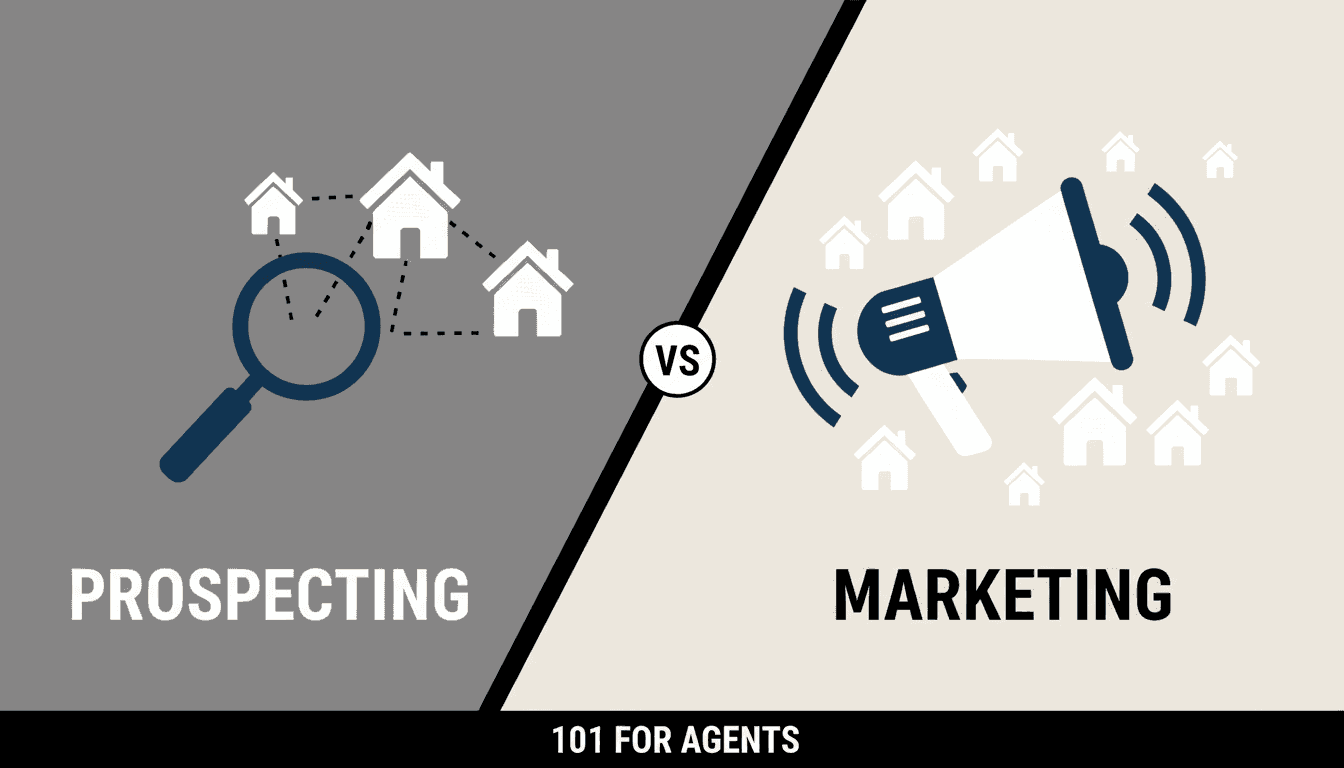
Real estate prospecting vs. marketing 101 isn’t just theory for new agents. It’s the line between always chasing your next commission and building a brand that attracts clients consistently. When we step back and look at the full picture, we see a simple truth: prospecting drives today’s business; marketing builds next year’s business.
In this guide, we’ll break down marketing vs. prospecting in real estate, show you the real differences, walk through pros and cons, and give you a practical way to combine both. Along the way, we’ll also tie in branding and logo decisions, because those sit squarely on the marketing side and directly impact how effective your prospecting and marketing become.
Prospecting vs Marketing in Real Estate: The Big Picture
At the highest level, prospecting vs marketing in real estate comes down to who starts the conversation and how many people you’re talking to at once.
- Real estate prospecting = outbound, one-to-one. You initiate contact with a specific prospect and start a conversation.
- Real estate marketing = inbound, one-to-many. You put messages and offers out so potential clients find you and raise their hand.
When we looked at how top-producing agents actually operate, one pattern stood out: you can’t avoid prospecting by spending all of your money on marketing, and you can’t scale just by grinding outbound calls forever without any brand behind you. You need a strategic mix of outbound prospecting and inbound marketing if you want both short-term deals and long-term business growth.
Think of it like this:
- Prospecting = hunting for leads. It’s direct outreach, manual effort, and quick feedback.
- Marketing = farming for leads. It’s planting seeds through content, ads, and branding that grow over time.
What Does “Prospecting” Mean in Real Estate?
Before we compare prospecting vs marketing, we need a clean definition of real estate prospecting.
A prospect is someone who matches your ideal client profile and might buy or sell, but hasn’t contacted you yet. Prospecting is the deliberate effort to find and reach out to these individuals, start one-to-one conversations, and move them into your real estate sales funnel.
Key Characteristics of Real Estate Prospecting
- Outbound lead generation: You initiate contact. This is classic client outreach.
- One-to-one communication: Calls, DMs, emails, door-knocking—highly personal.
- Short-term client acquisition: Designed to qualify and win listing or buyer appointments in the near term.
- Manual effort: You can use tools and scripts, but the conversations themselves aren’t automated.
- Relationship-based selling: You learn a prospect’s motivations, interests, and pain points in real time.
In practice, prospecting is exactly what most agents do before the market knows who they are. It’s uncomfortable at first, but it’s also the lowest-cost way to fill your pipeline if you have more time than money.
Real Estate Prospecting Activities (Concrete Examples)
Common prospecting strategies for real estate agents include:
- Prospecting calls:
- Calling your sphere of influence to check in and ask about plans or referrals.
- Cold or warm calling FSBOs and expired listings (where allowed).
- Circle prospecting around a new “Just Listed” or “Just Sold” property.
- Door-knocking and geo-farming outreach:
- Knocking doors around your latest listing or sale.
- Bringing printed market updates or buyer needs lists.
- Direct personal follow-up:
- One-to-one emails to open house visitors.
- LinkedIn or Instagram DMs to relocation prospects or local professionals.
- Texting leads who registered on your site or landing pages.
- Event-based prospecting:
- Hosting homebuyer or seller seminars and following up with attendees.
- Working a booth at a community event and collecting contact info.
All of these are contact and conversion activities. You’re not just putting your name out there—you’re asking questions, uncovering timing, and aiming for a first appointment.
How Branding and Logos Support Prospecting
We see a lot of agents treat prospecting and branding as separate worlds. In reality, your logo and visual identity quietly support your outreach every step of the way.
- When you knock on a door with a clean, consistent logo on your name tag, folder, or flyer, you feel more confident and appear more professional.
- When you follow up a circle prospecting call with a branded market report, people connect the conversation to the piece they see in their mailbox.
- When your email signature, business card, and social profiles all share the same simple monogram logo and colors, each touchpoint is more memorable.
This is why we often encourage agents to get a straightforward monogram-style logo in place early. It doesn’t close the deal for you—but it makes every interaction more credible and recognizable.
What Is Real Estate Marketing?
If prospecting is direct outreach, real estate marketing is the broader business strategy of promoting your brand, expertise, and services so that potential clients start coming to you.
Core Characteristics of Real Estate Marketing
- Inbound marketing: You create content, offers, and campaigns that draw people in.
- One-to-many communication: Social posts, videos, postcards, and ads reach dozens, hundreds, or thousands of prospects at once.
- Brand-building and awareness: You’re establishing who you are, what you do, and why you’re different—long before someone decides to sell or buy.
- Lead generation and nurturing: You capture contact info (via lead forms, landing pages, etc.) and nurture people through your real estate lead funnel over time.
- Systems and automation: Marketing automation tools, drip campaigns, and retargeting ads work while you’re asleep or at showings.
All the logo, branding, Canva templates, and AI-generated content you see agents obsess over? That’s squarely on the marketing side. It’s not busywork if it’s consistent and strategic—it’s how you build a brand that compounding awareness over time.
How Real Estate Marketing Generates Inbound Leads
Most effective real estate marketing follows a simple funnel:
- Awareness – Get attention:
- Listing videos and “Just Listed / Just Sold” posts.
- Neighborhood highlights and local business spotlights.
- Print mailers or local sponsorships.
- Engagement – Provide value:
- Market reports, blog posts, and YouTube explainers.
- Checklists and guides for first-time buyers or downsizing sellers.
- Branded email newsletters with local insights.
- Lead capture – Trade value for contact info:
- Home valuation tools on your website.
- Lead magnets like “7 Steps to Selling Your Home in [City].”
- Property alerts registration on your IDX site.
- Nurture – Stay top of mind:
- Automated email drips that educate and check in.
- Retargeting ads showing up on Facebook/Instagram after someone visits your site.
- Ongoing social content showcasing your wins and process.
By the time a marketing-generated lead reaches out, they often already recognize your logo, brand colors, and style from multiple touchpoints. That familiarity lowers resistance and speeds up trust.
Online and Offline Real Estate Marketing Channels
A balanced real estate marketing plan usually includes both online and offline tactics:
- Online marketing for agents:
- Real estate website and blog optimized for local SEO.
- Social media marketing (Instagram, Facebook, TikTok, LinkedIn).
- Paid advertising: Google Ads, Meta Ads, portal ads (Zillow, Realtor.com, etc.).
- Email marketing campaigns and newsletters.
- Video marketing on YouTube or short-form platforms.
- Offline marketing for real estate:
- Direct mail: postcards, neighborhood reports, newsletters.
- Yard signs, riders, and open house signage.
- Print ads in local magazines or newspapers.
- Community sponsorships and events.
- Flyers, door hangers, and community boards.
All of these rely on a recognizable visual identity—your logo, colors, typography—to build brand recall and reinforce your positioning in your farm area or niche.
Branding and Logos: Where They Fit in Prospecting vs Marketing 101
Because so many agents ask where logos and Canva templates fit into the prospecting vs marketing debate, let’s be very clear: your logo and branding are core pieces of your long-term marketing, and they amplify the results of both your outreach and your advertising.
Why Your Real Estate Logo Actually Matters
We like to compare your logo to curb appeal on a listing. It doesn’t sell the house by itself, but a bad first impression makes everything else harder.
- First impression: Your logo often shows up before you do—on signs, business cards, email signatures, and social profiles.
- Trust and professionalism: In a trust-based business, a sloppy or generic logo signals a sloppy or generic experience.
- Recognition: A simple, distinctive mark sticks in memory when someone sees your sign one day and your social ad the next.
- Consistency: When the same mark, fonts, and colors appear on your cards, mailers, and Instagram posts, your marketing starts to “stack” instead of starting from zero every time.
What Makes a Good Real Estate Logo?
Across all the logo and branding work we’ve done or reviewed, the best real estate logos tend to be:
- Simple: Minimal shapes, clear letters—easy to recognize at a glance.
- Memorable: A monogram, wordmark, or minimal icon that doesn’t look like every generic “roof + house” logo online.
- Versatile: Works in color and black-and-white, on signs, postcards, and social media avatars.
- Readable: Clean fonts that are legible on a mobile screen or a small business card.
- Aligned with your niche: Luxury branding looks different from first-time buyer branding or rural land branding.
Notice how this ties straight back into marketing vs prospecting: a logo like this doesn’t replace your outbound prospecting, but it does make all your outbound touches feel more like part of a cohesive real estate brand instead of a random one-off interaction.
Pros & Cons of Real Estate Prospecting
Now that we’re clear on what real estate prospecting is, let’s look at the pros and cons compared to marketing.
Advantages of Prospecting for Real Estate Agents
- Fast path to appointments: If you need deals now, focused prospecting is usually the quickest way to generate listing or buyer consultations.
- Highly targeted: You choose who to talk to:
- Owners in a building or street where you just sold a property.
- FSBOs at specific price points.
- Expired listings in a neighborhood you want to dominate.
- Low cash cost: Conversations don’t cost ad spend. Aside from dialers or data, your main cost is time and energy.
- Immediate feedback: You find out in minutes whether a lead is worth pursuing or not.
- Skill-building: Regular client outreach sharpens your scripts, objection handling, and confidence more than any course ever will.
Disadvantages of Prospecting
- Time-intensive: You’re trading your own hours and energy to fill the pipeline.
- Emotionally demanding: Rejection, no-shows, and “not interested” responses are part of the game.
- Hard to scale without a team: You can hire ISAs, but solo, you’re constrained by your schedule.
- Stops when you stop: If you pause prospecting for two months to handle active deals, your future pipeline dries up.
Pros & Cons of Real Estate Marketing
Marketing plays a different role in your real estate business than prospecting, especially when you add branding into the equation.
Advantages of Real Estate Marketing
- Scalable: One well-built campaign can reach thousands of people for months.
- Leverage and automation: Once your website, email funnels, and retargeting are in place, they work 24/7.
- Brand-building: Every ad, postcard, and post with your logo and name reinforces your position in your local market.
- Attracts warmer leads: By the time someone fills out your form or calls from a postcard, they’ve often seen your content and social proof.
- Compounding effect: A strong email list, YouTube channel, or social following can generate leads and referrals long after the initial campaign.
Disadvantages of Real Estate Marketing
- Slower to ramp up: Brand-building and content marketing take time before you see consistent lead flow.
- Requires budget or skills: Great creative, good copy, and solid CRM systems aren’t free.
- Less control over timing: You can’t force someone who downloaded your guide today to list next week.
- Easier to “hide” behind: It’s tempting to tweak logos and Canva templates all day instead of doing revenue-generating activities.
Prospecting vs Marketing in Real Estate: Side-by-Side Comparison
| Aspect | Prospecting (Outbound) | Marketing (Inbound) |
| Who starts the conversation? | You do (direct outreach). | The prospect does (responds to an ad, content, or offer). |
| Communication style | One-to-one or small group, highly personalized. | One-to-many, broad messages and content. |
| Time vs money | High time cost, low cash cost. | Higher cash cost (or skill investment), lower ongoing time cost. |
| Speed to results | Fast when done consistently—appointments this week. | Slower to start, but more consistent over time. |
| Scalability | Limited by your hours unless you build a team. | Highly scalable once systems and funnels are built. |
| Emotional load | Higher—rejection and direct feedback. | Lower direct rejection; performance shows up in metrics. |
| Role of branding/logo | Supports credibility on calls, in DMs, and leave-behinds. | Core to recognition and long-term brand-building. |
When to Prioritize Prospecting vs Marketing
In reality, you never choose between marketing vs prospecting forever; you adjust the mix based on your time, money, market conditions, and goals.
If You Have More Time Than Money
This is the typical scenario for new or re-launching agents: lots of available hours, limited marketing budget.
- Emphasize: Prospecting (direct outreach, daily).
- Support with: Low-cost marketing (simple branding, organic content).
Here’s how we’d structure a week:
- Daily: 2–3 hours of calls (sphere, FSBOs, expireds, circle prospecting).
- Daily: 10–20 personalized texts or DMs to past leads and contacts.
- Weekly: Door-knocking in a chosen farm area.
- Marketing support:
- A clean, basic website with your logo, headshot, and a simple lead form.
- One branded “Just Listed / Just Sold” social post per listing or sale.
- One simple, branded email newsletter per month.
Your logo and brand identity don’t need to be fancy at this stage. A simple monogram or name-based logo that’s consistent on your business card, website, and email signature is enough to support your prospecting and make you look put-together.
If You’re Busy and Have Some Budget
If you’re closing deals, short on time, but can invest money, the balance shifts.
- Emphasize: Marketing (ads, funnels, content).
- Maintain: Core prospecting blocks (skills and personal contact).
We like to structure it like this:
- Prospecting:
- 30–60 minutes per day calling hot leads and past clients.
- Consistent, personal follow-up on new inquiries.
- Marketing:
- Investing in a stronger logo and brand system (cards, signs, templates).
- Running paid lead generation campaigns to well-built landing pages.
- Setting up retargeting ads to people who visit your site or engage with videos.
- Outsourcing content production (video editing, graphic design) where possible.
This is where your branding really starts to pay dividends. When people see the same professional logo on your sign, website, and ads, they perceive you as a stable, established option in a crowded field.
In a Hot Real Estate Market
In a hot market, demand is high, and people are actively searching for agents and listings.
- Lean into: Marketing with a strong online presence and lead funnel.
- Keep: Prospecting for high-value opportunities (expireds, investors, move-up sellers).
Your focus here is to make sure that when people search for homes, agents, or market info in your area, your branded content and ads show up. Your logo on highly visible listings and “Just Sold” campaigns becomes a signal of success and social proof.
In a Slow or Uncertain Market
In a down or uncertain market, many people are hesitating. Fewer are actively Googling “best realtor in [city]” and voluntarily filling out forms.
- Emphasize: Prospecting—direct calls, DMs, and personal outreach.
- Use marketing for: Credibility and nurturing rather than pure lead volume.
We see agents win in slow markets by:
- Calling past clients and leads with data-backed updates and clear options.
- Hosting small, branded webinars or workshops addressing current concerns.
- Following up outreach with branded market reports, videos, or guides.
Your marketing assets and logo become proof and support you can share mid-conversation: “I’ll email you our latest market breakdown—it’s in an easy 2-page format we use with all of our clients.”
Time vs Money: Designing Your Lead Generation Mix
Almost every “prospecting vs marketing in real estate” decision can be simplified into a time vs money question.
- If you have more time than money, you should invest that time in outbound, manual lead generation (prospecting).
- If you have more money than time, you should invest that money into scalable, automated inbound marketing systems.
The trick is not to neglect either one completely. Even top teams that spend heavily on digital marketing still train in prospecting and conversion skills, because those skills turn raw leads into closings.
Step 1: Know Your Ideal Real Estate Client
Both prospecting and marketing get easier when you have a clear client persona—a detailed profile of the perfect clients you want to attract.
Elements of a Strong Real Estate Client Persona
- Demographics:
- Age range, typical income, family or household makeup.
- Common professions or life stages (first-time buyers, move-up families, downsizers, investors).
- Geographics:
- Specific neighborhoods, cities, or buildings you want to dominate.
- Property types (condos, townhomes, single-family, multi-family).
- Pain points and motivations:
- “We’ve outgrown this place but don’t know where to go next.”
- “We’re tired of renting while prices rise.”
- “We’re empty nesters with too much house.”
- “We want better investment cashflow.”
- Path to purchase:
- How do they research? Google? YouTube? Local Facebook groups?
- How long do they think before acting—30 days, 6 months, 2 years?
This clarity improves both sides of your lead generation:
- Your prospecting becomes more focused:
- You know which buildings or streets to call or door-knock.
- You tailor your questions and scripts to their exact concerns.
- Your marketing speaks directly to them:
- Your content uses their language and addresses their pain points.
- Your logo and visuals feel like “them” (luxury vs family-friendly vs investor-focused).
Step 2: Build a Simple but Strong Marketing Foundation
Before you pour money into advanced lead funnels, you need a basic, coherent real estate marketing foundation that includes your brand, logo, and core assets.
Define Your Real Estate Brand Identity
Start by answering three questions in plain language:
- Who do we help?
- Where do we help them?
- What makes our approach different?
Then choose three words you want people to feel when they see your marketing. For example: “modern, calm, expert” or “friendly, high-energy, results-driven.” Those words will guide your tone, fonts, and colors.
Create a Practical Visual Identity (Logo, Colors, Fonts)
You don’t need to overcomplicate this to get started:
- Logo:
- A monogram logo (e.g., “LN”) plus your full name and “Realtor®” works in almost every niche.
- Make sure you have at least:
- One dark version.
- One all-white version.
- Transparent PNGs that can overlay on photos.
- Colors:
- Pick 2–3 brand colors (primary, secondary, accent).
- Luxury might skew to black, white, gold, or deep navy.
- First-time buyer niche might use warmer, softer blues and greens.
- Typography:
- Choose one headline font and one body font.
- Keep them clean and readable; avoid overly decorative scripts.
We’ve seen agents overhauling their marketing just by tightening this up—suddenly every postcard, email, and social graphic looks like it comes from the same cohesive brand.
Core Marketing Assets Every Agent Should Have
- Website:
- Mobile-friendly, with clear “who we are, who we help, how to contact us.”
- Basic lead capture: contact form, home valuation request, property alerts sign-up.
- Branding: your logo in the header, consistent colors and fonts.
- Email marketing setup:
- A simple email service and a branded newsletter template.
- A master list of contacts and a plan to send at least monthly updates.
- Canva templates (or similar):
- “Just Listed / Just Sold” posts in your brand style.
- Market update posts.
- Educational tips or carousel posts.
- Printed materials:
- Business cards with your logo and contact info.
- Branded listing presentation and buyer guide PDFs.
- Yard sign design that clearly features your logo and name.
Step 3: Commit to a Prospecting Routine (That Uses Your Marketing)
Once your basic marketing foundation is in place, you can make your prospecting more effective by plugging those assets into your daily outreach.
Example Daily & Weekly Prospecting Plan
- Daily (Monday–Friday):
- 60–90 minutes of calls:
- Sphere of influence / past clients.
- New online leads in your CRM.
- Target lists (FSBOs, expireds, farm neighborhoods).
- 10–20 personalized follow-up messages:
- Texts or emails referencing a previous conversation.
- Sharing a relevant market update or guide.
- Weekly:
- 1–2 in-person or Zoom meetings with high-value contacts.
- Door-knocking in your farm around recent activity.
Using Marketing Assets Inside Prospecting Conversations
This is where we tie together outreach vs attraction strategies. Rather than just “checking in,” you can lead with value using your branded content:
- On calls:
- “We just put together a [Neighborhood] market report that shows how prices have shifted this year. Can I email you a copy?”
- In DMs:
- “I did a quick 2-minute video breaking down the pros and cons of selling this fall vs waiting. Want me to send it over?”
- At the door:
- “I’m giving neighbors a quick update on what this latest sale means for your home’s value. Here’s a one-page breakdown with my info if you have any questions.”
Because all of these pieces carry your logo, colors, and consistent design, they’re not just one-off touches. They reinforce your brand across multiple channels and make it easier for prospects to recognize you when they see your next sign or post.
Combining Prospecting and Marketing for a Stronger Sales Funnel
The most effective real estate lead generation strategies aren’t “prospecting vs marketing”; they’re prospecting and marketing working together through your sales funnel.
A Simple Real Estate Lead Funnel Using Both
- Top of funnel (awareness):
- Branding and logo on signs, social posts, and mailers.
- Local content about neighborhoods, pricing, and lifestyle.
- Mid-funnel (engagement and capture):
- Prospects follow you on social, visit your site, or opt into a lead magnet.
- You capture their info via forms, registrations, or sign-in sheets.
- Bottom of funnel (conversion):
- Prospecting kicks in: calls, DMs, and personalized follow-up.
- You offer CMAs, buyer consultations, or in-person meetings.
- Post-close (loyalty and referrals):
- Branded follow-up sequence: thank-you notes, check-ins, home anniversary messages.
- Ongoing newsletters and invites to client events.
Hunting vs Farming: How the Mix Changes Over Time
We often see agents move through three rough phases:
- Phase 1 – Heavy hunting (prospecting):
- Daily outbound calls and door-knocking.
- Simple but consistent branding on minimal marketing assets.
- Phase 2 – Balanced hunting and farming:
- Prospecting continues but with support from a growing database and content engine.
- Stronger marketing: better logo, website, email list, and ads.
- Phase 3 – Brand-led attraction:
- Referrals and repeat business dominate; people search you by name.
- Prospecting becomes more selective, focusing on high-value relationships and opportunities.
In every phase, your brand and logo are visible. Early on, they give your hustle a professional face. Later, they become the shorthand for a reputation you’ve earned through consistent prospecting and strong marketing.
How to Measure the Effectiveness of Prospecting vs Marketing
To optimize your mix of real estate prospecting and marketing, you need basic metrics and KPIs.
Prospecting Metrics to Track
- Number of dials or conversations per day.
- Conversations → appointments set.
- Appointments → signed agreements.
- Signed agreements → closed deals.
- Average commission per closed deal from prospecting sources.
Marketing Metrics and KPIs
- Website traffic (total and from key local pages).
- Conversion rate on lead forms and landing pages.
- Cost per lead (for paid campaigns).
- Email list growth and email open/click rates.
- Social engagement and reach (especially on core platforms).
- Number of referral and repeat clients (a sign your brand is working).
Reviewing these numbers monthly helps you decide when to double down on prospecting, when to invest more in marketing, and where your brand visibility is strongest.
Practical Next Steps: Apply Real Estate Prospecting vs Marketing 101 This Week
To turn all of this into action, here’s a simple checklist we recommend:
- Clarify your brand in writing:
- Who you serve, where you serve them, and how you’re different.
- Three words describing your brand (e.g., “modern, calm, expert”).
- Get a usable logo in place:
- Monogram or name-based logo, simple and readable.
- Dark and white versions, exported as transparent PNGs.
- Standardize your look:
- Pick 2–3 brand colors and 1–2 fonts.
- Update your business cards, email signature, and social banners.
- Launch or tighten your basic marketing:
- Clean up your website and add clear lead capture.
- Pick one consistent content channel (newsletter, Instagram, YouTube shorts).
- Commit to a prospecting schedule:
- Block daily time for outreach: calls, DMs, or door-knocking.
- Use your branded guides, reports, and videos as value-adds in those conversations.
Final Thoughts: You Need Both Prospecting and Marketing
When we zoom out, real estate prospecting vs marketing 101 comes down to this:
- Prospecting is proactive, one-to-one outreach that fills your pipeline fast.
- Marketing is strategic, one-to-many communication that builds your brand and fills your pipeline over time.
- Branding and your logo sit in the marketing camp, but they amplify every prospecting touch by making you recognizable and credible.
You can’t outsource the need for human conversations, and you can’t scale without systems and a brand that your market recognizes. The agents who win long term master both—using prospecting to create opportunities today and marketing (anchored by smart branding) to make sure those opportunities keep coming tomorrow.