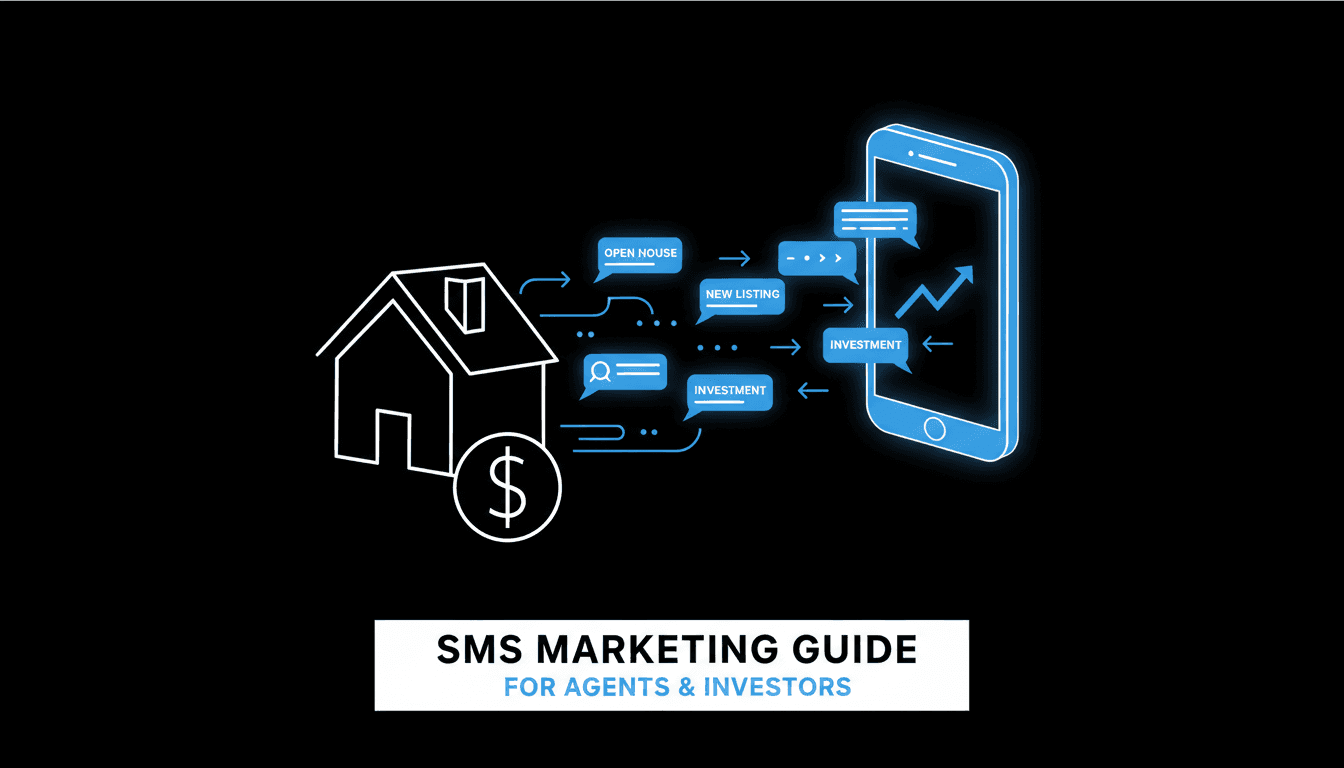
Real estate SMS marketing has gone from a “cool idea” to a primary channel for lead generation, nurturing, and even closing deals—especially from 2024 onward. We’re watching agents win listings in 25 texts, wholesalers pull $20k–$30k assignment fees from a single campaign, and teams quietly run 90,000‑text‑per‑month operations that feel surprisingly personal on the client side.
In this guide, we’ll break down how we’d build and scale SMS marketing for real estate in a way that’s profitable, compliant, and sustainable—whether you’re a solo agent, a broker with a team, a property manager, or a full‑time investor/wholesaler.
What Is Real Estate SMS Marketing?
Real estate SMS marketing is the use of text messages—sent from a professional SMS platform instead of your personal phone—to communicate with buyers, sellers, renters, and owners for both marketing and transactional purposes.
It typically includes:
- Bulk SMS campaigns for new listing alerts, open house invitations, price reductions, and market updates.
- Automated and triggered messages for lead follow-up, appointment reminders, and transaction milestones.
- Two-way business texting to answer questions, qualify leads, and coordinate showings in real time.
Everything runs on top of a real estate texting service or CRM with SMS built in—so you can segment, automate, track analytics, and stay compliant with opt‑in/opt‑out rules.
Why Real Estate SMS Marketing Works So Well Right Now
Across agents, investors, and platforms, we keep seeing the same pattern:
- Roughly 90–98% of texts are opened within minutes.
- 40–60% of buyers and sellers prefer SMS to calls or email.
- Well‑written campaigns get 10–30% response rates—often higher than cold email or social DMs.
- We regularly see deals acquired for well under $200 in SMS costs.
The behavioral nuance matters: people dodge unknown calls and ruthlessly delete cold emails, but they still read almost every text, even if they don’t reply. That’s why SMS has become the backbone of many real estate communication strategies.
Speed-to-lead and deal velocity
Lead portals and websites produce prospects who submit inquiries to multiple agents. When we respond within minutes by text—rather than hours later by email—we consistently see:
- Higher lead connection rates.
- Faster qualification (“serious vs. just browsing”).
- Shorter time from first contact to first showing.
In wholesaling and investing, the math is just as clear: one good text thread at the right time can turn into a $20k–$30k assignment fee. When you’re sending messages at fractions of a cent, real estate SMS marketing becomes a pure numbers game—as long as targeting, messaging, and compliance are dialed in.
Personal, but scalable
Text feels like a 1:1 channel, yet with the right real estate SMS platform we can:
- Personalize by name, neighborhood, and preferences.
- Segment by buyers vs sellers vs renters vs investors.
- Run bulk SMS for real estate campaigns that still feel like individual messages.
That’s how teams are sending tens of thousands of texts a month without coming across like robots.
Core Use Cases of SMS Marketing for Real Estate Professionals
At a high level, real estate text message marketing breaks into two big buckets:
- Lead generation & nurturing
- Transactional updates & service
1. Lead capture and speed-to-lead
Speed-to-lead is where SMS absolutely crushes. When a portal or website lead comes in, we don’t want to wait until we “have time” to call—we want an automated, instant text that starts a conversation while the intent is fresh.
- Keywords on signs & flyers
“Text HOMEINFO to 858585 for photos & price” on your yard sign or print ad: - The SMS keyword creates or updates a contact in your list.
- They get an automatic reply with a link to the listing or a lead magnet.
- Now you own that lead instead of hoping they remember your name later.
- Website & landing page opt-ins
We add a mobile number field plus explicit SMS consent to: - Home valuation forms.
- “Get listing alerts” sign-ups.
- Open house registration pages.
The moment they opt in, a real estate SMS drip sequence can welcome them, ask one qualifying question, and offer a call or viewing slot. - Instant portal follow-up
Lead from Zillow/Property Finder/Bayut hits your CRM → trigger an SMS: “Hi Alex, it’s Maria from BrightKey Realty. Thanks for inquiring about 123 Oak St. Are you free this weekend to see it? Reply 1 for Sat or 2 for Sun.”
2. Appointment scheduling, confirmations & reminders
Missed showings are a massive silent profit leak. We use SMS to plug it:
- Scheduling by text: “Are you free Thu 6pm or Sat 11am to view 456 Pine St? Reply 1 or 2.”
- Confirmations: “Confirmed: 456 Pine St, Sat 11:00 AM. Reply C to cancel or R to reschedule.”
- Automated reminders: 24 hours and 1 hour before, including address + map link + parking instructions.
In practice, strong real estate SMS automation around appointments can dramatically reduce no‑shows and keep your calendar under control.
3. New listing alerts, open houses and price reductions
This is classic text message marketing for real estate agents and still one of the highest‑ROI plays when done with segmentation:
- New listing alerts only to buyers whose saved criteria match:
“New 3BR in Lakeview, $495k, close to schools. Want photos & a 3D tour? Reply YES.”
- Open house invitations:
“Open House Sun 2–5 PM at 789 Maple Ave (modern 4BR). RSVP with YES to get directions.”
- Price drop alerts:
“Price drop: 321 Elm St reduced from $520k to $499k. Interested in a second look this weekend?”
4. Follow-ups and nurture campaigns
Most real estate databases are full of leads that were “touched” once or twice and then forgotten. SMS is ideal for bringing them back to life.
- Open-house follow-up:
“Thanks for stopping by 789 Maple Ave today. Any questions or feedback? Happy to send similar homes if you’d like.”
- Old buyer leads whenever you get a fitting listing:
“Hey Jenna, a new 3bd in Brookside just hit that made me think of you. Want details?”
We deliberately leave out price and address to create curiosity and invite a reply. - Educational drip SMS:
- “3 quick tips to get pre‑approved faster (link).”
- “Thinking of selling this year? Here’s what buyers are asking for right now.”
5. Offer status and transaction updates
Offer and escrow stages are time‑sensitive and emotional. We keep clients in the loop with short status texts, while email carries the details and documents:
- “Your offer on 321 Elm St has been submitted. I’ll call as soon as we hear back.”
- “Great news: your offer was accepted! I just emailed next steps—can you check now?”
- “Inspection confirmed for Tues at 10 AM. I’ll text a reminder the day before.”
- “Clear to close is in! I’ll send final details by email.”
6. Documents, applications and text‑to‑pay
We don’t attach PDFs via SMS; we send secure links:
- Rental applications and screening forms.
- Offer documents and disclosures (via e‑sign platform link).
- Deposit requests or application fees via text‑to‑pay links integrated with Stripe or similar.
That mix of instant notification + secure web flows is exactly what most modern real estate SMS notification systems are built for.
7. Long-term relationships and referrals
After closing, we use low‑frequency, high‑value texts to stay top-of-mind:
- “Happy 2‑year home‑iversary at 123 Oak St! Hope you’re loving the place.”
- “Quick question: if you got an offer at a strong price today, would you consider selling, or are you in ‘never leaving’ mode?”
- “If you know anyone thinking of buying or selling this year, I’d be honored to help. Feel free to share my number.”
Three Big Flavors of Real Estate SMS (and How They Differ)
In practice, we see three main “flavors” of real estate texting:
- Relationship-based agent outreach Agents and teams texting their database, neighborhoods, and other agents for listings, referrals, and client care.
- Wholesaler & investor lead generation High‑volume SMS to owners, landlords, and landowners for off‑market or distressed deals.
- Hybrid marketing + operations Brokers, builders, and property managers combining bulk SMS for real estate with automations, reminders, and transactional updates.
The tools and compliance baseline are similar, but tone, targeting, and volume vary a lot between a neighborhood agent and a statewide wholesaler blasting government lists.
How to Implement Real Estate SMS Marketing Step by Step
Step 1: Define clear goals
Before picking software, we decide what SMS should actually do:
- Boost speed-to-lead on web and portal inquiries?
- Reduce missed appointments and no‑shows?
- Drive more showings for specific listings?
- Turn old leads and past clients into active conversations?
- Generate off‑market deals as an investor or wholesaler?
These goals dictate what workflows we build first and which metrics we track (response rate, showings booked, deals closed, etc.).
Using your personal number for business texting seems convenient, but it quickly becomes a liability:
- No automation or integration.
- No centralized history across your team.
- High risk of your number getting flagged as spam by carriers.
A proper real estate texting service or CRM with SMS solves this. We look for features like:
- Two-way messaging with a shared inbox for your team.
- Automation: workflows, triggers, drip campaigns, autoresponders.
- Segmentation by location, budget, buyer/seller status, property type.
- CRM integrations (Salesforce, HubSpot, Zoho, Behomes, Follow Up Boss, etc.).
- Email + SMS support for omnichannel campaigns.
- Analytics: delivery rates, response rates, click tracking.
- Compliance tools: built‑in opt‑in/opt‑out, quiet hours, consent tracking.
Many teams use an all‑in‑one CRM like GoHighLevel (white‑labeled in various products), Behomes, or a Mailchimp stack with SMS. Others pair their existing CRM with a dedicated SMS platform (EZ Texting, Textedly, SalesMessage, etc.).
Step 3: Build a compliant, high-quality SMS list
Compliance is non‑negotiable. We only text contacts who’ve explicitly opted in or where we have a defensible basis for transactional communication.
Good list sources for SMS marketing for real estate agents include:
- Website and landing page forms with clear SMS consent.
- Open house registrations (digital or via QR code).
- “Text-to-join” keywords on signs, flyers, business cards, and social media.
- Your existing CRM of past clients who’ve given you their cell numbers for service communications (for transactional texts).
We avoid buying third‑party phone lists for marketing texts—they’re almost always a compliance and deliverability nightmare.
Step 4: Segment for relevance
Segmentation is where real estate SMS marketing goes from “spammy” to “this is actually helpful.” We like at least four dimensions:
- Role: buyers, sellers, renters, landlords, investors.
- Stage: new leads, active, under contract, past clients.
- Location: neighborhoods, zip codes, cities.
- Property & budget: beds/baths, price band, property type (condo vs SFH vs multifamily vs land).
Then we map campaigns accordingly:
- New listing alerts only go to buyers whose criteria match.
- Rental promotions only go to renters or landlord investors.
- Seller tips and CMAs only go to homeowners and past sellers.
Step 5: Design high-impact SMS workflows
We typically start with a few “core” real estate SMS automation workflows that move the needle fast:
- New lead welcome & qualification
- Trigger: new form/portal registration.
- Flow: instant welcome text → one qualifying question → call or calendar link.
- Appointment lifecycle
- Trigger: showing/meeting created in CRM or calendar.
- Flow: confirmation text → day‑before reminder → 1‑hour reminder → post‑appointment follow-up.
- Listing alerts
- Trigger: new property meets saved search criteria.
- Message: quick description + link, then “Want to see it?”
- Price change alerts
- Trigger: price drop or incentive update.
- Message: highlight the change + urgency CTA (“want a second look?”).
- Deal stage milestones
- Trigger: deal moves stages (offer submitted, accepted, inspection, appraisal, clear to close).
- Messages: short status updates with pointers to email or portal for detail.
- Post‑closing nurture
- Trigger: deal closed.
- Flow: thank-you text → 30‑day check‑in → 6‑month check‑in → annual home anniversary → occasional referral requests.
Real Estate SMS Marketing for Agents & Teams
Turning homeowners into listing leads by text
One of the simplest but most effective outbound SMS patterns we’ve seen agents use:
“Hi Ben, this is Jane from Compass. I just sold 123 Smith Street. I’m putting together local reports on what homes are selling for. Would you like one for your property?”
Why this works so well:
- It’s about them, not about you begging for a listing.
- It references a specific nearby sale, which makes it feel real.
- It naturally moves the conversation from SMS → email (for the CMA) → phone (for deeper discussion).
A follow‑up like “Do you feel the estimate I sent was low, high, or about right?” is easy to answer and pulls homeowners into a real pricing conversation—without feeling like a pushy prospecting script.
Using a dedicated “text line” instead of your personal number
We strongly recommend separating your high‑volume texting from your personal cell:
- Carriers are suspicious of one mobile number blasting hundreds of similar texts.
- If your personal line gets flagged, it can be painful to fix.
- You can’t share conversations or delegate replies if everything lives on your own phone.
A better setup for SMS for real estate agents:
- Buy a dedicated local SMS number (or a small pool of numbers) through your platform.
- Forward calls from that number to your main cell, so it still “works” when people dial.
- Handle SMS through a shared desktop/mobile inbox your team can access.
- When someone becomes a serious client, give them your personal number for white‑glove treatment.
Everyday database texting: the 5‑for‑5 habit
The single easiest real estate SMS marketing idea for agents is a daily 5‑for‑5:
- Pick 5 people from your CRM (past clients, sphere, warm leads).
- Spend 5 minutes sending genuinely personal texts (or quick selfie videos).
Examples:
- “Hey Sarah, drove past your old street today and thought of you guys. How’s the new place treating you?”
- “Hey Mike, saw your team in the playoffs and remembered you’re a superfan. Hope all’s well with you and the family.”
- “Happy 3‑year house‑iversary on Oak St! Anything you wish you’d known before buying that I should warn new buyers about?”
These aren’t pitchy at all; they’re relationship deposits. Done consistently, they quietly fuel repeat business and referrals.
Agent-to-agent SMS: moving stale listings
Texting other agents with aging listings is another underused play. One campaign that’s been extremely effective:
“Hey Lisa, is 789 Maple Ave still on the market? Want help getting it sold before its first birthday?”
The “before its first birthday” line is provocative enough to cut through the noise but still useful. We’ve seen response rates around 30% on scripts like this, leading to referrals, co‑list opportunities, and buyers for off‑MLS or price‑reduced properties.
High-Volume Real Estate SMS Marketing for Investors & Wholesalers
The basic math: texts per deal and cost
For investors and wholesalers, we look at texts required per deal by list type and what that translates to in SMS spend:
| List Type | Approx. Texts per Deal | Approx. SMS Cost (at ~$0.0087/text) |
| Probates (heirs) | ~500 | $4–5 |
| Driving for Dollars (distressed houses you’ve logged) | ~1,000 | $8–9 |
| AI-stacked / likely-to-sell lists | ~1,500 | $13 |
| Pre-foreclosures | ~3,000 | $26 |
| Other gov lists (liens, code violations, etc.) | ~5,000 | $43–45 |
| Generic paid lists (absentee, high equity) | ~10,000+ | $80–90+ |
When one assignment fee is worth $15k–$30k, spending under $100 in SMS for real estate marketing to generate that deal is an easy decision—as long as you’re operating within legal guardrails.
The “holy grail” list: your own CRM
Before buying lists, almost every wholesaler we know sees quick wins just by texting old leads in their own database:
“Hey John, we spoke a while back about your place on Elm. Are you still considering selling if the price made sense?”
Those leads have already heard of you. They’re far more likely to respond than fresh cold numbers, and the cost to re‑engage is pennies.
Two real-world SMS success examples
- Land wholesale deal (~$20,738 profit)
- Email builders asking exactly what lots they want and what they’ll pay.
- Pull a matching vacant land list (e.g., 2–3 acre lots, last purchase under $30k, owned >3 years).
- Skip trace and blast:
“I’ll pay you $25,000 net cash for [ADDRESS]. I’m buying 6 more lots this month. – Mike”
- Seller counters at $30k; you negotiate $28k net with assignment allowed.
- Assign to the builder at $50k, netting ~$20.7k after some fee splitting.
- House wholesale (~$31,200 assignment)
- Same pattern: tightly defined list + clean script + responsive follow-up.
- Negotiate by phone after initial SMS, then contract and resell.
Nothing exotic—just SMS campaigns for real estate investors executed with discipline.
How to Write Real Estate SMS Messages That Actually Get Responses
1. Keep it short, clear, and singular in purpose
One text, one outcome. We almost always include:
- Who we are (at least early on).
- The core point (what changed, what we have, or what we’re asking).
- One simple call to action (“Reply YES”, “Reply 1 or 2”, “Want details?”).
2. Personalize beyond just the name
Best-performing real estate SMS examples usually reference:
- Their first name.
- A specific property (their home, a nearby sale, or a listing they clicked).
- A neighborhood or building they care about.
For example:
“Hi Ben, it’s Jane from Compass. Just sold 123 Smith St around the corner. Want a quick update on what your place could sell for today?”
3. Avoid links in the very first contact
Cold or semi‑cold texts stuffed with links feel scammy. We usually:
- Start the conversation with a pure text question or offer.
- Send links only after the recipient engages (“Yes, send it over”).
- Frame them clearly: “Here’s the MLS gallery: [link]” instead of a naked URL.
4. Use curiosity and easy questions
Instead of dumping information, we often send “curiosity hooks” that invite a quick reply:
- “A new 4bd popped up in your price range—want details?”
- “Do you think your home would sell for more, less, or about what you paid today?”
- “Is everything okay with the property on Oak? Just noticed something and wanted to check in.” (for certain investor scripts)
5. Sign texts like a human
Adding “– First Name, Company” at the end helps phones display “Maybe [Name]” and immediately increases perceived legitimacy:
“– Dean, HarborPoint Realty”
Best Practices for Timing and Frequency
When to send real estate texts
- Stick to normal waking/business hours in the recipient’s time zone.
- Use late afternoons and weekends for open houses and same‑day showings.
- Be extra cautious with early mornings or late nights; some jurisdictions restrict marketing SMS during certain hours.
How often to text
We calibrate frequency based on segment and expectations:
- Active buyers & renters: as often as multiple times per week if the messages are highly relevant (matching listings, appointment reminders).
- Seller prospects: 1–4 times per month with a mix of market updates, CMA offers, and personalized check‑ins.
- Past clients: a few times per year plus key life/market events.
At opt‑in, we set expectations (“We’ll send up to 4 messages a month. Reply STOP to opt out.”) and continually watch opt‑out + complaint rates to adjust.
Combining SMS with Email and Other Channels
The role split: SMS vs email
Instead of SMS or email, we deploy them where each is strongest:
- SMS for real estate agents:
- Time-sensitive updates (new listing, price drop, offer status).
- Short Q&A and confirmations.
- Nudges to check email or portal.
- Email for real estate marketing:
- Newsletters and market reports.
- Long‑form property presentations.
- Documents and disclosures.
A simple pattern we use all the time:
- Send a detailed CMA or buyer packet via email.
- Immediately follow with SMS:
“Hi Dana, I just emailed a full report on your home’s value and local sales. Mind taking a look today? Happy to answer questions.”
CRM, WhatsApp and omnichannel integration
Modern platforms (Behomes, Mailchimp with SMS, Infobip, etc.) let us:
- Trigger SMS from CRM pipeline changes.
- Update records based on SMS replies (e.g., “interested in selling this year”).
- Combine SMS with WhatsApp, Telegram, and email in the same workflows.
This gives us a true omnichannel real estate marketing system where all communication is logged in one place.
Compliance, Privacy and SMS Regulations in Real Estate
High‑volume SMS without compliance is how agents, investors, and wholesalers end up with demand letters or worse. The specifics vary by country (TCPA in the U.S., different anti‑spam laws elsewhere), but core principles are the same.
1. Consent and opt-in
- Get clear, documented consent before sending marketing texts.
- Use explicit language on forms (“I agree to receive SMS about real estate listings and updates”).
- Avoid:
- Random cold SMS blasts to consumer cell phones without careful legal advice.
- Purchased phone lists for marketing.
2. Identify yourself and set expectations
- Include your name and company in the message body.
- Be transparent about:
- What type of messages they’ll receive (alerts, market updates, etc.).
- Roughly how often you’ll text.
3. Opt-out language and honoring STOP
- Include a simple opt‑out on promotional messages: “Reply STOP to unsubscribe.”
- Ensure your system automatically suppresses future sends to STOPped numbers.
4. Timing and content restrictions
- Many regions bar marketing SMS during nighttime/very early morning hours.
- Deceptive or misleading content can expose you to legal risk beyond SMS rules.
5. Data protection and recordkeeping
- Use a platform with solid security and a clear privacy policy.
- Keep records of consent, campaigns, and opt‑outs as required.
In short: treat real estate text message marketing like any other regulated channel. If you plan on high‑volume outreach, especially as an investor or wholesaler, it’s wise to sit down with a local attorney who actually understands TCPA and your state’s consumer laws.
Measuring and Optimizing Your Real Estate SMS Marketing
We never treat SMS as a “fire and forget” tactic. We measure and iterate.
Key SMS metrics to track
- Delivery rate – invalid numbers, carrier filtering issues.
- Response rate – how many people actually reply.
- Click-through rate – on tracking links.
- Appointment metrics – showings scheduled, no‑show reduction.
- Pipeline metrics – offers written, deals closed where SMS was the first or primary touch.
- Opt-out rate – critical safety valve for frequency/relevance.
A/B testing and experimentation
We continuously test:
- Different opening lines and CTAs (“Want details?” vs “Still interested in buying this year?”).
- Send times (morning vs afternoon vs weekend).
- Message length and formatting (with/without emojis, abbreviations).
Even small improvements in response rate compound across thousands of texts and can mean multiple extra closed deals a year.
Scaling with Automation and AI (Without Losing the Human Touch)
AI for first-level lead qualification
Once you’re sending thousands of texts per month, manually replying to every “maybe” or “wrong number” gets old fast. That’s where AI‑assisted routing is becoming powerful in real estate SMS platforms:
- AI reads incoming replies and:
- Confirms if it’s the right person.
- Identifies interest level (“curious”, “ready soon”, “not interested”).
- Collects basics (timing, condition, budget) for investors or agents.
- Only when a conversation meets your “hot lead” criteria does it get escalated to you or your team.
That’s how teams handle 90,000+ texts per month without sacrificing real human engagement where it matters most.
Call + text + email “triple tap” sequences
We also like stacking channels to increase connection rates:
- Double tap: SMS first (“I’m about to give you a quick call”), then call.
- Triple tap: email a report → SMS referencing that report → call non‑responders.
This pattern makes unknown numbers feel less random, increases pick‑ups, and uses SMS to boost the performance of your other channels.
Quick-Start Playbooks by Role
For solo agents & small teams
- Choose a CRM + SMS combo that handles contacts, automations, and compliance.
- Set up a dedicated local SMS number for marketing and follow-up.
- Enable SMS opt-in on every form and open house registration.
- Launch three automations:
- New lead welcome + qualification.
- Appointment confirmations and reminders.
- Post‑closing nurture (anniversaries, check‑ins).
- Build the daily 5‑for‑5 personal text habit to your database.
- Test one proactive campaign:
- “Just sold” CMA offers to nearby owners.
- Old buyers re‑engagement when new matching listings hit.
For investors & wholesalers
- Formalize your business presence (LLC, EIN, basic website, business email).
- Use an A2P‑compliant real estate texting platform with proper brand/campaign registration.
- Start with your own CRM:
- Tag all old leads.
- Hit them with a compliant, light‑touch follow-up text.
- Choose 1–2 high‑quality list types (probates, D4D, targeted landowners) instead of generic “everyone with equity.”
- Develop scripts that:
- Sound like a real person.
- Reference specifics (property, area).
- Don’t lead with links or over‑details.
- Scale volume only as you:
- Validate your deal‑per‑text math.
- Have a plan and budget for legal compliance.
Key Takeaways: How to Win with Real Estate SMS Marketing
- SMS is now a core channel in real estate—not an add‑on. It drives speed-to-lead, client engagement, and deal velocity if used well.
- List quality and targeting beat clever copy. Smart segmentation and timing produce more deals than fancy scripts sent to the wrong people.
- Keep messages human—short, specific, and curiosity‑driven, with clear CTAs and minimal links up front.
- Automate the boring parts (reminders, status updates, drip campaigns) so you can focus on real conversations.
- Integrate SMS with your CRM and email for a unified, omnichannel client experience.
- Respect compliance: consent, identification, opt‑outs, and timing rules are the price of playing at scale.
- Track your numbers and iterate. Once you know roughly how many texts it takes to book an appointment or close a deal, you can confidently scale spend and volume.
Used thoughtfully, real estate SMS marketing becomes a reliable engine for new listings, buyer clients, and off‑market deals—without burning bridges or risking your reputation.