Real estate has its own language, and when we’re in the middle of an offer, a loan application, or a contract review, we see the same terms come up again and again. Learning this vocabulary turns a confusing process into a series of clear decisions.
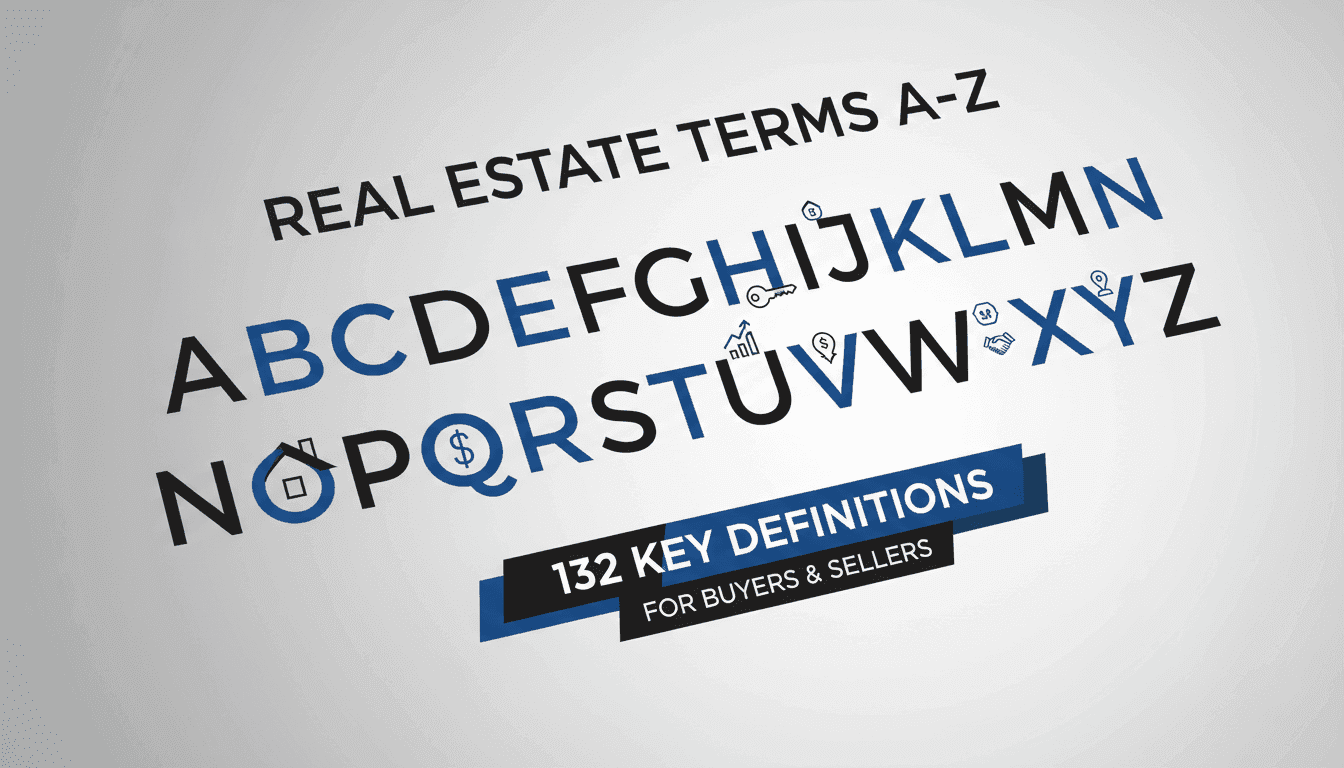
Below you’ll find a complete real estate glossary A–Z with 132+ essential real estate terms and definitions. We’ll keep things in plain English and highlight why each term matters when you’re buying, selling, or investing.
To make this real estate dictionary genuinely useful, we organize it alphabetically and weave in how the terms show up in real deals, not just textbook definitions. When we walk first-time buyers through a contract or explain numbers to investors, these are exactly the concepts we reference.
Use the A–Z index below to jump around as you need.
These “A” terms pop up constantly in offers, mortgages, and market reports.
Absorption Rate
Measures how fast homes are selling in a given market: homes sold in a period ÷ total homes for sale. When we evaluate whether a market favors buyers or sellers, this is one of the first metrics we check.
Adjustable-Rate Mortgage (ARM)
A mortgage where the interest rate can change over time based on an index. Typically starts with a low fixed rate (say, 5 years) and then adjusts annually within caps. ARMs can work for buyers who know they’ll move or refinance before the rate adjusts.
Addendum
An addition to a contract—for example, adding that the seller will leave appliances or change move-out dates.
Amendment
A change to an existing contract term, like altering price or which repairs the seller will complete after inspection.
Amenities
Features that add comfort or appeal: pools, gyms, concierge, parking, rooftop decks, playgrounds, or even high-speed Wi‑Fi in newer developments.
Air Rights
The right to build upward over a property. This matters mostly in dense cities where vertical development or views have huge value.
Amortization
The process of paying off a loan over time through regular payments that include both principal and interest. On a typical 30‑year mortgage, we see early payments go mostly toward interest and later payments more toward principal.
Appraisal
A professional estimate of a property’s value, usually ordered by the lender. If a home appraises low, it can force price negotiations, extra cash from the buyer, or contract cancellations.
Appraisal Contingency
A clause allowing the buyer to renegotiate or walk away if the appraisal comes in below the contract price without losing earnest money.
Appraisal Gap Coverage
An agreement (usually by the buyer) to cover a specific shortfall between appraised value and purchase price in cash. We see this used to win bidding wars in hot seller’s markets.
Assessment / Assessed Value
Value assigned by the local government for property tax purposes. It may lag behind true market value, especially in fast‑moving markets.
Assets (Real Estate Context)
Property or land with financial value that you own—often used when lenders verify your ability to close a deal.
Attached Home
A dwelling sharing one or more walls with other units, such as townhouses, row houses, condos, or apartments.
Backup Offer
An offer that becomes active only if the primary contract falls through. In tight inventory markets, we often encourage serious buyers to use backup offers strategically.
Bank-Owned Property / REO (Real Estate Owned)
A property that reverted to the lender after a foreclosure auction failed. Often sold “as is,” but sometimes at a discount.
Balloon Mortgage
Short‑term loan (often 5–7 years) with low or interest‑only payments, followed by a large lump‑sum payoff. Primarily used by experienced investors, not typical homebuyers.
Basement / Garden Level
Lower level of a home. Garden level is partially below ground with windows at or near yard level. These levels affect both value and perceived natural light.
Bilevel (Bi‑Level)
A house with two main levels and an entry between them, sometimes called a raised ranch.
Bill of Sale
Document transferring ownership of personal property (like appliances or furniture) from seller to buyer at closing.
Blind Offer
Offer submitted without physically visiting the property—common with out‑of‑town buyers or in hyper‑competitive markets.
Breach of Contract
Failure by either party to fulfill terms of a binding agreement, such as not closing on time or refusing to complete agreed repairs.
Broker (Real Estate Broker)
A real estate professional with additional licensing who can supervise agents and operate a brokerage. When we reference “the brokerage,” we’re talking about the broker’s firm.
Broker Price Opinion (BPO)
Value estimate prepared by an agent or broker. Less formal than an appraisal but often used by lenders and investors to gauge value quickly.
Building Codes
Legal standards that control construction safety (structure, fire, electrical, plumbing, etc.). Non‑compliant work can cause issues with permits and resale.
Building Completion Certificate (BCC) (UAE / some markets)
Document from the contractor to the developer certifying that a building is completed as per approved plans. In Dubai and similar markets, we wait on this before final handover of off‑plan units.
Buyer’s Agent / Buyer’s Representative / Selling Agent
Agent who represents the buyer’s interests: finding properties, analyzing value, structuring offers, negotiating, and guiding the deal to closing.
Buyer’s Market
Conditions where supply of homes exceeds demand. Buyers have stronger negotiating power, more concessions, and often longer days on market.
Buydown
Up‑front payment, often by the seller or builder, to temporarily lower the buyer’s interest rate. We sometimes use this instead of lowering the purchase price to reduce monthly payments.
Capital Gains Tax
Tax on the profit when selling a property. Rules differ for primary residences vs. investment properties and by holding period.
CapEx (Capital Expenditures)
Major, infrequent expenses like roof replacement or structural work. Investors should always separate CapEx from regular maintenance in their pro formas.
Capitalization Rate (Cap Rate)
Key real estate investing term: Net Operating Income (NOI) ÷ purchase price or value. A higher cap rate usually means higher return but also higher risk.
Cash Buyer
Buyer who doesn’t need a mortgage. Cash offers simplify deals and often beat higher financed offers because of speed and certainty.
Cash Flow
Money left after all operating expenses are paid. For rentals: rent income – (mortgage, taxes, insurance, maintenance, management, utilities) = cash flow. Positive cash flow is the foundation of sustainable buy‑and‑hold investing.
Cash-Out Refinance
Refinancing for more than you owe and taking the difference in cash, secured by your home’s equity.
Cash Reserves
Money set aside to handle vacancies, repairs, and emergencies. Lenders and savvy investors insist on healthy reserves for each property.
Class A / B / C Buildings
Shorthand investors use:
Closing (Settlement / Completion)
Final step in the home buying process: documents are signed, funds move, and title transfers from seller to buyer.
Closing Costs
All the fees on top of the purchase price: appraisal, lender fees, title insurance, recording, transfer taxes, attorneys/title company, etc. We always prepare estimates early so buyers aren’t surprised at signing.
Co‑Borrower / Joint Applicant
Additional borrower equally responsible for the loan. Common with spouses, partners, or parents helping children qualify.
Commission
Fee paid to listing and buyer’s brokerages, usually a percentage of the sale price and typically built into the seller’s side of the deal.
Commitment Letter
Formal letter from a lender stating they’ll provide a loan under specific terms, subject to conditions. Stronger than a pre‑approval.
Common Areas
Shared parts of a condo or multi‑family building: lobbies, hallways, elevators, gyms, pools, parking lots, gardens, etc.
Comparables (Comps)
Recently sold similar properties used to estimate a home’s value. When we debate pricing with clients, we’re nearly always working from comps.
Comparative Market Analysis (CMA)
An agent’s analysis of comps plus active and pending listings to recommend a listing price or evaluate offers.
Condominium (Condo)
Individually owned unit within a multi‑unit building or complex with shared common areas and typically an HOA.
Concession
Benefit one party offers (closing cost credit, repairs, furnishings, rent-back) to help get a deal done.
Contingency
Condition that must be satisfied for the sale to close. Common ones are financing, appraisal, and inspection. We use contingencies as key levers to manage risk and negotiate.
Contract (Purchase & Sale Agreement / PSA / SPA)
The binding agreement stating price, terms, deadlines, and contingencies of a real estate transaction.
Conventional Sale
Normal sale where the seller has enough equity and isn’t in foreclosure or doing a short sale.
Conspiracy to Boycott
Illegal collusion to keep a competitor from doing business—relevant to real estate brokers and service providers.
Credit Score
Three‑digit number used by lenders to judge credit risk. Better scores generally mean better loan terms and interest rates.
Curb Appeal
How attractive a property looks from the street. We see well‑staged exteriors dramatically improve showing traffic and offer strength.
Customer vs Client
A client has a formal relationship with the brokerage and receives fiduciary representation; a customer gets more limited assistance without full representation.
Days on Market (DOM) / Days in MLS
How long a property has been listed before going under contract. High DOM can signal overpricing or problems; low DOM often reflects strong demand.
Debt-to-Income Ratio (DTI)
Total monthly debt payments ÷ gross monthly income. Lenders use DTI to decide how large a mortgage payment you can safely handle.
Deed
The legal document transferring title (ownership) from seller (grantor) to buyer (grantee).
Deed Restrictions
Rules placed on a property’s use—like limits on short‑term rentals, architectural style, or building height.
Deed of Trust (in some states)
Document where a neutral third party holds title as security for the lender until the loan is repaid, functioning similarly to a mortgage.
Default
Failing to meet loan or contract obligations, usually by missing payments or deadlines.
Depreciation (Tax)
For investment properties, the IRS allows you to deduct the building’s value over time (even if the market value rises), which can shelter rental income from taxes.
Developer
Person or company that acquires land, builds, and sells properties—often behind new subdivisions and condo towers.
Digital Real Estate
Online assets like websites, domains, or even virtual land treated as investment property in a broader sense.
Disclosure / Seller’s Disclosure
Legally required statement where the seller lists known issues or defects. We always tell sellers: disclose honestly; cover up nothing.
Discount Broker
Brokerage offering reduced listing commissions, sometimes with more limited service.
Distressed Property
Property where the owner is in financial trouble or the home is in poor condition, often presenting opportunity for investors.
Down Payment
Buyer’s up‑front cash, expressed as a percentage of purchase price (3–20%+). Along with credit score and DTI, this drives available loan options.
Down Payment Assistance
Programs that help with part of the down payment or closing costs, especially for first‑time buyers and certain income brackets.
Dual Agency
One agent or brokerage representing both buyer and seller in the same deal. Legal in some regions, restricted or banned in others due to conflict of interest.
Dubai Land Department (DLD) (UAE)
Government authority overseeing property registration and regulation in Dubai. Any Dubai transaction we work on ultimately passes through DLD systems.
Due Diligence
The investigation period when a buyer evaluates inspections, title, HOA rules, neighborhood, and financials before fully committing.
Duplex
A building with two separate dwelling units, often attractive to house hackers who live in one unit and rent the other.
Earnest Money (Good Faith Deposit)
Buyer’s deposit to show seriousness, typically 1–5% of the purchase price, held in escrow and applied at closing.
Easement
Legal right for someone else to use part of your property—for example, a utility company’s right to access lines, or a shared driveway.
Encroachment
When structures like fences or additions cross onto a neighbor’s land. Surveys and title work help uncover these.
Equity
Your ownership stake in the home: market value minus loan balance. As you pay down principal and values rise, equity grows.
Escrow
Neutral third party or account that holds money and documents until all contract conditions are met, then disburses funds and records documents.
Estate (as Seller)
When a property is sold by the executor representing a deceased owner’s estate, often via probate.
Exclusive Agency Listing
Agreement where the seller can avoid paying the listing broker if they personally procure the buyer. If any other agent brings the buyer, commission is owed.
Exclusive Right to Sell
Most common listing agreement type. The listing broker is owed commission if the property sells during the agreement term, regardless of who finds the buyer.
Exclusive Right to Buy
Buyer‑broker agreement where a buyer works exclusively with one brokerage for a set period.
Exclusion
Item specifically listed in the contract as not transferring with the property (for example, a dining room chandelier or certain appliances).
Expired Listing
A property that was listed but did not sell during the listing contract period.
Fair Housing Act
U.S. federal law banning housing discrimination based on protected classes (race, color, religion, sex, national origin, familial status, disability). Every ad and showing we do must comply with this.
Fair Market Value (FMV)
The price a typical, informed buyer and seller would agree on in an open and competitive market.
Federal Housing Administration (FHA)
U.S. agency that insures certain mortgage loans, making it easier for borrowers with lower credit scores or smaller down payments.
FHA Loan
Government‑insured mortgage with low down payment options (as low as 3.5%), but with mortgage insurance premiums.
Financing (Investment Context)
How you structure paying for a property: cash, conventional loan, FHA, VA, hard money, private money, etc.
Fixed-Rate Mortgage
Mortgage with an interest rate that stays the same over the entire term, which keeps monthly principal and interest payments predictable.
Flat-Fee MLS Service
Service where a FSBO seller pays a set fee to place their home on the MLS, handling showings and negotiations themselves.
Flipping
Buying property (often distressed), renovating, and reselling quickly for profit. Requires precise budgeting for CapEx, holding costs, and resale values.
Fixer-Upper / Fix‑Up Property
Home needing significant repairs or updates, often priced below move‑in‑ready homes.
Foreclosure
Legal process where a lender takes back a property after the borrower defaults on mortgage payments.
Form F / MOU / SPA (UAE / Dubai)
Key sale documents in Dubai and similar markets. Form F (MOU) outlines agreement between buyer and seller; SPA (Sales & Purchase Agreement) is common with developers.
FSBO (For Sale By Owner)
Property sold directly by the owner without a listing agent. Buyers may still have their own agents representing them.
General Contractor
Professional responsible for coordinating trades and managing construction or renovation projects.
Graduated Payment Mortgage
Loan where payments start low and increase on a set schedule. Can help buyers who expect income to rise, but we always model future payment amounts carefully.
Grantor / Grantee
Grantor is the person transferring title (seller); grantee is the person receiving title (buyer).
Gross Rental Income (GRI)
Total income from a rental property before expenses—rents plus any additional fees (parking, laundry, storage, etc.).
Garden-Level Unit
Apartment or condo with windows at or near ground level; technically a kind of basement unit.
Great Room
Large open living space combining living, family, and often dining room functions.
Hard Money Lender
Private lender making short‑term, asset‑backed loans, often used for flips or bridge financing. Higher interest but faster and more flexible than traditional banks.
High-Rise / Mid-Rise
High‑rise buildings usually have 7+ stories; mid‑rises often 5–12 stories. Local codes vary, but buyers care about elevator access, views, and HOA fees.
Historical District
Area with special preservation rules. Exterior changes may require approvals, which is important to know before buying a property you plan to remodel.
Home Inspection
Professional evaluation of a property’s condition. We strongly encourage buyers to attend and ask questions; it’s more educational than just reading the report.
Home Inspection Contingency
Clause allowing buyers to renegotiate or walk away based on inspection results.
Home Warranty
Service contract covering repair or replacement of major systems and appliances due to normal wear, separate from homeowners insurance.
Homeowners Association (HOA)
Organization that sets and enforces rules (CC&Rs) in certain communities and maintains shared areas. Always read HOA documents carefully before closing.
HOA Fees / Dues
Regular payments owners make to fund HOA operations and amenities.
Homeowners Insurance
Insurance covering damage to your home and liability if someone is injured on your property. Required by lenders and wise even if you own free and clear.
HUD (U.S. Department of Housing and Urban Development)
Federal agency overseeing housing programs, including FHA and fair housing enforcement.
Hybrid / iBuyer
Technology-driven companies that make quick cash offers on homes, usually trading a slightly below-market price for speed and convenience.
IDX (Internet Data Exchange)
System that allows brokerages to share listings on websites and apps under specific rules.
Implied Contract
Agreement formed by actions or circumstances rather than written or spoken words. In real estate, we strongly prefer clear written agreements to avoid disputes.
Income Property
Property purchased primarily for the income it produces from rent rather than for personal use.
Inspection
Generic term for checks by specialists (structural, termite, sewer, roof, HVAC, etc.). For multi‑family or older properties, we often recommend multiple inspections.
Interest / Interest Rate
Cost of borrowing money, expressed as a percentage of the loan amount.
Internal Rate of Return (IRR)
Advanced investment metric capturing overall annualized return, accounting for timing of cash flows. Seasoned investors compare deals using IRR alongside cap rate and cash-on-cash.
Irrigated Lot / Irrigation Well
Property with access to irrigation water rights or wells, which matters for landscaping, agriculture, and sometimes value in rural markets.
Joint Tenancy
Form of co‑ownership with equal shares and “right of survivorship.” If one owner dies, their share automatically passes to the remaining joint tenants.
Kickback
Illegal, undisclosed payment to a real estate professional in exchange for steering business to a particular vendor. Lenders, agents, and title companies must follow strict anti‑kickback laws.
Kick-Out Clause
Clause that lets a seller continue marketing the home and accept another offer if the current buyer’s contingent offer (often home sale contingency) doesn’t firm up in time.
Landscape
Design and condition of outdoor areas—lawns, gardens, patios. Good landscaping enhances curb appeal and perceived value.
Lease
Rental agreement specifying rent, term, and rules for tenant use of a property.
Lease Termination
Ending a lease early by agreement or under defined conditions. Investors should understand local landlord‑tenant laws here.
Lease Violation
Breaking the rules in a lease, such as nonpayment, unauthorized pets, or illegal activity.
Leverage
Using borrowed money to buy property. It amplifies returns when values rise and cash flow is strong, but also magnifies losses when things go wrong.
Lien
Legal claim against a property as security for a debt. Mortgages, tax liens, and mechanic’s liens all show up on title searches.
Listing
A property that’s officially for sale and actively marketed, usually entered into the MLS.
Listing Agent / Seller’s Agent
Agent hired by the seller to market the home, advise on pricing, and negotiate offers.
Listing Agreement
Contract between seller and brokerage granting the broker the right to market and sell the property, specifying commission and services.
Listing Fee
Portion of the total commission paid to the listing brokerage.
Loan Contingency / Financing Contingency
Protects buyers if they can’t secure financing by a deadline. If properly used, it allows buyers to exit without losing earnest money.
Long-Term Rental
Property rented on leases typically 12 months or longer, as opposed to nightly or weekly short‑term rentals.
Manufactured Home
Home built in a factory and transported to the site, formerly called a mobile home. Financing and zoning can differ from site‑built homes.
Market Value
Likely sale price in current open market conditions, often informed by comps and appraisals.
Mixed-Use Building
Property combining residential, retail, office, or other uses in one building or development.
Model Home / Show Home
Decorated example unit in new developments used to market floor plans and finishes to buyers.
Months of Inventory (MOI)
Active listings ÷ monthly closed sales. Indicates how long it would take to sell all current listings at the current sales pace.
Mortgage
Loan secured by real property. If you default, the lender can foreclose and sell the home.
Mortgage Broker
Intermediary who shops multiple lenders to find loan options for borrowers.
Mortgage Insurance / Private Mortgage Insurance (PMI)
Insurance protecting the lender if the borrower defaults. Typically required for conventional loans with <20% down and for FHA loans.
MOU (Memorandum of Understanding) (UAE)
Preliminary agreement between buyer and seller, often formalized using specific forms like Dubai’s Form F.
Mudroom
Small room or area by an entrance for coats, shoes, and storage.
Multi-Family Property
Property with more than one dwelling unit (duplex, triplex, four‑plex, or larger apartment buildings).
Multiple Listing Service (MLS)
Shared database real estate agents use to list and discover properties and share cooperating commissions.
NAR (National Association of REALTORS®)
Largest U.S. trade association for real estate professionals. Members can use the REALTOR® title and must follow its Code of Ethics.
Negative Fraud (By Omission)
Deliberately withholding required information—like failing to disclose known defects. Illegal and grounds for serious penalties.
Net Lease
Lease where tenants pay some or all property expenses (taxes, insurance, maintenance) in addition to base rent.
Net Listing
Agreement where an agent’s fee is any amount above a minimum price the seller wants. Because of potential conflicts, these are banned or tightly regulated in many places.
Net Operating Income (NOI)
Income from a rental after operating expenses but before mortgage and taxes. Fundamental metric for valuing income property.
New Listings
Number of properties that hit the market in a given time—part of watching housing market inventory trends.
No Objection Certificate (NOC) (UAE / Dubai)
Document from a developer or authority stating there’s no objection to transferring property ownership. We cannot complete certain transfers without it.
Novation
Replacing one contract with another, transferring rights and obligations to new parties—occasionally used in more complex deals.
Oqood (Pre‑Title) (Dubai / UAE)
Interim ownership document for off‑plan properties before the final title is issued. Key to tracking rights during construction.
Offer
Written proposal from a buyer stating price, terms, and contingencies. We structure offers based on comps, client goals, and seller leverage.
Off-Market Property
Property not advertised publicly on the MLS—sold privately, pocket listed, or only marketed to select buyers.
Off-Plan Property
Property sold before completion, typically in pre‑construction developments. Buyers rely heavily on developer reputation, plans, and show units.
Off-Street Parking
Parking spaces on private property (driveways, garages, lots) rather than public streets. A big factor in urban values.
Open House
Scheduled time when a listed property is open to any potential buyers without appointments.
Open Listing
Non‑exclusive listing where multiple agents (or the owner) can attempt to sell; only the agent who brings the buyer gets paid.
Open Space / Green Space
Undeveloped or landscaped land for parks and recreation, often protected by zoning.
Open-End Mortgage
Loan with a maximum limit that allows borrowers to draw additional funds later, commonly for renovations.
Option Period (in some regions)
Timeframe where the buyer can cancel the contract for any reason (typically for a small fee) while they complete inspections.
Owner Financing / Seller Financing / Purchase Money Mortgage
When the seller acts as the lender, allowing the buyer to pay over time instead of using a bank. We sometimes see this used when buyers can’t qualify conventionally or when sellers want steady income.
Partial Basement
Basement that covers only part of the home’s footprint.
Patio Home / Cluster Home
Typically single‑story or 1.5‑story homes on small lots, often with shared maintenance or HOA involvement.
Pending
Status when a seller has accepted an offer and contingencies are mostly resolved; the deal is moving toward closing.
Personal Property (Chattel)
Movable items not permanently attached to the property, such as furniture and many appliances.
Pocket Listing
Listing where the agent does not place the property in the MLS but markets it privately, subject to MLS and association rules.
POA (Power of Attorney)
Legal authorization for one person to sign documents and act on another’s behalf in a transaction.
Post-Closing Occupancy Agreement / Rent-Back
Agreement allowing the seller to stay in the home after closing for a specified period, often paying rent to the buyer. We use this regularly when sellers need time to move or close on their next home.
Pre-Approval
Lender has reviewed and verified income, assets, and credit and issued a letter with a specific loan amount. In practice, this is the baseline we want for buyers before serious shopping.
Pre-Qualification
Rough estimate of what you might qualify for, based on self‑reported (unverified) information.
Preliminary Title Report
Report from a title company detailing liens, easements, and claims before it issues title insurance.
Principal (Loan)
Original loan amount plus any unpaid balance—not including interest.
Private Money Loan / Private Lender
Loan from individuals or small entities, commonly used for flips, bridge loans, or unique situations.
Probate Sale
Sale of a property from a deceased owner’s estate under court supervision.
Proof of Funds (POF)
Documentation (like bank statements or letters) verifying that a buyer has enough cash to close. Essential for cash offers and large down payments.
Property Insurance
Coverage protecting against damage or loss to the physical property—mandatory in nearly all financed deals.
Property Management
Day‑to‑day management of rental property: finding tenants, collecting rent, handling maintenance, and bookkeeping.
Property Tax
Tax levied by local governments based on assessed value, funding schools, roads, and services.
Purchase and Sale Agreement (PSA) / Sales & Purchase Agreement (SPA)
The full, binding real estate contract setting out all terms of a sale. We walk clients through this line by line because it contains every critical real estate contract term.
Power Buyer
Company that helps buyers make stronger offers (often cash-backed) or buy before selling their current home.
Quadruplex (4‑plex)
Multi‑family property with four separate units.
Quit-Claim Deed
Deed that transfers whatever interest the grantor has in a property without guaranteeing clear title. Common in family transfers and divorces, not typical arm’s‑length sales.
REALTOR®
Licensed real estate professional who is a member of NAR and bound by its Code of Ethics. All REALTORS® are agents or brokers, but not all agents are REALTORS®.
Real Estate Agent
Licensed professional who represents buyers and/or sellers in property transactions and earns commission when deals close.
Real Estate Arbitrage
Strategy of profiting from price or rent differences between markets—for example, buying in a cheaper area and renting to higher‑income visitors.
Real Estate Lien
Legal claim on property to secure payment of a debt, such as a mortgage or unpaid contractor bill.
Real Estate Listing
Public presentation of a property for sale, including photos, price, and property details across MLS, portals, and marketing channels.
Real Estate–Owned (REO)
Property owned by a lender after completion of the foreclosure process.
Real Estate Market Analysis
Detailed look at neighborhood data, prices, rents, inventory, absorption rate, and economic drivers to evaluate buying or investing conditions.
Refinancing (Refi)
Replacing an existing mortgage with a new one—typically to get a lower rate, adjust the term, or access equity.
Relocation (Relo)
Moves connected to job changes, sometimes coordinated or subsidized by employers or relocation companies.
Rent-Back Agreement
Specific form of post‑closing occupancy where the seller rents from the buyer for an agreed period.
Rent Control
Strict limits on rent levels and increases in certain cities. Investors need to understand local rent control laws before buying there.
Rent Stabilization
Regulations allowing controlled, typically annual rent increases rather than fixed caps.
Rent to Own (RTO)
Agreement where a tenant rents with an option or obligation to buy later; sometimes a portion of rent goes toward the purchase price.
Rental Income
Money collected from renting property, before expenses. It’s the top line in most investment property analyses.
Reverse Mortgage
Loan product allowing older homeowners (usually 62+) to convert home equity into cash, typically repaid when they move, sell, or pass away.
Sales & Purchase Agreement (SPA) (UAE / Developers)
Formal contract between developer and buyer setting price, payment terms, and obligations for new-build units.
Seasonality
Predictable waves in housing demand and pricing tied to seasons, school calendars, and local climate.
Secondary Market
Where existing loans and mortgage-backed securities are bought and sold between investors.
Seller’s Agent / Listing Agent
Agent representing the seller, focusing on pricing strategy, marketing, and negotiation to maximize the seller’s net.
Seller’s Market
Market condition where demand exceeds supply. We often see multiple offers, appraisal gaps, and shorter contingencies in strong seller’s markets.
Seller Disclosure
Form where the seller discloses known issues, past repairs, or hazards that could affect the property’s value or safety.
Short Sale
Sale where the property is sold for less than what is owed on the mortgage, with the lender’s approval, to avoid foreclosure.
Short-Term Rental (STR)
Property rented on a nightly or weekly basis, such as vacation rentals and many Airbnb listings.
Split-Level / Tri-Level
Homes with staggered floors and short sets of stairs between living and bedroom areas.
Squatters’ Rights (Adverse Possession)
Legal doctrines that can, under strict conditions, grant ownership to someone who occupies property without permission for a long period while the owner does not object.
Staging
Preparing a home for sale with strategic furniture, décor, and decluttering to maximize appeal in photos and showings. We routinely see well‑staged homes sell faster and for more.
Tenant Screening
Process of checking credit, income, employment, background, and rental history before approving a tenant.
Tenant Turnover
How often tenants move out and must be replaced. Higher turnover increases vacancy costs and wear on the property.
Timeshare
Shared ownership of a vacation home where each owner has the right to use it during designated time periods.
Title
Legal ownership of property and the bundle of rights attached to that ownership.
Title Insurance
Insurance protecting owners and lenders against loss from title defects, liens, or ownership disputes discovered after closing.
Title Search
Detailed examination of public records to verify clear ownership and reveal liens, easements, or encumbrances before closing.
Turnkey Property
Property that’s move‑in‑ready or rent‑ready the day you buy it, needing no significant work.
Under Contract
Status when buyer and seller have a signed agreement and are working through contingencies and closing tasks.
USDA Loan
U.S. Department of Agriculture-backed mortgage for eligible rural properties and qualified borrowers, often with low or zero down payment.
Unenforceable Contract
Agreement that looks valid but can’t be enforced (e.g., missing legally required elements or involving illegal terms).
Vacancy Rate
Percentage of time units are empty over a given period. A critical metric for landlords; low vacancy is ideal but must be balanced against rent levels.
VA Loan
Mortgage guaranteed by the U.S. Department of Veterans Affairs for eligible veterans and some service members, often allowing 0% down and no PMI.
Valuation (Property Valuation)
General term for estimating what a property is worth—via appraisal, broker opinion, or automated models. We cross‑check valuations from multiple sources rather than relying on a single number.
Withdrawn / Canceled Listing
Property that was listed for sale but taken off the market before being sold. It may come back later, often at a new price or with a new strategy.
Zestimate
Zillow’s automated home value estimate. It’s a useful ballpark but not a substitute for a professional CMA or appraisal. We use it as one data point, not as a final decision-maker.
Zoning
Local laws controlling how land can be used (residential, commercial, industrial, mixed-use) and what can be built. Zoning shapes everything from single-family neighborhoods to dense urban cores.
While this A–Z real estate glossary covers 132+ definitions, certain real estate terms matter more depending on who you are:
If we had to pick a short list for almost everyone, it would be: pre-approval, down payment, earnest money, appraisal, inspection, contingencies, closing costs, equity, mortgage types (fixed vs ARM), HOA, title, title insurance, and seller’s disclosure. These drive most of the money and risk in a typical residential purchase.
First-time homebuyers should feel comfortable with pre-qualification vs pre-approval, debt-to-income ratio (DTI), FHA vs conventional loans, earnest money, inspection and appraisal contingencies, PMI, and closing costs. Understanding these upfront makes your home search and contract negotiations far less stressful.
Landlords and investors should master NOI, cap rate, cash flow, vacancy rate, GRI, leverage, CapEx, depreciation, tenant screening, and rent control or stabilization rules in their city. These are the core investing and rental property terms that determine whether a deal truly performs or not.
Many core concepts are similar worldwide (valuation, mortgages, title), but in Dubai and broader UAE markets you’ll see specific real estate terminology like DLD (Dubai Land Department), RERA, Oqood, NOC, Form F, BCC, and off-plan more often. When we’re working across borders, we always map these local terms back to their nearest equivalents in the buyer’s home system so nothing gets lost in translation.
We recommend three steps: (1) bookmark this A–Z real estate glossary, (2) highlight terms directly on your contract, appraisal, and loan estimate as you read them, and (3) ask your agent or lender to explain anything you can’t define yourself. After one or two transactions, most of this vocabulary becomes second nature.

Hey, in Propphy we're determined to make a business grow. My only question is, will it be yours?
It's totally free, with no commitments
Hey, in Propphy we're determined to make a business grow. My only question is, will it be yours?
It's totally free, with no commitments