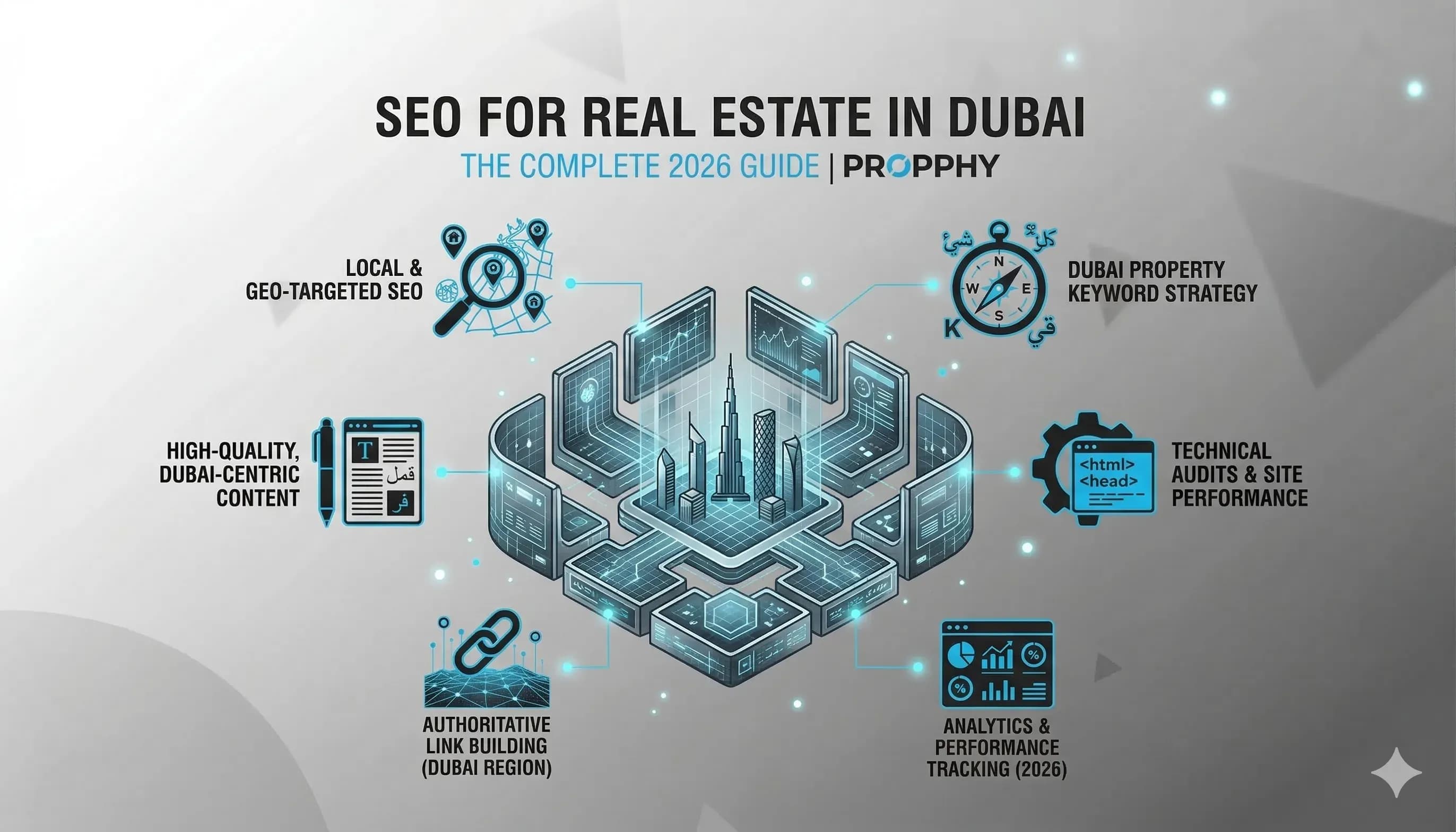
I’m Juan Adrogué, Founder & Lead Strategist at Propphy. Here’s the blunt version: most Dubai real estate websites do not lose on Google because the market is too competitive. They lose because they publish generic pages, chase broad vanity keywords, ignore community-level intent, and treat SEO like blog decoration instead of a lead-generation system.
That approach gets smoked in Dubai. This market is too active, too international, and too segmented by area, property type, and buyer profile. Dubai Land Department reported 226,000 real estate transactions worth AED 761 billion in 2024, and Property Finder’s 2025 year-in-review said Dubai’s market value grew another 31% year over year. When demand is that strong, search behavior fragments fast: buyers search by community, investors search by return, and sellers search by service-specific trust signals. You can verify those numbers on the Dubai Land Department and Property Finder.
SEO in 2026 is not about “ranking for Dubai real estate.” It is about becoming the best answer for a very specific search, on a very specific page, for a very specific buyer moment. That is how agents stop renting traffic and start compounding it.
Dubai Land Department says real estate transactions reached 226,000 in 2024, worth AED 761 billion. DLD also reported broker-executed transactions hit 96,440 in 2025, while brokerage commissions rose 31% to AED 13.59 billion. Property Finder’s annual market watch said Dubai real estate value grew 31% year over year, with residential transaction value up 26% and population inflows above 200,000 net new residents. Those are not soft signals. They tell you Dubai is still growing, competition is intensifying, and digital discoverability matters more every year. Sources: DLD 2024 transactions report, DLD brokerage sector update, and Property Finder market watch.
SEO matters in Dubai because the market is too expensive and too competitive to depend only on paid traffic. When every serious brokerage is bidding on the same categories in Google Ads and portals dominate discovery, organic search becomes the channel that compounds instead of resetting every month. A well-ranked page for “off plan property in Dubai,” “Dubai Marina apartments for sale,” or “real estate agency in Downtown Dubai” can keep generating qualified demand without charging you again for every click.
This matters even more now because the market itself keeps expanding. DLD’s 2024 transaction numbers and Property Finder’s 2025 growth data show a market with real momentum, not a flat category fighting over scraps. At Propphy, we’ve seen the same pattern repeatedly: the agents who win organic search are usually the ones who publish trust-heavy, location-specific, intent-matched pages before everyone else does. In Dubai, SEO is not a branding extra. It is infrastructure for long-term lead flow.
Dubai agents should target keywords by intent, not by ego. That means splitting your keyword universe into transaction pages, location pages, property-type pages, investor pages, developer pages, and trust pages. Search behavior in this market is clearly community-led: Bayut’s 2025 sales report said Dubai Marina stayed the top choice for luxury apartment sales, while Property Finder’s portal data showed JVC leading apartment-rental page views. That is exactly why generic pages underperform; buyers search for place, price band, and purpose, not just “real estate.”
The smartest mix is broad enough to create authority and narrow enough to convert. You want head terms that build market visibility, but your real pipeline usually comes from long-tail combinations like community + property type + action, or audience + outcome, such as “Dubai investment properties” or “off plan apartments in Business Bay.” Those terms map much better to actual leads.
| Target keyword | Search intent | Estimated monthly volume | Difficulty |
|---|---|---|---|
| dubai real estate | Broad commercial / research | 8,000–12,000 | High |
| real estate agency dubai | Commercial / agency comparison | 1,500–3,000 | High |
| properties for sale in dubai | Transactional | 5,000–9,000 | High |
| apartments for sale in dubai | Transactional | 3,000–6,000 | High |
| villas for sale in dubai | Transactional | 2,000–4,000 | High |
| off plan property dubai | Transactional / investor | 1,500–3,500 | Medium |
| dubai marina apartments for sale | Community-level transactional | 700–1,500 | Medium |
| downtown dubai real estate | Community-level commercial | 500–1,200 | Medium |
| dubai investment properties | Investor / commercial | 400–900 | Medium |
| best areas to invest in dubai property | Informational / investor | 300–800 | Medium |
Estimated volumes above are practical planning ranges based on commercial SEO datasets and live SERP competition. They are directional estimates, not official Google numbers, but they are the kind of ranges real agencies use when prioritizing page creation and forecasting effort.
Google does not rank real estate sites because they “look premium.” It ranks pages through automated systems that evaluate relevance, usefulness, and many other signals across billions of pages. Google’s own documentation says its ranking systems prioritize helpful, reliable content created for people, while its mobile-first indexing documentation makes clear that Google uses the mobile version of a site for indexing and ranking. That immediately kills a lot of lazy real estate SEO, because half the market still ships thin mobile experiences, weak page copy, and template pages with no real substance.
Third-party correlation studies still reinforce the basics. Backlinko’s 11.8 million-result analysis found stronger rankings were associated with more backlinks, more referring domains, and more comprehensive content, even if correlation is not the same thing as causation. So the real answer is simple: if your page matches intent, proves expertise, loads cleanly on mobile, earns links, and genuinely answers the query better than the current top results, you have a shot. If it is just another brochure page, you do not.
A serious Dubai real estate website should not be built around just Home, About, Listings, and Contact. It should be built around search demand. In practice, that means creating a page system: main service pages, community pages, developer pages, property-type pages, investor pages, seller pages, and editorial guides that support those commercial URLs. If your site only talks about your agency, Google has very little to rank for besides your brand name.
The minimum stack I recommend is this: one strong agency page, one page for each core service, one page for each strategic community, one page for each major developer you actively sell, one page for each major buyer intent such as off-plan or investment property, and one trust layer containing reviews, case studies, and FAQs. When we build content systems at Propphy, that architecture is usually what creates momentum first. It turns the site from a static brochure into a searchable map of Dubai demand.
On-page SEO for real estate is not stuffing “Dubai property” into every paragraph. It is page clarity. Google’s documentation says title links should be unique, clear, concise, and accurate; snippets come from page content and sometimes meta descriptions; and descriptive alt text helps search engines understand images in context. That matters a lot for real estate because buyers decide fast, and your pages live or die on whether searchers immediately understand what they are clicking.
A strong page usually has one primary intent, one clear H1, a title tag that says exactly what the page is about, supporting copy that answers buyer questions, internal links to related communities or services, original visuals, and a conversion path that matches the stage of intent. For example, a community page should cover who it is for, property mix, price positioning, lifestyle fit, nearby landmarks, and next-step CTAs. That is what “optimized” looks like in 2026: not keyword density, but high-intent clarity wrapped in trust, structure, and useful detail.
The biggest technical SEO mistakes in Dubai are not exotic. They are boring, repeated, and expensive: thin mobile versions, weak internal linking, duplicate location pages, bad canonical handling, fragmented multilingual setups, JavaScript-heavy listing pages that render poorly, and media assets that slow down key commercial URLs. Google explicitly says it uses the mobile version of your content for indexing and ranking, and warns that when mobile pages have less content than desktop pages, traffic loss can follow. It also says missing structured data, titles, descriptions, or key images on mobile can hurt how pages are indexed.
For international real estate brands, multilingual implementation is another killer. Google supports hreflang, but it expects properly mapped alternate URLs and bidirectional references between localized versions. It also deprecated Search Console country targeting years ago, so you cannot rely on old country-targeting shortcuts anymore. If your English, Arabic, and Russian versions are messy, duplicated, or cross-linked badly, your international SEO will wobble before content quality even enters the conversation.
The link-building that works in Dubai real estate is the kind that deserves to exist. Google’s starter guide says links are a crucial way search engines discover pages, and large ranking studies still show strong relationships between backlinks, referring domains, and visibility. So yes, authority still matters. But the play is not random guest posts and directory spam. It is earning links from sources that make sense in the category.
For agents and brokerages, that usually means digital PR around market commentary, original data pages, genuinely useful area guides, developer roundups, local partnerships, press mentions, business citations, and selective features in trusted publications or industry sites. A page called “Our Services” will rarely earn links. A page called “Best Areas to Invest in Dubai for Rental Yield in 2026,” backed by useful research and clear methodology, can. That is the difference. The best links are not built to manipulate rankings; they are built because the page is reference-worthy. That is the standard we use at Propphy, and it compounds better than cheap outreach ever does.
SEO usually starts working in layers, not all at once. The first layer is indexing and early visibility. The second is movement for long-tail or low-competition terms. The third is meaningful traffic. The fourth is qualified leads. In Dubai real estate, that sequence often takes longer than agents want because the SERPs are crowded with portals, aggregators, large brokerages, and older domains that already have trust and link equity. There is no serious version of SEO where you publish ten pages and dominate in a month.
What you can expect is this: fast wins usually come from specific community pages, service pages, and low-friction trust queries; bigger head terms take longer and depend on content depth, internal linking, backlinks, and brand demand. Google can discover pages automatically, but ranking them is a separate battle. If your strategy is good, you may see movement within a few months. If your goal is category-level dominance, think in quarters, not weekends.
For most Dubai brokerages, local SEO matters first and international SEO matters second. That sounds counterintuitive because Dubai attracts global buyers, but Google’s own local ranking guidance is clear: local results are mainly based on relevance, distance, and prominence. If you want to rank in map-oriented and location-sensitive searches, your Business Profile, local signals, reviews, category choices, and on-site location relevance still matter. You cannot skip that layer just because your clients are international.
International SEO becomes critical when you actively target multiple languages, multiple buyer geographies, or region-specific landing pages. In that case, Google recommends separate URLs for localized versions and proper hreflang implementation, while also making clear that old Search Console country targeting is deprecated. The winning approach is usually not either-or. It is sequencing: own Dubai-local trust first, then expand into multilingual and geo-specific content for international investors. If you try to look global before you look credible in Dubai itself, rankings usually stay average in both places.
The same five mistakes show up again and again, and they kill otherwise decent websites.
First, targeting only broad terms like “Dubai real estate” while ignoring community-level intent. Second, publishing thin location pages with no original insight, no trust signals, and no conversion path. Third, breaking mobile parity even though Google indexes from the mobile version. Fourth, treating Google Business Profile as optional, despite local ranking being shaped by relevance, distance, and prominence. Fifth, confusing activity with strategy, which means posting random blogs instead of building a page system that supports commercial URLs.
There is a sixth mistake too, even if nobody likes hearing it: copying the portals. Portals win with inventory scale. Independent agencies win with specificity, trust, local expertise, and sharp positioning. If your site tries to be a worse version of a portal, it loses. If it becomes the best answer for a defined slice of demand, it can rank and convert.
Measure SEO the way a brokerage measures deals: by pipeline quality, not vanity dashboards. Google Search Console should tell you which pages get impressions, clicks, CTR, position changes, and which queries are driving visibility. Google’s own documentation says the Search performance report breaks traffic down by queries, pages, and countries, while Business Profile Performance shows views, searches, calls, website clicks, and other interactions from Search and Maps. That is your operational layer.
But that is still not enough. You also need to connect those search signals to business outcomes in GA4 or your CRM: lead forms, WhatsApp clicks, calls, booked viewings, valuation requests, and deal source quality by landing page. Google explicitly recommends using Search Console and Google Analytics together because one explains how people found you and the other explains what they did after landing. If your rankings improve but qualified inquiries do not, the problem is not SEO visibility. It is offer-message-page fit.
The questions below are the ones that come up most often in strategy calls, audits, and rebuild projects. The pattern is always the same: agents want to know whether SEO is still worth doing, how granular pages should get, whether listings can rank, and how to balance local buyers with international investors. Those are the right questions. The wrong question is usually “How do I rank fast?” because that leads people toward shortcuts, not systems.
A better way to think about SEO in Dubai is this: every page should target a specific search intent, every section of the site should support a commercial objective, and every metric should connect back to lead quality. When you look at SEO through that lens, the tactical decisions become much easier and much less random.
Yes, if the community matters commercially and you can make the page genuinely useful. Community pages work because Dubai search behavior is heavily area-led. People do not just search “buy property in Dubai”; they search for Downtown, Dubai Marina, Palm Jumeirah, JVC, Business Bay, and other neighborhoods with very different buyer profiles. A strong community page lets you match that intent and explain who the area fits, what property mix exists there, what price positioning looks like, and why someone should inquire through you instead of bouncing back to a portal.
The key is avoiding copy-paste templates. If every community page says the same thing with a different area name, Google and users both smell it instantly. Real local detail is what makes those pages work. That is why the best-ranking area pages usually feel more like smart market briefs than generic landing pages.
Listing pages can rank, but usually not by trying to out-portal the portals. The portals win a lot of high-volume transactional SERPs because they have massive inventory, strong link profiles, and constant freshness. An independent brokerage usually wins by ranking hybrid pages: curated collection pages, community pages, developer pages, off-plan pages, investor pages, and editorial-commercial pages that explain choices instead of just dumping listings.
Listings still matter because they support internal linking, conversion, and freshness, but they often work best as the destination attached to a stronger intent page. Think “Best Off-Plan Projects in Dubai Hills” leading into relevant inventory, not a raw grid with weak copy. That format gives Google context and gives the user a reason to stay.
Not automatically. Publishing every week is useless if the topics are random. A brokerage should publish when the article supports a keyword cluster, a sales page, or a trust gap in the funnel. Good examples are investor guides, community comparisons, ROI explainers, buying-process content, visa-related property questions, and developer-specific opportunity pages. Bad examples are generic news summaries nobody searched for and nobody will link to.
Frequency matters less than strategic coverage. One strong article that supports a money page and earns links is worth more than ten filler posts. At Propphy, the best-performing content systems we see are usually mapped backwards from commercial intent, not forwards from a content calendar. Publish with purpose, not because “SEO needs blog volume.”
English is enough for many brokerages to start, but Arabic absolutely matters if you want deeper local relevance and broader market coverage. If you publish in multiple languages, Google recommends separate localized URLs and proper hreflang implementation so the correct version can be shown by language or region. That means multilingual SEO is not just translation; it is technical structure plus content quality plus user relevance.
The bigger mistake is launching weak translated pages. A thin Arabic version of an English page does not make you multilingual in any meaningful SEO sense. If you add Arabic, do it seriously: localized copy, proper internal linking, correct tags, and pages that reflect real user questions. Otherwise, English-only with a stronger execution often performs better than half-done multilingual SEO.
They do different jobs. Google Ads is faster for immediate lead capture and testing offer-market fit. SEO is slower, but it compounds and reduces how dependent you are on paying for every click forever. In a high-cost category like Dubai real estate, that distinction matters. If all your demand comes from paid media, your acquisition machine resets every month and your margins stay exposed.
The strongest setup is usually both: Ads for immediate intent capture, SEO for durable visibility, trust, and category ownership. But if the question is which one creates a more defensible asset, it is SEO. A ranking page, a trusted brand, and a strong content architecture continue working after the spend stops. An ad does not. That is why the best operators build both systems instead of arguing about one.
Start by fixing positioning, not plugins. Pick the services, communities, and buyer intents that actually matter to your business, then map pages around them. After that, clean up titles, H1s, internal linking, mobile experience, and Google Business Profile basics. Google’s documentation makes it clear that mobile parity, descriptive titles, and complete business information are foundational. Those basics are not sexy, but they are where most real estate sites leak performance first.
If you skip straight to backlink tactics or blog volume without a page strategy, you just amplify confusion. The first real SEO win is usually clarity: who you serve, where you rank, what each page is for, and what action you want from the searcher. Once that is locked, everything else gets easier.
SEO for Dubai real estate in 2026 is not mysterious. It is disciplined. Build pages around intent. Respect mobile-first indexing. Treat local trust as infrastructure. Use multilingual SEO only when you can implement it properly. Earn links by publishing pages worth citing. Then track performance all the way to leads, not just clicks.
That is the whole game. Not hacks. Not fluff. Just sharper positioning, better pages, stronger trust, and patience long enough to let compounding do its job.

Hey, in Propphy we're determined to make a business grow. My only question is, will it be yours?
It's totally free, with no commitments
Hey, in Propphy we're determined to make a business grow. My only question is, will it be yours?
It's totally free, with no commitments