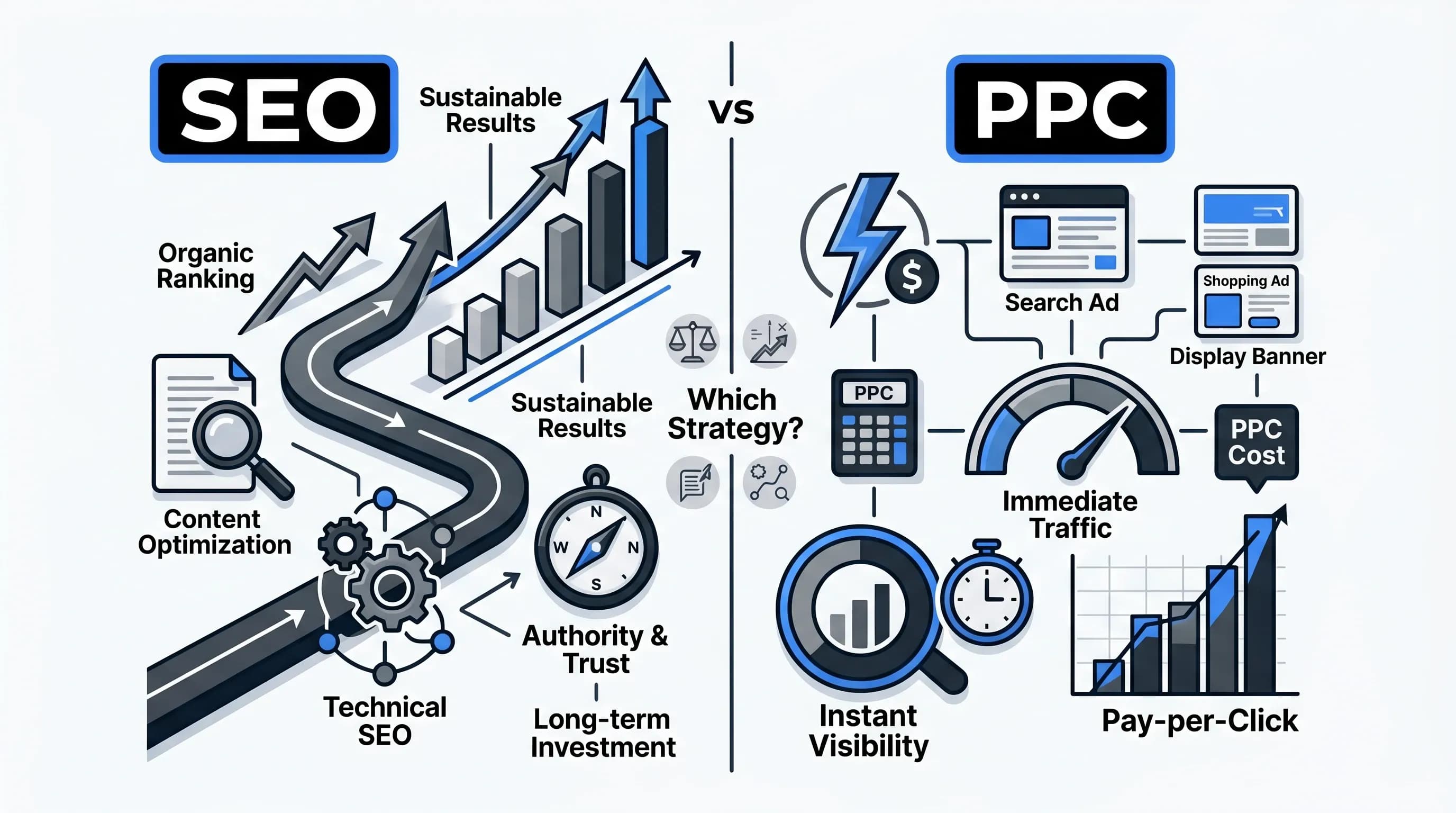
When we compare SEO vs PPC, we are really comparing two different ways to win visibility in search engines. Both can bring traffic, leads, calls, bookings, sales, and new customers. But they work very differently, cost money in different ways, and support different stages of a business growth strategy.
The simplest way we like to explain it is this: SEO is the marathon runner, and PPC is the sprinter. SEO is slower, steadier, and built for long-term growth. PPC is fast, direct, and built for immediate visibility. Another useful comparison: SEO is more like buying a house, while PPC is more like renting an apartment. With SEO, we are building an asset. With PPC, we are paying for access.
That does not mean one is automatically better than the other. The smarter question is not always “SEO or PPC?” It is often: which one should we use first, and how can we use SEO and PPC together?
For real estate agents, brokerages, property managers, mortgage professionals, home service companies, investors, and local businesses, this decision matters a lot. Paid ads can generate buyer or seller leads quickly, but costs can rise fast. Organic SEO can build long-term visibility for searches like “homes for sale in [city],” “best realtor near me,” “property management company in [city],” or “how to sell a house fast,” but it takes time and consistency.
| Category | SEO | PPC |
|---|---|---|
| Main meaning | Search engine optimization | Pay-per-click advertising |
| Traffic type | Organic traffic from unpaid search results | Paid traffic from sponsored ads |
| Search placement | Organic listings, map pack, featured snippets, local results, rich results | Google Ads, Microsoft Ads, shopping ads, display ads, local service ads, remarketing ads |
| Cost model | No direct cost per organic click, but requires investment in content, technical SEO, tools, links, and expertise | Advertisers pay per click, impression, conversion, or campaign objective depending on platform |
| Speed | Usually takes months to build meaningful rankings | Can generate traffic shortly after launch |
| Longevity | Can keep producing traffic after initial work | Traffic usually stops when ad spend stops |
| Control | Less direct control because search engines decide rankings | High control over budget, keywords, targeting, ad copy, and landing pages |
| Trust | Often seen as more credible because results are not labeled as ads | Can convert well, but ads are clearly labeled as sponsored |
| Best for | Long-term growth, authority, content assets, local SEO, sustainable lead generation | Immediate leads, new launches, testing, promotions, remarketing, high-intent searches |
SEO, or search engine optimization, is the process of improving a website so search engines can understand it, trust it, and rank it for relevant searches. SEO focuses on earning visibility in organic search results, meaning the unpaid listings that appear on Google, Bing, and other search engines.
In real estate, SEO might help a brokerage rank for searches like “condos for sale in Miami,” “best real estate agent in Austin,” “homes with pools in Scottsdale,” or “property management services in Denver.” For a local service business, it might mean ranking in the map pack for “roofer near me” or “emergency plumber in [city].”
The big appeal of SEO is that we do not pay Google every time someone clicks an organic result. But calling SEO “free traffic” is misleading. Someone still has to write the content, optimize the site, fix technical issues, build backlinks, improve the Google Business Profile, and maintain the website. If we do it ourselves, we pay with time. If we hire professionals, we pay with money.
The major difference is that the SEO work we do today can keep paying us back for months or years. A strong neighborhood guide, property type page, service page, comparison article, or local landing page can continue bringing qualified organic traffic long after it is published.
Good SEO is not about stuffing keywords onto a page. It is about matching search intent. A page targeting “how to buy a first home” should educate. A page targeting “real estate agent near me” should help someone choose and contact an agent. A page targeting “property management company pricing” should explain cost, value, and next steps clearly.
PPC, or pay-per-click advertising, is a digital advertising model where we usually pay when someone clicks an ad. In search marketing, PPC often means Google Ads or Microsoft Ads, where businesses bid on keywords and appear in sponsored results on search engine results pages.
PPC can include more than search ads. It can also include Google Shopping Ads, Performance Max campaigns, display ads, YouTube Ads, social media ads, remarketing ads, Local Service Ads, and other paid media placements.
The biggest appeal of PPC is speed. If the landing page is ready and the campaign is set up properly, we can start getting impressions, clicks, and leads very quickly. Sometimes that can happen the same day. That is why PPC is useful for a real estate team launching a new development, an investor testing “we buy houses” keywords, a property manager entering a new market, or a brokerage trying to generate seller leads right now.
But PPC has one hard reality: the moment we stop paying, the traffic stops. With PPC, we are renting visibility. As long as the budget is there, we can show up. Once the budget disappears, so do the ads.
The clearest SEO vs PPC difference is this:
SEO is about improving organic visibility in search engine results pages. PPC is about buying paid visibility through sponsored listings. Both can put us in front of people with strong search intent, but the cost structure, timeline, control, and long-term value are very different.
SEO shows up in organic listings, local packs, People Also Ask boxes, featured snippets, image results, video results, and other organic SERP features. PPC shows up in paid search ads, shopping results, display placements, video ads, remarketing ads, and other sponsored positions.
This matters because user behavior is different. Some people click ads, especially when they need something urgently. Others skip ads and go straight to organic results because they trust them more. In local search especially, a lot of attention can go to the map pack and organic results, not just paid ads.
If we need traffic immediately, PPC usually wins. We can launch a Google Ads campaign, bid on high-intent keywords, and send users to a landing page quickly.
However, fast does not always mean instantly profitable. PPC campaigns often need learning time. The algorithm needs data, and we need to refine keywords, negative keywords, ad copy, bids, tracking, and landing pages. For many businesses, we should think in terms of at least an 8–12 week testing and optimization window before judging performance too harshly.
SEO is slower. A new site may take 3, 6, 9, or 12 months to see meaningful growth, especially in competitive markets. In real estate, ranking for broad keywords like “homes for sale,” “real estate agent,” or “property management” can be extremely competitive. We can move faster by targeting long-tail keywords, neighborhood terms, niche property types, and local intent, but SEO is still a long-term play.
PPC is transactional. We pay, we get traffic. We stop paying, traffic stops.
SEO is cumulative. The content we publish, links we earn, local signals we build, and technical improvements we make can continue helping the site over time. A well-ranking page can bring leads for months or years. A real estate neighborhood guide can rank for dozens of related searches. A property management service page can keep generating calls without paying for each visitor.
That does not mean SEO is “set it and forget it.” We still need updates, maintenance, technical monitoring, and competitive improvements. But SEO has a compounding effect that PPC does not.
The cost difference between SEO and PPC is one of the biggest reasons businesses struggle to choose. PPC cost is direct. SEO cost is usually indirect.
With PPC, we pay every time someone clicks an ad. The actual cost-per-click, or CPC, depends on the industry, keyword, competition, location, Quality Score, and landing page experience.
Some clicks are affordable. Others are brutally expensive. In local service industries, a deck builder keyword in one city might cost around $5 per click, while plumbing, roofing, legal, water damage restoration, mortgage, or investor-related keywords can be much higher. Personal injury law can reach $50, $100, or even $200 per click in competitive markets. Water damage restoration can also reach around $100 per click in some local markets.
The same logic applies to real estate. A broad keyword like “real estate agent near me” might be manageable in one city and extremely expensive in another. Keywords like “sell my house fast,” “cash home buyer,” “mortgage refinance,” or “property management company” can become competitive because each lead may be worth a lot.
And not every click becomes a lead. If clicks cost $30 and every 5 clicks produces one lead, the cost per lead is about $150 before we know whether that lead becomes a customer. If that customer is worth $3,000, the math may work. If the job is worth $200 with thin margins, PPC may be painful.
SEO does not charge us per click, but it is not free. SEO costs may include:
The upside is that SEO cost does not always scale directly with traffic. If we invest in a strong local guide, service page, or real estate resource and it eventually brings hundreds or thousands of organic visits, the effective cost per visitor can drop dramatically over time.
Simple rule: PPC cost scales with clicks. SEO cost builds assets that can keep producing clicks.
There is no universal winner in SEO vs PPC ROI. The better return depends on timeline, margins, customer lifetime value, conversion rate, competition, and tracking.
PPC ROI can often be calculated quickly. If we spend $2,000 on ads and generate $8,000 in revenue, we can evaluate return almost immediately. PPC is highly measurable when tracking is set up correctly.
SEO ROI is usually delayed. We might spend $5,000 on content, technical improvements, and optimization, see modest growth for a few months, and then generate recurring traffic and leads over the next year. That makes SEO harder to evaluate in the short term but potentially stronger over the long term.
Many businesses use last-click attribution, which gives all credit to the final channel before conversion. That can mislead us.
For example, a home seller might first discover a real estate agent through an organic blog post about “how to sell a house before buying another.” Later, they compare agents, leave the site, see a remarketing ad, click a paid search ad for “listing agent near me,” and finally book a consultation.
If we only use last-click attribution, PPC gets all the credit. But SEO introduced the brand and built trust earlier in the journey. That is why we prefer looking at assisted conversions, multi-touch attribution, CRM data, call quality, and closed revenue whenever possible.
We should prioritize SEO when we want long-term visibility, trust, and sustainable traffic. SEO is especially useful when people research before buying, compare options, or need education before they make a decision.
Use SEO when:
For real estate, SEO is powerful because people search throughout the entire buying and selling journey. They search for neighborhoods, schools, market trends, mortgage questions, home values, staging tips, moving guides, agent comparisons, and property listings. PPC tends to perform best near the bottom of the funnel, but SEO lets us build trust much earlier.
We should prioritize PPC when speed, control, and targeting matter most. If we need traffic now, PPC is usually the faster path.
Use PPC when:
For example, if someone searches “emergency plumber near me,” “sell my house fast,” “book apartment tour today,” or “mortgage broker near me,” they are not casually browsing. They have immediate intent. That is where PPC can shine.
The best search marketing strategy is often not SEO vs paid search. It is SEO and PPC together. These channels should not operate in silos. They should share keyword data, landing page insights, conversion data, and messaging lessons.
We like to think of it as a relay race. PPC gets us out of the blocks fast, then SEO carries the baton over the long distance. PPC gives speed. SEO gives stability.
PPC gives fast keyword and conversion data. Search term reports show the actual queries people used before clicking an ad. That can reveal high-converting long-tail keywords, question-based searches, local modifiers, product modifiers, and content gaps.
If a PPC campaign shows that “luxury condos in downtown [city]” or “property management for single-family homes” converts well, that keyword deserves SEO attention. We might build a dedicated landing page, a guide, supporting blog posts, and internal links around it.
SEO data can also improve PPC strategy. Organic search performance can show which pages engage users, which topics have demand, which queries have high impressions, and which content already converts.
If a neighborhood guide is generating strong organic engagement but not enough leads, we can retarget those visitors with PPC ads. If a service page converts well organically but does not rank for enough commercial keywords yet, PPC can fill the gap.
PPC is great for testing headlines, offers, and calls to action. If one ad headline gets a much higher click-through rate, we can use that insight to improve SEO title tags, meta descriptions, H1s, and landing page copy.
For example, if “Get a Free Home Valuation” outperforms “Speak With a Local Agent,” that may be useful for organic snippets and real estate landing pages.
Many organic visitors do not convert on the first visit. A buyer might read a neighborhood guide and leave. A seller might check a pricing article and compare options. A landlord might read a property management guide but not request a quote.
Remarketing lets us bring those visitors back through display, search, social, or video ads. This connects SEO’s discovery power with PPC’s conversion acceleration.
When we rank organically and run paid ads, we can appear more than once on the same search results page. For local businesses, the ideal search page may include paid ads, Local Service Ads, Google Business Profile/map pack visibility, and organic rankings.
Think of Google like shelf space in a grocery store. The more relevant shelf space we occupy, the harder we are to ignore. If our ad appears at the top, our business appears in the map pack, and our website ranks organically, we look more established and credible.
For local businesses, including real estate professionals, we usually like a blended approach. Local search results often include several valuable sections:
If we can show up in paid ads, the map pack, and organic results, we can dominate much more of the search results page.
If competition is low, the map pack can sometimes be one of the fastest SEO wins. A well-optimized Google Business Profile with strong reviews can make a major difference, especially for searches like “realtor near me,” “property manager near me,” or “home inspector in [city].”
For many local businesses, the practical strategy is simple: use PPC now for leads, and build SEO in the background for long-term stability.
The right choice depends on business stage, cash flow, competition, margins, customer value, and timeline. We should be honest about what we can sustain.
If PPC requires $3,000 per month to compete in a market, can we sustain that long enough to test properly? If SEO requires 6–12 months of consistent investment before meaningful results, can our cash flow support that? The worst move is starting a strategy we cannot sustain long enough for it to work.
Our simple framework: Use PPC for speed. Use SEO for stability. Use both when we want the strongest search marketing system.
SEO and PPC have different KPIs, but both should connect to business outcomes.
Clicks are useful, but they are not the finish line. We care about qualified leads, booked appointments, clients, revenue, and profit.
The main difference is that SEO earns organic visibility, while PPC buys paid visibility. SEO focuses on ranking in organic search results. PPC focuses on paying for ads that appear in sponsored placements.
SEO is better for long-term traffic, credibility, and sustainable growth. It is not usually better if we need leads immediately. SEO takes time, but it can deliver strong long-term ROI once rankings and authority build.
PPC is better for speed, targeting, testing, and immediate visibility. It is not usually better for long-term sustainability because traffic stops when ad spend stops.
No. PPC does not directly improve organic SEO rankings. Google Ads and organic rankings are separate systems. However, PPC can indirectly support SEO by revealing high-converting keywords, testing ad copy, promoting content, and retargeting organic visitors.
In many cases, yes. SEO and PPC together create a stronger search marketing strategy. PPC provides immediate traffic and data, while SEO builds long-term visibility and authority.
SEO does not require payment for each organic click, but it is not free. SEO requires time, content, technical work, tools, optimization, backlinks, and ongoing maintenance.
PPC can be worth it for small businesses if the numbers work. We need enough budget, proper tracking, strong landing pages, realistic CPC expectations, and margins that support paid acquisition.
PPC gives faster results. A campaign can start generating traffic shortly after launch. SEO usually takes months to produce meaningful rankings and organic traffic.
PPC can show ROI faster, while SEO often has stronger long-term ROI potential. The best answer depends on conversion rate, customer value, margins, competition, and attribution.
Yes. Strong SEO can reduce dependence on paid traffic by generating organic leads and sales. SEO can also improve landing page quality, messaging, and trust, which may support better paid campaign performance.
SEO and PPC are different tools. PPC gives us speed, control, testing, and immediate visibility. SEO gives us trust, authority, compounding traffic, and long-term ROI.
If we need customers today and have the budget, PPC is usually the fastest move. If we are building for the future, SEO is essential. If we can afford both, the strongest strategy is to use PPC to generate data and revenue now while SEO builds the foundation that lowers acquisition costs over time.
So instead of asking only, “Which is better, SEO or PPC?” we should ask: which channel does our business need first, and how can we eventually make both work together?
That is the real winning strategy: use PPC for speed, use SEO for stability, and combine both for stronger search visibility.
Hey, in Propphy we're determined to make a business grow. My only question is, will it be yours?
It's totally free, with no commitments
Hey, in Propphy we're determined to make a business grow. My only question is, will it be yours?
It's totally free, with no commitments