Great storytelling is not reserved for novelists, filmmakers, TED speakers, or the naturally charismatic person who can turn a trip to the grocery store into a five-minute performance. We used to think storytelling belonged to people with dramatic life experiences: near-death escapes, wild adventures, impossible odds, or heartbreak worthy of a movie trailer. But the more we study effective storytelling techniques, the clearer it becomes that powerful stories are not about having a spectacular life.
Great storytelling is about helping people experience meaning through moments.
A story about walking dogs at 4 a.m. can be more memorable than a story about climbing a mountain if it is told with specificity, emotion, and purpose. A short video about cooking a burger faster than a drive-through can get millions of views if it asks a clear question, builds tension, and answers quickly. A real estate agent can make a neighborhood tour unforgettable if they stop listing amenities and start showing the transformation a buyer can imagine there.
Whether we are writing a blog post, building a brand story, designing eLearning content, preparing a sales presentation, creating a social media video, or pitching a real estate listing strategy, stories help us do what raw facts rarely can: capture attention, create emotional connection, improve knowledge retention, build trust, and move people to act.
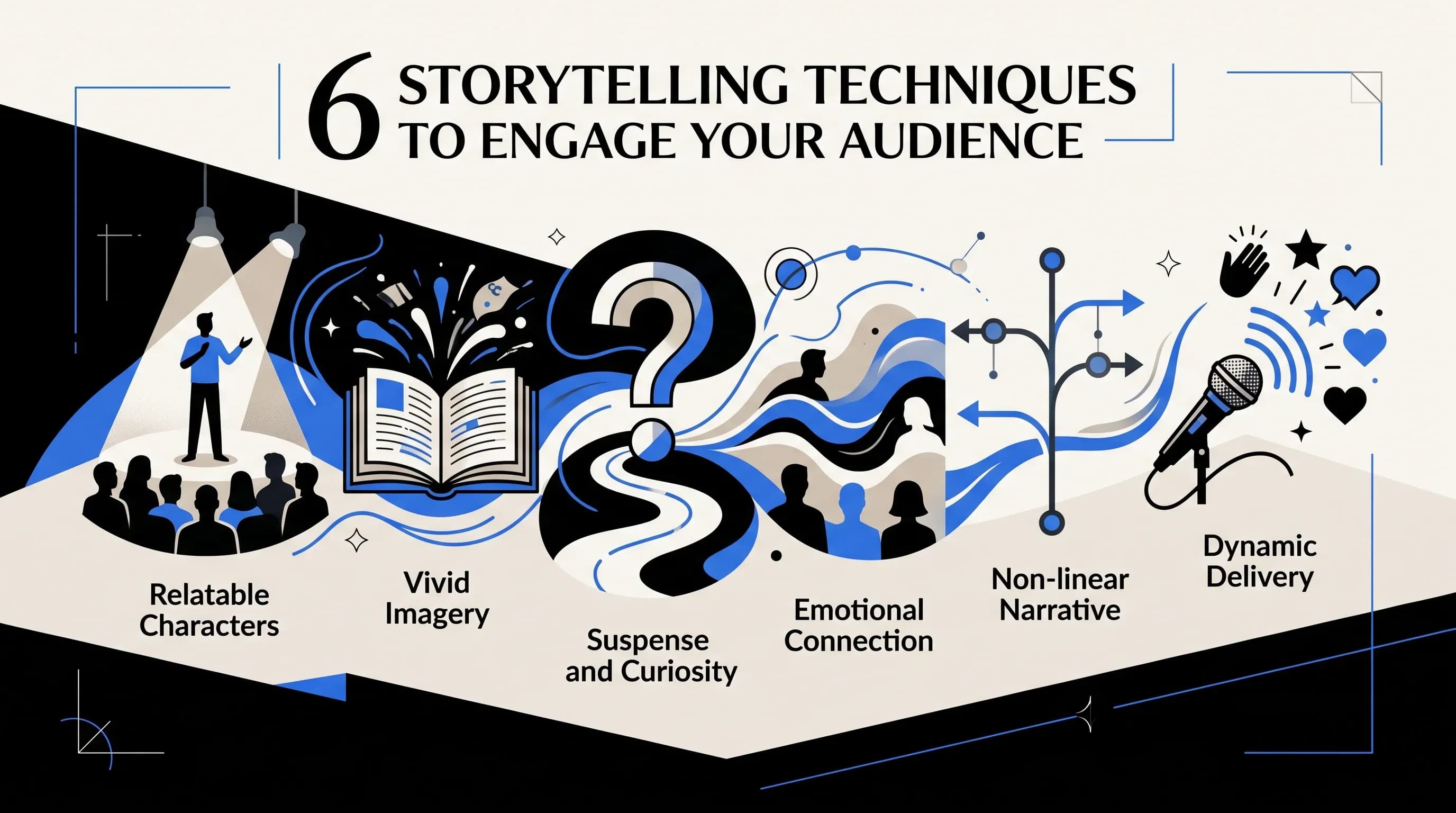
In this guide, we are going to break down 6 storytelling techniques that make messages clearer, more persuasive, and harder to forget. These storytelling methods work for marketing, sales, writing, presentations, corporate training, brand storytelling, social media, video scripts, and business communication.
Storytelling techniques are repeatable narrative methods, frameworks, and structures that help us organize information into a compelling story. They give our message shape. Instead of dumping facts, features, statistics, or opinions on an audience, we guide people through a journey: a situation, a problem, a struggle, a choice, a transformation, and a meaningful outcome.
That structure matters because attention is fragile. If we begin too far before the real story starts, people drift. If we pile up events with “and then, and then, and then,” the narrative feels flat. If we never explain why the story matters, the audience may enjoy the moment but forget the message.
The best storytelling frameworks help us answer questions like:
Using a storytelling structure is not cheating, and it does not limit creativity. A framework is not the story itself. It is the frame that helps the story land. The right story structure removes unnecessary details, sharpens the emotional point, and makes the message easier to follow.
People do not remember information only because it is accurate. They remember information because it feels meaningful. Facts inform, but stories stick.
That is why Apple product launches, Nike campaigns, memorable TED Talks, high-performing sales presentations, and effective online courses often rely on narrative structure. The best communicators are not always the ones with the most data. They are the ones who organize that data into a story people can understand, feel, and repeat.
In real estate, for example, a weak listing description says, “Three-bedroom home with updated kitchen and large backyard.” A stronger story says, “Saturday mornings start in the sunlit kitchen, coffee on the island, kids running through the back door toward the fenced yard, and the dog already waiting by the patio.” The facts are still there, but now the buyer can picture a life.
Strong storytelling can help us:
| Storytelling Technique | Best For | Core Idea |
|---|---|---|
| Three-Act Structure | Brand stories, writing, videos, presentations, customer journeys | Setup, confrontation, and resolution create a complete narrative arc. |
| Story–Problem–Solution–Proof–CTA | Sales pages, product demos, real estate pitches, webinars, executive presentations | Start human, clarify the problem, present the solution, prove it, and ask for action. |
| Golden Circle | Brand storytelling, leadership, mission-driven marketing, business communication | Start with why, then explain how, then show what. |
| Before–After–Bridge | Copywriting, landing pages, sales storytelling, coaching, transformation stories | Show the current pain, the better future, and the path between them. |
| Problem–Agitate–Solve | Persuasive storytelling, ads, sales presentations, eLearning, direct response content | Name the problem, make the stakes clear, then offer the solution. |
| Star–Chain–Hook | Short-form video, social media posts, ads, email, direct response messaging | Capture attention, build belief, and drive action. |
The three-act structure is one of the oldest and most reliable storytelling techniques. Aristotle described stories as having a beginning, middle, and end, and modern storytelling still follows this same basic rhythm because it mirrors how people naturally understand change.
In marketing, sales, eLearning, real estate, and writing, the three-act structure gives us a complete journey:
The setup introduces the audience to the situation. This is where we establish context, identify the status quo, and make the current reality feel recognizable.
A strong setup answers:
One mistake we see constantly is starting too far before the actual story begins. People explain the background, then more background, then family history, then industry context, and finally say, “Anyway, the real story starts when…” Usually, everything before that sentence can be cut.
Start closer to the action.
Instead of: “Our company has been in business for twenty years, and we serve homeowners across the region.”
Try: “Last spring, a homeowner called us after her listing had sat on the market for 73 days with no serious offers.”
Now we are in a scene. Something is happening. A person has a problem. The audience has a reason to keep reading.
The confrontation is where the story becomes interesting. Without conflict, pressure, uncertainty, or stakes, we do not really have a story. We have a report.
Conflict does not have to mean explosions, villains, or dramatic arguments. In business storytelling, conflict is often practical:
The key is causality. A boring story says, “This happened, and then this happened, and then this happened.” A compelling story uses but and therefore.
“The seller wanted a fast offer, but the home was priced above the market. Therefore, buyers kept comparing it to newer properties nearby. But lowering the price too soon could create panic. Therefore, we needed a strategy that changed the story buyers were telling themselves about the home.”
That “but” and “therefore” rhythm creates momentum. It turns a sequence of events into a narrative with tension.
The resolution shows how the problem is solved or how the hero moves forward. In business storytelling, the hero is usually not our company. The hero is the customer, learner, client, employee, reader, or audience member. Our product, service, training, or recommendation is the guide, tool, or bridge that helps the hero succeed.
A simple three-act real estate example might look like this:
The three-act structure works because it gives people the world before, the struggle, and the improved future. It is simple, but it is not shallow. It is the foundation of countless compelling stories.
The Story–Problem–Solution–Proof–CTA framework is one of the best storytelling techniques for sales presentations, product demos, launch videos, pitch decks, listing presentations, webinars, and landing pages. It is a practical commercial storytelling structure often associated with Steve Jobs-style product storytelling and modern marketers who study persuasive presentations.
The sequence is:
Start with a hook. The first job of a story is not to be beautiful. The first job is to make people want the next sentence.
A hook can be:
Specific hooks beat vague hooks. “You won’t believe this” is weak because it gives no real information. A stronger hook gives us topic, surprise, and conflict.
“This $40 cup became a billion-dollar status symbol, but the company almost discontinued it.”
That line works because it creates curiosity immediately. In real estate, marketing, or sales storytelling, the same principle applies. We want to open a loop in the audience’s mind.
Once we have attention, we need focus. One of the biggest mistakes in persuasive storytelling is trying to solve too many problems at once. A sales story, brand story, or presentation becomes stronger when it names one urgent problem the audience recognizes.
For example:
“The problem is not that buyers dislike the property. The problem is that the listing is not helping them understand why this home fits the life they want.”
That is more compelling than saying, “We need better marketing.” It clarifies what is broken.
After the problem is clear, the solution should feel like the natural next step. It should not interrupt the story. It should answer it.
For example:
“The solution is a story-driven listing strategy: lead with the lifestyle, use photos that create a visual journey, write copy around buyer motivations, and support the campaign with short-form neighborhood video.”
This works because the solution is tied directly to the problem. We are not just describing services. We are explaining how the hero moves forward.
A story becomes persuasive when it is supported by evidence. Emotion opens the door, but proof builds trust.
Proof can include:
In sales storytelling, proof helps customers feel safe saying yes. In eLearning, proof may show up as realistic feedback inside a scenario. In real estate, proof might be days on market, list-to-sale price ratio, showing activity, offer volume, or testimonials from sellers who felt guided instead of pressured.
Finally, we need a call to action. Do not assume the audience will infer what to do next. A strong CTA answers:
Examples include:
This storytelling framework works because it combines emotion, logic, evidence, and action in a sequence that is easy to follow.
Simon Sinek’s Golden Circle is one of the most influential storytelling frameworks for leaders, brands, and organizations. Its core idea is simple: start with why.
Many businesses communicate from the outside in:
But more inspiring communication often works from the inside out:
The “why” is the belief, purpose, or emotional reason behind the message. It explains why the audience should care beyond the product, feature, service, listing, or transaction.
Ask:
For example, a real estate brand might not start with, “We help people buy and sell homes.” It might start with:
“We believe moving should feel less like a transaction and more like a guided transition into the next chapter of your life.”
That “why” creates emotional relevance. It tells us there is a human purpose behind the service.
The “how” explains the process, values, method, or approach that supports the purpose.
“We do that by combining pricing strategy, local market knowledge, story-driven marketing, clear communication, and step-by-step guidance from preparation to closing.”
The “how” builds credibility. A purpose without a method can feel like a slogan. A clear method makes the belief practical.
The “what” is the offer, product, service, course, presentation, or recommendation.
“That is why we help homeowners sell with a strategy that positions their property clearly, attracts qualified buyers, and protects their confidence throughout the process.”
The Golden Circle is especially useful for brand storytelling, leadership communication, recruiting, internal culture, content marketing, and mission-driven businesses. It helps us communicate not just what we do, but why it matters.
One of the most comforting things about storytelling is that we do not need a wild life to tell better stories. We need to notice the meaning inside ordinary moments. A story about walking dogs before sunrise is not powerful because dogs are unusual. It becomes powerful when it reveals responsibility, burnout, healing, discipline, or rediscovering presence.
The Golden Circle helps us find that meaning. It asks us to move beyond “what happened” and into “why it mattered.”
That is also what strong brand storytelling does. A mortgage advisor is not just processing loans. A home inspector is not just checking systems. A real estate agent is not just opening doors. The “why” turns the work into a story people can care about.
Before–After–Bridge, often shortened to BAB, is a classic copywriting and storytelling technique. It is simple, memorable, and effective because it focuses on transformation.
The structure is:
BAB works especially well in marketing, real estate copywriting, sales presentations, coaching, training, internal change communication, and personal development content.
The “before” stage describes the audience’s current reality. It should be specific enough that they think, “Yes, that is exactly what is happening.”
“Your team is creating more content than ever, but every campaign still feels rushed. Videos take too long, social posts feel disconnected, and the brand message changes depending on who is writing.”
Or in a real estate context:
“You know your home has value, but every pricing conversation feels uncertain. You do not want to leave money on the table, but you also do not want the listing to sit for weeks while buyers move on to newer options.”
This is not fearmongering. It is recognition. A good “before” makes the audience feel understood.
The “after” stage paints the better future. Avoid vague promises like “things will be better.” Show what better actually looks like.
“Now imagine launching with a clear pricing strategy, listing copy that frames the home around buyer motivation, photography that tells a visual story, and a marketing plan that creates confidence instead of guesswork.”
The “after” helps people see the transformation. It moves the story from frustration to possibility.
The bridge explains how to move from the current state to the desired state.
“The bridge is a repeatable storytelling strategy: identify the buyer’s real motivation, show the current friction, position the property as the answer, support the message with market proof, and make the next step clear.”
BAB is powerful because it makes value visible. Instead of saying, “We offer marketing services,” we show the journey from confusion to clarity.
Problem–Agitate–Solve, or PAS, is one of the most persuasive storytelling techniques in copywriting, advertising, sales, eLearning, and business communication. It is especially useful when the audience knows there is a problem but has not yet felt enough urgency to act.
The structure is:
PAS is more emotionally intense than Before–After–Bridge. BAB focuses on transformation. PAS focuses on urgency.
Start by naming the problem clearly.
“Your sales team has good data, strong products, and professional presentations, but prospects still leave meetings unclear about why they should act now.”
Or:
“The listing is getting views, but not enough showings.”
The problem should be direct and recognizable.
Agitation means making the real cost of the problem visible. It is not manipulation. It is clarity.
Good agitation may include:
For example:
“If buyers are viewing the listing but not scheduling showings, the issue may not be visibility. It may be desire. The property is being seen, but the story is not strong enough to make buyers rearrange their weekend, call their agent, and step inside.”
That agitation deepens the problem. It shows what is really at stake.
Defined stakes make any story more engaging. In a sales story, the buyer may lose budget or momentum. In a workplace scenario, a manager may lose team trust. In a cybersecurity course, one careless click may expose sensitive data. In a real estate transaction, hesitation can mean losing the right buyer, the right property, or negotiating power.
Finally, introduce the solution.
“Instead of simply adding more facts to the listing, rebuild the story around the buyer’s life: the morning routine, the commute, the school pickup, the dinner on the patio, the quiet office upstairs, and the neighborhood moments that make the home feel worth seeing.”
PAS works because it mirrors how people often decide to change. They recognize a problem, feel the seriousness of it, and then look for a way out.
PAS is powerful, but it needs judgment. If every message is written as a crisis, the audience gets exhausted. We want to make the stakes clear, not turn every inconvenience into a catastrophe.
The best PAS storytelling is honest. It says, “Here is the problem. Here is why it matters. Here is the practical way forward.”
Star–Chain–Hook is a compact storytelling structure that works especially well for short-form content, ads, email campaigns, landing pages, social media posts, listing captions, video scripts, and direct response messaging.
The structure is:
The star is the attention-grabber. It can be a bold claim, surprising insight, vivid image, emotionally appealing promise, or specific question.
“The best selling point of this home is not the kitchen. It is the life that kitchen makes possible.”
That line creates curiosity. It invites the audience to look beyond features.
For short-form video, the star must work quickly. People decide in seconds whether to continue watching. A vague opening like “Here is something interesting” is weak. A specific opening is stronger:
“This 900-square-foot condo feels larger than homes twice its size, and the reason is hidden in the floor plan.”
The chain supports the opening claim. Each link gives the audience another reason to believe.
A chain may include:
For example:
“The open sightline from the kitchen to the living area makes the main space feel connected. The built-in storage keeps clutter out of view. The balcony extends the living area outside. And because the building sits two blocks from the train, the owner gets more usable time every weekday.”
Each sentence adds a link in the chain. We are not listing features randomly. We are building belief.
The hook tells the audience what to do next. It should be direct, relevant, and connected to the value we have just established.
“If you want a smaller space that still lives comfortably, schedule a private showing this week.”
Another way to think about Star–Chain–Hook is:
This technique is especially useful in noisy environments where people are overloaded with information. The star stops them, the chain convinces them, and the hook gives them a next step.
The six storytelling frameworks above help us organize the message. But structure alone is not enough. A story also needs emotional involvement. These storytelling strategies can strengthen any framework, whether we are writing, selling, teaching, presenting, or marketing.
People connect deeply with stories when they see themselves in the hero. In business storytelling, the hero is usually not the brand. It is the customer. In eLearning, it is the learner. In sales, it is the buyer. In real estate, it is the person trying to move from one chapter of life to the next.
To make the audience the protagonist:
A protagonist does not have to be ordinary to be relatable. Sometimes audiences connect with characters who represent what they aspire to become: more confident, decisive, ethical, creative, resilient, or skilled.
This may be the biggest difference between average storytellers and great ones: average storytellers report; great storytellers relive.
Reporting sounds like this:
“The meeting was tense.”
Reliving sounds like this:
“Nobody spoke for several seconds. The only sound was the air conditioner humming above us.”
Reporting gives facts. Reliving creates experience.
Specificity makes stories memorable. People often think being general makes them more relatable, but general emotion is forgettable. Specific detail lets the audience enter the scene through their own body.
Instead of saying:
“The street was quiet.”
We can say:
“The streets were empty except for the glow of streetlights on the wet road and the jingle of the dogs’ collars.”
That detail creates a scene. We can see it, hear it, and feel it.
Sensory storytelling makes a narrative more immersive. This is especially useful in video marketing, eLearning, writing, presentations, and real estate content, where we want people to feel present inside the experience.
The VAKS model can help:
Instead of writing, “The home has a nice backyard,” we might write:
“At sunset, the backyard catches the last warm light of the day, with enough space for a long table, a grill, and kids chasing each other across the grass while dinner finishes.”
That is still marketing, but it is no longer just a list. It is a moment.
A story becomes powerful when we care about the people inside it. But that does not mean every character needs a long biography. Character is revealed through choices under pressure.
Ask:
In a sales story, the customer’s choice may reveal caution, ambition, frustration, or urgency. In workplace training, a manager’s choice may reveal leadership style. In a listing story, a seller’s choice to invest in preparation before going live may reveal trust in the process.
Objects can also reveal character. A championship ring from a parent, two shirts hanging in a closet, a stolen gemstone, a child’s drawing on the refrigerator, or a bright orange dog ball with the number four written on it can become emotionally powerful if the object carries memory, longing, identity, or loss.
The object should not be random decoration. It should affect the plot or expose something about the person holding it.
Stories become more engaging when the audience understands what can be won or lost. Stakes create urgency.
To define stakes, ask:
In a real estate story, the stakes might be selling before a relocation deadline, avoiding a price reduction, winning a competitive offer, or protecting a family’s next step. In a corporate training scenario, the stakes might be safety, compliance, customer trust, or team morale. In a sales conversation, the stakes might be missed revenue, lost time, or an opportunity slipping to a competitor.
When people understand the stakes, they become invested.
A cliffhanger creates curiosity by leaving something unresolved. In learning, marketing, presentations, and sales, cliffhangers can motivate people to continue, reflect, or act.
Useful cliffhanger-style questions include:
The goal is not to confuse the audience. The goal is to keep them mentally engaged after the content ends.
A story is not just a pile of good moments. It needs shape, rhythm, and direction.
Good writing varies pace. Short sentences create punch. Medium sentences create flow. Longer sentences can build momentum when the idea is swelling toward something important and the audience is ready to be carried by the rhythm of it.
Repetition also creates pattern. Pattern creates expectation. And once the audience expects something, we can either satisfy that expectation or break it.
A repeated phrase can become powerful:
“We told ourselves the listing just needed more time.”
“Again, we told ourselves it just needed more time.”
“By the third week, we stopped saying it needed more time and admitted it needed a better story.”
Repetition gives the story shape. It makes the final shift more satisfying.
Different storytelling frameworks serve different purposes. The best technique depends on the audience, platform, message, and desired outcome.
| If You Want To... | Use This Storytelling Technique |
|---|---|
| Create a complete journey with a beginning, conflict, and resolution | Three-Act Structure |
| Persuade clearly in a pitch, product demo, or sales presentation | Story–Problem–Solution–Proof–CTA |
| Communicate purpose, leadership, or brand values | Golden Circle |
| Show transformation from current pain to better future | Before–After–Bridge |
| Create urgency and make the cost of inaction clear | Problem–Agitate–Solve |
| Write short-form content, ads, captions, or direct response messages | Star–Chain–Hook |
We can also combine storytelling structures. A sales presentation might start with the Golden Circle, use Problem–Agitate–Solve to create urgency, include proof through the Story–Problem–Solution–Proof–CTA framework, and end with a Star–Chain–Hook-style call to action.
Weak version:
“This updated three-bedroom home features hardwood floors, a modern kitchen, and a fenced backyard.”
Story-driven version:
“The heart of this home is the kitchen, where morning light hits the island before the rest of the house is awake. From there, the day opens into the living room, the back patio, and a fenced yard built for dogs, kids, garden beds, or quiet evenings after work.”
The second version still communicates features, but it turns them into an experience.
Problem: “Your team is spending more time preparing presentations than having meaningful customer conversations.”
Agitate: “That means every new opportunity creates more pressure. Slides get customized at the last minute, messaging changes from rep to rep, and prospects leave without a clear reason to act.”
Solve: “A repeatable sales storytelling framework gives every rep a clear way to start with the customer’s world, show the cost of inaction, present the recommendation, and make the next step easy.”
Instead of teaching a cybersecurity rule as a static slide, we can create a scenario:
“It is 4:58 p.m. on Friday. An email from the CFO asks you to open an attached invoice before the finance team leaves for the weekend. The logo looks right. The tone feels urgent. But one detail seems off. What do you do?”
That story places the learner in the protagonist’s shoes. It creates stakes, pressure, and a decision. The lesson becomes active instead of passive.
Why: “We believe people make better housing decisions when they feel informed, respected, and never rushed.”
How: “We combine local market insight, clear communication, negotiation strategy, and story-driven marketing to guide every step.”
What: “We help buyers and sellers move with more confidence.”
This is stronger than starting with a generic service list because it gives the brand emotional purpose.
Many stories begin before they need to. If the real story starts when the laptop freezes in front of twelve executives, start there. If the real story starts when the buyer walks into the kitchen and stops speaking, start there. If the real story starts when the inspection report threatens the deal, start there.
Context matters, but too much context too early kills curiosity.
“We were nervous” is a report. “The paper in our hands started to wrinkle because our palms were sweating” is a moment. Reliving pulls the audience into the experience.
In brand storytelling and sales storytelling, the customer should usually be the hero. The brand is the guide. If we make ourselves the hero too often, the audience may feel like spectators instead of participants.
Specificity helps, but clutter hurts. Good description is not about piling on adjectives. It is about choosing the right detail. One vivid detail can do more than ten generic ones.
A story becomes powerful when the audience understands why it matters. One simple phrase can help:
“The reason we are telling you this is because...”
That sentence forces the story to connect to the listener, reader, buyer, or learner.
There is a balance. Sometimes the meaning should be clear. Other times, especially in teaching, coaching, leadership, or sales, the relevance needs to be stated directly. But if we reach a strong ending and then keep explaining, the magic can leak out.
Trust the audience when the meaning is obvious. Clarify when the lesson matters.
If we simplify these six storytelling techniques into one practical checklist, it looks like this:
The best storytelling techniques help us do more than communicate facts. They help us create meaning. They show people what matters, why it matters, what is at stake, and what to do next.
The six storytelling techniques we covered are:
We do not need a dramatic life to become better storytellers. We need attention. We need structure. We need specificity. We need honesty. And most of all, we need to notice the meaning inside ordinary moments.
Because every business, brand, course, presentation, property, product, and person already contains stories. The question is whether we are merely reporting them, or learning how to make people feel them.
Hey, in Propphy we're determined to make a business grow. My only question is, will it be yours?
It's totally free, with no commitments
Hey, in Propphy we're determined to make a business grow. My only question is, will it be yours?
It's totally free, with no commitments