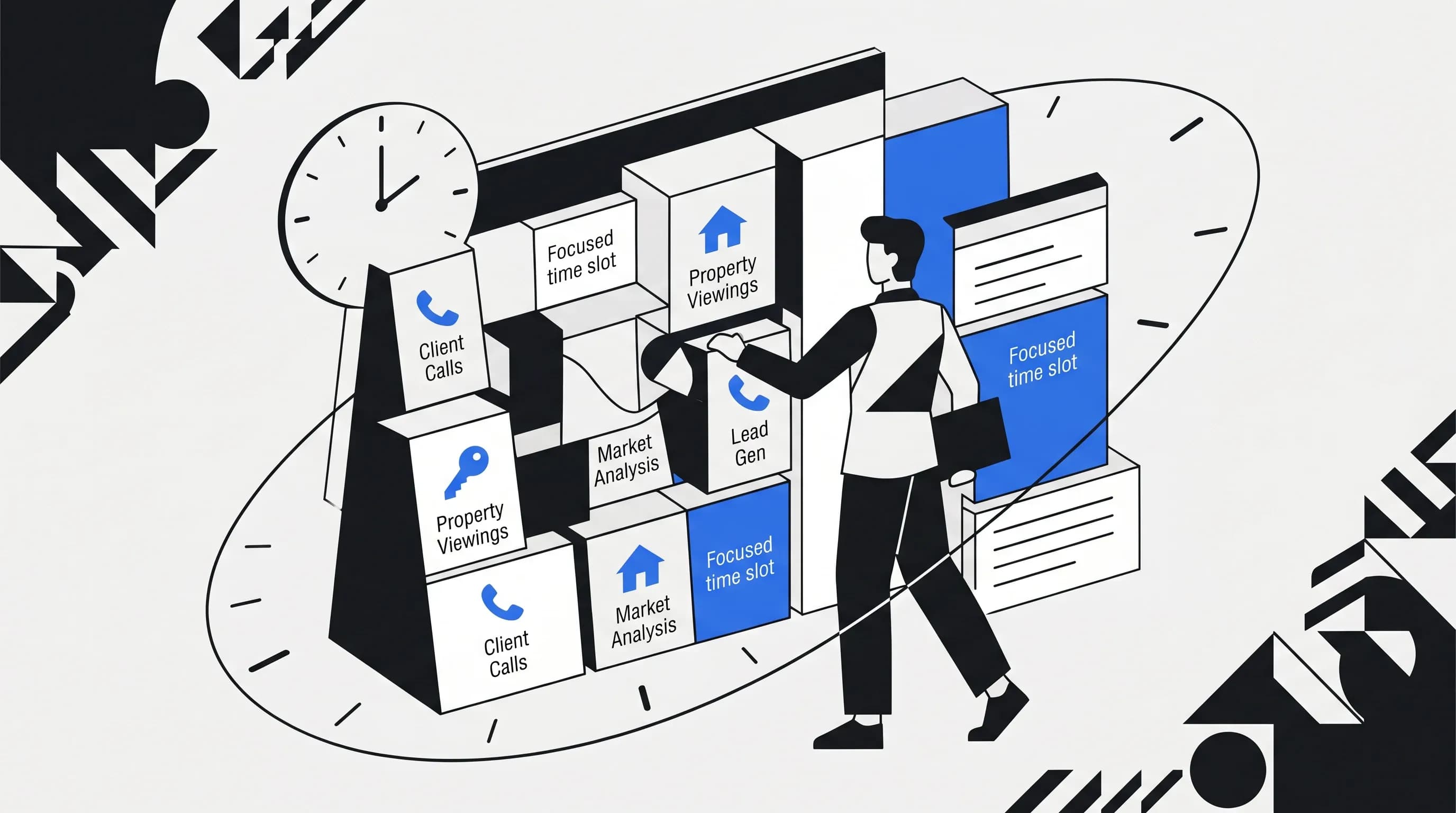
If we work in real estate, we already know how easy it is to stay busy all day and still feel like we did not move the business forward. We can answer texts, check email, drive across town, tweak marketing, scroll for content ideas, handle paperwork, and react to one “urgent” thing after another. Then the day ends, and the real revenue-generating activities barely happened.
That is exactly why time blocking for real estate agents matters. It gives structure to a business that is naturally full of interruptions. Instead of letting the day happen to us, we decide in advance how our time will be used. In our experience, that shift is where real estate time management starts becoming real estate productivity.
This guide walks through how to get started with time blocking, how to build a manageable schedule, and how to protect the work that actually creates closings, commissions, and better work-life balance.
Time blocking is a scheduling method where we assign specific time slots to specific categories of work. Rather than saying, “We need to prospect, follow up, handle admin, and post on social media today,” we decide when each of those things will happen.
A simple way to think about it is this: budgeting tells our money where to go before it disappears, and time blocking tells our hours where to go before they disappear.
For busy real estate agents, this matters because time is inventory. If we misuse it, we do not just lose hours. We lose momentum, lead conversion, confidence, and income.
The purpose is not to create a pretty calendar. The purpose is to give important work a protected place in the day.
Most agents do not have a time problem as much as they have a priority problem. Real estate time management is really about deciding what deserves our best hours and what does not.
The question is not only, “How can we fit more into the day?” It is, “What should we be doing at all, and when should we be doing it?”
That distinction matters because a full calendar does not automatically equal a productive business. Some tasks feel like work but do not move us closer to listings, appointments, negotiations, or closings. We can spend far too much time on Canva, inbox cleanup, low-return networking, or endlessly reorganizing a CRM while the actual moneymaking work gets delayed.
In most real estate businesses, the highest-value activities include:
If those are not on the calendar, we are leaving the business to luck.
Before building a time-blocking calendar, we need to know what the calendar is supposed to help us accomplish. “Be more organized” is not enough. “Work harder” is not enough either.
Strong time management strategies for real estate agents begin with specific goals, such as:
Once the goal is clear, our schedule becomes easier to build. We can ask which tasks are important, which are urgent, which are repeatable, and which should be delegated, delayed, or dropped.
Before creating an ideal schedule, we should evaluate our current schedule honestly. For one full week, track everything.
This is where many agents discover the truth: we are not always losing time to laziness. We are losing it to fragmentation, interruptions, and low-value task switching.
During the review, look for patterns:
A good schedule is built around reality, not fantasy.
One of the best ways to understand real estate time blocking is the rocks, pebbles, and sand analogy. The rocks are the most important things. The pebbles support them. The sand is everything else.
If we fill the jar with sand first, the rocks will not fit.
For real estate professionals, the rocks are usually:
The sand is often:
A smart time-blocked schedule puts the rocks in first. That is how we make room for high-value activities before the day gets loud.
If there is one pattern that consistently shows up in realtor time management, it is this: successful agents protect the morning.
By afternoon, the business often turns reactive. Buyers want access. Sellers need updates. Lenders call. A title issue pops up. A contract deadline gets closer. If we wait until later to do our most important work, there is a good chance it will not happen.
Morning is where we can reclaim focus.
That does not mean every agent needs the same hours. It means we need a consistent start and a defined point when work begins. For many agents, a strong morning routine includes three categories:
A grounded start can dramatically improve focus. That might mean prayer, journaling, meditation, quiet reflection, gratitude, or simply a few minutes without the phone. The principle is simple: do not let notifications hijack the day before we even begin.
A walk, stretching, yoga, a short workout, or even a few minutes outside can improve energy, mood, and resilience. Real estate can be physically stagnant and mentally draining, so movement supports better productivity.
Even for agents working from home, there is a real difference between drifting into the day and preparing to work. A simple startup routine helps us show up more intentionally.
If we only protect one time block, it should usually be lead generation. This is the engine of the business. When prospecting disappears, the pipeline eventually reflects it.
Lead generation can include:
Most agents do not need to prospect all day. But they do need consistency. A common benchmark is 90 minutes to 2 hours a day, 4 to 5 days a week.
We should treat this block like a listing appointment. If something legitimate displaces it, we move it. We do not delete it. That one rule can completely change schedule management for Realtors.
A short prep ritual helps remove friction. Otherwise, we can waste the first 20 or 30 minutes “getting ready to work” without ever really starting.
Before lead generation begins:
Simple systems reduce procrastination. In real estate productivity, small setup habits often make the difference between a block we intend to do and a block we actually complete.
One of the strongest time management skills for real estate agents is learning not to confuse urgent with important. Real estate is full of things that feel loud, immediate, and emotionally demanding. But not everything that is urgent is business-building.
| Task Type | What to Do | Examples |
|---|---|---|
| Important and urgent | Do first | hot lead response, contract deadline, same-day listing prep |
| Important but not urgent | Schedule deliberately | prospecting, database nurture, continuing education, planning |
| Urgent but less important | Delegate or limit | routine scheduling, document chasing, repetitive admin |
| Neither important nor urgent | Reduce or eliminate | mindless scrolling, unnecessary meetings, busywork |
This is where the Eisenhower Method, the 80/20 rule, and the 4Ds of time management become useful. If 80% of our results come from 20% of our activities, our calendar should reflect that reality.
Not every hour has the same value. Some periods are naturally better for focused, conversation-based work. Others are better for administrative tasks, paperwork, or routine follow-ups.
During high-energy hours, schedule:
During lower-energy hours, schedule:
Do not waste your best mental window on inbox maintenance if that same window could be used for revenue-generating activities.
Task batching is one of the most effective real estate productivity systems because it reduces context switching. Every time we jump from one type of work to another, we lose momentum.
Examples of batching:
We can also use themed days or themed afternoons:
This kind of workflow management for agents makes the week feel more manageable and less mentally cluttered.
Time blocking does not work if we assign time but do not defend it. A prospecting block is only useful if we actually prospect during it.
To reduce distractions:
Notifications, texts, and reactive inbox checking are not a schedule. They are interruptions. Real estate agent efficiency improves when we stop allowing every outside request to break concentration.
No real estate schedule survives unchanged. Clients cancel. Showings run late. Inspections get rescheduled. A hot buyer appears in the middle of something else. That is why buffer time is not optional.
Helpful ways to build flexibility into the calendar:
This is where structured flexibility beats rigidity. We want a schedule strong enough to guide the day, but flexible enough to survive actual real estate.
Administrative tasks matter. Compliance matters. Transaction coordination matters. But admin supports income. It does not usually create it.
That is why it helps to block administrative work instead of letting it spread across the entire day.
Examples:
This keeps revenue-generating activities from being crowded out by paperwork and repetitive tasks.
One of the fastest ways to improve task management for real estate agents is delegation. If we insist on personally handling everything, we limit growth.
Tasks that can often be delegated include:
That might mean a virtual assistant, transaction coordinator, in-house assistant, or marketing agency. Delegation is not about avoiding work. It is about reserving our time for relationship building, client meetings, negotiations, and lead conversion.
Many agents do not fail because time blocking is a bad strategy. They fail because they never build the review habit that keeps the system updated.
A weekly planning session of 30 to 60 minutes is often enough. Friday afternoon or Sunday evening both work well.
During that review, we can:
This is especially important for agents with families, part-time schedules, or inconsistent appointment flow. A realistic schedule we will follow beats a perfect schedule we abandon.
If we are part-time, time blocking matters even more. Limited hours mean limited margin for drift. We cannot afford to spend our few available windows on low-value activity.
Strong part-time schedule management may include:
For many part-time agents, the database is the best place to start. Letting the sphere know what we do, staying top of mind, and building consistent relationship-based outreach often produces better results than trying to do everything at once.
The best productivity tools are the ones we actually use. We do not need a complicated stack to make time blocking work.
Useful options include:
Some agents do well with a hybrid setup, such as a digital calendar for scheduling and a paper planner for daily visibility. The key is to avoid rainbow chaos and disconnected systems.
Best practices:
An end-of-day routine is one of the most underrated time management strategies for real estate agents. Without it, we often start the next morning already feeling behind.
A quick reset can include:
Even 10 to 15 minutes can make the next day much smoother.
Important work is not limited to immediate transactions. Continuing education, legal updates, market trends, script practice, technology learning, and negotiation improvement all deserve calendar space too.
These tasks are important but often not urgent, which means they are easy to postpone. But over time, they improve service quality, confidence, compliance, and earning potential.
If we never block time for learning, we stay reactive not just in our schedule, but in our skills.
Real estate productivity should not come at the expense of sustainability. A well-built schedule includes recovery, breaks, and personal life.
We should deliberately schedule:
Burnout prevention is part of real estate agent organization. Agents who never recover become less focused, less patient, and less effective. Protecting personal time helps us perform better professionally.
Here is a simple framework we can adapt based on market, business model, and personal responsibilities:
This may be the most practical rule in all of realtor time blocking. Things will come up. We will have an inspection issue, a hot lead, a contract fire, a childcare conflict, or a real emergency.
That does not mean the block disappears. It means we move it immediately.
If lead generation gets bumped for a legitimate appointment, we reschedule it to later that day or another protected slot. We do not just hope it happens. We physically move the block.
That habit keeps important work alive even when the day gets chaotic.
Time blocking is not set-and-forget. We should regularly evaluate whether the calendar is helping us win the day.
Questions to ask:
The goal is not calendar perfection. The goal is a schedule that improves focus, efficiency, and results.
Time blocking is one of the simplest and most effective productivity strategies for Realtors because it forces the calendar to reflect what actually matters. It helps us stop being busy and broke, stop living in reaction mode, and start building a business with more consistency and less chaos.
If we are just getting started, we do not need to overhaul everything at once. We can begin with four moves:
From there, we can layer in batching, better boundaries, automation, delegation, admin blocks, continuing education, and stronger recovery habits.
Busy is not the goal. Productive is. Profitable is. Peaceful is. And in real estate, that often starts with one protected block at a time.

Hey, in Propphy we're determined to make a business grow. My only question is, will it be yours?
It's totally free, with no commitments
Hey, in Propphy we're determined to make a business grow. My only question is, will it be yours?
It's totally free, with no commitments