If we’re honest, most of us didn’t get into real estate because we love checklists and calendars. We got into this business for freedom, flexibility, and uncapped income—then discovered that without a solid real estate agent planner, every day can feel like chaos.
The agents who hit their goals consistently—the six‑figure solo agents, the 22‑year‑olds closing 75 deals a year off online leads, the listing agents who don’t work nights and weekends—have one thing in common: they run their business from a clear, repeatable daily schedule and to‑do list, not from their inbox.
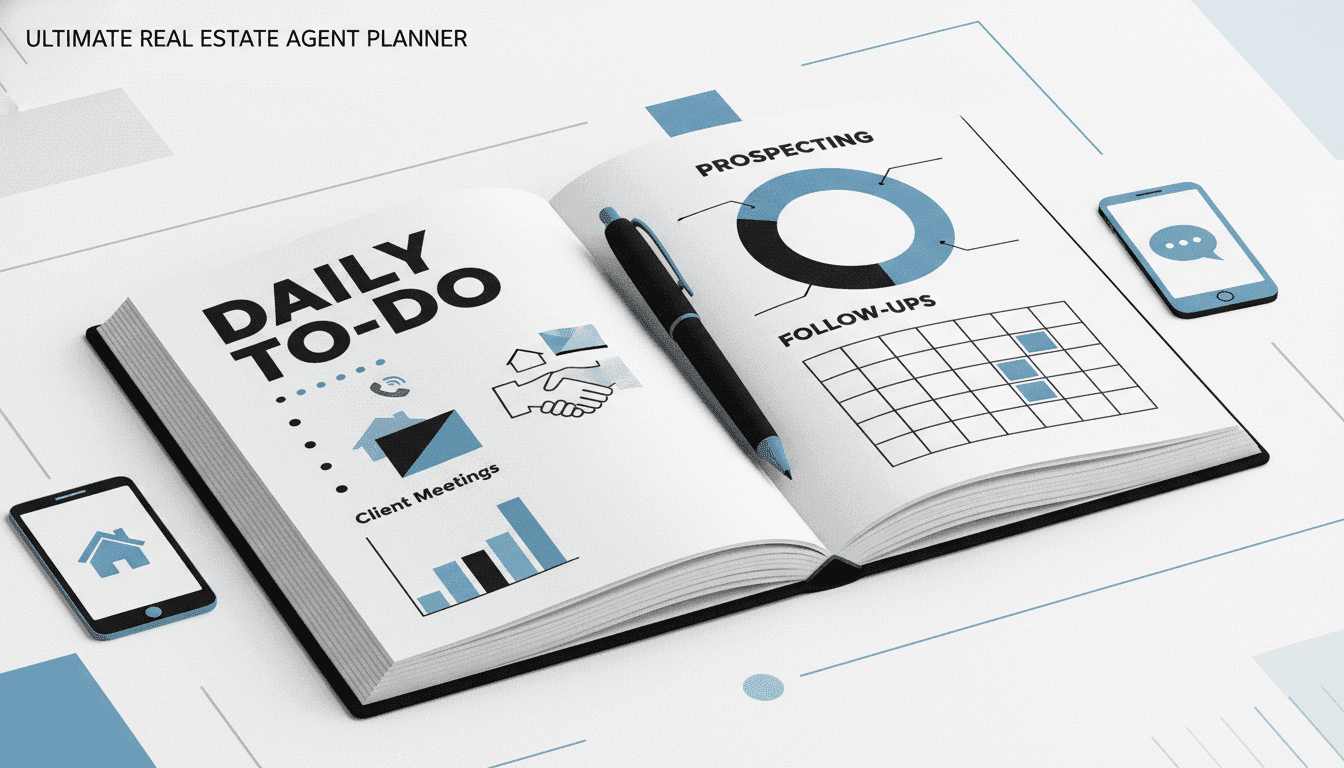
In this guide, we’re building the ultimate real estate agent daily to‑do list and turning it into a practical real estate agent planner you can follow every single day. We’ll cover time blocking, lead generation, follow‑up, client care, content, and even when to switch your phone off.
Why Every Agent Needs a Real Estate Agent Planner (Not Just a Pretty Notebook)
We’ve all met agents who seem “busy” nonstop yet barely close any deals. The difference between busy and productive usually comes down to one thing: a daily planner that prioritizes income‑producing activities and protects time for everything else.
Your planner—whether it’s a digital calendar, a printable real estate daily planner, or a simple legal pad—should help you:
- Be successful & organized instead of reactive and overwhelmed.
- Build a consistent real estate agent daily schedule that you can improve over time.
- Track your daily activity so you can tweak your inputs instead of lowering your goals.
- Balance lead generation, follow‑up, client service, marketing, and personal life without burning out.
The tools can be simple. We’ve seen top‑producing agents succeed with nothing more than a notebook where they write a five‑item “Power List” of income‑producing tasks every night and then execute it relentlessly the next day. Others use a full‑blown real estate productivity planner with daily, weekly, and monthly pages. The common thread is that they treat their planner like a boss, not a suggestion.
Core Principles Behind a Successful Real Estate Agent Daily Schedule
Before we lay out the actual to‑do list, we anchor everything in a few rules. These are the principles we see over and over again in the agents who build a six‑figure business from scratch.
- We’re business owners, not employees. No one is going to fire us for spending three hours fiddling with our logo or scrolling the MLS. The market will just ignore us. Our real estate agent business planner has to treat prospecting and appointments like non‑negotiable shifts.
- Income‑producing activities come first. Lead generation, lead follow‑up, and appointments always go on the calendar before email, paperwork, or Canva designs. We’ve watched brand‑new agents double their business simply by doing 3+ hours of lead gen a day and refusing to schedule anything over that block.
- Routines beat motivation. None of us wake up excited to call expireds every day. The agents who win are the ones who follow their daily success checklist whether they feel like it or not.
- Done beats perfect. Imperfect calls, rough‑cut videos, and simple follow‑up texts will always beat the perfect plan we never execute.
- We track the numbers. A good real estate daily activity tracker doesn’t just list tasks; it tracks:
- Contacts made
- Appointments set
- Appointments gone on
- Listings taken and contracts signed
- Closings
Once we know those numbers, we can adjust our activity instead of shrinking our goals.
The Four “Big Rocks” Your Daily To‑Do List Must Move
Every page of your real estate agent planner—whether it’s daily, weekly, or monthly—should push four big priorities forward:
- Generate business (lead generation, prospecting, marketing).
- Convert business (lead follow‑up, consultations, appointments).
- Serve at a high level (client updates, transaction management, local market expertise).
- Protect your longevity (self‑care, time off, training, systems).
When we started treating our schedule like this, it became obvious why we were sometimes exhausted but broke: we were spending whole weeks in “service mode” on a few deals, with nothing in the pipeline behind them. The fix wasn’t working harder; it was treating lead gen and follow‑up as sacred calendar blocks.
Step 1: The Night‑Before Planning Ritual (10–20 Minutes)
Your ultimate real estate agent daily to‑do list actually starts the night before. This is where a lot of top agents quietly win.
Write Your 5‑Item Power List
Instead of 47 random tasks, we write down five income‑producing items that must get done tomorrow. Not errands. Not admin. These are the things that directly move money closer to the bank:
- Call 30 people (expireds, FSBOs, sphere, or online leads).
- Door knock 30–50 homes around a Just Listed or Just Sold.
- Film and post 2 short‑form videos (market update + buyer tip).
- Send CMAs and follow‑up calls to 3 warm seller leads.
- Book 2 buyer consultations from this week’s online leads.
We consider the day “won” when the Power List is done, regardless of the noise.
Glance at Tomorrow’s Calendar
We quickly review the next day’s time blocks in our real estate agent schedule planner:
- 3‑hour lead gen block protected?
- Follow‑up time blocked?
- Appointments confirmed?
- Content / marketing slot in place?
- Personal commitments (family, workouts, downtime) protected first?
The goal is to never wake up wondering what to do. When we skip this step, we feel it the next morning.
Step 2: Morning Foundation – Mindset, Market, and Skills
Your morning routine doesn’t need to look like a guru on Instagram. It just needs to get your body, brain, and skills warmed up so you can hit your scheduled income‑producing work on time.
Mindset & Self‑Care (30–60 Minutes)
In our own real estate daily planner, the first line item every day is some combination of:
- Workout, walk, or stretching (often while listening to a sales or real estate podcast).
- Short mindset practice—gratitude, journaling, prayer, or visualization.
- 10–20 minutes of reading something that sharpens our skills or thinking.
This isn’t fluff. Agents who ignore their own energy quickly notice it in their tone on the phone, their patience with clients, and their ability to handle rejection.
Local Market Check (10–30 Minutes)
We treat this like brushing our teeth: non‑negotiable, daily, and quick.
- Log into the MLS and pull the 24‑hour market report for our key areas.
- Scan:
- New listings and price changes.
- Pending and closed sales.
- Expired and canceled listings.
- Note any patterns:
- Average days on market.
- List‑to‑sale price ratios.
- Price bands moving fastest.
Over time this makes us the local expert even if we’re “new.” One of the agents we modeled this on used daily MLS reviews to compensate for being only 22 years old; within months, he knew his market stats better than most 10‑year veterans, and it showed in his listing appointments.
Scripts and Skill Practice (15–20 Minutes)
Before prospecting calls, we spend a few minutes on:
- Role‑playing FSBO, expired, and online lead scripts with a partner, or
- Reading our scripts out loud several times, focusing on objection handlers that tripped us up recently.
Our real estate daily activity tracker isn’t just about how many people we talk to; it’s also about how effective we are in those conversations. Skill practice turns more of those contacts into appointments.
Step 3: The Non‑Negotiable Lead Generation Block (2–3 Hours)
This is the heart of any serious real estate productivity planner. The common pattern we’ve seen across six‑figure agents is simple: 2–3 hours of focused, no‑distraction lead gen almost every weekday. Everything else is scheduled around this block.
What Goes Into Your Lead Generation Time Block
We prioritize in this rough order, depending on our pillars:
- New online leads from portals, ads, or our own website.
- Call immediately, with a simple approach: “We saw you were looking at [area/address]. When would you like to see it?”
- We learned very quickly that over‑qualifying online leads on the first call kills momentum. Meeting them and building rapport first dramatically improves conversion.
- New expired and canceled listings.
- They’ve already raised their hand to sell once.
- Morning is prime time before other agents hit them.
- New FSBOs.
- We focus on understanding their true motivation and showing them a better net result, not just telling them they “need an agent.”
- Old expireds and FSBOs.
- Work backward; we’ve watched these quietly become a consistent listing source because almost no one follows up months later.
- FRBOs and absentee owners.
- Many are one bad tenant away from selling if we present the right options.
- Circle prospecting / Just Listed / Just Sold calls.
- Builds brand as “the agent” in a specific farm area.
- Sphere and past clients.
- We rotate through our database, calling just to check in and naturally uncover opportunities and referrals.
Rules for the Lead Gen Block
- No email, no social scrolling, no MLS rabbit holes.
- We track:
- Start and end times.
- Number of contacts (actual conversations, not just dials).
- Appointments set.
- If something urgent comes up, it goes in the white space later, not in this block.
This is the part of the schedule that most agents struggle to protect—but it’s also the piece that turns a “busy” business into a profitable one.
Step 4: Lead Follow‑Up & CRM Time (About 1 Hour)
Lead generation fills the top of your funnel; lead follow‑up is what turns your effort into appointments and contracts. A proper real estate agent planner separates these two activities on purpose.
Daily Follow‑Up Checklist
- Check your CRM task list for the day’s follow‑ups (hot, warm, and nurture leads).
- Call, text, or email:
- Leads from the last 24–72 hours who haven’t booked yet.
- Warm leads who said “follow up in a few weeks.”
- Past clients and sphere members you haven’t touched recently.
- Move everyone forward:
- Set a consultation or showing.
- Send a personalized property list or CMA.
- Confirm the next follow‑up date and method.
- Update CRM notes and tag each contact correctly (buyer/seller, hot/warm/nurture, lead source).
We’ve seen agents double their closed deals without changing their lead sources, simply by installing a 60‑minute daily follow‑up block and using their CRM as a true client logbook and organizer instead of an expensive contact list.
Step 5: Client Updates & Transaction Work (1–2 Hours)
Once new business and follow‑up are covered, we shift into client service and transaction management. A strong real estate broker planner or transaction log helps keep all the moving parts organized.
Daily Client Service To‑Dos
- Review all active files.
- Where are we in the contract timeline?
- Are inspections, appraisals, and financing on track?
- Any documents missing or outstanding signatures?
- Proactively update all active sellers.
- Showings and feedback.
- Relevant new comps or market shifts.
- Upcoming dates and what to expect.
- Proactively update all active buyers.
- Status of offers, negotiations, and lender progress.
- New properties they should see.
- Key deadlines and what you need from them.
- Handle paperwork and coordination:
- Drafting and reviewing offers, counters, addenda, and disclosures.
- Scheduling inspections and walk‑throughs.
- Coordinating with lenders, attorneys, and title companies.
If you don’t have a transaction coordinator, we recommend dedicating a consistent daily slot in your real estate agent daily planner to this work so it doesn’t consume your mornings.
Step 6: Appointments, Showings & Field Work (1–3 Hours)
These are your highest dollar‑per‑hour activities: listing appointments, buyer consultations, showings, inspections, appraisals, final walk‑throughs, and networking meetings. In most real estate agent schedules, this block lives in the afternoon or early evening.
How We Plan Our Appointment Time Blocks
- Prep time. For each appointment, we block time to:
- Run and print CMAs or net sheets.
- Review notes on the client’s situation and goals.
- Gather listing or buyer presentation materials.
- Drive time. We add realistic travel time (plus a buffer) into our planner, not just the appointment itself. That alone reduced our stress and lateness dramatically.
- Follow‑up time. After each appointment, we schedule 10–15 minutes in our daily planner for:
- A thank‑you text or email.
- Notes into the CRM.
- Next‑step tasks (e.g., “Send listing agreement,” “Email lender intro”).
When we don’t have many appointments yet, we use this time for showings with active buyers, door knocking around an open house or recent sale, or filming property tours and neighborhood spotlights for social media.
Think of your content as your social media content planner – real estate agent edition. It’s your way of prospecting at scale and nurturing your sphere without being everywhere in person.
What Goes on Our Daily Marketing Checklist
- Post at least one piece of content.
- Short‑form videos (Reels, TikTok, Shorts) with quick tips, market updates, or neighborhood tours.
- Carousel posts with buyer/seller checklists.
- Stories showing behind‑the‑scenes of your day.
- Engage with your audience.
- Reply to all DMs and comments.
- Comment meaningfully on local businesses, friends, past clients, and warm leads.
- Check ad performance (if you run ads).
- Look at cost per lead and basic metrics.
- Make small tweaks instead of constant reinvention.
A lot of agents we look up to treat this as a non‑negotiable 15–30 minute block inside their real estate planner, not something they squeeze in “when they have time.” That consistency is what eventually makes strangers feel like they know, like, and trust you.
Step 8: Admin, Systems & Money Management (30–60 Minutes)
Admin doesn’t create income directly, but clean systems make growth and sanity possible. A good real estate agent organizer or transaction log keeps these tasks from falling through the cracks.
Daily Admin To‑Dos
- Process email and voicemail.
- Scan for urgent items (offer deadlines, contract issues) first.
- Flag anything needing thoughtful responses.
- Move lower‑priority messages into a white‑space block, not your prime hours.
- Update transaction checklists.
- Initial and date what’s done.
- Assign anything pending to yourself or your TC with due dates.
- Log mileage and expenses.
- Quick entries now beat hours of catch‑up at tax time.
- Check your automations.
- Are CRM drips sending correctly?
- Do canned email templates still reflect your current process?
We learned fast that treating this as a small but consistent daily time block keeps paperwork from becoming a weekend‑killing monster.
Step 9: Self‑Care, Boundaries & Avoiding Burnout
The point of a well‑designed real estate agent planner isn’t to cram more work into every day. It’s to create a business that supports a life you actually enjoy.
How We Protect Our Energy in the Planner
- Block personal time first.
- Family dinners.
- Kids’ events.
- Date nights.
- Workouts and hobbies.
- Schedule at least one true day or half‑day off per week.
- We’ve seen several top listing agents build six‑figure businesses while protecting Sundays or evenings simply by saying, “These are my showing hours,” and then sticking to them.
- Build in white space.
- Intentional 30–60 minute blocks for catching up, returning messages, and putting out fires.
- This is where the chaos goes, instead of invading your lead gen time.
- End‑of‑day review.
- Two quick questions:
- “What did we do well today?”
- “What will we do differently tomorrow?”
Example Time‑Blocked Real Estate Agent Daily Schedule
Every market and lifestyle is different, so adjust the clock times. What matters is the order and the priorities.
| Time | Focus | Key Tasks |
| 6:30 – 7:30 | Mindset & Self‑Care | Workout or walk, quick mindset/reading, breakfast |
| 7:30 – 8:00 | Plan & Market Check | Review planner & Top 3, MLS 24‑hour report, quick script warm‑up |
| 8:00 – 11:00 | Lead Generation (Non‑Negotiable) | Online leads, expireds, FSBOs, circle prospecting, sphere |
| 11:00 – 12:00 | Lead Follow‑Up & CRM | Call/text warm & hot leads, confirm appointments, update CRM |
| 12:00 – 1:00 | Lunch & Micro‑Review | Eat, short walk, review morning calls, note key objections |
| 1:00 – 3:00 | Client Work & Transactions | Consultations, contracts, inspections, lender/title calls, client updates |
| 3:00 – 5:00 | Appointments & Field Work | Showings, listing appointments, inspections, open house prep or door knocking |
| 5:00 – 5:30 | Social Media & Marketing | Post content, engage, check ads, touch base with sphere |
| 5:30 – 6:00 | Admin & Tomorrow’s Plan | Quick email clean‑up, update checklists, write tomorrow’s Power List |
For part‑time agents, we compress this framework; for high‑volume agents with support staff, we offload transaction work and double‑down on prospecting and appointments. The structure stays the same.
The Non‑Negotiable Real Estate Agent Daily Checklist
If you want a version you can literally print and tuck into your real estate agent daily planner, here it is:
- [ ] Review calendar and set today’s Top 3 priorities.
- [ ] Check MLS / 24‑hour market report for your key areas.
- [ ] 2–3 hours of lead generation (track contacts and appointments).
- [ ] 1 hour of focused lead follow‑up (update CRM and next steps).
- [ ] Proactively update all active buyers and sellers.
- [ ] Work active files (contracts, coordination, transaction checklists).
- [ ] Post on social media and engage with your audience.
- [ ] Nurture your database (calls/texts/emails to sphere and past clients).
- [ ] Move your body, eat real meals, and take short breaks.
- [ ] Protect white space and personal time; write tomorrow’s Power List.
How to Turn This Into Your Own Real Estate Agent Planner System
You don’t have to buy a fancy notebook to implement this. We’ve seen agents use everything from Amazon real estate agent planners to Trello boards to plain spreadsheets. What matters is that your system includes:
- Daily pages with:
- Time‑blocked schedule.
- Top 3 priorities.
- Lead gen and follow‑up trackers (contacts, appointments, notes).
- Client update checklist.
- Weekly pages for:
- Prospecting volume goals and results.
- Listings taken, buyers signed, contracts written.
- Open houses planned and executed.
- Content and marketing plan.
- Monthly/quarterly pages to review:
- Lead sources and ROI.
- Conversion rates at each stage (lead → appointment → signed → closed).
- Business expenses and income.
- Skill gaps and training priorities.
Start simple. For the next 30 days, build one basic page into your routine:
- Night before: write your 5‑item Power List.
- Next day: follow the time‑blocked schedule as closely as you can.
- End of day: total your contacts and appointments, review what worked, plan tomorrow.
Final Thoughts: Build the Routine, Then Let the Routine Build the Business
The ultimate real estate agent daily to‑do list isn’t a magic spell—it’s a structure. When we rewired our days around the principles in this guide, the changes showed up in very tangible ways: more appointments on the calendar, more offers written, fewer surprises in transactions, and a lot less end‑of‑day guilt.
Use this as your master template. Treat your real estate agent planner like a boss would: protect your lead gen block, hold yourself to your Power List, and review your numbers regularly. The motivation and confidence tend to follow the routine—not the other way around.
If you’d like a customized version of this schedule (for new vs. experienced, part‑time vs. full‑time, buyers vs. listings, or online‑lead heavy businesses), tell us a bit about your situation and we can map this framework directly onto your week.