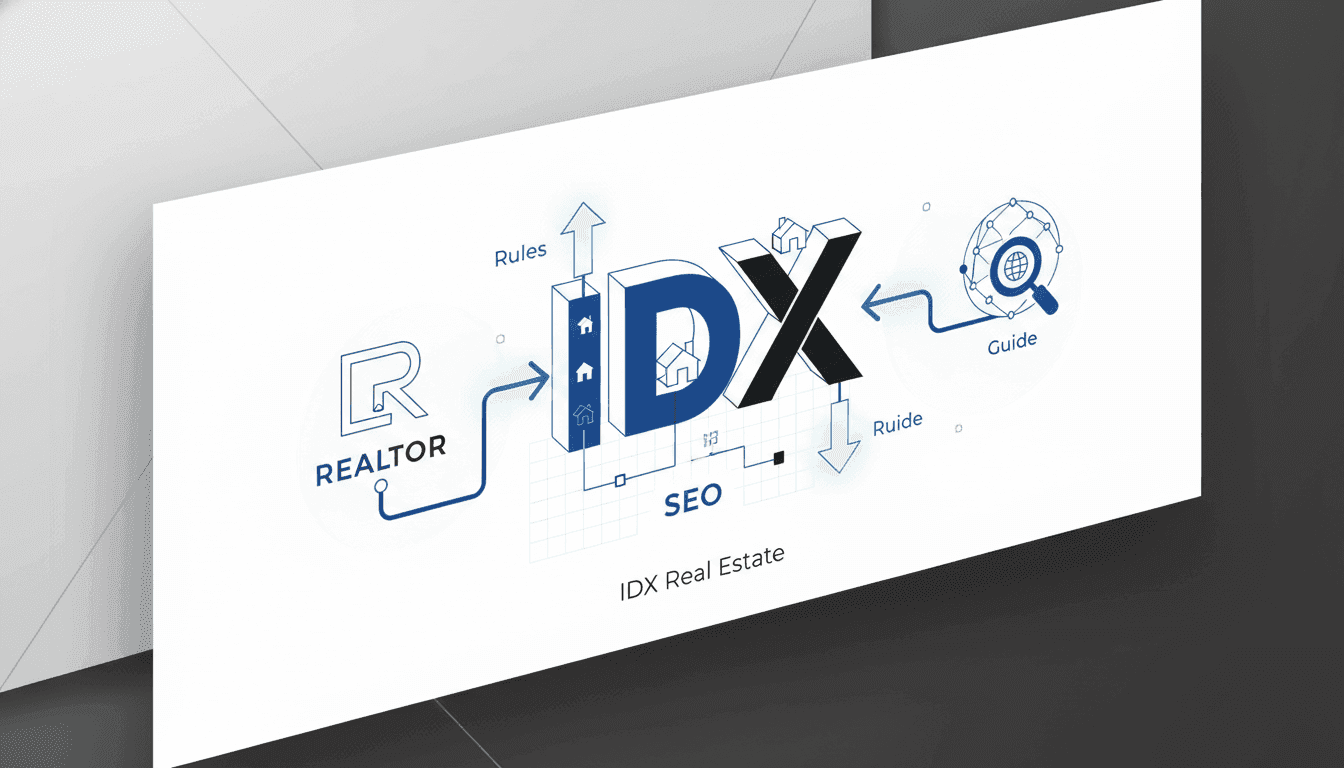
When people ask “what is IDX,” they’re usually talking about IDX in real estate, not Google’s former “Project IDX” for developers. In our world, IDX stands for Internet Data Exchange, and it’s the engine that powers live MLS listings on real estate websites.
In this guide, we’ll break down what IDX is, how it works with the MLS, what the rules are, and how to use IDX for SEO, lead generation, and CRM integration so you can actually turn traffic into closed deals.
What Is IDX (Internet Data Exchange) in Real Estate?
IDX (Internet Data Exchange) is the combination of rules, licenses, and technology that lets real estate agents and brokers:
- Access listing data from their Multiple Listing Service (MLS), and
- Display those MLS listings on public real estate websites for home buyers to search.
We like to explain it this way:
IDX is the legal and technical bridge between the MLS and your website. It’s how you get live MLS property listings onto your own domain in a compliant way.
Without IDX, your website would only be able to show your own listings or manually entered properties. With IDX, you can offer a full MLS-powered home search, which is why almost every serious real estate agent website uses some kind of IDX integration.
IDX vs. MLS: What’s the Difference?
It’s easy to mix these up, so we keep the distinction simple:
- MLS (Multiple Listing Service): The private, professional database where agents and brokers enter and share listings with each other.
- IDX (Internet Data Exchange): The program and technology that allows authorized members to share a subset of those MLS listings with the public on websites.
Think of the MLS as the source of truth and IDX as the public window into that data.
Why IDX Exists and Why It Matters Today
Before IDX and widespread online search, buyers had almost no direct access to listings. They called an agent, the agent ran a private MLS search, and then decided which homes to show.
As the web took off in the late 1990s, it became obvious that:
- Consumers wanted to search homes online themselves.
- Sellers wanted maximum exposure for their listings.
- Brokers needed a way to participate online without completely losing control of their data.
So the National Association of Realtors (NAR) created what was first called the Broker Reciprocity program (approved May 22, 2000) and is now usually called IDX policy. The core idea:
- Brokers who opt into IDX can display each other’s active listings on their websites.
- Everyone follows the same IDX rules, regulations, and attribution requirements.
Today, IDX is fundamental to real estate marketing. Most buyers start their home search online, and if your site doesn’t have an IDX-powered property search tool, they simply go to a portal or a competitor who does.
Key IDX Terms: Broker Reciprocity, Participants, Feeds & More
To really understand what IDX is in real estate, we need to unpack some common phrases you’ll see in MLS paperwork and from IDX providers.
Broker Reciprocity / IDX
In many MLSs, Broker Reciprocity is essentially the same as IDX. The reciprocity part is important:
- If a broker opts in to IDX/Broker Reciprocity:
- They allow other participants to display their listings.
- They get to show all those participants’ listings on their own IDX website.
- If they opt out:
- Their listings don’t appear on other IDX sites.
- They also lose the right to display other participants’ listings.
Opting out dramatically reduces online exposure, which is why participation rates in most MLSs are high.
Participants vs. Subscribers
- Participant: The principal broker who is the official MLS member.
- Subscriber: Individual agents who work under that participant.
Local IDX regulations define whether individual agents can have their own IDX real estate website or whether all IDX feeds must be controlled at the broker level.
IDX Feed, IDX Plugin, IDX Provider
- IDX feed: The data connection from the MLS to your website or your vendor’s system. This is often what people mean when they ask, “What is an IDX feed?”
- IDX plugin: Software (commonly a WordPress IDX plugin) that receives that feed, maps MLS fields, and displays listings & search interfaces on your site.
- IDX provider / IDX vendor: A third-party company that handles MLS integration, hosting, and tools. They may offer an all-in-one IDX solution with website + MLS IDX integration + lead capture.
How Does IDX Work With MLS Listings?
At a high level, IDX for real estate agents has three layers: policy, licensing, and technology. Here’s how they fit together.
1. Policy: NAR IDX Rules and Local MLS Regulations
NAR publishes the national NAR IDX policy inside the Handbook on Multiple Listing Policy, and each MLS adds its own local rules. Together they dictate:
- Which listings can be shown via IDX (generally active, non-confidential listings).
- Refresh requirements (e.g., IDX data must be updated every 12 hours or better).
- Mandatory MLS IDX disclaimers and attribution text.
- How you must display the listing broker and/or listing agent.
- What’s prohibited:
- Falsifying or materially altering listing information.
- Redistributing IDX data outside approved uses.
- Exposing confidential fields (e.g., showing lockbox codes).
2. Licensing: Getting Permission to Use IDX Data
You don’t just plug into the MLS; you or your vendor must sign IDX license agreements. Those agreements specify:
- Exactly which data fields you can use.
- How often data must be refreshed.
- Restrictions on data usage and redistribution.
- Who is responsible if rules are breached (often the broker and/or vendor).
There are two common paths:
- Direct member access – the broker (or sometimes agent) signs the IDX license and connects directly or via a developer.
- Vendor access – an IDX provider signs master agreements with the MLS, then you subscribe to their platform and they handle compliance.
3. Technology: Moving MLS Data to Your Website
The technical side is where terms like IDX framing, FTP, RETS, and RESO Web API come in.
IDX Technologies: Framing, FTP, RETS and RESO Web API
IDX Framing
With IDX framing, your “search” pages basically show content hosted on someone else’s server (typically the vendor’s), inside an HTML frame or iframe.
- Pros: Simple, cheap, fast to launch.
- Cons: Limited control, and weak SEO value because most search engines treat that content as belonging to the vendor’s domain, not yours.
FTP (File Transfer Protocol)
Older IDX solutions used FTP for the MLS data feed:
- The MLS exports big files of listings.
- Your server downloads those files on a schedule.
This puts data on your server (better for SEO than framing) but is inefficient because you often have to re-download large files just to get a few updates.
RETS (Real Estate Transaction Standard)
RETS replaced a lot of FTP-based IDX feeds. It allows:
- Incremental updates – only data that actually changed is transferred.
- More frequent, efficient syncing.
Many MLS IDX integrations still run on RETS today, though the industry is migrating to APIs.
RESO Web API
The RESO Web API is the modern standard championed by the Real Estate Standards Organization (RESO). Instead of downloading giant blobs of data, your site or vendor queries listings in real time via a web API.
- Pros: Faster, more flexible queries, better alignment with modern web tech, and strong SEO when paired with SEO-friendly page structures.
- Trend: Vendors are increasingly “API-first,” phasing out older methods on new projects.
Benefits of IDX for Real Estate Agents and Brokers
From a business standpoint, the “what is IDX” question quickly turns into “why should we care?” These are the benefits we focus on when we’re planning real estate marketing strategies.
1. Display Live MLS Listings on Your Website
With MLS IDX integration, your site can show:
- Not just your own listings, but nearly all active listings from your MLS (subject to participation and opt-outs).
- Rich details: photos, price, beds, baths, square footage, map location, days on market, and more.
That transforms a brochure site into a real, searchable home portal that buyers actually want to use.
2. Better Property Search Experience
Modern IDX solutions give you a full-featured property search tool with:
- Search by price, location, beds/baths, property type.
- Map search, polygon search, and sometimes school districts or neighborhoods.
- Filters based on MLS fields like year built, square footage, or amenities.
The smoother the search UX is, the longer buyers stay, and the more likely you are to capture leads directly on your own site instead of sending them to portals.
3. Real Estate Lead Generation & Lead Capture
IDX is a powerful lead-generation engine when you configure it correctly. Most IDX platforms let you:
- Allow anonymous search initially, then require registration to:
- Save favorite listings.
- Save searches.
- Receive email alerts for new matches.
- Offer “Request info,” “Schedule a showing,” or “Ask a question” forms on every listing.
Those registrations and inquiries become exclusive leads for you—unlike big portals where multiple agents may compete for the same contact.
4. SEO Benefits of IDX Listings
If your IDX solution is implemented correctly (no pure framing, clean URLs, indexable pages), it can be an SEO lead-generation machine:
- Thousands of unique listing pages that search engines can index.
- SEO-friendly URL structures like
/homes-for-sale/city/neighborhood/property-id. - Dynamic pages for saved searches or communities that can rank for “homes for sale in [area]”.
This is why we pay close attention to whether a vendor offers SEO-friendly IDX with real, crawlable content versus search forms embedded in iframes.
5. Credibility and Professionalism
When a consumer lands on a site that offers full MLS IDX search with live data, it instantly signals:
- You’re an active, legitimate real estate professional.
- You have access to current market information.
- You’re serious enough about your business to invest in technology.
That perceived authority is a major reason IDX is now considered a must-have real estate marketing tool.
6. Workflow Automation With CRM Integration
Most of the value of IDX comes when we connect it to a real estate CRM and automate follow-up. With proper IDX CRM integration you can:
- Automatically create leads and deals when a visitor registers or asks for info.
- Track buyer behavior—what they viewed, which searches they saved, their budget range.
- Trigger email or SMS sequences tailored to their location and price preferences.
This is where IDX stops being “just a website feature” and becomes part of a full real estate sales pipeline.
IDX vs. VOW vs. Zillow & Other Portals
IDX vs. VOW (Virtual Office Website)
VOW (Virtual Office Website) is a different way to give online access to MLS data, typically with more detailed information but under stricter conditions.
- VOW:
- Requires users to register and agree to terms before seeing data.
- May display more detailed MLS data than IDX allows publicly.
- IDX:
- Generally allows anonymous browsing of public fields.
- Is designed primarily as a public marketing and lead-gen tool.
Many brokers use both: IDX for open marketing and VOW behind registration for clients who want deeper data.
IDX vs. Zillow, Trulia and Other Portals
- MLS / IDX: MLS is the source database, and IDX is the controlled way members can display that data on their own sites.
- Zillow/portals: Large consumer platforms that ingest MLS and other feeds, then sell leads and advertising back to agents.
With portals, the portal owns the audience and usually the lead routing. With your own IDX real estate website:
- You control branding, UX, and data capture.
- Leads are yours alone, not shared with competing agents.
Free vs. Paid IDX Solutions
When people first learn what IDX is, they naturally ask if there’s a free IDX option. The answer is “sort of,” but with trade-offs.
“Free” or Low-Cost IDX Options
- Basic tools sometimes offered by brokerages or franchises.
- Lightweight IDX widgets included with cheap template sites.
These can be fine for a minimal presence, but they often come with:
- Limited customization.
- Weaker SEO impact (framing, non-indexable content).
- Few lead-capture or CRM features.
Paid IDX Providers
A robust paid IDX provider typically includes:
- Reliable MLS IDX feed with frequent data refreshes.
- Full-featured property search, maps, and filters.
- Lead capture tools and sometimes integrated or connected CRM.
- SEO-friendly page structures and URLs.
- Support and guidance on IDX compliance requirements.
The monthly fee is essentially the cost of turning your site into a 24/7 lead-generation machine instead of just a digital business card.
How to Add IDX to Your Real Estate Website (Step-by-Step)
Now that we’ve covered the “what is IDX” side, let’s walk through how to actually add IDX to a real estate website.
Step 1: Confirm Your MLS IDX Program and Eligibility
Start with your local MLS or association:
- Confirm that they offer an IDX or Broker Reciprocity program.
- Ask:
- Who can participate (brokers only, or individual agents too)?
- What forms and IDX license agreements need to be signed?
- Whether there are MLS data access fees.
- What exact IDX attribution text and disclaimers are required.
Make sure your license and MLS membership are in good standing; IDX is generally only available to active MLS members and their authorized vendors.
Step 2: Decide on Your IDX Website Strategy
Broadly, we see two main approaches:
Option A: All-in-One IDX Website
Here, you choose an all-in-one IDX provider that includes:
- Website design and hosting.
- Built-in MLS IDX integration.
- Lead capture, sometimes email marketing or basic CRM.
Pros:
- Fastest way to launch an IDX real estate website.
- The vendor handles technical setup and compliance details.
Cons:
- Less flexibility in design and layouts.
- You’re more locked into their platform for the long term.
Option B: IDX Plugin on an Existing Site (e.g., WordPress)
If you already have a WordPress, custom, or other CMS site, you can:
- Install an IDX plugin or connect to a vendor’s IDX API.
- Integrate search forms, listing grids, and detail pages into your existing design.
Pros:
- Maximum control over branding and SEO structure.
- Flexible integration with other tools (CRM, marketing, analytics).
Cons:
- More technical work (hosting, performance, maintenance).
- You or your developer must be comfortable with IDX configuration.
Step 3: Choose the Best IDX Provider or Plugin for You
When we evaluate IDX solutions, we look at a consistent checklist:
- MLS coverage: Do they support your specific MLSs and any neighboring ones you care about?
- Data refresh rate: How often does the IDX data feed update? (At least every 12 hours; hourly or near real-time is better.)
- Technology stack: Do they use RETS or RESO Web API for robust, future-proof integrations?
- SEO features:
- Indexable listing pages (no pure framing).
- Clean, SEO-friendly URLs.
- Control over metadata and on-page elements.
- Lead capture tools:
- Registration settings (soft vs. hard sign-up).
- Save searches, favorites, and email alerts.
- CRM integration: Can it push leads into your real estate CRM with fields like price range, search area, and property type?
- Customization & UX: Can you tailor search forms, listing layouts, and filters to your market?
- Support and documentation: Helpful support and clear IDX compliance guidance save you a lot of time.
Step 4: Implement IDX and Test Everything
Implementation steps depend on your approach, but usually include:
- Submitting your MLS paperwork (or vendor’s online forms).
- Obtaining any necessary MLS credentials or API keys.
- Configuring your plugin or vendor dashboard:
- Setting up default search pages.
- Customizing filters and search forms.
- Adding listing widgets (featured, new, price-reduced, etc.).
- Integrating lead forms with your CRM and email marketing tools.
Then thoroughly test:
- Searches on desktop and mobile.
- Navigation to individual listing detail pages.
- Lead forms (do new leads show up in your CRM with the right information?).
- Required IDX attribution, MLS disclaimers, and listing broker details on every search and listing page.
- Site speed and image optimization.
IDX Rules, NAR Policies and Compliance Explained
Because IDX touches MLS data, rules and compliance are a big deal. When we’re helping agents deploy IDX, we always review:
Common IDX Display Rules
- Attribution: You must clearly identify the listing broker/office and often the MLS name on listing pages.
- Disclaimers: Most MLSs require specific disclaimer language about data accuracy, update times, and ownership.
- Data integrity: You may not materially alter key listing information such as price, status, or basic features.
- Opt-outs and seller instructions: Respect listing-level and seller-level requests not to display certain info.
Data Usage & Redistribution Restrictions
Your IDX license will spell out what you cannot do:
- Resell or share raw IDX data feeds with third parties that aren’t authorized.
- Copy large amounts of IDX data to other platforms without permission.
- Use IDX data in ways that violate fair housing or privacy laws.
This is why many brokers prefer an experienced IDX provider or vendor that already understands NAR regulations and local MLS rules.
Integrating IDX With Your Real Estate CRM and Sales Pipeline
Once you understand what IDX is technically, the next step is to treat it as part of your sales process rather than “just a website feature.” CRM integration is where this happens.
What a Good IDX–CRM Integration Should Do
- Automatic lead creation: Every registration, showing request, or “contact us” on IDX pages should instantly create a lead in your CRM.
- Behavior tracking: Sync:
- Homes viewed.
- Saved searches and favorites.
- Search criteria (city, min/max price, beds, property type).
- Segmentation: Tag or cluster leads based on preferences so you can send targeted updates (e.g., “condos under $400k in Downtown”).
- Automation: Trigger workflows:
- Instant welcome emails.
- Market update campaigns.
- Tasks for follow-up calls when a lead returns to the site or favorites a property.
With this setup, your IDX site becomes the front door for lead capture and your CRM becomes the engine that turns those leads into closings.
IDX FAQ: Quick Answers to Common Questions
What does IDX mean in real estate?
In real estate, IDX means Internet Data Exchange. It’s the system of rules, licenses, and technologies that lets MLS participants legally display active MLS listings on public real estate websites.
What is an IDX feed?
An IDX feed is the data pipeline from the MLS to your site (directly or via an IDX vendor). It continually updates your site with new listings and changes (price, status, etc.) according to MLS and NAR IDX policy.
What is an IDX plugin for WordPress?
A WordPress IDX plugin is a software add-on that connects your WordPress site to your IDX feed or vendor. It:
- Maps MLS data fields (price, beds, baths, photos, etc.).
- Creates search pages, listing grids, and individual property pages.
Do I need an IDX license to show MLS listings?
Yes. Either:
- You (or your broker) sign IDX license agreements with the MLS and connect directly, or
- You work through an authorized IDX provider that has already signed those agreements.
How often should IDX data be refreshed?
Most MLSs require IDX feeds to be refreshed at least every 12 hours. For accuracy and user experience, we strongly prefer solutions that refresh hourly or near real-time, especially in fast-moving markets.
Is IDX data confidential?
The public IDX data you display is not confidential—confidential fields are excluded by MLS policy. But the underlying feeds and data structures are still protected; you can’t freely redistribute them outside of approved IDX uses.
Can I opt out of Broker Reciprocity / IDX?
In many MLSs, yes. But opting out means:
- Your listings don’t appear on other participants’ IDX sites.
- You lose the right to display their listings on yours.
Because that significantly reduces online visibility, most brokers choose to opt in and follow IDX rules instead of staying out.
Wrap-Up: What IDX Is and How to Use It Strategically
To bring it all together:
- IDX (Internet Data Exchange) is the real estate industry’s standard for putting MLS listings on public websites while respecting NAR and MLS rules.
- It combines:
- Policy (NAR IDX policy, Broker Reciprocity rules).
- Licensing (IDX agreements between MLS, brokers, and vendors).
- Technology (IDX feeds, plugins, RETS, RESO Web API).
- For agents and brokers, IDX is how you:
- Offer a full MLS-powered home search on your own domain.
- Drive SEO traffic with rich, indexable listing pages.
- Capture and nurture leads using CRM integration and automation.
If you’re planning your next real estate website or upgrading an existing one, treating IDX as a central piece of your lead generation and sales pipeline—not just a plugin—will give you a clear competitive edge.