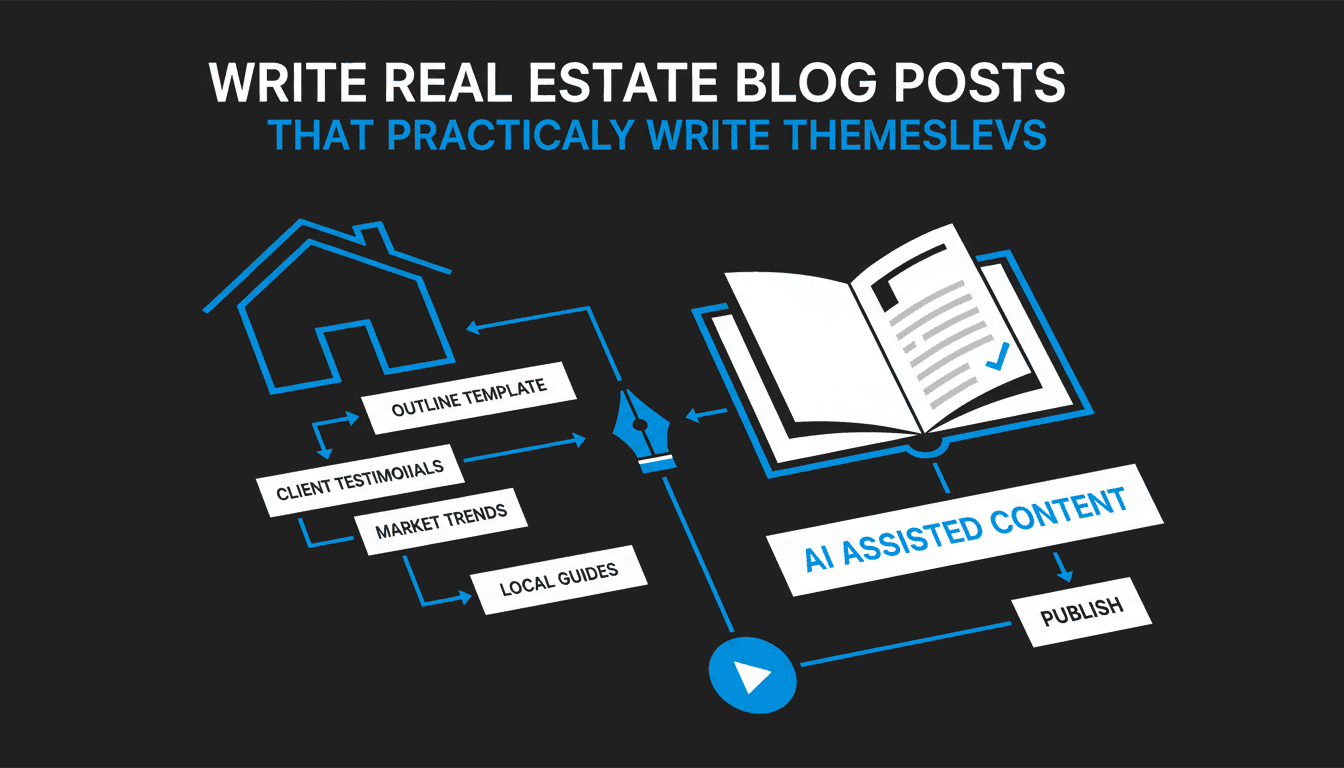
We don’t need to be “writers” to run a powerful real estate blog. When we build content around the conversations we already have every day with buyers and sellers, real estate blog posts really can feel like they practically write themselves.
Below we’ll walk you through a complete, practical system: how to come up with easy real estate blog ideas, turn them into posts fast, batch them into a content calendar, and use them to generate leads and boost your SEO—without feeling like you’re back in English class.
Why Real Estate Agents Should Bother Blogging at All
Before we talk about writing, we need to be clear on why consistent real estate blogging is worth our time.
- Shorten your sales cycle – Prospects look us up online before they call. When our real estate blog already answers their big questions and objections, those leads show up warm and pre‑educated. One good post can save us from repeating the same explanation dozens of times.
- Generate more (and better) leads – A strategic real estate content marketing plan attracts people actively searching “how to sell a home in [city]” or “moving to [neighborhood].” Those are serious buyers and sellers—not random tire‑kickers.
- Boost SEO and search visibility – Google loves fresh, relevant, keyword‑rich content. Regular long‑form real estate blog posts help our site rank for local search terms (like “homes for sale in [neighborhood]” plus process and how‑to queries).
- Build brand awareness and authority – When people repeatedly see our name attached to clear, helpful real estate blogs, we’re no longer “just another agent.” We’re the local authority.
- Educate and serve our community – Real estate blogging lets us explain the buying and selling process, demystify financing, and highlight neighborhoods and local events. That’s valuable whether someone buys this year or three years from now.
The Mindset Shift: Stop “Writing,” Start Documenting
Most of us get stuck because we treat blogging like writing an essay. Instead, we approach it as documenting what we already say and do.
- We answer FAQs all day.
- We handle objections in listing appointments.
- We explain market trends to nervous buyers.
- We talk about neighborhoods, local events, schools, commutes, and amenities.
All of that is real estate blog content. Our job is simply to capture it in a structured, searchable format.
8 Types of Real Estate Blog Posts That Practically Write Themselves
Instead of staring at a blank page, we build our real estate blog strategy around a small set of repeatable, “plug‑and‑play” post types. Once we have these templates, we can write real estate blog posts quickly and consistently.
1. FAQ Posts: Turn Everyday Questions into Real Estate Blog Articles
FAQ posts are the easiest way to start blogging for real estate agents because we’re literally writing down answers we already know by heart.
Step 1: Brain‑dump your FAQs
We open a document and list every question buyers, sellers, and investors ask us, such as:
- “How much do I need for a down payment in [city]?”
- “Should I sell my home before I buy another?”
- “How long does it take to close on a house?”
- “Which repairs should I do before listing?”
- “What are closing costs and who pays them?”
That list alone can become 10–30 real estate blog posts.
Step 2: Use a simple FAQ blog template
For each question, we follow this structure:
- Headline: Include the question plus a local keyword.
- Intro: 2–4 sentences explaining why people are confused and promising a clear answer.
- Answer: Break it into short sections or bullet points. Use examples from our market.
- Local context: Explain anything unique to our city, price range, or niche.
- CTA: “If you’d like a personalized breakdown for your situation in [city], reach out here…”
Example title ideas:
- “How Much Down Payment Do You Really Need to Buy a Home in [City]?”
- “How Long Does It Take to Sell a House in [City] Right Now?”
- “What Are Closing Costs When Selling a Home in [City]?”
2. Objection‑Handling Posts: Answer the “Yeah, But…” Before They Say It
Objections make fantastic real estate blog topics because they’re emotional and specific. When we address them head‑on in our content, we build trust and shorten our sales cycle.
Common objections we can turn into blog posts:
- “I want to find my new home before I list this one.”
- “Can’t I just sell my house myself and save the commission?”
- “Is now really a good time to buy? Maybe I should wait.”
- “I’ll just use Zillow. Why do I need a real estate agent?”
- “I don’t want to do any repairs before listing.”
Template for an objection‑handling real estate blog post:
- Title: Phrase it as the question they’re secretly asking.
Example: “Should You Buy a New Home Before Selling Your Current One in [City]?” - Intro: Acknowledge the concern, show empathy, and promise a balanced answer.
- Section: Pros of their idea – When might it make sense? Show you’re not just shutting them down.
- Section: Cons and hidden risks – The part they’re not seeing.
- Section: How we guide clients – Offer a simple framework or rule of thumb.
- Section: Next steps – A short checklist or questions to ask themselves.
- CTA: Invite them to a quick, no‑pressure consult.
3. Market Update Posts: Turn Stats into Simple Stories
We already watch market statistics. Turning them into real estate market update blog posts is mostly about structure and plain English.
Core questions our audience has:
- Is it a buyer’s market or a seller’s market?
- Are prices going up or down in my neighborhood?
- How long are homes taking to sell?
- What’s happening with interest rates and inventory?
Template for a market stats real estate blog post:
- Title: “[Month/Year] Real Estate Market Update for [City/Neighborhood]”
- Intro: 2–3 sentences giving the big picture (“inventory is rising,” “still competitive for buyers,” etc.).
- Key numbers:
- Median sale price
- Average days on market
- Number of new listings
- Average list‑to‑sale price ratio
- What this means for sellers: Plain‑language explanation and 2–3 tips.
- What this means for buyers: Same idea, with practical advice.
- Our take: Short commentary about what we’re seeing on the ground.
- CTA: Offer a free market snapshot for their specific home or neighborhood.
Once we build one market update template, we can quickly create variations for different areas or property types and batch them for the month.
Community posts are some of the easiest and most shareable real estate blog ideas. We already talk about schools, parks, cafés, commutes, and amenities with clients; now we simply package that into blog content.
Community‑focused real estate blog topic ideas:
- “A Local’s Guide to the Best Coffee Shops in [Neighborhood]”
- “Family‑Friendly Neighborhoods in [City]: Schools, Parks & Playgrounds”
- “Best Dog‑Friendly Spots in [City] (Parks, Trails & Patios)”
- “Living in [Neighborhood]: Pros, Cons, Schools, and Commute Times”
- “Free Things to Do in [City] This Weekend”
Simple structure:
- Intro: Describe the vibe of the neighborhood or the theme (e.g., “best brunch spots”).
- List: 5–10 places with:
- Short description
- Why locals love it
- Address/area and any pro tips (parking, best time to go)
- Wrap‑up: Who this area or set of spots is best for (families, young professionals, retirees, etc.).
These community posts help with hyperlocal SEO and build trust with people relocating who don’t know the area yet.
5. Round‑Up Posts: Let the Community Help You Create Content
Round‑up posts (“best of” style posts) are a form of real estate blog content that can almost write themselves because we invite other people to contribute the words.
Examples:
- “7 Local Businesses That Make [Neighborhood] a Great Place to Live”
- “10 Favorite Brunch Spots in [City], Chosen by Locals”
- “5 Gyms and Fitness Studios in [City] Loved by Residents”
How we create a round‑up post:
- Pick a theme – Cafés, breweries, parks, fitness studios, small businesses, etc.
- Make a list of businesses – Aim for 5–10.
- Reach out with a short message – Ask each owner for 2–3 sentences about what makes their place special and what they love about the community.
- Paste their quotes into the post – Add our own 1–2 sentence commentary and basic info.
- Publish and share – Then send the link to each business and tag them on social media.
Result: The content is largely written for us, and the featured businesses often share our post with their audiences, boosting traffic to our real estate blog.
6. Evergreen “How‑To” Guides: Real Estate Content That Works All Year
Evergreen real estate blog posts are those timeless “how‑to” articles that stay relevant for years with minor updates. They’re the backbone of an easy content strategy because we can keep using and repurposing them.
Evergreen real estate blog topic ideas:
- “Step‑by‑Step Guide to Buying Your First Home in [City]”
- “How to Prepare Your Home for Sale in [City] (Without Overspending)”
- “What to Expect During a Home Inspection in [State/City]”
- “Moving to [City]: A Complete Relocation Checklist”
- “7 Mistakes to Avoid When Selling Your Home in [City]”
Basic structure for a how‑to real estate blog post:
- Clear, benefit‑driven title (“Complete Guide,” “Step‑by‑Step,” “Avoid These Mistakes”).
- Intro that names the audience (first‑time buyers, downsizers, investors, etc.).
- Numbered steps or sections, each with:
- Plain‑English explanation
- Local tips (timing, average costs, quirks of your market)
- Short examples
- Conclusion with a checklist or summary.
- CTA inviting them to schedule a consultation or download a related resource.
7. “SpinBack” Posts: React to News Instead of Starting from Scratch
SpinBack content means we take something that already exists—like a news article or industry report—and “spin” it back with our own commentary and local angle. This is one of the fastest ways to generate real estate blog posts when we’re short on time.
Where to find inspiration:
- Local newspaper real estate or business sections
- National real estate blogs and housing market reports
- City council or planning/zoning announcements
- Trending topics in real estate Facebook groups
Examples of SpinBack real estate blog post titles:
- “What [Local Newspaper] Got Right (and Wrong) About the [City] Housing Market”
- “New Short‑Term Rental Rules in [City]: What Homeowners Need to Know”
- “Interest Rates Are Up: 5 Practical Tips for Buyers in [City] Right Now”
Basic SpinBack structure:
- Introduce the article or issue and link to the source.
- Quote brief excerpts (don’t copy the whole thing).
- Add our commentary: what this really means for buyers/sellers locally.
- Offer practical do’s and don’ts for homeowners and buyers.
8. Area Event Posts: Quick, Clickable, and Great for Local SEO
Local event posts are easy real estate content ideas that keep us visible and relevant in the community, even for people not yet ready to move.
Ideas for event‑based real estate blog posts:
- “What’s Happening in [City] This Month: [Month/Year] Event Round‑Up”
- “Family‑Friendly Fall Festivals in [Area]”
- “4th of July Fireworks and Events in [City]”
- “Holiday Events and Light Displays Around [City]”
Simple formula:
- Gather 10–20 events from local calendars, tourism sites, and Facebook events.
- For each:
- Event name
- Date and time
- Location
- 1–2 sentence description
- Link for more info
- Group events by type (family‑friendly, date night, food & drink, outdoors, etc.).
- Add a short intro and conclusion.
A Simple System to Batch Real Estate Blog Posts (30 Posts in 30 Days if You Want)
Writing one real estate blog article at a time is slow and discouraging. Instead, we rely on batching—creating multiple blog posts in a single focused session and then scheduling them out.
Batching Base Content: Real Estate Blogging on Autopilot
Step 1: Choose your base content types
We pick a core mix from the easy formats above:
- FAQs
- Objection‑handling posts
- Monthly market statistics updates
- Area events round‑ups
- Evergreen how‑to guides
- Community and “best of” posts
Step 2: Create simple templates for each type
We write one outline per format (H2s, bullet points, and CTAs). After a couple of runs, we’re just filling in blanks with new topics, neighborhoods, and dates.
Step 3: Block time to write in bunches
- Once a week (or twice a month), block 2–3 hours.
- In that window, our only job is to draft 3–4 short posts using templates.
- We don’t over‑edit; we just get them to “done” and schedule them.
Output: Even modest consistency—8–12 posts a month—turns into 100+ real estate blog posts in a year, without daily stress.
An Example 30‑Day Real Estate Blogging Plan
Here’s a simple structure to keep real estate content creation predictable:
- Week 1 Batch Session
- 2 FAQ posts
- 1 objection‑handling post
- 1 market update for your primary city or neighborhood
- Week 2 Batch Session
- 1 community guide (“Best [topic] in [area]”)
- 1 area events round‑up for next month
- 1 evergreen how‑to guide
- 1 SpinBack post about a local market story
- Weeks 3–4 – Repeat the pattern, or start a series like “Neighborhood Spotlights” or “Seller Mistakes.”
SEO Tips: How to Write Real Estate Blog Posts Buyers and Google Both Love
We don’t need to be full‑time SEOs, but we do want our real estate blog content to show up in search results. A few simple habits go a long way.
1. Pick a Clear Audience and Sub‑Niche for Each Post
Instead of writing for “everyone,” we decide exactly who each post is for:
- First‑time buyers in [city]
- Move‑up sellers in [specific neighborhood]
- Investors looking for small multifamily properties
- Luxury condo buyers in the downtown area
- Relocating families with school‑age kids
Then we reflect that niche in the title, examples, and call to action. Hyper‑specific content tends to rank better and convert better than generic “one‑size‑fits‑all” advice.
2. Do Quick, Free Keyword Research
To find real estate blog keywords fast, we can simply use Google:
- Type in a phrase like “selling a home in [city]” or “moving to [city].”
- Look at autocomplete suggestions to see real search phrases.
- Check the “People also ask” box for questions we can turn into blog posts or subheadings.
- Scroll to the bottom for “related searches” for more keyword ideas.
Each phrase we see is a potential real estate blog topic or long‑tail keyword to target.
3. Optimize Real Estate Blog Posts for SEO (Without Keyword Stuffing)
Once we have a target keyword like “how to sell a house in [city],” we use it naturally in key places:
- Title (H1): Include the keyword and a benefit.
- URL slug: Keep it short and descriptive (e.g.,
/sell-house-[city]). - First 100–150 words: Use the phrase once near the beginning.
- At least one H2 subheading: Like “Steps to Sell a House in [City].”
- Body copy: Sprinkle a few variations (e.g., “selling your home in [city],” “home sellers in [city]”).
We avoid keyword stuffing; we write as if we’re speaking to a real client, and let SEO support that conversation.
Writing Style: Casual, Clear, and Client‑Friendly
Our real estate blog is not a legal contract or textbook. The best‑performing real estate blogs sound like a knowledgeable friend explaining things at a coffee shop.
- Use “you” and “we.”
- Keep paragraphs short—2–4 lines max.
- Use subheadings, bullets, and bold to break up long text.
- Explain jargon or avoid it entirely.
- Include local color and examples from actual streets, neighborhoods, and price points.
When readers feel we’re talking directly to them, they’re more likely to read to the end—and more likely to reach out.
Publishing is only half the job. For real estate blogging to generate leads, we need a simple promotion routine.
1. Share Your Real Estate Blog Posts Everywhere (Without Being Spammy)
- Email newsletter: Add a “New on the Blog” section with 1–3 posts and brief teasers.
- Social media: Share posts on Facebook, Instagram, LinkedIn, Threads, etc., with a short summary or question, not just a link.
- Community groups: For event and community posts, share in local Facebook or Nextdoor groups where allowed. Focus on being genuinely helpful.
- One‑to‑one: Text or email specific posts to leads when they ask questions your post answers.
2. Use Visuals and Infographics
Visual content helps real estate blog posts stand out and perform better on social media.
- Add at least one strong image per post—local photos, listing photos (where appropriate), or lifestyle shots of the neighborhood.
- For market updates, include a simple chart or graphic showing price or inventory trends.
- For process posts, consider a simple infographic or step‑by‑step diagram.
Recycling, Updating, and Outsourcing: Make Your Real Estate Blog Sustainable
To keep our content machine running without burning out, we aggressively reuse, refresh, and, when needed, outsource parts of the process.
1. Recycle and Update Old Real Estate Blog Posts
- Update stats and screenshots in older market updates and how‑to guides annually or quarterly.
- Split big guides into series (e.g., a 3,000‑word “Complete Seller Guide” can become five shorter, SEO‑friendly blog posts).
- Turn blogs into other formats: short videos, social media carousels, email sequences, or downloadable checklists.
2. When to Outsource Real Estate Blog Writing (and How to Do It Right)
If we hit capacity, we can have real estate blog posts written by experts or freelancers—but we stay in control of the strategy.
Before outsourcing, we should:
- List our core topics: FAQs, objections, community guides, event posts, and evergreen how‑tos.
- Decide on our tone (casual, clear, no hype, compliant with local regulations).
- Provide local details writers won’t know (neighborhood names, typical price ranges, unique rules).
We then review every draft to ensure accuracy and that it sounds like us. Outsourcing becomes a way to scale, not a substitute for our expertise.
Putting It All Together: Real Estate Blogging Made Easy
When we combine these elements—a small set of repeatable post types, batching sessions, simple SEO habits, and a basic promotion routine—writing real estate blog posts stops feeling overwhelming.
- We’re no longer inventing topics from scratch; we’re documenting what we already say.
- We’re not trying to write daily; we’re batching content and scheduling it.
- We’re not guessing at SEO; we’re using real questions and phrases our clients type into Google.
- We’re not shouting “buy now”; we’re educating, informing, and building trust with our community.
That’s how we create a real estate blog that practically writes itself—while quietly working 24/7 to warm up leads, build our brand, and keep us top of mind in our market.